



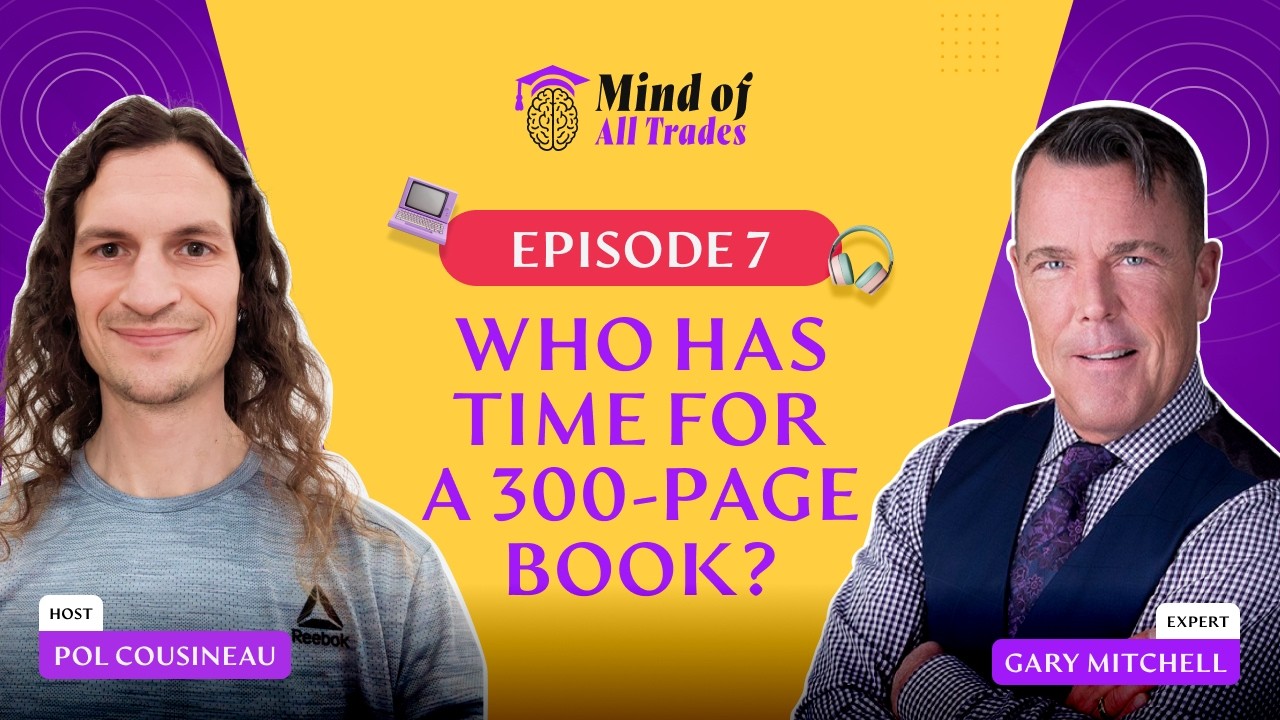
How to Turn One Book Into an App, Workbooks, and a Mastermind - Gary Mitchell - Part 2 - EP 7
The Mindset That Scales Your Business
Description
“I don’t know too many lawyers that can sit down and read a 300-plus-page book in their spare time.” That’s why Gary Mitchell didn’t stop at the book.
In Part 2, Gary and Pol Cousineau look under the hood at how Gary turned one book into workbooks, an app, and a masterclass, and how each piece fits into a ladder of offers that runs from a content subscription all the way up to premium one-on-one coaching. Gary explains how he designs each level around how people learn and how much support they need, why sharing your framework doesn’t cannibalize your premium offers, and the simple hiring rule that keeps you from burning out before help arrives. They close on A players, delegation, and the legacy Gary wants to leave.
In this episode, you’ll hear:
How Gary teaches the same message through one-on-one coaching, a mastermind, an app, workbooks, and retreats
Why peer learning works so well for risk-averse professionals
How the book became workbooks, an app, and a masterclass, and why giving away information doesn’t hurt sales
How Gary builds accountability into his mastermind, one commitment at a time
His 60/80/100 rule for knowing when to start hiring
The AI tools Gary relies on, and how he delegates the tech he’d rather not touch
How to spot your A players, and why it always comes back to attitude
Chapters:
02:32 – How One Book Becomes Workbooks, an App, and a Mastermind
09:13 – The Fear of Giving Away Your Content
15:21 – Designing Offers Around Your Clients’ Time
20:22 – Accountability and the Power of a Quick Win
23:29 – Why People Don’t Change Until It Hurts, and When to Hire
27:05 – Gary’s Tools and AI Stack
31:41 – Build Leaders: Strengths, A Players, and How Deep to Delegate
38:31 – Reasonable Expectations and Knowing Your Team
42:18 – Where to Find Gary’s Book and Program
About Gary Mitchell
Gary Mitchell is a law firm architect, business coach, and the founder of OnTrac Coach. Since 2005, OnTrac Coach has helped law firm owners create systems and processes to scale their firms for growth, increase revenues and profits, develop best leadership practices, build extraordinary teams, and gain more freedom. Gary has twice been named a top 10 coach to law firms in North America and is the author of four books, most recently The AND Approach: How to Grow Your Law Firm AND Gain More Freedom. Before coaching, he trained as an actor and singer and performed all over the world.
Chapter workbooks for The AND Approach are now available on Gary’s website, and he is launching The AND Approach Law Firm Growth Masterclass and The AND Approach Podcast.
Check out The AND Approach book written by Gary Mitchell: https://ontraccoach.com/the-and-approach/
Connect with Gary:
- Website: https://ontraccoach.com/
- LinkedIn: https://www.linkedin.com/company/ontrac-coach/
- Facebook: https://www.facebook.com/ontraccoach
- YouTube: https://www.youtube.com/ontraccoach/
- Instagram: https://www.instagram.com/theandapproach/
Want to be a guest on Mind of All Trades? Apply here: https://mindofalltrades.com/podcast-application
Follow Mind of All Trades:
- YouTube: https://www.youtube.com/@MindofAllTrades
- Spotify: https://open.spotify.com/show/4MixC1mfhhUVIOFO1mywUc
- Apple Podcasts: https://podcasts.apple.com/us/podcast/mind-of-all-trades/id6807196830
- Instagram: https://www.instagram.com/mindofalltrades/
- Amazon Music: https://music.amazon.com/podcasts/32ce7fa4-4473-4c53-9256-7fca60e47331/mind-of-all-trades
- LinkedIn: https://www.linkedin.com/company/mind-of-all-trades/
Theme music by Breakmaster Cylinder.
Also Listen On


Transcript
Click to read the transcript
[00:00:00] Gary Mitchell: I don’t know
[00:00:00] too many lawyers
[00:00:01] that can sit down
[00:00:02] and read a 300-plus page
[00:00:04] book in their spare time.
[00:00:06] Pol Cousineau: And how are you
[00:00:08] blending that accountability
[00:00:09] in these higher-end offers?
[00:00:11] Gary Mitchell: By the end
[00:00:12] of the meeting,
[00:00:13] everyone will commit.
[00:00:14] Pol Cousineau: I find that
[00:00:15] when you set
[00:00:15] too many goals
[00:00:17] and you fail,
[00:00:19] it can have
[00:00:19] a demotivating impact.
[00:00:21] Gary Mitchell: Do one and do it
[00:00:22] really, really well, right?
[00:00:24] Let’s get,
[00:00:24] let’s get a quick win.
[00:00:26] Let’s get a win.
[00:00:27] Pol Cousineau: Who are your A players,
[00:00:29] and who could be
[00:00:30] potential leaders?
[00:00:31]
[00:00:38] Pol Cousineau: Welcome to Mind of All Trades, the podcast where edupreneurs turn knowledge into impact. I’m your host, Pol Cousineau, and together we explore the craft and commerce of educational businesses, we look at the strategy, we look at the systems, and we look at the real implementation work that has to happen behind the scenes.
[00:00:58] Before we dive in, make sure you subscribe so you don’t miss future episodes. We’ll be sharing practical guides, conversations, and examples for edupreneurs who are building real momentum in their business, and for coaches, course creators, podcasters, and membership site owners who need help with the tech behind the business.
[00:01:18] Check out The Digital Navigator. The Digital Navigator helps with fully managed websites, funnels, analytics, automations, and ongoing tech support. So instead of having a bunch of disconnected tools, your systems can work together, and you can spend more of your time focused on the business, the offer, and the people you serve.
[00:01:39] You can learn more at thedigitalnavigator.com. Now, let’s jump into today’s episode.
[00:01:45] In part one, Gary Mitchell, business coach and author of The AND Approach, showed us why holding on tight to control makes you the bottleneck in your own business. We talked about why perfectionism does not exist, how to manage your team without spyware, how to start with the team you already have, and why your right-hand person is the linchpin.
[00:02:07] And we got into Gary’s big idea. You can grow your business and gain your freedom at the same time. In this part, Gary shows how he teaches all of this, how one book can turn into workbooks, an app, and a mastermind with accountability and quick wins built in. Then we get into when to hire, how to use AI, and how to build a team of A players.
[00:02:31] Let’s dive into it
[00:02:32] Now, what I think would be interesting is taking a left turn because there’s so many vehicles or medium that you’re using for educating people, for training, for doing change, right? You’ve got master classes, workshops, coaching, you have an app, books, you’re getting ready to launch a podcast.
[00:02:52] So how does all of that fit together, right? H- how are you piecing this? Yeah
[00:02:59] Gary Mitchell: First of all, they, they’re just different mediums to get the, the messaging and tips out, right? So there’s the one-on-one, the premium coaching one-on-one. Some people want that level of attention where it’s just me and the law firm owner. Maybe their director of operations is in on calls if, like, if they’re as close as that director is as yours is,
[00:03:19] and I’ve seen that. Um, so I would have– I’d be working with them both simultaneously. So that’s one. The next le- level down will be the mas- the Law Firm Growth Mastermind, which I’m introducing on Tuesday with a live event on LinkedIn, but it’ll be launching in September. Um, and that’s for people who do want… Because that’s not only the group mastermind, but that’ll also include one hour of individual coaching with me per month, email support. I’m creating a LinkedIn group exclusively for members of this mastermind, so it’s not, it’s a private group. What this does is add community and peer learning to the one-to-one.
[00:03:55] So they’re not just learning from me, they’re learning from other law firm owners, okay? So
[00:04:00] Pol Cousineau: And what’s the benefit of the peer learning? Because a lot of people say that, but what does that really mean i- in practice? Why is that good for them?
[00:04:08] Gary Mitchell: well, lawyers always wanna know what other lawyer… What’s working for other lawyers, okay? So they’ll always… Th- th- it’s, it’s kind of a joke, uh, it’s unwritten, but it’s been said many times. Um, most lawyers will look, be keeping a very close eye on the lawyer across the street. If they try anything and it works, boom, they immediately are, are on top of it. If they try anything, it fails, they never go near it. They always wait for other, uh, people to go first because they’re so risk-averse, right? Again, that’s part of why we hire them, right? So,
[00:04:40] uh, the peer learning, when p- when it’s closed, it’s anonymous, it’s, uh, peer learning. They can… They’re getting the value of community connections and peer, uh, peer sharing and learning. Um, it- just constant, constant support throughout the process. So that’s somebody who doesn’t need the premium completely one-to-one, right? Who does see the value in group
[00:05:04] work. The next layer down would be the app. So it’s, now we’re into DIY territory, do it yourself, and that’s a lot of lawyers. I mean, I’m not even… The way we’re setting it up is you don’t, it’s not dual l- like Duolingo, where you have to do a module like a chapter to graduate to the next one. No, no, no, no, no. I know my target audience. Lawyers want control. You buy a subscription to the app, and you’re, you’ve got access to all the modules. You take them in what- I will put them in the order that they were designed,
[00:05:32] Pol Cousineau: Mm-hmm.
[00:05:33] Gary Mitchell: but lawyers, lawyers will pick and choose.
[00:05:36] They ultimately will. So they’ll pick that, uh, they’ll pick that and they, they, they can do it on their own time, completely anonymously. They don’t, uh, you know… Again, there’s, there’s not as much of a commitment, um, financially. The, uh, next level down would be, um, I’ll be doing retreats, annual
[00:05:56] retreats. Summer retreats in British Columbia, winter, winter retreats in, uh, Costa Rica. So this is for, as you know, in, when we’re talking about educational businesses, people learn in different ways. People need different levels of support, right? From the premium down to the access to all the information. Read this, read the book, right?
[00:06:17] Then we have
[00:06:17] the, uh, we companion l- um, workbooks up on the website for sale. So you read the book, that’s information, and then the workbooks are designed to walk you through implementation. So again, DIY, right? And then the retreats are for the, for the lawyers and eventually other business owners who can go away somewhere beautiful, uh, for three to five days, absorb some information, and go back and implement some of it. There’s different levels for different, uh, people and the way they learn. So that’s basically, the whole formula is designed to give people options, uh, based on how they, how best they learn and how much support they need. But the messages are always the same. The information is always the same. The approach is always the same because it works,
[00:07:02] Pol Cousineau: And how do you repurpose, right? ‘Cause it’s the same essentially, but you’ve developed all these different methods or medium. So how did you approach it to start dissecting it? Because that’s something that we hear, “Oh, repurpose. Reuse your content.”
[00:07:17] But then how do we do that in practice?
[00:07:20] Gary Mitchell: Uh, I don’t know how to explain it. I mean, from the book, uh, we create workbooks, right?
[00:07:28] Pol Cousineau: So you started with the book as that was your first
[00:07:31] Gary Mitchell: Yes. Well, the, the, basically the book, this book is literally the combination of everything I have ever learned.
[00:07:39] Okay
[00:07:40] So it’s not just coaching lawyers, it’s the business before that, it’s everything. Um, so it’s all the articles, all the, uh, uh, prior presentations.
[00:07:49] It’s basically all gone into this book. So from the book content, we develop the educational component of… I mean, there’s a, there’s a quiz at the end of each chapter, but it’s, that’s not fully educational, right? It’s
[00:08:02] just to kind of alert, alert, uh, the reader, uh, where they’re at. Um, the workbooks are literally getting them into action. There’s a commitment statement at the end of each workbook or each module. Uh, the app is even further. So the app is gonna have the read section, a voice section, almost like an audiobook, videos, and workbooks, and they can go in, uh, digitally on their phone or the computer from anywhere. The main reason why I’m doing this, uh, is because I don’t know too many lawyers that can sit down and read a 300-plus page book in their spare time. So somebody puts the earbuds in, goes for a run, or they’re on the s- in, on the subway on the way to work, or they’re in the car, or they’re walking their dog, or they’re doing something else, so they’re mul- multipurposing and they’re absorbing the information. So that’s the real reason why I’m doing the app and the audiobook.
[00:08:54] Pol Cousineau: And allows you to meet them where they’re at.
[00:08:57] Gary Mitchell: Exactly. You, well, you basically just summed up my whole blurb. I- I’m, I’m, I’m trying to be where they’re at. Wherever they’re at, I’m trying to give them an in to absorb this information in the best way that they will and can. Right?
[00:09:13] Yeah
[00:09:13] Pol Cousineau: And, and now I’m gonna flip it over a little bit because I know some business owners, they’re afraid of cannibalizing their own content. So they say, “Oh, but if I put everything in a book or if I put everything in an app,” like you were saying, “people are not gonna sign up for my mastermind. They’re not gonna get my premium course.
[00:09:31] They’re not gonna come to my retreat.” And there’s like a fear-based, uh, mentality, almost like the, the content or s- the substance can’t be, uh, reused. And let me explain a bit more, and then I can get your thoughts on that. Like, have you had people where they’ve read the book and then they say, “Okay, great, now I wanna join,” let’s say even one-on-one coaching, right?
[00:09:54] And it’s not like a or, basically, is, is where I’m getting at. Like, have you noticed that in the clients that you serve where they might consume multiple of these mediums
[00:10:05] and they’re not necessarily competing? Because again, I get that all the time and people say, ” Oh, I’m gonna make this free video series.
[00:10:12] I’m gonna make this webinar, but I certainly can’t teach my framework in this because why would they sign up for my program?” And I say, “Well, if you don’t teach your framework or you don’t share some of these ingredients, they’re just going to realize you can’t give them the solution
[00:10:25] Gary Mitchell: Well, s- okay, so this, this masterclass on Tuesday, I’m touching on the approach. I’m not giving them the f- the exact ingredients,
[00:10:35] right? I’m, I’m going over the formula, mindset, leadership, right people, right roles, right direction. Yes, but I’m not going through everything that I go through in either the mastermind or the one-to-one. So, and you can do that in the book. I mean, information, Pol, the bottom line is, in this day and age, information is everywhere,
[00:10:54] right?
[00:10:54] If people, if just, people just want information, you can get it in seconds, right? With this, you know, uh, more powerful by 100 million times than the, the computer that sent the first rocket to the moon.
[00:11:06] Pol Cousineau: And for those of you on audio, he’s showing his
[00:11:09] Gary Mitchell: Oh, okay. So you’re just getting audio. I didn’t realize that. Um, but here’s the thing, they’re different, they’re different people. Like, one lawyer, I did a consultation with him, and before the consultation he says, “I took your advice, I went and bought your book.” And this is, like, two books ago. It’s still, it’s still in circulation.
[00:11:27] I have three books in circulation right now.
[00:11:29] Um,
[00:11:30] Pol Cousineau: Mm-hmm
[00:11:31] Gary Mitchell: and he said, “I’m cheap, Gary.” So he’ll never hire me, okay? He’s gonna read the book, and he’s gonna stumble through trying to implement all that stuff on his own. Good luck. Hope– I wish you well. And there are some people that only need information, um, because we are dealing with a very smart cohort of people here. Um, so they can read a book, they can absorb it, and they… Maybe not all of it, but they can implement some of the things, so they’ll see value. There, again, there’s others who will need the second level of the app, a little more guidance, right? The workbooks, right? And then some will need another level, where they’re doing– they’re getting some human interaction, and some want the premium, “I want you only focused on me and my law firm at any given moment when we’re working together.” Right? So again, it’s meeting people where they’re at. We’re not all the same. We don’t all learn the same way. Some are visual, some are audio, some are experiential. Well, I’m definitely experiential, right? Um, I knew nothing before starting my own business, right? And built a national event with media coverage, built marketing partners.
[00:12:38] I didn’t know anything about marketing or media, right? Got in there, got my hands dirty like a serial entrepreneur, like many of your listeners,
[00:12:46] Pol Cousineau: Yeah. So there’s a, a, a depth as well, right? Of the content. Like we’re saying, hey, you can explain some of the big ideas, but there’s only so much you can do in a master class or there’s only so much a book can contain. The other thing I’m hearing is about practice, getting your reps in. Like if you’re in a mastermind, you can apply, come back, some things work, something didn’t work, then you can get feedback, course correct.
[00:13:12] While if you’re doing it by yourself, it can be difficult. You said that you use sports analogy. Well, you can watch a YouTube video and let’s use boxing ’cause I’ve done some amateur boxing when I was younger. And then, okay, well here’s how you do the jab and here’s how you do the right hook. Okay, you can do it all this time, but it’s very different if there’s a coach that can observe you and he says, “Hey, wait a minute.
[00:13:33] When you’re doing your jab, y- you need to change the angle a little bit, or here’s your distance,” right? And then there’s that feedback that accelerates the
[00:13:42] Gary Mitchell: Absolutely. Absolutely. And then when you add to that other law firm owners who are experiencing very similar challenges, if not the exact same things, and they’re opening to share… Like, there’s gonna be an application process for the mastermind. I don’t want just– It’s not just… We gotta have people who are committed to not only their firm, but committed to sharing their challenges, their experience, what the, what has worked for them, so that the value of the group, um, is, is growing as, as a whole. And there’s gonna be a maximum of 10 per, per mastermind. Like, it can’t be unlimited. I’ve gotta be able to give attention. Um, but yeah, no, it’s, uh, we– Again, it’s, I do not have a one-size-fits-all. I’ve got multiple ways for people to get into, um, and if they just want information, the lowest l- the lowest rung will be a new s- this is gonna be new, too.
[00:14:37] It’s all gonna be… All of this is coming out in the next four weeks before September, which I always call the new year of business. Um, and the lowest rung will be just a simple, uh, subscription to the vault, which is ongoing content. So it’s the 20 years of content that I built, tips, strategies, podcasts, articles, blogs, everything. Plus ongoing more information. So if somebody just wants a constant stream of content, uh, ideas, strategies, um, that’s the, that’s the l- that’s the entry level, and it goes up from there, all the way to premium one-to-one coaching. So there’s really something for everyone, every stage in their career, uh, every learnings mo- like, style. Um,
[00:15:21] Pol Cousineau: And now that you’re changing this, how did you come up with these different ladders? ‘Cause now you introduced the vault. Like, did you try to think about how everything would fit together at once, or did you go piece by piece? Like, how did you architect this?
[00:15:35] Gary Mitchell: Okay, that’s a good question because when I wrote the book, already I had in the, in the back– I mean, I’ve been thinking app for years, okay? Like years. So, and I’ve, I– The previous publishers never got around to doing an audiobook. Uh, so app and audiobook were already on the horizon. Then I’ve just seen what’s been evolving in the industry over the last couple years, and cohorts, masterclasses, masterminds have become even more popular, and so that’s why I wanted to offer it.
[00:16:03] So basically, the masterclass, which I’m doing live on LinkedIn, is kind of an introduction to the AND Approach concept, and then showcasing, uh, the mastermind, uh, group as an offering, right? Um, I know personally that I will probably enjoy the mastermind work even more because there’s gonna be more collaboration, right?
[00:16:23] There’s gonna be more discussions. It’ll be a 90-minute, uh, group meeting once a month, and we’ll be collaborating, not just me with one law firm owner. It’ll be me with n- 10 law firm owners, and we’re gonna be discussing different challenges and different angles and different solutions, and I love being in that collaborative environment.
[00:16:41] I really do.
[00:16:42] Pol Cousineau: Mm-hmm. So some of the design is based on what you want and what you like. I mean, we started at the relational, right? The human aspect, and this is what I’m hearing what’s gonna be great about the mastermind, and this is something that you love, that you’ll enjoy. But then were you kinda trying to see, “Hey, do I have something for the different price tiers?”
[00:17:01] Gary Mitchell: That’s, yep, that’s part of it too, right? Different, um, again, people are d- at, at different places with how much they’re willing to invest, uh, in their business. Time and money,
[00:17:12] right?
[00:17:13] Pol Cousineau: Mm-hmm. Time is one of the big one that I’m seeing right now. Like, I have a lot of people I work with that used to have very long programs, one year, two year programs, and now they’ve been cutting down on the time or making it, like, seasonal tho- because there’s so much pressure coming in. I don’t know if you’ve noticed that with…
[00:17:33] I mean, it’s kind of interesting ’cause the lawyers are very busy and, and the people you work with. But ha- have you noticed their relationship to time and time as a resource has evolved or changed?
[00:17:45] Gary Mitchell: It’s always been the number one, um, resource in law firms because they bill, right? Time is money. Um, and again, not all do, uh, some are contingency, but at about, at the end of the day, in services, there is only so much time because it’s a service and that takes a human being, right? And no matter what you’re doing or no matter how hard you’re working, there is an infinite, uh, amount, like, uh, uh, sorry, there is a, um, limited amount of time at your disposal.
[00:18:15] There is a finite to it,
[00:18:17] right? Um, so time is al- I don’t know that it’s increased. Um, I mean, the younger generation of lawyers are following the rest of the Gen Z and millennials. They w- they do want a life. They’re not gonna put in 14-hour days.
[00:18:31] They won’t stand for that. Um, so I actually think these approaches and these philosophies are gonna land and hit with the younger generations even more than my generation
[00:18:42] Pol Cousineau: And I can see a trap with time because people often think, “Oh, I need to add more to what I’m selling so people see the value.” So you said there’s a meeting once a month. It could be easy to think, “Oh, this is high priced. Let me add a second meeting or a third meeting because that will justify it.” Or people make a course and then they think, “Let me add five, six more hours.
[00:19:06] Let me add more modules so that the value will be there.” And I often say, “No, actually,” because if you can transmit the skill, the knowledge, the experience, the capability in less time, that’s going to be more valuable for your A players, for the people that really want it, for the elite
[00:19:24] Gary Mitchell: Mm-hmm. I agree. Um, one, a 90-minute group session, uh, and a one-hour one-on-one with email follow-up, that’s enough. That will be enough if they’re committed. They will see the needle move, right? And see, that’s the accountability factor, too. With the, with the app, there isn’t any accountability. With the workbooks, there isn’t a…
[00:19:47] They’re doing it on their own, okay? Once you get to the mastermind group and the one-to-one, there is a big accountability factor. Um, so that’s something, too, and that’s a human thing, right? I, I know I have to hold myself account. And what’s interesting, too, is I’ve, I’ve noticed, because I’ve had Anne on as an EA for about a year, I’ve noticed that I enjoy being accountable to her, okay? Um, it’s, it’s not just a one-way street,
[00:20:16] but we all need a- we all need accountability. That’s just a human
[00:20:21] characteristic,
[00:20:22] Pol Cousineau: And how are you blending that accountability in these higher-end offers? How do you, how do you provide that accountability?
[00:20:29] Gary Mitchell: Well, we will set, uh, the intentions of ev- By the end of the meeting, everyone will commit. It’s only gonna take a couple minutes. Everyone is gonna commit to one, uh, ma-main task and one s- uh, sub, um, task to be completed in over the next month. And these will be like pro- like a project or to engage and start executing on it.
[00:20:54] Then we follow up, I’ll follow up in the one-to-one, and then they also have the email support to follow up with me in between. So we move it forward. Everybody’s said in front of everybody, everybody, uh, I commit… It’s actually in the workbooks. There, there’s a commitment statement at the end of each, uh, module workbook, each chapter workbook. Um, so everyone- They’re saying it in front of, uh, the, the rest of the peer group, “I commit to doing this over the next 30 days.” Right? So yeah, I don’t see adding more time. I think they are very busy. I have to deliver maximum, uh, value in the least amount of time
[00:21:28] Pol Cousineau: Mm-hmm. And I like that accountability with their peers, right? In the group, there’s a public statement, and because of that… And also you said, like, one thing, right? You didn’t say 10 projects. ‘Cause I also see that sometimes, is like the, uh, I don’t know, like, uh, when, when you eat a meal, right, they say people sometimes order so much and they can’t eat all of that.
[00:21:54] And then I find that when you set too many goals
[00:21:58] and you fail, it can have a demotivating impact. Because then you come back and then you say, “Well, hey, I got two done, but I had five goals that I wanted to set.” Somehow it changes the energy there. There’s something
[00:22:10] Gary Mitchell: Oh, absolutely. Yeah. Do one and do it really, really well, right? Let’s get, let’s get a quick win. Let’s get a win. Because see, that’ll motivate more than anything else, right? When they get, when they do get a win, when they see something put into action and it works, that motivates them. Maybe the second month of the program, they’re, they do two things, right? Depends on what those things are too, right? Some are bigger than others,
[00:22:34] right? One month maybe they’ll do five in between the group work and the one-on-one, uh, call with me. Um, I don’t have all the answers, Pol, ’cause I’ve never run one before. I’m designing this from scratch. I’ve, I’m looking at what other providers are doing in other industries.
[00:22:49] I’m taking my 20 years experience. I know, I know lawyers, that one thing I do know. I know they need this, so I’m just trying to put different options on the table for them on how to get it,
[00:22:59] how to get into action, and how to make the changes. Now, understanding all of this, and I’m gonna be saying this on the masterclass, uh, Tuesday, as human beings, we don’t change unless we’ve reached a level of pain. So I’m gonna ask them, “At what level of pain are you at today? Are you at enough pain where you’re ready to make some changes? If you’re not, don’t waste your time.”
[00:23:28] Pol Cousineau: Mm-hmm.
[00:23:29] Gary Mitchell: Unfortunately, I think this is the biggest fault of human beings, is that we don’t change behavior until it becomes so painful that if we don’t, we can’t, we can’t go on.
[00:23:43] Pol Cousineau: Yeah. A- and that’s a hard one because again, like you’re saying, well, we don’t feel the pain yet, so then it’s difficult to anticipate what that would feel like. It’s like we’re… I’m going back full circle to the hiring. I find it strange that businesses have a scaling plan, “Hey, we’re gonna grow by this much,” and then there’s no HR plan to hire, bring in people before you need to.
[00:24:05] And then all of a sudden there’s this influx of new clients, and now you need to hire, but you have to serve all these clients, and now you’ve created this problem. And I see it as well with systems, because I have another business with The Digital Navigator that does a lot of technology services, and people normally wait for their systems to break before looking at another solution.
[00:24:26] And then the problem becomes gigantic. But maybe it’s because of what you’re saying, where they need to feel the pain enough?
[00:24:34] Gary Mitchell: There’s very few, there’s very few human beings, uh, let’s face it, throughout history, that have been proactive and can see, uh, the opportunity before it arri- arrives. Okay? They’re the greatest entrepreneurs of our lifetime. Um, I’m not gonna mention any names. I think people pretty much know who they are,
[00:24:52] right? That’s an extraordinary ability and very, very rare. Okay? Very, very rare. That is, like, probably, uh, a, a partial percent, like a partial 1%, like 0.5, 0.2,
[00:25:09] 0.2% of the population of the planet. I don’t know what it is, but it’s really, really low. Um, and they’re the most extraordinary forward-thinking visionaries throughout history. Okay? But most people are not like that. They have to… They wait till the problem… I mean, I was simple hiring, uh, this formula I came up with years ago, 60, 80, 100. When you’re at 60% of capacity, you start looking for help because by the time you’re 80%, that leaves you only 20% left to put into the training and development to get those people up to your standards. ‘Cause if you wait to 100, you wait till you’re at 100, the same thing happens over and over and over again. You’re burnt. You rush the onboarding. You rush the direction. They fail. They come back to you. You’re doing it all over again. Boom. You fire them and start all over, and it keeps going and going and going and going and going.
[00:26:01] So
[00:26:01] Pol Cousineau: there’s such a thing as ruining the talent, right? If you’re at 100% and you can’t onboard them, they might have been an amazing person. You just
[00:26:09] Gary Mitchell: Given the right…
[00:26:10] Pol Cousineau: attention, the capabilities, the systems, and you’re like, “Oh, the fault was on theirs.” Well, no, actually you ruined them.
[00:26:16] Gary Mitchell: Yes. Well, that’s it. And, uh, lawyers are not the best at taking, taking the blame, uh, for things. Um, so this is part… It’s a, it’s not an easy, it’s not an easy job, but, um, you know, most of the time my clients self-select. They’ve done a little bit of reflecting.
[00:26:33] They know they’ve done w- they’ve done well, they’ve made, made some mistakes, but they’ve also made some very good decisions. Uh, and they come to a point where they realize that to get to the next level, they do need to bring on help. Then it’s a question of how, how and what does that help look like, right?
[00:26:49] They’re not… When they’re coming to me, they’re not l- they’re not trying to decide if they need help. They’ve ma- they’ve crossed that, uh, plateau or f- or, uh, prairie, whatever you wanna call it, that field. They’re on the other side. They know they need help. Now they just need to figure out how and what it looks like
[00:27:05] Pol Cousineau: Mm-hmm. Now, I’m curious because we’re talking about change, planning, not feeling the pain, and, uh, with OnTrack Coaching, you’re making a lot of changes right now, and we live in a world where there’s technology everywhere. So a- what does your systems look like? Have you been changing some of the tools you’re using, your work methods, the software?
[00:27:26] I’m curious at looking a bit under the hood there
[00:27:29] Gary Mitchell: Uh, well, I do use, uh, Google Meet for the coaching calls now, and I have Fathom to record all the calls so I can be present because I always used to maintain… I always used to do telephone calls because I was taking the notes,
[00:27:43] right? Uh, without, without the video, you lose one sense and your other senses are heightened.
[00:27:48] And I’ve gotten many compliments over the years about how detailed my notes have been just because of listening, right? Which is 90% of coaching. At least 90% of coaching is listening. So I’ve, I’ve, I’ve adopted those and the AI, Fathom is like an AI, um, a program. It, it’ll, um, record and also, um, dictate the whole meeting.
[00:28:11] So that saves
[00:28:12] Pol Cousineau: you using the coaching feature in there? ‘Cause I know they have a mode too where you can say, “Hey, look for these types of things,” and then it can score and give feedback to people. Or are you using only the summary dictation
[00:28:24] Gary Mitchell: Right now I’m just using the transcript and the summary and the, uh, and the recording. Um, ’cause again, I don’t wanna control too much, uh, for their experience,
[00:28:34] right? They’re probably, they, they are probably likely still writing notes out. It’s in
[00:28:39] their nature. But it saves me, because one of the things I was afraid of is if I, I’m focused on looking into the camera at the, at the, uh, client all the time, how am I writing notes, right?
[00:28:50] Pol Cousineau: Yes. Yes. And I find that with myself too. I’m very good at writing notes, but then it becomes increasingly difficult to give those insights and pay attention to the nuances, and then really come in laser-focused. And these tools really make a big difference ‘ cause it takes part of the burden off, right?
[00:29:10] Without necessarily sacrificing the quality, because later on they may wanna have those notes, summaries, “Hey, wait, what we’re recovering,” uh, et cetera. So those are some of the tools. So Google, Google Hangouts, Fathom, and then, uh, what are some of the other tools you might be using?
[00:29:28] Gary Mitchell: Well, I am using, uh, I’m using Claude, uh, AI for a lot of the, uh, content creation
[00:29:35] and repurposing. Absolutely. Um, I’ve been… Actually, I’ve been going to school with AI this year, learning more and more and more. And again, technology is not, it’s not my thing. It’s, uh, it’s always been, uh, more challenging, but it is getting easier and easier, and I have had some suc- success with creating certain things for content and delivery, and it’s like, oh wow, that just took like hours off my plate, right? Turns hours into minutes,
[00:30:06] so
[00:30:06] Pol Cousineau: Yeah. Yeah, I’ve been diving di- uh, going deep into Claude and some of those tools there. And then does some of your team help you with some of the technology part? Because you
[00:30:15] Gary Mitchell: Oh, yeah.
[00:30:15] Pol Cousineau: not come the easiest, right?
[00:30:17] Gary Mitchell: No, I have an, I have a CAIO. I came up with the term. He liked it. He was gonna look at CTO, and I’m like, “No, because you’re more specifically focused on AI, so we’re gonna call you the CAIO.” He helps me out a lot. My EA, Anna, helps me. Um, if there’s something I, I know I’m gonna get frustrated with and I’ll procrastinate, I just, I delegate it
[00:30:42] Pol Cousineau: Yeah. Yeah. And then it’s learning what’s in our skill set and, and what’s not in the skill set. I mean, I have a, a client too where her business manager is not a technological person, and she was getting really concerned about, well, how is she gonna work in this world of technology? I’m like, “Oh, no, no, there’s so many tools today that, for example, using Claude, you can use voice to text.
[00:31:03] It can extract information from the project management system, tell it back to you,” right? And then there’s people in her team that are much more technologically advanced. I said, “Well, we wanna rely on these people for the deep technology work,” uh, like sending out automated emails and personalizations and follow-ups and all of these advanced, you know, functionalities.
[00:31:25] And then it’s realizing that stay in your strengths, right?
[00:31:30] Gary Mitchell: Yep
[00:31:31] Pol Cousineau: And you don’t need to improve on those weaknesses if that’s not a major blocker, and just find the A player that will come and solve that for you.
[00:31:40] Gary Mitchell: Yep
[00:31:41] Pol Cousineau: Yeah. Yeah. Okay. So, so that’s, that’s really insightful. Uh, is there something else that you wanna share with our audience that you feel would really, uh, help benefit them?
[00:31:50] I mean, we covered so much during the interview.
[00:31:53] Gary Mitchell: Well, I think if you start, you start like I’ve, I’ve mentioned before, you start with your strengths, okay? Leave your weaknesses, build your team or strengthen your team, the one you already have, uh, putting into place the right people in the right functions. You might have the right people, maybe one of them or two of them are not in the right roles. That’s another thing to examine. So, um, you know, maybe taking that approach that, uh, you know, how can I help you help me? Sitting down with every single one of your main team members, uh, auditing the processes that you’re doing, uh, their experience, where, what ideas. I mean, uh, without being right in front of the person, you know, in your audience, I don’t know what to, what degree they’re over-managing. I know they’re over-managing
[00:32:41] Pol Cousineau: Yeah, that’s for
[00:32:42] Gary Mitchell: but I don’t know to what degree they’re over-managing. So to give specific advice would be tough, but start with your strengths and look at that approach of building your A team and stop trying to do everything on your own. Letting go of control at the same time as you’re building up your people, right?
[00:32:59] Great leaders create more leaders, and that frees you up. That gives you capacity and freedom.
[00:33:05] So, um,
[00:33:07] I mean, you think about the, the…
[00:33:09] Go
[00:33:09] Pol Cousineau: it might be identifying, like, who would be A players in your team or who might be that great leader, right? Like, when I take a look at, uh, Kathleen, my director, she started as a virtual assistant a decade ago.
[00:33:25] So it could have been easy to think, “Oh, this is a virtual assistant,” and I per- put that person in a box.
[00:33:32] But what I did is I observed her capabilities, her value, her determination, and then I thought, “Okay, this, this is an A player. This can be a leader.” And then I’ve been working with her, and it’s interesting ’cause you gave that example earlier with, with yours, or your Kathleen, I should say, your version of Kathleen.
[00:33:50] And I said, “No, no, you’re gonna be running the company later on. This is what I envision for you.” And she’s like, “Really?” I says, “Yeah. You can do it. You can do that potential. You, you, you can achieve this.” And then right now you have a team, whoever’s listening, maybe you have four people, six people, eight people, whatever that is, right?
[00:34:09] 15 people. Who are your A players, and who could be potential leaders? And then also, if you don’t know everyone… ‘ Cause for me, I don’t spend time. You know, you gave the, the receptionist example, right? Like, there’s only so much time, so I don’t have the same level of attention and time with every person in my team.
[00:34:29] But it is important for me to either try to discover what might be their talents or have my managers discuss more with them because
[00:34:37] Gary Mitchell: okay, so here’s another thing of delegation. You can only go so deep into your organization. Minimum, the layer down below you, you need to know all of them and be quite, uh, in touch regularly with them. Then you need to train them to do that with the next layer down. So you replicate each, and that’s how you get through the organization, right? I’ve said that to, to Anna five years ago, maybe six ye- years ago. She was a VA, a part-time VA, and it was through an agency. And, and I’m getting– I’m gonna go back to attitude. How do you determine your A team? With by attitude. You have somebody who shows up every day, they’re delightful to work with, they’re a team player. If they don’t know something, they figure it out, or they come to you and ask for help or ask other people for help. There’s no friction. Uh, it might take them a little longer to figure something out, but they always do. Okay? Um, they’re not the person who always has the best idea, uh, who doesn’t communicate, who would– is hard to work with in teams, is always, like, dragging the energy down. Doesn’t matter how proficient they are at their job, what comes with it is not worth it. So how do you determine your A people and who to further develop? It’s attitude. ‘Cause I saw that in Anna six years ago. I saw someone who, if they didn’t know, she’d tell me, but then she’d figure it out.
[00:36:04] “I’ll go away, and I’ll come back to you with a solution.”
[00:36:07] Excellent. That’s something off my list. Thank
[00:36:10] Pol Cousineau: Exactly.
[00:36:11] Gary Mitchell: Right? Like, I don’t, I don’t expect an instant, uh, if you… Like, I don’t expect anyone to know everything. But her attitude about, “I’ll get to it, I’ll figure it out,” and the growth I’ve seen in her over the last few years, absolutely, I can see, because by the time we get there, she will know every facet of the business.
[00:36:32] I mean, she already knows eighty percent,
[00:36:34] Right
[00:36:35] And so I will be doing my bucket list travel and speaking and writing more books. I love writing. Um, you know, having fantastic, uh, guests on my podcast, right? So, and at the same time, it’s like, I wanna pay this forward, right? I feel I’ve had a very… I’m not the wealthiest person by far, not even close, but the experiences that I’ve had in my life have been phenomenal.
[00:37:03] The places I’ve been, the people I’ve had the opportunity to work with and collaborate with, what I’ve learned, um, I consider myself a very rich man for that, right? And now I’m at a point, I guess most people are the– I guess what I’m, I’m go- I’m coming up to a milestone,
[00:37:20] uh, birthday, Pol, so I’ve, I’ve coined it that I’m now entering my third act. And I guess, I guess a lot of people, uh, especially entrepreneurs, when they get to their third act, they start thinking about legacy and what can I do to pay it forward and, no, I don’t need my name on buildings.
[00:37:39] Pol Cousineau: No.
[00:37:40] Gary Mitchell: Uh,
[00:37:40] nope, nope, nope, nope. But how do I pay it forward? And, and part of that is in dealing with Anna and because she’s put a lot into this and It’s– I can’t take that for granted.
[00:37:51] Not everyone does that. This is my baby. See, that’s the other thing, getting back to the, uh, business owners. The first thing you need to get over is no one will ever have as much skin in the game as you do. So stop expecting it, okay? This is your baby, literally. Uh, you, you gotta readjust your expectations. Excellence, loyalty, dedication, yes, these are all things we should expect, but we also have to build the, the right culture, uh, the right tools, the right systems, and the right support to encourage that kind of culture, right? And we have to be good leaders. It
[00:38:30] all starts at the top.
[00:38:31] Pol Cousineau: Yeah. And it’s also, like you said, realizing that this is our baby, and to adjust with expectations as well of people around us. I find sometimes the expectations are unreasonable, and because of that, then we might think that someone is not living up to them, which they aren’t, but maybe your expectations were not, you know, were not in line.
[00:38:53] Uh, I, I did… Yeah, I did notice when you were explaining too about having rapport with your immediate, uh, people below you, right? That’s really important knowing them. But also there’s a point where you can’t know everyone in the organization in and out. And for me, part of that was encouraging my managers to get to know them, and I was shocked because there was someone in our team, I thought he was underperforming.
[00:39:17] Very direct. I’m like, “Wow, his work never that great. What’s going on?” And then it turned out that, that when that manager met with this person, he kept getting analytical work. He’s a very creative person. So now we’ve moved him to video editing and design, and we were trying to get him to do analytic reports and, like, Google Analytics stuff and all of this level, and working in spreadsheets and all this.
[00:39:45] So the problem wasn’t even that person, and I s- And it was interesting because I’ve always felt that person was very loyal, and I was like, “Okay, there’s something great about this person, but there’s something
[00:39:56] Gary Mitchell: they didn’t, they, why they didn’t say anything and they ju- I mean, that would be, that would be like putting… That would be akin to putting me in charge of analytics, right? I’m a creative person. I would s- I would be stifled. I’d be suffocated. But the loyalty comes in the fact that they didn’t say anything ’cause they didn’t wanna, uh, tick you off, right?
[00:40:15] So they just, they muddled through the work as best they could, and there’s an ex- there’s a great example of right people, right roles, right? You could have the right people, maybe you’re not, they’re not in the best role.
[00:40:26] Pol Cousineau: Exactly.
[00:40:27] And then it’s being okay
[00:40:28] Gary Mitchell: your immediate, your immediate, your first level, your first level of management, you know, if you haven’t already, you go, uh, go for coffee, go for lunch, whatever time you can spare, and really get into the thick of things and, and delve into are they happy where they are? Are they being, are they being… Are they functioning at their highest level doing things they truly are passionate about and love, or is there another area where, uh, they would prefer to be contributing, right? I mean, you have to have those honest conversations and not assume that, you know, you’re putting this one person… I w- I worked with two office managers, the original office manager and the office manager that replaced her for maternity leave. The replacement was 10 times better.
[00:41:17] More open. It was attitude. It was attitude. Um, and if I had been, uh, continuing on with that firm after the, uh, first office manager returned, I would’ve been more engaged to suggest that to the, um, managing partner. Um, because that, that role, it’s like you’re director of operations. It really is the right-hand arm of the company. Um, and you have to have the most excellent person in that role.
[00:41:45] Pol Cousineau: Mm-hmm.
[00:41:46] Gary Mitchell: And literally it’s like, it’s like CEO, okay? Um, if the CEO is broken, the company’s gonna be broken, pure and
[00:41:55] simple, you know? So-
[00:41:57] Pol Cousineau: There, there was no chance at that, at that stage, and that’s building your leadership team, and then also… Yeah, yeah. So I, I feel there’s so many lessons that we got from you, Gary, and I really appreciate the time that, you know, you’ve invested in this conversation. I’ve been, uh, taking some notes, mental notes, ’cause I’m paying attention to you.
[00:42:19] Just going back on that. Yes, yes. Uh, and then, uh, I wanna make sure that people know again where to grab, you know, your book, know about your programs. So there is the website ontrackcoach.com, and that is O-N-T-R-A-C-C-O-A-C-H.com.
[00:42:42] Gary Mitchell: Correct.
[00:42:43] Pol Cousineau: And then from there, are they able to find the different things that you offer or-
[00:42:47] Gary Mitchell: yep. And also the book is easily, uh, um, you can get the book on Amazon, both the Kindle version and the soft,
[00:42:55] softcover. Um, but yeah, the workbooks will be up on the, uh, website, the link to the, uh, book, the link to the app, uh, mastermind, all of it. Everything’s there. Also, you can check out my LinkedIn profile, Gary Mitchell, and OnTrack Coach has a company page. Um, yeah, like I’m hoping to launch the retreats for next year, and the retreats will be open to, uh, all law firm, professional service firm owners, but the members of the mastermind group will receive discounts to the retreats. And, um, yeah. And there’s a lot, there’s a lot of, uh, you know, there’s a lot of more information on the website too about what we talked to about during your podcast, Pol, so there probably is some value. Um, I do encourage people from other industries ’cause like we talked from the beginning, a lot of these strategies and tips are really trans-transferable across all business.
[00:43:47] Pol Cousineau: Well, that’s what I was going to say because in the book, as everyone can see, there’s a lot of knowledge that can be gained even if you’re not a legal professional.
[00:43:57] So definitely would encourage to get it. And would you mind saying the title again for people? I’ll have it in the show notes as well, but
[00:44:03] Gary Mitchell: Yeah. The and approach, how to grow your law firm and gain more freedom
[00:44:09] Pol Cousineau: Thank you so much, Gary Mitchell. It was a pleasure to have you on Mind of All Trades
[00:44:13] Gary Mitchell: Thank you, Pol. My pleasure as
[00:44:15] well
[00:44:15] Pol Cousineau: Thanks for listening to Mind of All Trades. Don’t forget to subscribe, review, and share. Join our community at mindofalltrades.com to grow your learning business with the people who get it. Our music is by the mysterious Breakmaster Cylinder.
[00:44:32]
Highlights & Timestamps
02:32 – How One Book Becomes Workbooks, an App, and a Mastermind
09:13 – The Fear of Giving Away Your Content
15:21 – Designing Offers Around Your Clients’ Time
20:22 – Accountability and the Power of a Quick Win
23:29 – Why People Don’t Change Until It Hurts, and When to Hire
27:05 – Gary’s Tools and AI Stack
31:41 – Build Leaders: Strengths, A Players, and How Deep to Delegate
38:31 – Reasonable Expectations and Knowing Your Team
42:18 – Where to Find Gary’s Book and Program

About Host
Pol is a strategist and mentor who’s helped countless educators and entrepreneurs scale their businesses with clarity and ease.
From running a data-driven digital agency to co-founding an eLearning platform, he brings both technical expertise and heart-centered leadership.
With Mind of All Trades, Pol brings those lessons to the mic… helping you learn what it really takes to succeed online.
Recent Episodes
Fear Is the Poison of Any Workplace - Bruno Cignacco - Part 2 - EP 13 –
S1 Ep13

Pol Cousineau
October 29, 2026
“Fear is the venom, the poison of any work environment.” Bruno Cignacco says it is the first thing a leader should look for.
In Part 2, Bruno and Pol Cousineau get practical about what a compassionate business looks like day to day. Bruno explains why qualitative factors like kindness and cooperation should come before the numbers, how an anonymous survey can show whether your team is working in fear, and why serving customers is different from selling to them. They also cover why high tech needs high touch, what Trader Joe’s kept when others automated, how fully online teams can build trust, and the one question Bruno asks himself every morning.
In this episode, you’ll hear:
- Why qualitative factors like kindness and cooperation should come before the numbers
- How to find out if your team is working in fear, using anonymous surveys and suggestion boxes
- Why fear makes people defensive, less creative, and worse at serving customers
- Serving versus selling: finding out what customers need and giving more than they expect
- High tech and high touch: why customers still need to reach a real person after they buy
- What Trader Joe’s kept when other grocers moved to self-checkout
- A weekly social hour for online teams, and why knowing the person matters more than the role
- The second edition of The Art of Compassionate Business, and the question Bruno asks every morning
Chapters:
00:00 – Coming Up and Intro
02:40 – Measuring Compassion: Qualitative vs. Quantitative
11:28 – Fear in the Workplace, Groupthink and Serving vs. Selling
24:16 – Experience Engineering: High Tech Needs High Touch
30:38 – Test Your Own Customer Experience
33:11 – Trader Joe’s: Why Real People Beat Self-Checkout
38:46 – Keeping Remote Teams Connected
44:30 – Why Social Time Boosts Productivity
48:28 – The Second Edition and What COVID Changed
55:17 – Closing Advice: Add Value to Every Stakeholder
About Bruno Cignacco
Bruno Cignacco has run his international consultancy since 1993. He is an international business consultant, TEDx speaker, university lecturer, and bestselling author with more than 30 years of experience advising and training hundreds of companies worldwide on international trade, marketing, negotiation, and compassionate business. He is a Senior Fellow of the Higher Education Academy in the UK, and in 2024 he was named by World’s Leaders Magazine as one of the world’s most transformational leaders changing the face of business. Bruno teaches that companies can be profitable and compassionate at the same time, and he is based in London.
Bruno’s book, The Art of Compassionate Business: Main Principles for the Human-Oriented Enterprise, is published by Routledge.
Check out The Art of Compassionate Business, written by Bruno Cignacco: https://www.routledge.com/The-Art-of-Compassionate-Business-Main-Principles-for-the-Human-Oriented-Enterprise/Cignacco/p/book/9781032445427
Connect with Bruno:
- Website: https://brunocignacco.com/
- LinkedIn: https://www.linkedin.com/in/dr-bruno-roque-cignacco-sfhea-0609317/
Want to be a guest on Mind Of All Trades? Apply here: https://mindofalltrades.com/podcast-application
Visit The Digital Navigator: https://thedigitalnavigator.com/
Follow Mind Of All Trades:
- YouTube: https://www.youtube.com/@MindofAllTrades
- Spotify: https://open.spotify.com/show/4MixC1mfhhUVIOFO1mywUc
- Apple Podcasts: https://podcasts.apple.com/us/podcast/mind-of-all-trades/id6807196830
- Instagram: https://www.instagram.com/mindofalltrades/
- Amazon Music: https://music.amazon.com/podcasts/32ce7fa4-4473-4c53-9256-7fca60e47331/mind-of-all-trades
- LinkedIn: https://www.linkedin.com/company/mind-of-all-trades/
Theme music by Breakmaster Cylinder.
Listen Now
Profit and Compassion Aren't Opposites - Bruno Cignacco - Part 1 - EP 12 –
S1 Ep12
Pol Cousineau
October 26, 2026
“By caring for them, you’re caring for your business.” Bruno Cignacco has spent years researching companies that are both compassionate and highly profitable.
In Part 1, Bruno and Pol Cousineau put a big question to the test: can a company be compassionate and profitable at the same time? Bruno explains the principles behind it, from social reciprocity and respecting people’s autonomy to treating the human being as the most important resource in any business, and why Patagonia ran an ad telling customers not to buy its jacket. They close on a free, actionable tip any business can use: read your reviews, look for the patterns, and learn from the companies in your space with the best ones.
In this episode, you’ll hear:
- Why profit and compassion aren’t incompatible, and what Bruno’s research found
- Social reciprocity: why people who are cared for give their best in return
- Respecting autonomy instead of micromanaging employees or hard-selling customers
- Why the human being is the most important resource in any business
- What Patagonia’s “do not buy this jacket” ad says about long-term thinking
- Under promise, over deliver, and why one weak department can undo the rest
- A free research tip: read your reviews, find the patterns, and study the companies with the best ones
Chapters:
00:00 – Coming Up and Intro
02:30 – How Profit and Compassion Intersect
10:42 – Patagonia and the “Do Not Buy This Jacket” Ad
19:40 – When Bad Practices Catch Up With You
27:09 – When One Department Ruins the Customer Experience
34:19 – The Zero-Cost Tip: Read Your Reviews
42:22 – No Feedback Means Flying Blind
About Bruno Cignacco
Bruno Cignacco has run his international consultancy since 1993. He is an international business consultant, TEDx speaker, university lecturer, and bestselling author with more than 30 years of experience advising and training hundreds of companies worldwide on international trade, marketing, negotiation, and compassionate business. He is a Senior Fellow of the Higher Education Academy in the UK, and in 2024 he was named by World’s Leaders Magazine as one of the world’s most transformational leaders changing the face of business. Bruno teaches that companies can be profitable and compassionate at the same time, and he is based in London.
Bruno’s book, The Art of Compassionate Business: Main Principles for the Human-Oriented Enterprise, is published by Routledge.
Check out The Art of Compassionate Business, written by Bruno Cignacco: https://www.routledge.com/The-Art-of-Compassionate-Business-Main-Principles-for-the-Human-Oriented-Enterprise/Cignacco/p/book/9781032445427
Connect with Bruno:
- Website: https://brunocignacco.com/
- LinkedIn: https://www.linkedin.com/in/dr-bruno-roque-cignacco-sfhea-0609317/
Want to be a guest on Mind Of All Trades? Apply here: https://mindofalltrades.com/podcast-application
Follow Mind Of All Trades:
- YouTube: https://www.youtube.com/@MindofAllTrades
- Spotify: https://open.spotify.com/show/4MixC1mfhhUVIOFO1mywUc
- Apple Podcasts: https://podcasts.apple.com/us/podcast/mind-of-all-trades/id6807196830
- Instagram: https://www.instagram.com/mindofalltrades/
- Amazon Music: https://music.amazon.com/podcasts/32ce7fa4-4473-4c53-9256-7fca60e47331/mind-of-all-trades
- LinkedIn: https://www.linkedin.com/company/mind-of-all-trades/
Theme music by Breakmaster Cylinder.
Listen Now
Give Your Students Room to Fail - David Fradin - Part 2 - EP 11 –
S1 Ep11
Pol Cousineau
October 22, 2026
“People are not liabilities, they’re assets, yet they show up in the P&L as a liability.” It’s the argument Dave Packard made in the early 1980s, and David Fradin says most companies still haven’t taken it on board.
In Part 2, David and Pol Cousineau get into how David trains other trainers to deliver his courses, and why so many companies now treat training as an expense to cut. Pol brings his accounting lens to the P&L problem, and David explains why the only time he gets called is when product failures start hitting the bottom line. They also cover why David uses historical examples instead of current ones, what partnership disputes taught him about keeping control of a company you start, and his one piece of advice for anyone teaching: make the class fun.
In this episode, you’ll hear:
- How David trains trainers: observe the course, teach it while he observes, then get signed off
- Why David sells to both the training department and the leader who owns the P&L
- Why companies treat training as an expense, and the Dave Packard argument against it
- Why urgency, usually from product failures, is what gets David hired
- Why he uses historical examples instead of current ones
- What partnership disputes taught him about keeping control of your company
- Shared values, decisions close to the customer, and understanding culture in global markets
Chapters:
00:00 – Coming Up and Recap
02:37 – Training the Trainers to Multiply Yourself
05:21 – Landing Corporate Training Clients
09:55 – Training on the P&L: Expense or Asset
14:26 – How Corporate Training Deals Work
18:38 – Retention Tricks and the Cisco Feedback Culture
21:46 – Use Examples From History, Not Hype
25:59 – Partnerships Gone Wrong: Never Lose Control
30:14 – Flat Fees and Shared Values Instead of Partners
35:44 – Running a Global Team Across Cultures
42:46 – Training Mandates and Closed Markets
About David Fradin
David Fradin is the founder and president of Spice Catalyst, a worldwide product management and product marketing training, consulting, and assessment organization. He spent more than 47 years across 75-plus products and services at 25 organizations and 11 startups, starting as a classically trained Hewlett-Packard product manager before Apple recruited him to bring the first hard disk drive to market on a personal computer. At Apple, he rose to Apple III group product manager and then independent business unit manager. Earlier, he pioneered environmental mediation, resolving a seven-year dispute over Lake Superior taconite tailings. He is the author of Building Insanely Great Products, Organizing and Managing Insanely Great Products, and the 796-page Successful Product Design and Management Toolkit with Wiley. He has trained product and marketing managers at Cisco, Capital One, Cognizant, Infosys, and Pitney Bowes, and sits on the board of Manipal Global Academy of IT in India.
Learn more about David’s training, courses, and books at Spice Catalyst: https://www.spicecatalyst.com
Missed part 1? Watch here: https://mindofalltrades.com/episodes/ep10-david-fradin-room-to-fail-part-1/
Connect with David:
- Website: http://www.spicecatalyst.com
- LinkedIn: https://www.linkedin.com/in/davidfradin/
Want to be a guest on Mind Of All Trades? Apply here: https://mindofalltrades.com/podcast-application
Follow Mind Of All Trades:
- YouTube: https://www.youtube.com/@MindofAllTrades
- Spotify: https://open.spotify.com/show/4MixC1mfhhUVIOFO1mywUc
- Apple Podcasts: https://podcasts.apple.com/us/podcast/mind-of-all-trades/id6807196830
- Instagram: https://www.instagram.com/mindofalltrades/
- Amazon Music: https://music.amazon.com/podcasts/32ce7fa4-4473-4c53-9256-7fca60e47331/mind-of-all-trades
- LinkedIn: https://www.linkedin.com/company/mind-of-all-trades/
Theme music by Breakmaster Cylinder.
Listen Now
Give Your Students Room to Fail - David Fradin - Part 1 - EP 10 –
S1 Ep10
Pol Cousineau
October 19, 2026
“You have to give your student enough room to fail because people tend to learn more from their failures than from their successes.” David Fradin learned that as a flight instructor, and it shapes how he designs every course he teaches.
In Part 1, David and Pol Cousineau dig into how David turned his product management training into a 796-page university-level book, and why it only came together once he found the right framework. David explains the five keys to product success behind SPICE, why he quizzes students every five to 10 minutes, and how a course workbook can become a portfolio that helps students get hired. They close on why the real money in his business is in in-person corporate training, and how he scaled it by training other trainers.
In this episode, you’ll hear:
- How a training trip to Singapore led to a 796-page book with Wiley
- The five keys to product success behind David’s SPICE framework
- Why a book stalls without a structure, and how David used his courses as the outline
- Why stories help students remember the concept
- Quizzing every five to 10 minutes, and what it does for retention
- Giving students room to fail, and the flight-training method behind his exercises
- Why the real money is in in-person training, and how training other trainers helped him scale
Chapters:
00:00 – Coming Up and Intro
03:50 – How a 796-Page Textbook Came to Be
08:45 – How the SPICE Framework Unlocked the Book
15:00 – Just Sit Down and Write
22:41 – Structure First, Outline Second
26:41 – Storytelling and Starting With a Framework
29:36 – Calling Out the Competition
33:11 – Creating Online Courses and Quizzes
36:55 – Workbooks, Exercises, and Room to Fail
42:42 – Workbooks as a Portfolio and the Limits of Udemy
46:56 – Where the Real Money Is: In-Person Training
About David Fradin
David Fradin is the founder and president of Spice Catalyst, a worldwide product management and product marketing training, consulting, and assessment organization. He spent more than 47 years across 75-plus products and services at 25 organizations and 11 startups, starting as a classically trained Hewlett-Packard product manager before Apple recruited him to bring the first hard disk drive to market on a personal computer. At Apple, he rose to Apple III group product manager and then independent business unit manager. Earlier, he pioneered environmental mediation, resolving a seven-year dispute over Lake Superior taconite tailings. He is the author of Building Insanely Great Products, Organizing and Managing Insanely Great Products, and the 796-page Successful Product Design and Management Toolkit with Wiley. He has trained product and marketing managers at Cisco, Capital One, Cognizant, Infosys, and Pitney Bowes, and sits on the board of Manipal Global Academy of IT in India.
Learn more about David’s training, courses, and books at Spice Catalyst: https://www.spicecatalyst.com
Want to be a guest on Mind Of All Trades? Apply here: https://mindofalltrades.com/podcast-application
Follow Mind Of All Trades:
- YouTube: https://www.youtube.com/@MindofAllTrades
- Spotify: https://open.spotify.com/show/4MixC1mfhhUVIOFO1mywUc
- Apple Podcasts: https://podcasts.apple.com/us/podcast/mind-of-all-trades/id6807196830
- Instagram: https://www.instagram.com/mindofalltrades/
- Amazon Music: https://music.amazon.com/podcasts/32ce7fa4-4473-4c53-9256-7fca60e47331/mind-of-all-trades
- LinkedIn: https://www.linkedin.com/company/mind-of-all-trades/
Theme music by Breakmaster Cylinder.
Listen Now
Stop Being the Hero of Your Business - Bill Flynn - Part 2 - EP 9 –
S1 Ep9
Pol Cousineau
October 15, 2026
“The question you should be asking is: why did this decision reach me?” It’s the question at the center of what Bill Flynn calls decision capital.
In Part 2, Bill and Pol Cousineau dig into the hero trap: why leaders who were rewarded for years for having the answer end up as the bottleneck in their own business, and why pulling back can leave the team feeling abandoned. Bill explains his three leadership identities, the vacation test, and what a Navy submarine captain learned when he stopped giving orders. They close on why Bill sets standards instead of giving feedback, and the two steps he recommends for educational business owners stuck in the weeds.
In this episode, you’ll hear:
- Why being the hero who always has the answer becomes a trap as your business grows
- Bill’s three leadership identities: controller, builder, and architect
- The vacation test, starting with a vacation from a single meeting
- Decision capital, and the exercise that shows which decisions actually need you
- How intent-based leadership turned the worst submarine in the US Navy into the best
- Pre-mortems, after-action reviews, and milestones that keep projects on track
- Why Bill sets standards instead of giving feedback, and how red, yellow, green check-ins work
Chapters:
02:33 – How Bill’s Books Help Him Reach a Million Lives
05:24 – The Idea Behind The Hero Trap: Controller, Builder, Architect
12:09 – Escaping the Hero Trap: Stop Making Every Decision
20:36 – Turn the Ship Around: Let Your Team Decide
25:33 – Making Failure Okay: After-Action Reviews and Pre-Mortems
30:10 – Milestones: Checking In Without Micromanaging
33:32 – “How Do You Know?”: Testing Your Assumptions
40:25 – Which Metrics Matter: Leading Indicators and Red, Yellow, Green
45:59 – Setting Standards, Outcomes, and Checklists
49:39 – Advice for Educational Business Owners: Vision First, Then Audit Your Offers
54:37 – Where to Find Bill and The Hero Trap
About Bill Flynn
Bill Flynn is the founder of Catalyst Growth Advisors and an executive coach, speaker, and advisor to CEOs of scaling companies. He teaches management science to CEOs and their leadership teams so they can take the guesswork out of growth. Bill brings more than 30 years of operating experience as an eight-time VP of sales, two-time CMO, and general manager of a $100 million-plus division, across 10 startups, two IPOs, and seven acquisitions. He is a member of Marshall Goldsmith’s MG100 coaching community, and his writing has appeared in Harvard Business Review, Training Magazine, and ATD. He is the author of Further Faster and is based in Greater Boston.
Bill’s new book, The Hero Trap, comes out in October 2026 and is available to pre-order on Amazon. It centers on his core idea: great leaders build organizations that make their own indispensability unnecessary.
Check out The Hero Trap book written by Bill Flynn: https://catalystgrowthadvisors.com/the-hero-trap/
Connect with Bill:
Website: https://catalystgrowthadvisors.com/
LinkedIn: https://www.linkedin.com/in/billflynnpublic
Want to be a guest on Mind Of All Trades? Apply here: https://mindofalltrades.com/podcast-application
Follow Mind Of All Trades:
- YouTube: https://www.youtube.com/@MindofAllTrades
- Spotify: https://open.spotify.com/show/4MixC1mfhhUVIOFO1mywUc
- Apple Podcasts: https://podcasts.apple.com/us/podcast/mind-of-all-trades/id6807196830
- Instagram: https://www.instagram.com/mindofalltrades/
- Amazon Music: https://music.amazon.com/podcasts/32ce7fa4-4473-4c53-9256-7fca60e47331/mind-of-all-trades
- LinkedIn: https://www.linkedin.com/company/mind-of-all-trades/
Theme music by Breakmaster Cylinder.
Listen Now
Customers Don't Buy, They Hire - Bill Flynn - Part 1 - EP 8 –
S1 Ep8
Pol Cousineau
October 12, 2026
“People do not buy products and services from you. They hire them to get a certain job or set of jobs done for them.” It’s the idea at the center of how Bill Flynn now teaches CEOs to sell.
In Part 1, Bill and Pol Cousineau dig into why most companies sell on the supply side while their customers buy on the demand side. Bill explains how studying decision science took him from struggling in his first sales job to being the number one or two salesperson everywhere he went, what a dining room table taught one condo developer about why people don’t buy, and how to interview customers so they tell you things they didn’t know they knew. They close on the three things thriving businesses get right, and why cash should be your primary financial metric.
In this episode, you’ll hear:
- How Bill built a solo advisory business he works about 30 days a year
- Why he chose Scaling Up over EOS, and why selling takes both competence and confidence
- How studying decision-making turned his sales results around
- Jobs to Be Done and Demand Side Sales 101: why customers hire products instead of buying them
- The functional, social, and emotional reasons behind every purchase
- How to interview customers like an investigative journalist
- The three things thriving businesses get right: teams, systems, and cash
Chapters:
00:00 – Coming Up and Intro
03:43 – A One-Person Business Built Around 100 Days a Year
07:12 – Choosing an Expertise: Scaling Up vs. EOS
10:33 – Competence, Confidence, and Learning to Sell
17:58 – Jobs to Be Done: Why Customers Hire You
22:25 – Applying Jobs to Be Done to Training
25:37 – Turning Customer Needs Into Your Message
31:59 – Customer Discovery and Designing for What They Want
38:29 – Fewer Features, Fewer Bonuses, Clearer Language
41:36 – Bending the Curve: Why Most Businesses Struggle
48:51 – Getting Better and Aiming for a Million Lives
About Bill Flynn
Bill Flynn is the founder of Catalyst Growth Advisors and an executive coach, speaker, and advisor to CEOs of scaling companies. He teaches management science to CEOs and their leadership teams so they can take the guesswork out of growth. Bill brings more than 30 years of operating experience as an eight-time VP of sales, two-time CMO, and general manager of a $100 million-plus division, across 10 startups, two IPOs, and seven acquisitions. He is a member of Marshall Goldsmith’s MG100 coaching community, and his writing has appeared in Harvard Business Review, Training Magazine, and ATD. He is the author of Further Faster and is based in Greater Boston.
Bill’s new book, The Hero Trap, comes out in October 2026. Like Further Faster, it centers on his core idea: great leaders build organizations that make their own indispensability unnecessary.
Check out The Hero Trap book written by Bill Flynn: https://catalystgrowthadvisors.com/the-hero-trap/
Connect with Bill:
Website: https://catalystgrowthadvisors.com/
LinkedIn: https://www.linkedin.com/in/billflynnpublic
Want to be a guest on Mind Of All Trades? Apply here: https://mindofalltrades.com/podcast-application
Follow Mind Of All Trades:
- YouTube: https://www.youtube.com/@MindofAllTrades
- Spotify: https://open.spotify.com/show/4MixC1mfhhUVIOFO1mywUc
- Apple Podcasts: https://podcasts.apple.com/us/podcast/mind-of-all-trades/id6807196830
- Instagram: https://www.instagram.com/mindofalltrades/
- Amazon Music: https://music.amazon.com/podcasts/32ce7fa4-4473-4c53-9256-7fca60e47331/mind-of-all-trades
- LinkedIn: https://www.linkedin.com/company/mind-of-all-trades/
Theme music by Breakmaster Cylinder.
Listen Now
View More
0 Comments