



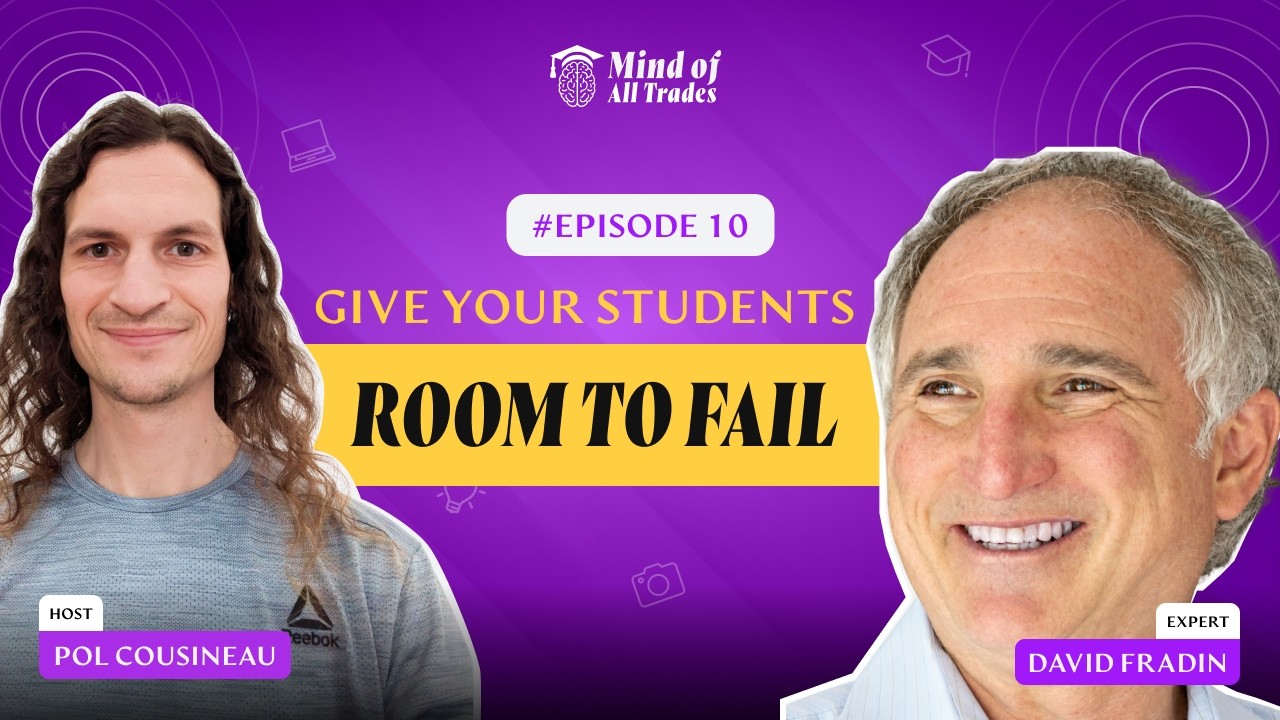
Give Your Students Room to Fail - David Fradin - Part 1 - EP 10
The Mindset That Scales Your Business
Description
“You have to give your student enough room to fail because people tend to learn more from their failures than from their successes.” David Fradin learned that as a flight instructor, and it shapes how he designs every course he teaches.
In Part 1, David and Pol Cousineau dig into how David turned his product management training into a 796-page university-level book, and why it only came together once he found the right framework. David explains the five keys to product success behind SPICE, why he quizzes students every five to 10 minutes, and how a course workbook can become a portfolio that helps students get hired. They close on why the real money in his business is in in-person corporate training, and how he scaled it by training other trainers.
In this episode, you’ll hear:
- How a training trip to Singapore led to a 796-page book with Wiley
- The five keys to product success behind David’s SPICE framework
- Why a book stalls without a structure, and how David used his courses as the outline
- Why stories help students remember the concept
- Quizzing every five to 10 minutes, and what it does for retention
- Giving students room to fail, and the flight-training method behind his exercises
- Why the real money is in in-person training, and how training other trainers helped him scale
Chapters:
00:00 – Coming Up and Intro
03:50 – How a 796-Page Textbook Came to Be
08:45 – How the SPICE Framework Unlocked the Book
15:00 – Just Sit Down and Write
22:41 – Structure First, Outline Second
26:41 – Storytelling and Starting With a Framework
29:36 – Calling Out the Competition
33:11 – Creating Online Courses and Quizzes
36:55 – Workbooks, Exercises, and Room to Fail
42:42 – Workbooks as a Portfolio and the Limits of Udemy
46:56 – Where the Real Money Is: In-Person Training
About David Fradin
David Fradin is the founder and president of Spice Catalyst, a worldwide product management and product marketing training, consulting, and assessment organization. He spent more than 47 years across 75-plus products and services at 25 organizations and 11 startups, starting as a classically trained Hewlett-Packard product manager before Apple recruited him to bring the first hard disk drive to market on a personal computer. At Apple, he rose to Apple III group product manager and then independent business unit manager. Earlier, he pioneered environmental mediation, resolving a seven-year dispute over Lake Superior taconite tailings. He is the author of Building Insanely Great Products, Organizing and Managing Insanely Great Products, and the 796-page Successful Product Design and Management Toolkit with Wiley. He has trained product and marketing managers at Cisco, Capital One, Cognizant, Infosys, and Pitney Bowes, and sits on the board of Manipal Global Academy of IT in India.
Learn more about David’s training, courses, and books at Spice Catalyst: https://www.spicecatalyst.com
Want to be a guest on Mind Of All Trades? Apply here: https://mindofalltrades.com/podcast-application
Follow Mind Of All Trades:
- YouTube: https://www.youtube.com/@MindofAllTrades
- Spotify: https://open.spotify.com/show/4MixC1mfhhUVIOFO1mywUc
- Apple Podcasts: https://podcasts.apple.com/us/podcast/mind-of-all-trades/id6807196830
- Instagram: https://www.instagram.com/mindofalltrades/
- Amazon Music: https://music.amazon.com/podcasts/32ce7fa4-4473-4c53-9256-7fca60e47331/mind-of-all-trades
- LinkedIn: https://www.linkedin.com/company/mind-of-all-trades/
Theme music by Breakmaster Cylinder.
Also Listen On


Transcript
Click to read the transcript
[00:00:00] Pol Cousineau: And how did you
[00:00:00] actually put that book together?
[00:00:02] Because 796 pages
[00:00:05] seems like a lot.
[00:00:06] David Fradin: Just sit down and do it.
[00:00:08] Just sit there and write.
[00:00:10] Pol Cousineau: And then why
[00:00:11] such a short timeframe
[00:00:13] before quizzing them?
[00:00:14] David Fradin: the real money
[00:00:15] is in the in-person
[00:00:16] courses and training.
[00:00:17] Pol Cousineau: So what are other techniques
[00:00:18] that you found
[00:00:19] to help the students
[00:00:21] retain the knowledge
[00:00:23] in what you’re trying
[00:00:24] to teach them?
[00:00:25] David Fradin: you have to give
[00:00:26] your student enough room
[00:00:28] to fail because
[00:00:29] people tend to learn more
[00:00:30] from their failures
[00:00:31] than from their successes.
[00:00:33]
[00:00:40] Pol Cousineau: Welcome to Mind of All Trades, the podcast where edupreneurs turn knowledge into impact. I’m your host, Pol Cousineau, and together we explore the craft and commerce of educational businesses, we look at the strategy, we look at the systems, and we look at the real implementation work that has to happen behind the scenes.
[00:01:00] Before we dive in, make sure you subscribe so you don’t miss future episodes. We’ll be sharing practical guides, conversations, and examples for edupreneurs who are building real momentum in their business, and for coaches, course creators, podcasters, and membership site owners who need help with the tech behind the business.
[00:01:20] Check out The Digital Navigator. The Digital Navigator helps with fully managed websites, funnels, analytics, automations, and ongoing tech support. So instead of having a bunch of disconnected tools, your systems can work together, and you can spend more of your time focused on the business, the offer, and the people you serve.
[00:01:40] You can learn more at thedigitalnavigator.com. Now, let’s jump into today’s episode. and today’s d- guest is David Fradin. David is the founder and president of Spice Catalyst, a worldwide product management and product marketing training, consulting, and assessment organization. Before Spice Catalyst, he spent 47 plus years across 75 plus products and services at 25 organizations and 11 startups, most notably as a classically trained Hewlett-Packard product manager before Apple recruited him to bring the first hard disk drive to market on a personal computer.
[00:02:25] I don’t think a lot of people can brag about that one. David rose to the role of Apple III product… group product manager and then independent business unit manager, which is the same organizational level as Steve Jobs at the time, something else that a lot of us may not be able to brag about. Earlier still, he pioneered environmental mediation, resolving a seven-year dispute over Lake Superior taconite tailings that earned him the nickname the Henry Kissinger of Northern Minnesota from the Duluth News.
[00:02:59] I wish I had a cool nickname like that. He is the author of Building Insanely Great Products, Organizing and Managing Insanely Great Products, and with Wiley, authored the 796-page university-level Successful Product Design and Management Toolkit. He has trained product and marketing managers at companies including Cisco, Capital One, Cognizant, Infosys, and Pitney Bowes, and sits on the board of Manipal Global Academy of IT in India.
[00:03:36] You can find out more about David’s work through the Spice Catalyst website at spicecatalyst.com. Welcome to Mind of All Trades, David. It’s a pleasure to have you here.
[00:03:47] David Fradin: Yeah. Uh, thank you for, uh, putting up with me
[00:03:50] Pol Cousineau: Oh, well, you’ll thank me at the end of the show, right? We don’t know yet. I was really excited to have you on the show because you have such a wealth of experience, and one of the things to me that stood out is actually the 796-page university-level book that you authored. And I’d like to just jump right into that about how did that project come about?
[00:04:20] David Fradin: Well, a, uh, friend of mine, uh, well, he, he became a friend of mine, uh, back in the early, um, 2010s, the country of Singapore asked me to come there and teach them about developing products, because up until then, they were primarily doing IT services, uh, things like the, uh, uh, the two… K2 or 2K transition, that type of thing. And they were paying their, uh, IT engineers, uh, 100, $150 an hour, and the, the country was competing with China that was offering, uh, the same thing for about $25 an hour. So the country of Singapore wanted to figure out how they could get into products, so they asked me to come there and, um, give a, a, uh, a lecture to the chief executive officers of most of the major companies in Singapore, and then offer a three-day training course on, uh, product management, or as I prefer to call it, product success. So, um, a fellow by the name, uh, from, uh, Infosys, who was the VP of product management training at Infosys in, uh, India, uh, asked if he could come, so he, he did. He attended, uh, all, uh, four days. And, uh, he then, uh, invited me to, um, uh, go to India, uh, uh, and connected me with Manipal, uh, University. Uh, and while I was there, I was also able to teach, uh, Cisco’s product managers, and he had written a book on data analytics that Wiley had published, so he introduced me to the general manager of Wiley in India, and they loved the idea to have a book on product success, and that’s how it ended up, uh, that, that it was published there. It’s been used as an executive training or MBA training book in, uh, several universities, uh, including, I forget what it is, an IIPM, uh, Lucknow, which is a preeminent university in India, uh, similar to Harvard, uh, in the United States. And, uh, several thousand, uh, uh, p-people have gone through that course, and I teach, uh, some seminars in that, uh, uh, uh, occasionally
[00:06:39] Pol Cousineau: And how did you actually put that book together? Because 796 pages seems like a lot. Did you have help from ghostwriters or other people? How, how did you actually do all of that?
[00:06:53] David Fradin: Well, and AI didn’t even exist then. Uh, so, um, what I focused the book around is the hard skills and the soft skills required for product success, and, um, and around the key components of product success, which is, uh, fivefold. Uh, first one is you must have a product market strategy that is a plan for the product. Uh, and you need to write that before you start development, as opposed to a lot of people and companies, uh, don’t start development, they start marketing it right away and try to, uh, uh, fail fast quickly, uh, as opposed to, uh, ready, uh, uh, aim, fire. Uh, and then the second thing is the, is the P in SPICE Catalyst.
[00:07:40] The S was, uh, product market strategy. The P stands for the process. Uh, the need– you need to have, uh, uh, repeatable processes in order to enhance the chances for success. The I is having the information necessary to make informed decisions. Uh, the C is understanding your customer, what it is that they want to do, why they want to do it, when they want to do it, where they want to do it, how they want to do it, what’s standing in their way, how important is it for them to get it done, and then how satisfied are they with other potential solutions as opposed to your potential, uh, product. And lastly, the E stands for the 130 skill sets or competencies your individuals and your organizations have to have at a basic, intermediate, and an advanced level in order to be successful. So the book’s chapters, uh, go through all of those kinds of things, uh, plus the soft skills of networking, leadership, uh, uh, and things like that
[00:08:45] Pol Cousineau: And had you already built the SPICE framework before you wrote the book?
[00:08:49] David Fradin: Yeah, I first, uh, codified it in my shorter pamphlet, which is only 196
[00:08:54] pages that I called, uh, “Building Insanely Great Products.” And then what I did with, uh, wildly successful, uh, uh, d- design tools and, and management, uh, uh, uh, tool, uh, uh, book is to expand on that in greater depth and also go into more of the soft skills required
[00:09:17] Pol Cousineau: And when you made this very small pamphlet, did you, like, have the rough lines of the framework? Like, how did it actually come about? ‘Cause you now have, right, this, this acronym SPICE. There’s clear concepts. How did that creative process of building the framework happen?
[00:09:36] David Fradin: Well, um, when I first started the book, I didn’t have that framework and, uh, was stalled for several years before I came up with the framework and I said, “Ah, that’s the organizational structure I need for the book.” Uh, and then immediately the book fell into place
[00:09:52] Pol Cousineau: And was there something that brought it to light? ‘Cause you said, “Ah.” So it almost like there was a moment where it all came together
[00:10:00] David Fradin: Well, what motivated me is, um, according to, uh, uh, Mar- McKinsey, the market research firm, um, uh, the world, this would be about 10 years ago now, was spending well over a trillion dollars in, uh, new product development. And other figures are out there saying anywhere from 35% to 75% of those investments fail in the marketplace. So I felt if I could contribute to improved chances of product success, then that would be less wasted resources, uh, more resources producing profits, so we could pay people more and we can, uh, take care of, uh, our environment
[00:10:41] Pol Cousineau: Yeah, that seems to make sense to me. And then were you kind of contemplating to get this acronym and these concepts from SPICE, or were you discussing with someone to brainstorm it? Uh, because I’m thinking about our listeners, and some of them might be lucky and they have already a framework for what they’re teaching and training in, but others, they might be in those several years of struggle that you described a moment ago.
[00:11:08] And I’m trying to see if we have ideas or, you know, how your journey might be able to help and support them
[00:11:14] David Fradin: Well, a, uh, a friend of mine, uh, that was in the field of product management and training, um, suggested the title “Building Insanely Great Products,” which is a rip-off of what Steve Jobs used to say. We would, uh… He said at Apple, “We’re gonna build insanely great products.” Uh, so I was, uh, uh, building on that, on those, on those shoulders. And then over time, uh, I left that organization and started SpiceCatalyst. Uh, and my business partner at the time had been the Apple II product group product manager when I was the Apple III group product manager before I rose to business unit manager for the Apple III, uh, product line. And, uh, he suggested the name SpiceCatalyst because I was into food, and he figured it had, uh, you know, just like Apple got named after an apple orchard, uh, our company could be named after spices.
[00:12:11] Pol Cousineau: So it seems like we should be doing a duel of hot peppers. I enjoy hot peppers myself, so
[00:12:20] I
[00:12:20] David Fradin: So he proposed the name, and then as I was, uh, trying to finish building and selling great products, uh, this would be back in 2016, um, I came across, uh, the keys to product success and then adopted the SPICE as an acronym. So now I tell people the name did not come from peppers, but it came from, uh, an acronym for the five keys to product success.
[00:12:48] Pol Cousineau: Right. And then it seems like you were working on that framework and those concepts, and you matched it afterwards to the letters with SPICE, not the other way around
[00:12:56] David Fradin: Right. Actually, uh, not an acronym, it’s a, uh, a mnemonic
[00:13:01] Pol Cousineau: Ah, okay. And what is the difference between the two?
[00:13:05] David Fradin: Um, one starts with the letter P and the other one starts with the letter A
[00:13:10] Pol Cousineau: Okay.
[00:13:13] David Fradin: I don’t know.
[00:13:14] Pol Cousineau: Yeah. Okay, well, I’ll have to research that one after the show and find the, the difference between them. So I’ve probably been using the term wrong this whole time for so many years. So now that you had that, that framework, that definitely helped unlock the book, but you’re also mentioning the business side.
[00:13:32] So then did you use that, what did you say? M- m- mnemonic?
[00:13:38] David Fradin: No more, I like
[00:13:39] Pol Cousineau: Yeah, did you use that mnemonic, uh, expression SPICE as you were building out then, like the workshops, your other offerings? How did that come into play?
[00:13:47] David Fradin: Yeah. Well then that immediately suggested to do a, uh, a workshop or a course over, uh, one or two days that focuses on the 32 elements of a product market strategy. And then, uh, another course came out of it is, uh, Understanding the Cu-Customer, which is a design thinking and value proposition course. Uh, and then there’s some soft skill courses, um, uh, managing product teams and so forth. And then there’s a, a, a course in the fundamentals of marketing and, and another course in social media marketing.
[00:14:27] Pol Cousineau: And were those all based on the same body of work and what ended up being inside of the book and the pamphlet, or
[00:14:35] David Fradin: Yes. Actually, I, uh, wrote most of the courses before I wrote the book, and then borrowed heavily against the courses, uh, uh, to provide the outline, uh, for the book. And then of course, as, as you know, in print, you can go into a lot more detail than you can in a, in a lecture or in a course.
[00:14:54] Uh, so that’s how I expanded it to the, uh, the mere 796 pages
[00:15:00] Pol Cousineau: So then that might be an approach that someone listening could take if they’ve got different types of workshops or courses and they wanna put a book together, is looking at the outline, the curriculum, and then starting to fit that together. Is, would you say that would, yeah, that would be a good approach for them?
[00:15:18] Is there any specific advice that you would give to someone doing that?
[00:15:21] David Fradin: just, sit down and do it. Just sit there and write. Um, uh, uh, uh, last year, um, a, uh, a cousin of mine, uh, sent me a, uh, a bunch of letters that my dad had written home during World War II when he was serving in the US military, and they were pretty funny letters. He was a very, uh, good, uh, humorous, but, uh, instead of being, uh, another Mark Twain, he turned out to be a master plumber. Uh, and, uh, I was struggling for a structure to that book. I knew I was gonna name the book, uh… My dad’s name was Hyman, H-Y-M-A-N, uh, and he sometimes went by the nickname Hymie. This is before, uh, some people said it’s an antisemitic term, but it’s not. It was my dad’s name. And I, uh, uh… So, uh, the title of the book was gonna be “Letters From My Hymie,” uh, not to be cu- accused with “Letters From My Vagina,” which is another very famous book or something like that. And, uh, I struggled a bit for, uh, a structure and then realized that the letters, uh, uh, were written over, like, a three-year period from, like, 1940, ’41 through 1945, and a few more letters after that. And, um, so I just decided to use chronological order, uh, for it. And in my research for it, uh, and with the letters that my cousin sent to me, was an 18-page, uh, uh, autobiography that my grandfather, uh, uh, Louis Fraden, dictated, uh, to my brother’s, uh, my, my father’s eldest brother, and his wife was a stenographer. Uh, he, uh, Morris Fraden, was the, uh, uh, librarian of the, of the US Navy in the Pentagon, uh, for many years. So I think that’s why Morris kept all these letters that my dad wrote home And I, uh, I got that 18-page, uh, thing where my, um, grandfather, uh, grew up in Ukraine to avoid the Russian-Japanese War. He, like others, burned his lungs with, uh, muriatic acid so he didn’t have to go to the front line. So they put him behind the lines to tend to the horses, which led to a career as a blacksmith, and eventually he got hired by the governor of Kyiv, uh, to maintain the f- 200 horses, uh, that the governor had. So he was constantly making and putting horseshoes on all these horses. And then the seventh of Polgrum Holocaust was about to be spread by the Cossacks throughout Ukraine, and the governor came to him and gave him several hundred dollars and said, “Get the hell out of the country before they kill you.” So he left, um, took a boat to New York, and, uh, a year and a half later was able to send enough money back to get his wife and, uh, his eldest son, uh, Morris, uh, uh, to the United States. And he gravitated, uh, then to Baltimore, where my dad was born, and eventually to Washington, D.C. And in my research for the book, I found that there’s a French book, uh, called “The Book of Fraden,” which is in French, and I flunked French, so I couldn’t read it. But I read it through Google Translate and found out that my grandmother, uh, a mere 26 generations ago, uh, left Spain in 1492. Now he– she left there either in search of Columbus or because of the Spanish Inquisition, and was, uh, traveling through southwestern France and, uh, got, uh, confronted by some thieves. And a gallant young man, uh, by the name of Fraden came out of the, uh, forest with his friends, and he had a big sword and he, uh, he warded off these thieves. Uh, saw my grandmother, who was 15 at the time, fell madly in love with her, uh, converted to Judaism, um, got married And then when the French started cracking down, uh, in the, uh, what was it?
[00:19:38] The 1800s against Jews, uh, he– his family, his, uh, uh, s- uh, converted back to Cat- Catholicism. One of them became the mayor of Lyon. Another one opened a Fraden winery, uh, in southeastern, uh, or southwestern, uh, France. And another one became a, uh, a knight in the, uh, France’s Round Table equivalent and was appointed, uh, a duke by, uh, I think it was King Louis, uh, some other, like, VI or something like that. So that’s why that book, “Letters From My Hymie,” is from Duke, uh, Fraden, uh, because according to, uh, French aristoc- aristocracy, uh, if you have a duke in your family, all of the following male descendants are dukes. uh, uh, I conveniently ignore the French Revolution, which, which got rid of that, uh, so that I can adopt the name, uh, Duke Fraden. And the, the whole structure for the book came out that I start with, um, Louis’ memories, uh, uh, flash back to the things I look- learned about my history, uh, from the, uh, uh, the book of Fraden and, uh, extracted as much from that that I could, that I felt relevant. And then the key thing is I thought it’d be interesting to describe around the dates of the letters, of each letter that my dad, uh, sent home, what was going on in the world and what was going on at the United States at that time. Uh, so there’s a little bit of a historical journey, uh, woven in between each of the letters
[00:21:24] Pol Cousineau: Hmm. Now this is a completely separate book, right? About…
[00:21:27] David Fradin: Right
[00:21:28] Pol Cousineau: Yeah. Okay. S- sorry, I’m following the two tracks here, so there’s… ‘Cause I was thinking, “Okay, did that make its way into the textbook?”
[00:21:37] David Fradin: did not, that was written after the textbook. And, uh, in order to confuse you, I was answering the question of, uh, how did I organize, how did I structure the book? How did I organize it?
[00:21:49] Pol Cousineau: Yeah, yeah, exactly. That’s why. And then I was like, “Okay, wait, I just wanna make sure there’s two books going on here.” So for that one, you know, pulling from the chronology definitely helped you, and then you did some digging in there. And then interestingly enough, you’re referencing a book within a book, which is a, an odd pattern because most of the books I read, there’s an author in there, there’s another book in the book, and it’s something I just keep noticing.
[00:22:14] I’m like, “Why does this almost always happen in the books?” And now you’re explaining,
[00:22:19] David Fradin: well, we
[00:22:20] have to refer to something other than something that AI made up
[00:22:24] Pol Cousineau: Yes. Yes, exactly. So then that book, once you explain, right, how you had the chronology set up in there, is there more that you wanted to share about how you wrote that one?
[00:22:38] David Fradin: Letters from my Hymie?
[00:22:39] Pol Cousineau: Yes
[00:22:41] David Fradin: Uh, no, then that thing fell together very quickly. I, I think once you have the structure or organization for the book, everything comes together very easily. Uh, a lot of people suggest you start with an outline. Well, if your head is empty, it’s kinda hard to outline what it is that you wanna do.
[00:23:00] So that part of it is the hardest part. It evolves over time, and then it’s just straightforward. Okay, here’s this letter. Now let’s research, uh, what happened in the world and in the United States before then, and then after then. And, uh, I looked up the history of each of the places where my dad was stationed, like, uh, Quantico, Virginia, uh, like, uh, uh, Pens- uh, Pensacola, Florida, like, um, uh, Tennessee, uh, like, uh, Guantanamo Bay, uh, uh, like South Carolina, those kinds of things. And, um, you can see different things going on in those different areas of, uh, the United States, uh, during World War II
[00:23:48] Pol Cousineau: Hmm. And then you didn’t make an outline or you made that afterwards once you
[00:23:54] David Fradin: I, I made that out afterwards
[00:23:56] and, uh, the chapter headings ended up to be the table of contents or, or the outline
[00:24:03] Pol Cousineau: Okay. Now, I haven’t written a book myself, but once you had the chapter headings, for me, that seems like the approach because I had to do a, a CPA exam in Canada, which is notoriously difficult. And, uh, one of the questions is like a five-hour question, and the question itself is like 30 to 50 pages. So then what I did is I kinda tried to figure out, okay, here’s all the different concepts and eventually almost like mini chapters of the answer, organized that, and then I went back and filled in the blanks.
[00:24:36] So it seems like once you had these chapter headings, then you were able to come back and then again fill in the blanks, and then did you go in from start to finish for writing the book, or you went through different sections in
[00:24:49] David Fradin: the, uh, well, I started with, uh, Lewis Fraden’s, uh, memoirs, but then I put a, uh, uh, a preamble on there and a dedication, um, and, uh, insulted my cousin because she lives in Florida and hates lizards, so I said she’s a lizard lover. And, uh, insulted my sister who is three years older, who was constantly beating me up as we grew up. Uh, so s- that’s wa- my way of getting back at them. Now it’s in print, everyone’s gonna believe it. Uh, and, uh, and then I rolled into Lewis’ thing and then, uh, uh, into my dad’s growing up, uh, having, uh, saw, uh, Charles Lindbergh after his 19, what was it, 29, uh, solo flight from, uh, New York to Paris, um, and, um, uh, on the streets in Washington, D.C.
[00:25:47] when World War II broke out. And I oftentimes asked him if he knew of the Holocaust going on in, uh, Germany at that time. He didn’t quite say he did or he didn’t. And then I said, “What did you do about it?” And, uh, he didn’t quite say he did or didn’t, but it turns out that there were 600– I found in my research that, uh, in the United States military during World War II, there was, uh, 600,000 Jews, uh, which represented, uh, I think it was 10% of all the Jews in the United States at the time, uh, vastly outweighing the representation from any other, uh, ethnic or religious group. Uh, so the Jews knew that they were getting slaughtered in Germany, and the only way to bring that to an end was to join the United States military and, uh, confront Hitler
[00:26:41] Pol Cousineau: Taking a small left turn from that . Uh, I noticed that you’re yeah, I noticed that you’re, you’re using quite a bit of storytelling. So have you been using that approach as well in your trainings and in your workshops? Is that how you’re help- like conveying concepts?
[00:26:59] David Fradin: Yeah, I do that, uh, over time I started doing it more and more and more because people kept asking for more stories. Uh, I think in great part because it’s easier to remember the story than it is to remember the concept. And if you remember the story, then you can remember what the concept was that you’re, uh, talking about
[00:27:19] Pol Cousineau: Hmm. So now I wanna make the connection again before, uh, “Letters From Your Hymie” and the other book that in theory came before, right? But the more academic book. So then how can… Because people won’t have necessarily a chronological order or things like this, right? They’re pulling maybe from their course materials, from workshops.
[00:27:40] So how do we transfer the story you just taught to now writing a more maybe like workshopy training academic book?
[00:27:50] David Fradin: Yeah, the, uh, “Letters from my Hymie” was easy because it was, uh, chronological. Um, other books, uh, based on training has gotta be organized, uh, based upon the sections of the training, and then just go into more deep, uh, depth for each of those things. So like in “Successful Product Design and Management Toolkit,” uh, and in “Building and Selling Great Products,” uh, just, uh, describing the product market strategy, of which there’s 32 elements, and I had developed a, uh, graphical framework which people can get on, uh, on successful products at my spicecatalyst.com website. Uh, I identified in a, in a flow diagram, uh, what should come first, uh, in the product market strategy, the next, the next, all the way, uh, to the end. And then, uh, the, the book, uh, turned out to be a description of each of those boxes that’s in that flow diagram. So the concept of a framework, uh, uh, is a good way to start. Uh, uh, the notion of a framework, uh, came from software product development in the 1990s. It didn’t exist before then. Uh, so there’s lots of frameworks out there. And one of the things I do is I go through my product management training, uh, competitors and, uh, point out how, uh, all of them are inadequate, uh, to having success, uh, and, uh, and showing that I have, uh, uh, rejected some of their, uh, str- uh, framework, uh, strategies, and I’ve created others, uh, which would be much better to follow
[00:29:33] Pol Cousineau: And do you call them out directly?
[00:29:35] David Fradin: Oh yeah
[00:29:36] Pol Cousineau: Hmm, okay, that’s interesting, ’cause I see some people are concerned and typically try to not mention direct competitors, but it seems like that’s actually part of your approach. You call them out and you say, “Hey, here’s the deficiencies in what they’re doing and how they’re proposing, and here’s why my way is better, and here’s how you do it.”
[00:29:56] David Fradin: Yeah. Well, I forget the name of the guy, the great Chinese general. I forget when,
[00:30:02] Pol Cousineau: Sun Tzu?
[00:30:03] David Fradin: Yeah, what was it? The 1500s, he wrote “The Art of War.”
[00:30:07] Pol Cousineau: Yes.
[00:30:07] I mean, I’m not sure about the date, but I’m– Sun Tzu and “The Art of War,” that one I’ve got.
[00:30:13] David Fradin: And, uh, when I began in product management at Hewlett-Packard, that was one of the books we were required to read. And of course, one of the chapters in there is to know your enemy. Uh, so you gotta know your competition, and that is one of the boxes in the product market strategy is doing the competitive research. So even to the point of sketching out your, um, strengths, weaknesses, opportunities, and threats, do the same thing for them, so that when the issue comes up in a competitive environment and people are saying, “Well, why are you better than this thing or that thing?”
[00:30:53] Or, “Why is your product better?” Or, “Why is your service better?” Uh, you have ready answers to that question
[00:30:59] Pol Cousineau: That makes a lot of sense. Now, in terms of your weaknesses, do you also, because you’ve anticipated them, call them out and then defend them, or you just have that in your back pocket so you’re aware that that might come up?
[00:31:13] David Fradin: Uh, their weaknesses or my weakness
[00:31:15] Pol Cousineau: ‘ cause you said including my weaknesses or, or areas that are maybe not as strong, right?
[00:31:20] If I heard correctly
[00:31:22] David Fradin: Yeah. Well, in the competitive research, you need to do that. Um, and then you need to do the things that are necessary to strengthen your weaknesses so that it’s no longer weak. In the case of the other– your competitor’s weaknesses, of course, you bang on that. Uh, like, uh, the leader at that time in the product management training phase was primarily focused on teaching engineers how to do marketing. And, uh, that does not mean you have any ability whatsoever to put together a 32-part product market strategy. You’re just taking the product to market. Uh, uh, and, and that, that kind of thing I, I was, uh, able to point out
[00:32:06] Pol Cousineau: Mm-hmm. So their weaknesses, you call them out. Your own, you try to strengthen them or have another compensatory mechanism so that basically it doesn’t cause you to lose the business
[00:32:20] David Fradin: Yeah. And, and the case against the, uh, product marketing trainer, and they had nobody on their board, on their advisory committee, or even on their staff that had ever had any experience as a product manager. Uh, and I was able to compare that and contrast it to my experience as one and my other trainers’ experience as, uh, former product managers.
[00:32:45] Pol Cousineau: Hmm. So I feel like this could be valuable when people are doing corporate trainings or B2B type training where these strengths and weaknesses might come up more into play than like a B2C type approach. Does that sound fair?
[00:33:02] David Fradin: Yeah, and that’s what I do, uh, predominantly is B2B
[00:33:06] Pol Cousineau: Exactly. Yeah, that’s why I wanted to kinda anchor, right, the concepts in this. But you also have Udemy courses, and are those ones B2B or it’s kinda like professionals that end up consuming those that are obviously in a business, but who’s the audience for the Udemy courses?
[00:33:25] David Fradin: It’s, uh, it’s professionals, people that, uh, are or want to be, uh, product managers, uh, because they don’t have that training. Usually, most product managers are trained on the job, and it’ll take them one to three years before they become proficient. But if they take my courses, which are available on demand online through, uh, Univey, uh, they can, uh, become proficient very quickly
[00:33:51] Pol Cousineau: And then when you made those courses, what did that process look like?
[00:33:57] David Fradin: Uh, in that case, I outlined them, uh, based upon my knowledge and then just go ahead and wrote them. And the technique I used is I would, uh, use the, uh, voiceover or the text, uh, as the foundation, and then I would create the slides with bullet points that, uh, um, came in and out, dissolved in and dissolved out, uh, as the voiceover is emphasizing those particular points. And then I put that all together, um, as a video for each of the lectures, and then I interspersed, uh, each lecture with a quiz after, uh, the lecture was done to make sure that people remember the key, uh, learning, uh, points, uh, in each of the lectures
[00:34:45] Pol Cousineau: And how much value do you feel the quizzes are bringing to retention?
[00:34:50] David Fradin: I think it brings a lot because it focuses people on what was important from the five to 10-minute lecture that they just, uh, uh, viewed and heard
[00:35:00] Pol Cousineau: Yeah, I was bringing that up because it’s interesting in the e-learning world, I’m not seeing a lot of people doing quizzes, assessments, verification, right? That the knowledge is actually being transmitted and retained. Yet personally, I think this is extremely important so that we have recall and there is something of substance that we keep with us, uh, as well
[00:35:29] David Fradin: I agree. And, um, my experience in, uh, that kind of training goes back to the 1990s, uh, when I was one of the pioneers of using multimedia in training. Uh, even to the point that the, uh, US Navy’s Top Gun School, uh, down in Miramar, uh, asked me to come down, uh, and give a lecture to their trainers on how they could train the, uh, the Navy, uh, Top Gun pilots better and faster. Uh, and that’s when I first started exploring these different, uh, concepts
[00:36:02] Pol Cousineau: Hmm. And then you mentioned like a quiz comes after about like 10 minutes of teaching or so?
[00:36:07] David Fradin: Yeah.
[00:36:08] Five, every five to 10 minutes I would pause and ask, uh, three to five questions
[00:36:14] Pol Cousineau: And then why such a short timeframe before quizzing them?
[00:36:19] David Fradin: Uh, I t- uh, people generally don’t have much of a span of attention. It’s especially true recently, where if you can keep someone’s attention for more than two to three minutes, you’re doing pretty good. Uh, so by breaking it up, uh, that helps. And in fact, uh, Wiley said to me, uh, for that book, uh, “Why don’t we put, uh, the, the, uh, questions in there?” So I wrote them a battery of like 800 questions they could stick in the book. Uh, and it can– It’s also used as a, uh, final test, uh, for that particular course
[00:36:55] Pol Cousineau: Hmm. So then that makes sense to me with keeping the attention span, especially in the age of very short videos, a lot of things coming your way. On the social media platforms, I’m pretty sure that, like, a video watch is three seconds. And hey, you got a watch, and I think 15 seconds is a full playthrough.
[00:37:16] Doesn’t matter how long that video was, right? It’s just to show how short the attention span, uh, are of people. So what are other techniques that you found to help the students retain the knowledge in what you’re trying to teach them?
[00:37:31] David Fradin: Well, I ask them also to do exercises. So each of the courses has an accompanying workbook. So there’s a product ma- product market strategy workbook, um, and I have different components like, um, uh, one component would be what is it that your customer wants or your, yeah, your customer wants to do? Uh, list it out. Uh, how do they wanna do it? Why do they wanna do it? Where do they wanna do it? So forth. You list, list all that out in a, uh, PowerPoint like, uh, uh, presentation. And then you, uh, in the in-school course, that’s presented back to, uh, the class, and each of them gets up and presents what they found in each of the areas of the product market strategy as each of the 32 elements are, uh, walked through, uh, uh, taught and walked through. So the exercise is– accomplishes two things. One is, uh, from my background as a flight instructor, uh, teaching in one of the most hazardous environments, uh, in the world, that if you teach properly, you’re able to go home that night and have dinner. If you don’t teach properly, you’re gonna be in a, a fireball, uh, someplace on, on the, the Earth’s surface. Uh, and, uh, you have to give your student enough room to fail because people tend to learn more from their failures than from their successes. And you also go through a process, uh, that the, uh, Army Air Force developed, uh, back in the ’40s for World War II to train their pilots, and that is you demonstrate or show them what you’re gonna, uh, teach them. Then you, uh, uh, have them do it, and you tell them, uh, step-by-step what to do as they do it, and then you have them do it and tell you back, uh, how to do it And I know when I first, uh, soloed, uh, up in Reno Stead Air Force Base as a Civil Air Patrol cadet, uh, back in 1966, um, after about two and a half hours of flying time, uh, the instructor said to me, ” You’re doing pretty good.
[00:39:49] You wanna try one by yourself?” And what I thought he meant was that he was gonna not grab the control column and straighten the airplane out just before we were about to crash every time, uh, when we were coming in for a landing. And before I knew it, he jumped out of the airplane.
[00:40:05] And,
[00:40:06] Pol Cousineau: jumped out of the airplane
[00:40:07] David Fradin: while we were on the ground, uh, taxiing back for another touch and go, and he says, “Okay, go your, uh, go do f- your first solo.” And then I thought, you know, he promised me that, uh, two things. One is, um, uh, for every takeoff, there’ll be at least one landing, and that, uh, he won’t go along with me on my first solo. So I said, “Well, if he figures I can do it, I can do it.” So I gave that little Cessna 150, uh, all its power, uh, and the 100 horses started whining, and we ripped off down the runway.
[00:40:43] Now, Reno Stead’s at a half a mile, uh, so it takes a lot of room to get up enough speed. It’s a half a mile… Uh, excuse me, it’s a mile above sea level, so the air is much thinner. And, uh, took off, and I found myself repeating to myself everything the instructor had said at each stage of going, uh, upwind, crosswind, downwind, uh, base leg, final approach, uh, and looking for the clues of whether you’re too high or too low, checking your airspeed indicator to make sure that, uh, you’re not going too fast or too slow. Um, remembering that, uh, at the, uh, uh, key point, which is exactly opposite of where you tend to land, you drop the flaps 10%, you turn to base another 10%, uh, turn to final another 10%, and then you stabilize the approach and drop the final 10%, and then you add power or remove power as necessary, depending by whether you’re, uh, above the, uh, flight track or, or below. So yeah, having that kind of exercise after each lesson. And then the second benefit I mentioned earlier was two, is that if someone was, uh, trying to learn the art of, uh, product management, um, and they go in for an interview, generally they’ll be asked, uh, “Give me an example of some product that you managed.” And if you don’t have one, you’re not gonna get the job.
[00:42:15] But if you, if you go through the workbook, uh, for, uh, each of my courses, you could put that together, say, in a, in a loose-leaf binder with all the slides and say, “Yeah, here, I put together a product manager– a product management strategy on this product, and here’s the entire strategy.” And you can start flipping that, through that with your, uh, potential, uh, manager and prove to them that, uh, you know how to do the job
[00:42:42] Pol Cousineau: So it can serve as a starting portfolio, and this is something that could be interesting for someone training or with a course or a program to consider, because if you can give your students something to show, and in this context, if someone is going to use that in their professional career, it can give them a leg up.
[00:43:02] But this is also something that can differentiate you from a competitor, right? When we go back to analyzing what others are doing, if they don’t have that showcase and you have it and you can help people get placed easier, that would be a strong benefit
[00:43:15] David Fradin: Exactly. And a number of people have, uh, mentioned to me that they’ve, uh, uh, gone through my courses, filled out the workbook, printed it off, stuck it in a loose-leaf binder, taken it in, and they, they got hired
[00:43:29] Pol Cousineau: Now, when it’s in a classroom setting, I presume that you’re able to give them feedback on those exercises. What about in the online world? Like in Udemy, do you also make them go through those exercises? How does that contrast?
[00:43:44] David Fradin: Yeah. In the, uh, the online world, uh, I suggest they go through the exercises, and if they want feedback on it, they could, uh, email me their workbook and, uh, I’ll give them some feedback. Uh
[00:43:59] Pol Cousineau: Do people take you up on that?
[00:44:01] David Fradin: No
[00:44:02] Pol Cousineau: Yeah, I was thinking that because today anything that causes friction… So for today, anything that causes friction, uh, is seen as challenging. So, oh, wait, there’s an email address here. I have to copy-paste it in my email software. Like, I can’t send him an instant message or, or something like this, right?
[00:44:21] And upload the workbook directly. Uh, I could see people not taking that action. And f- yeah
[00:44:30] David Fradin: the, the Udemy platform does not provide for that. They can send me a message, but they can’t send me an attachment
[00:44:37] Pol Cousineau: Exactly. And that’s why I was thinking there’s a big obstacle, and when we’re looking at engineering a training experience online, then it’s good to consider these different types of, of factors. And obviously there’s a platform limitation, right? With Udemy, when did you get started there?
[00:44:56] David Fradin: Oof Probably about 2015.
[00:45:02] Pol Cousineau: Oh, wow. Yeah, so Kwadwo
[00:45:06] David Fradin: at that time, they were doing a focus not only on consumer students, but also on business students. So the head of the business group didn’t know anything about marketing, so he took my, my course on marketing and used that to market the business thing. Uh, then, uh, they had a management change, and they couldn’t understand, uh, training for business. So, uh, my pr- I, I was making about $500 a month off of my courses. Now it’s dropped to about $5 a month because Udemy doesn’t know how to focus on, uh, business, uh, type training, professional training.
[00:45:44] And, uh, if someone would, was to t- uh, pay for my in-person cour- course, they’d pay at least $1,000 per person per day. So these, uh, courses that I offer there, uh, for, at that time, $200, um, was worth $2,000 if it was done in person. Uh, but, uh, Udemy couldn’t understand that. I, I said they were trying to market, uh, my product market strategy course the same way they would market, uh, underwater leathercraft, uh, to a consumer. And, uh, eventually, uh, and then they say, “Okay, we’re having a, a, a…” There’s 11 Ps to part- uh, to marketing. Uh, product, uh, placement, pricing, positioning, that kind of thing. And, um, uh, the only one that Udemy could follow, uh, for years has been pricing. So they would decide to say, “Okay, uh, we’ll make, uh, uh, an offer of, uh, $80 for your $200 thing.” And then they would run a sale on that, which would get it down to about $16, and it just wasn’t worth, wasn’t worth my time or attention to it anymore.
[00:46:56] Pol Cousineau: Hmm. But you still decided to keep it on there, and then you focused your energy in the in-person courses and training? Is that what you did?
[00:47:03] David Fradin: Yeah, my, uh, that– the real money is in the in-person courses and training. Um, if I had, um, you know, 10, 15, 20 students. Uh, for example, the Botswanian telecommunications company, uh, contacted me and asked me to come to Botswana, uh, to train their, uh, new product managers because the telecommunications company had been a publicly owned utility of the Botswanian government, and now they’re private, so they have to figure out how to be successful. And, uh, I said, “Okay, I’ll be happy to come. Where is Botswana?” And they said, uh, “In Africa.” So I looked it up on the map, and Botswana is north of South Africa, and I’m going, “How in the world do you get something north of south?” So I had to go there and see it myself. And they had, um, uh, uh, I think it was, uh, 18 students in the class.
[00:48:03] They paid $18,000 for it, plus travel. And then, uh, Capital One Bank had 30-some people in the class, uh, in Richmond, Virginia, and they paid $36,000. Uh, and the business model I put together is I then trained other people that were former product managers. Uh, one of them was a, uh, fellow professor at Manipal, uh, University. Another one was a former client of mine who’s the VP of product management of, uh, Nixdorf, uh, uh, uh, Diebold, which makes the ATM machines at, uh, at banks and that type of thing. Uh, so I trained them up on my courses, and I-I’ll pay them $1,000 a day to teach and, uh, uh, I would have made– I’d be making, uh, 10 or $15,000 a day, uh, from the students.
[00:48:55] So minus my expenses, the margin and the money is in the in-person training, uh, until COVID hit
[00:49:02] Pol Cousineau: Until COVID. Now, we might get there, but I wanna dig a bit deeper into that business model, because what I’m understanding is that you’re basically getting one sale that allows you to get many students. So you don’t have to enroll each individual student. And then you expanded by basically training trainers, right?
[00:49:26] A- and then that allowed you to scale more. I- is that how kinda that worked?
[00:49:31] David Fradin: Exactly. So I could, I could handle any number of trainings on any number of day, uh, any place in the world. Uh, my, uh, uh, uh, fellow professor is in, in India, so it was a lot easier for him to teach in Europe, uh, online. Uh, and then, uh, my other, uh, trainer, he’s in Ohio, so he would handle the, uh, the East Coast and the East Coast time zones, and I would handle the in-person training at Cisco, uh, and the West Coast, uh, uh, time zones. Uh,
[00:50:06] and it was much better fe- for me to multiply myself and, uh, uh, uh, uh, have others do the training.
[00:50:16]
[00:50:18] Pol Cousineau: Now, after you had
[00:50:19] the trainers trained,
[00:50:20] weren’t you afraid
[00:50:21] that they would start
[00:50:22] competing against you
[00:50:23] and then just take
[00:50:23] the business
[00:50:25] and cut you out?
[00:50:26] David Fradin: Yeah, but that’s one
[00:50:27] of the risks
[00:50:28] you have to take.
[00:50:29] Pol Cousineau: And why do you think
[00:50:30] that perspective has changed?
[00:50:32] Because for me,
[00:50:32] it’s obvious
[00:50:33] that training is valuable.
[00:50:35] David Fradin: people are not liabilities,
[00:50:37] they’re assets,
[00:50:38] yet they show up
[00:50:39] in the P&L as a liability.
[00:50:42] Pol Cousineau: This looks pretty grim to me.
[00:50:44] Is there any ways
[00:50:44] to mitigate that.
[00:50:46] David Fradin: Maybe go to Mars.
[00:50:47] I don’t know.
[00:50:48] I’ve been trying
[00:50:48] to crack that.
[00:50:49]
Highlights & Timestamps
00:00 – Coming Up and Intro
03:50 – How a 796-Page Textbook Came to Be
08:45 – How the SPICE Framework Unlocked the Book
15:00 – Just Sit Down and Write
22:41 – Structure First, Outline Second
26:41 – Storytelling and Starting With a Framework
29:36 – Calling Out the Competition
33:11 – Creating Online Courses and Quizzes
36:55 – Workbooks, Exercises, and Room to Fail
42:42 – Workbooks as a Portfolio and the Limits of Udemy
46:56 – Where the Real Money Is: In-Person Training

About Host
Pol is a strategist and mentor who’s helped countless educators and entrepreneurs scale their businesses with clarity and ease.
From running a data-driven digital agency to co-founding an eLearning platform, he brings both technical expertise and heart-centered leadership.
With Mind of All Trades, Pol brings those lessons to the mic… helping you learn what it really takes to succeed online.
Recent Episodes
Fear Is the Poison of Any Workplace - Bruno Cignacco - Part 2 - EP 13 –
S1 Ep13

Pol Cousineau
October 29, 2026
“Fear is the venom, the poison of any work environment.” Bruno Cignacco says it is the first thing a leader should look for.
In Part 2, Bruno and Pol Cousineau get practical about what a compassionate business looks like day to day. Bruno explains why qualitative factors like kindness and cooperation should come before the numbers, how an anonymous survey can show whether your team is working in fear, and why serving customers is different from selling to them. They also cover why high tech needs high touch, what Trader Joe’s kept when others automated, how fully online teams can build trust, and the one question Bruno asks himself every morning.
In this episode, you’ll hear:
- Why qualitative factors like kindness and cooperation should come before the numbers
- How to find out if your team is working in fear, using anonymous surveys and suggestion boxes
- Why fear makes people defensive, less creative, and worse at serving customers
- Serving versus selling: finding out what customers need and giving more than they expect
- High tech and high touch: why customers still need to reach a real person after they buy
- What Trader Joe’s kept when other grocers moved to self-checkout
- A weekly social hour for online teams, and why knowing the person matters more than the role
- The second edition of The Art of Compassionate Business, and the question Bruno asks every morning
Chapters:
00:00 – Coming Up and Intro
02:40 – Measuring Compassion: Qualitative vs. Quantitative
11:28 – Fear in the Workplace, Groupthink and Serving vs. Selling
24:16 – Experience Engineering: High Tech Needs High Touch
30:38 – Test Your Own Customer Experience
33:11 – Trader Joe’s: Why Real People Beat Self-Checkout
38:46 – Keeping Remote Teams Connected
44:30 – Why Social Time Boosts Productivity
48:28 – The Second Edition and What COVID Changed
55:17 – Closing Advice: Add Value to Every Stakeholder
About Bruno Cignacco
Bruno Cignacco has run his international consultancy since 1993. He is an international business consultant, TEDx speaker, university lecturer, and bestselling author with more than 30 years of experience advising and training hundreds of companies worldwide on international trade, marketing, negotiation, and compassionate business. He is a Senior Fellow of the Higher Education Academy in the UK, and in 2024 he was named by World’s Leaders Magazine as one of the world’s most transformational leaders changing the face of business. Bruno teaches that companies can be profitable and compassionate at the same time, and he is based in London.
Bruno’s book, The Art of Compassionate Business: Main Principles for the Human-Oriented Enterprise, is published by Routledge.
Check out The Art of Compassionate Business, written by Bruno Cignacco: https://www.routledge.com/The-Art-of-Compassionate-Business-Main-Principles-for-the-Human-Oriented-Enterprise/Cignacco/p/book/9781032445427
Connect with Bruno:
- Website: https://brunocignacco.com/
- LinkedIn: https://www.linkedin.com/in/dr-bruno-roque-cignacco-sfhea-0609317/
Want to be a guest on Mind Of All Trades? Apply here: https://mindofalltrades.com/podcast-application
Visit The Digital Navigator: https://thedigitalnavigator.com/
Follow Mind Of All Trades:
- YouTube: https://www.youtube.com/@MindofAllTrades
- Spotify: https://open.spotify.com/show/4MixC1mfhhUVIOFO1mywUc
- Apple Podcasts: https://podcasts.apple.com/us/podcast/mind-of-all-trades/id6807196830
- Instagram: https://www.instagram.com/mindofalltrades/
- Amazon Music: https://music.amazon.com/podcasts/32ce7fa4-4473-4c53-9256-7fca60e47331/mind-of-all-trades
- LinkedIn: https://www.linkedin.com/company/mind-of-all-trades/
Theme music by Breakmaster Cylinder.
Listen Now
Profit and Compassion Aren't Opposites - Bruno Cignacco - Part 1 - EP 12 –
S1 Ep12
Pol Cousineau
October 26, 2026
“By caring for them, you’re caring for your business.” Bruno Cignacco has spent years researching companies that are both compassionate and highly profitable.
In Part 1, Bruno and Pol Cousineau put a big question to the test: can a company be compassionate and profitable at the same time? Bruno explains the principles behind it, from social reciprocity and respecting people’s autonomy to treating the human being as the most important resource in any business, and why Patagonia ran an ad telling customers not to buy its jacket. They close on a free, actionable tip any business can use: read your reviews, look for the patterns, and learn from the companies in your space with the best ones.
In this episode, you’ll hear:
- Why profit and compassion aren’t incompatible, and what Bruno’s research found
- Social reciprocity: why people who are cared for give their best in return
- Respecting autonomy instead of micromanaging employees or hard-selling customers
- Why the human being is the most important resource in any business
- What Patagonia’s “do not buy this jacket” ad says about long-term thinking
- Under promise, over deliver, and why one weak department can undo the rest
- A free research tip: read your reviews, find the patterns, and study the companies with the best ones
Chapters:
00:00 – Coming Up and Intro
02:30 – How Profit and Compassion Intersect
10:42 – Patagonia and the “Do Not Buy This Jacket” Ad
19:40 – When Bad Practices Catch Up With You
27:09 – When One Department Ruins the Customer Experience
34:19 – The Zero-Cost Tip: Read Your Reviews
42:22 – No Feedback Means Flying Blind
About Bruno Cignacco
Bruno Cignacco has run his international consultancy since 1993. He is an international business consultant, TEDx speaker, university lecturer, and bestselling author with more than 30 years of experience advising and training hundreds of companies worldwide on international trade, marketing, negotiation, and compassionate business. He is a Senior Fellow of the Higher Education Academy in the UK, and in 2024 he was named by World’s Leaders Magazine as one of the world’s most transformational leaders changing the face of business. Bruno teaches that companies can be profitable and compassionate at the same time, and he is based in London.
Bruno’s book, The Art of Compassionate Business: Main Principles for the Human-Oriented Enterprise, is published by Routledge.
Check out The Art of Compassionate Business, written by Bruno Cignacco: https://www.routledge.com/The-Art-of-Compassionate-Business-Main-Principles-for-the-Human-Oriented-Enterprise/Cignacco/p/book/9781032445427
Connect with Bruno:
- Website: https://brunocignacco.com/
- LinkedIn: https://www.linkedin.com/in/dr-bruno-roque-cignacco-sfhea-0609317/
Want to be a guest on Mind Of All Trades? Apply here: https://mindofalltrades.com/podcast-application
Follow Mind Of All Trades:
- YouTube: https://www.youtube.com/@MindofAllTrades
- Spotify: https://open.spotify.com/show/4MixC1mfhhUVIOFO1mywUc
- Apple Podcasts: https://podcasts.apple.com/us/podcast/mind-of-all-trades/id6807196830
- Instagram: https://www.instagram.com/mindofalltrades/
- Amazon Music: https://music.amazon.com/podcasts/32ce7fa4-4473-4c53-9256-7fca60e47331/mind-of-all-trades
- LinkedIn: https://www.linkedin.com/company/mind-of-all-trades/
Theme music by Breakmaster Cylinder.
Listen Now
Give Your Students Room to Fail - David Fradin - Part 2 - EP 11 –
S1 Ep11
Pol Cousineau
October 22, 2026
“People are not liabilities, they’re assets, yet they show up in the P&L as a liability.” It’s the argument Dave Packard made in the early 1980s, and David Fradin says most companies still haven’t taken it on board.
In Part 2, David and Pol Cousineau get into how David trains other trainers to deliver his courses, and why so many companies now treat training as an expense to cut. Pol brings his accounting lens to the P&L problem, and David explains why the only time he gets called is when product failures start hitting the bottom line. They also cover why David uses historical examples instead of current ones, what partnership disputes taught him about keeping control of a company you start, and his one piece of advice for anyone teaching: make the class fun.
In this episode, you’ll hear:
- How David trains trainers: observe the course, teach it while he observes, then get signed off
- Why David sells to both the training department and the leader who owns the P&L
- Why companies treat training as an expense, and the Dave Packard argument against it
- Why urgency, usually from product failures, is what gets David hired
- Why he uses historical examples instead of current ones
- What partnership disputes taught him about keeping control of your company
- Shared values, decisions close to the customer, and understanding culture in global markets
Chapters:
00:00 – Coming Up and Recap
02:37 – Training the Trainers to Multiply Yourself
05:21 – Landing Corporate Training Clients
09:55 – Training on the P&L: Expense or Asset
14:26 – How Corporate Training Deals Work
18:38 – Retention Tricks and the Cisco Feedback Culture
21:46 – Use Examples From History, Not Hype
25:59 – Partnerships Gone Wrong: Never Lose Control
30:14 – Flat Fees and Shared Values Instead of Partners
35:44 – Running a Global Team Across Cultures
42:46 – Training Mandates and Closed Markets
About David Fradin
David Fradin is the founder and president of Spice Catalyst, a worldwide product management and product marketing training, consulting, and assessment organization. He spent more than 47 years across 75-plus products and services at 25 organizations and 11 startups, starting as a classically trained Hewlett-Packard product manager before Apple recruited him to bring the first hard disk drive to market on a personal computer. At Apple, he rose to Apple III group product manager and then independent business unit manager. Earlier, he pioneered environmental mediation, resolving a seven-year dispute over Lake Superior taconite tailings. He is the author of Building Insanely Great Products, Organizing and Managing Insanely Great Products, and the 796-page Successful Product Design and Management Toolkit with Wiley. He has trained product and marketing managers at Cisco, Capital One, Cognizant, Infosys, and Pitney Bowes, and sits on the board of Manipal Global Academy of IT in India.
Learn more about David’s training, courses, and books at Spice Catalyst: https://www.spicecatalyst.com
Missed part 1? Watch here: https://mindofalltrades.com/episodes/ep10-david-fradin-room-to-fail-part-1/
Connect with David:
- Website: http://www.spicecatalyst.com
- LinkedIn: https://www.linkedin.com/in/davidfradin/
Want to be a guest on Mind Of All Trades? Apply here: https://mindofalltrades.com/podcast-application
Follow Mind Of All Trades:
- YouTube: https://www.youtube.com/@MindofAllTrades
- Spotify: https://open.spotify.com/show/4MixC1mfhhUVIOFO1mywUc
- Apple Podcasts: https://podcasts.apple.com/us/podcast/mind-of-all-trades/id6807196830
- Instagram: https://www.instagram.com/mindofalltrades/
- Amazon Music: https://music.amazon.com/podcasts/32ce7fa4-4473-4c53-9256-7fca60e47331/mind-of-all-trades
- LinkedIn: https://www.linkedin.com/company/mind-of-all-trades/
Theme music by Breakmaster Cylinder.
Listen Now
Stop Being the Hero of Your Business - Bill Flynn - Part 2 - EP 9 –
S1 Ep9
Pol Cousineau
October 15, 2026
“The question you should be asking is: why did this decision reach me?” It’s the question at the center of what Bill Flynn calls decision capital.
In Part 2, Bill and Pol Cousineau dig into the hero trap: why leaders who were rewarded for years for having the answer end up as the bottleneck in their own business, and why pulling back can leave the team feeling abandoned. Bill explains his three leadership identities, the vacation test, and what a Navy submarine captain learned when he stopped giving orders. They close on why Bill sets standards instead of giving feedback, and the two steps he recommends for educational business owners stuck in the weeds.
In this episode, you’ll hear:
- Why being the hero who always has the answer becomes a trap as your business grows
- Bill’s three leadership identities: controller, builder, and architect
- The vacation test, starting with a vacation from a single meeting
- Decision capital, and the exercise that shows which decisions actually need you
- How intent-based leadership turned the worst submarine in the US Navy into the best
- Pre-mortems, after-action reviews, and milestones that keep projects on track
- Why Bill sets standards instead of giving feedback, and how red, yellow, green check-ins work
Chapters:
02:33 – How Bill’s Books Help Him Reach a Million Lives
05:24 – The Idea Behind The Hero Trap: Controller, Builder, Architect
12:09 – Escaping the Hero Trap: Stop Making Every Decision
20:36 – Turn the Ship Around: Let Your Team Decide
25:33 – Making Failure Okay: After-Action Reviews and Pre-Mortems
30:10 – Milestones: Checking In Without Micromanaging
33:32 – “How Do You Know?”: Testing Your Assumptions
40:25 – Which Metrics Matter: Leading Indicators and Red, Yellow, Green
45:59 – Setting Standards, Outcomes, and Checklists
49:39 – Advice for Educational Business Owners: Vision First, Then Audit Your Offers
54:37 – Where to Find Bill and The Hero Trap
About Bill Flynn
Bill Flynn is the founder of Catalyst Growth Advisors and an executive coach, speaker, and advisor to CEOs of scaling companies. He teaches management science to CEOs and their leadership teams so they can take the guesswork out of growth. Bill brings more than 30 years of operating experience as an eight-time VP of sales, two-time CMO, and general manager of a $100 million-plus division, across 10 startups, two IPOs, and seven acquisitions. He is a member of Marshall Goldsmith’s MG100 coaching community, and his writing has appeared in Harvard Business Review, Training Magazine, and ATD. He is the author of Further Faster and is based in Greater Boston.
Bill’s new book, The Hero Trap, comes out in October 2026 and is available to pre-order on Amazon. It centers on his core idea: great leaders build organizations that make their own indispensability unnecessary.
Check out The Hero Trap book written by Bill Flynn: https://catalystgrowthadvisors.com/the-hero-trap/
Connect with Bill:
Website: https://catalystgrowthadvisors.com/
LinkedIn: https://www.linkedin.com/in/billflynnpublic
Want to be a guest on Mind Of All Trades? Apply here: https://mindofalltrades.com/podcast-application
Follow Mind Of All Trades:
- YouTube: https://www.youtube.com/@MindofAllTrades
- Spotify: https://open.spotify.com/show/4MixC1mfhhUVIOFO1mywUc
- Apple Podcasts: https://podcasts.apple.com/us/podcast/mind-of-all-trades/id6807196830
- Instagram: https://www.instagram.com/mindofalltrades/
- Amazon Music: https://music.amazon.com/podcasts/32ce7fa4-4473-4c53-9256-7fca60e47331/mind-of-all-trades
- LinkedIn: https://www.linkedin.com/company/mind-of-all-trades/
Theme music by Breakmaster Cylinder.
Listen Now
Customers Don't Buy, They Hire - Bill Flynn - Part 1 - EP 8 –
S1 Ep8
Pol Cousineau
October 12, 2026
“People do not buy products and services from you. They hire them to get a certain job or set of jobs done for them.” It’s the idea at the center of how Bill Flynn now teaches CEOs to sell.
In Part 1, Bill and Pol Cousineau dig into why most companies sell on the supply side while their customers buy on the demand side. Bill explains how studying decision science took him from struggling in his first sales job to being the number one or two salesperson everywhere he went, what a dining room table taught one condo developer about why people don’t buy, and how to interview customers so they tell you things they didn’t know they knew. They close on the three things thriving businesses get right, and why cash should be your primary financial metric.
In this episode, you’ll hear:
- How Bill built a solo advisory business he works about 30 days a year
- Why he chose Scaling Up over EOS, and why selling takes both competence and confidence
- How studying decision-making turned his sales results around
- Jobs to Be Done and Demand Side Sales 101: why customers hire products instead of buying them
- The functional, social, and emotional reasons behind every purchase
- How to interview customers like an investigative journalist
- The three things thriving businesses get right: teams, systems, and cash
Chapters:
00:00 – Coming Up and Intro
03:43 – A One-Person Business Built Around 100 Days a Year
07:12 – Choosing an Expertise: Scaling Up vs. EOS
10:33 – Competence, Confidence, and Learning to Sell
17:58 – Jobs to Be Done: Why Customers Hire You
22:25 – Applying Jobs to Be Done to Training
25:37 – Turning Customer Needs Into Your Message
31:59 – Customer Discovery and Designing for What They Want
38:29 – Fewer Features, Fewer Bonuses, Clearer Language
41:36 – Bending the Curve: Why Most Businesses Struggle
48:51 – Getting Better and Aiming for a Million Lives
About Bill Flynn
Bill Flynn is the founder of Catalyst Growth Advisors and an executive coach, speaker, and advisor to CEOs of scaling companies. He teaches management science to CEOs and their leadership teams so they can take the guesswork out of growth. Bill brings more than 30 years of operating experience as an eight-time VP of sales, two-time CMO, and general manager of a $100 million-plus division, across 10 startups, two IPOs, and seven acquisitions. He is a member of Marshall Goldsmith’s MG100 coaching community, and his writing has appeared in Harvard Business Review, Training Magazine, and ATD. He is the author of Further Faster and is based in Greater Boston.
Bill’s new book, The Hero Trap, comes out in October 2026. Like Further Faster, it centers on his core idea: great leaders build organizations that make their own indispensability unnecessary.
Check out The Hero Trap book written by Bill Flynn: https://catalystgrowthadvisors.com/the-hero-trap/
Connect with Bill:
Website: https://catalystgrowthadvisors.com/
LinkedIn: https://www.linkedin.com/in/billflynnpublic
Want to be a guest on Mind Of All Trades? Apply here: https://mindofalltrades.com/podcast-application
Follow Mind Of All Trades:
- YouTube: https://www.youtube.com/@MindofAllTrades
- Spotify: https://open.spotify.com/show/4MixC1mfhhUVIOFO1mywUc
- Apple Podcasts: https://podcasts.apple.com/us/podcast/mind-of-all-trades/id6807196830
- Instagram: https://www.instagram.com/mindofalltrades/
- Amazon Music: https://music.amazon.com/podcasts/32ce7fa4-4473-4c53-9256-7fca60e47331/mind-of-all-trades
- LinkedIn: https://www.linkedin.com/company/mind-of-all-trades/
Theme music by Breakmaster Cylinder.
Listen Now
How to Turn One Book Into an App, Workbooks, and a Mastermind - Gary Mitchell - Part 2 - EP 7 –
S1 Ep7
Pol Cousineau
October 8, 2026
“I don’t know too many lawyers that can sit down and read a 300-plus-page book in their spare time.” That’s why Gary Mitchell didn’t stop at the book.
In Part 2, Gary and Pol Cousineau look under the hood at how Gary turned one book into workbooks, an app, and a masterclass, and how each piece fits into a ladder of offers that runs from a content subscription all the way up to premium one-on-one coaching. Gary explains how he designs each level around how people learn and how much support they need, why sharing your framework doesn’t cannibalize your premium offers, and the simple hiring rule that keeps you from burning out before help arrives. They close on A players, delegation, and the legacy Gary wants to leave.
In this episode, you’ll hear:
How Gary teaches the same message through one-on-one coaching, a mastermind, an app, workbooks, and retreats
Why peer learning works so well for risk-averse professionals
How the book became workbooks, an app, and a masterclass, and why giving away information doesn’t hurt sales
How Gary builds accountability into his mastermind, one commitment at a time
His 60/80/100 rule for knowing when to start hiring
The AI tools Gary relies on, and how he delegates the tech he’d rather not touch
How to spot your A players, and why it always comes back to attitude
Chapters:
02:32 – How One Book Becomes Workbooks, an App, and a Mastermind
09:13 – The Fear of Giving Away Your Content
15:21 – Designing Offers Around Your Clients’ Time
20:22 – Accountability and the Power of a Quick Win
23:29 – Why People Don’t Change Until It Hurts, and When to Hire
27:05 – Gary’s Tools and AI Stack
31:41 – Build Leaders: Strengths, A Players, and How Deep to Delegate
38:31 – Reasonable Expectations and Knowing Your Team
42:18 – Where to Find Gary’s Book and Program
About Gary Mitchell
Gary Mitchell is a law firm architect, business coach, and the founder of OnTrac Coach. Since 2005, OnTrac Coach has helped law firm owners create systems and processes to scale their firms for growth, increase revenues and profits, develop best leadership practices, build extraordinary teams, and gain more freedom. Gary has twice been named a top 10 coach to law firms in North America and is the author of four books, most recently The AND Approach: How to Grow Your Law Firm AND Gain More Freedom. Before coaching, he trained as an actor and singer and performed all over the world.
Chapter workbooks for The AND Approach are now available on Gary’s website, and he is launching The AND Approach Law Firm Growth Masterclass and The AND Approach Podcast.
Check out The AND Approach book written by Gary Mitchell: https://ontraccoach.com/the-and-approach/
Connect with Gary:
- Website: https://ontraccoach.com/
- LinkedIn: https://www.linkedin.com/company/ontrac-coach/
- Facebook: https://www.facebook.com/ontraccoach
- YouTube: https://www.youtube.com/ontraccoach/
- Instagram: https://www.instagram.com/theandapproach/
Want to be a guest on Mind of All Trades? Apply here: https://mindofalltrades.com/podcast-application
Follow Mind of All Trades:
- YouTube: https://www.youtube.com/@MindofAllTrades
- Spotify: https://open.spotify.com/show/4MixC1mfhhUVIOFO1mywUc
- Apple Podcasts: https://podcasts.apple.com/us/podcast/mind-of-all-trades/id6807196830
- Instagram: https://www.instagram.com/mindofalltrades/
- Amazon Music: https://music.amazon.com/podcasts/32ce7fa4-4473-4c53-9256-7fca60e47331/mind-of-all-trades
- LinkedIn: https://www.linkedin.com/company/mind-of-all-trades/
Theme music by Breakmaster Cylinder.
Listen Now
View More
0 Comments