



Give Your Students Room to Fail - David Fradin - Part 2 - EP 11
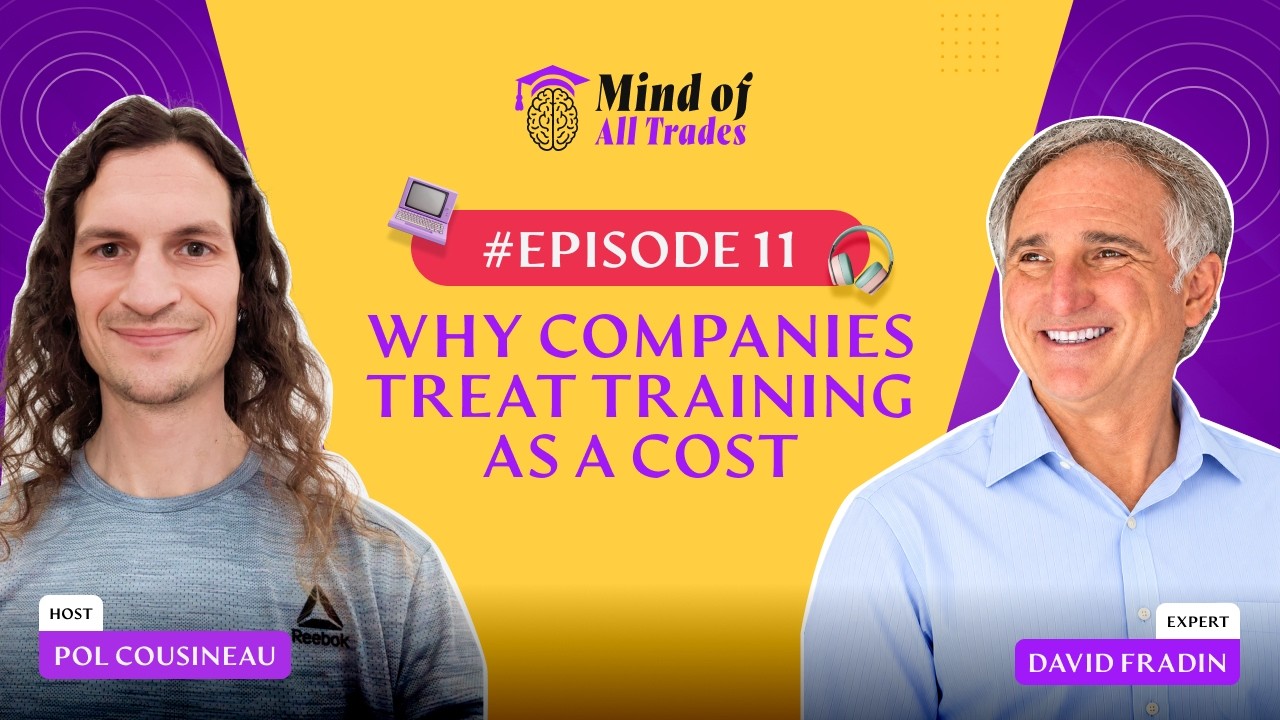
The Mindset That Scales Your Business
Description
“People are not liabilities, they’re assets, yet they show up in the P&L as a liability.” It’s the argument Dave Packard made in the early 1980s, and David Fradin says most companies still haven’t taken it on board.
In Part 2, David and Pol Cousineau get into how David trains other trainers to deliver his courses, and why so many companies now treat training as an expense to cut. Pol brings his accounting lens to the P&L problem, and David explains why the only time he gets called is when product failures start hitting the bottom line. They also cover why David uses historical examples instead of current ones, what partnership disputes taught him about keeping control of a company you start, and his one piece of advice for anyone teaching: make the class fun.
In this episode, you’ll hear:
- How David trains trainers: observe the course, teach it while he observes, then get signed off
- Why David sells to both the training department and the leader who owns the P&L
- Why companies treat training as an expense, and the Dave Packard argument against it
- Why urgency, usually from product failures, is what gets David hired
- Why he uses historical examples instead of current ones
- What partnership disputes taught him about keeping control of your company
- Shared values, decisions close to the customer, and understanding culture in global markets
Chapters:
00:00 – Coming Up and Recap
02:37 – Training the Trainers to Multiply Yourself
05:21 – Landing Corporate Training Clients
09:55 – Training on the P&L: Expense or Asset
14:26 – How Corporate Training Deals Work
18:38 – Retention Tricks and the Cisco Feedback Culture
21:46 – Use Examples From History, Not Hype
25:59 – Partnerships Gone Wrong: Never Lose Control
30:14 – Flat Fees and Shared Values Instead of Partners
35:44 – Running a Global Team Across Cultures
42:46 – Training Mandates and Closed Markets
About David Fradin
David Fradin is the founder and president of Spice Catalyst, a worldwide product management and product marketing training, consulting, and assessment organization. He spent more than 47 years across 75-plus products and services at 25 organizations and 11 startups, starting as a classically trained Hewlett-Packard product manager before Apple recruited him to bring the first hard disk drive to market on a personal computer. At Apple, he rose to Apple III group product manager and then independent business unit manager. Earlier, he pioneered environmental mediation, resolving a seven-year dispute over Lake Superior taconite tailings. He is the author of Building Insanely Great Products, Organizing and Managing Insanely Great Products, and the 796-page Successful Product Design and Management Toolkit with Wiley. He has trained product and marketing managers at Cisco, Capital One, Cognizant, Infosys, and Pitney Bowes, and sits on the board of Manipal Global Academy of IT in India.
Learn more about David’s training, courses, and books at Spice Catalyst: https://www.spicecatalyst.com
Missed part 1? Watch here: https://mindofalltrades.com/episodes/ep10-david-fradin-room-to-fail-part-1/
Connect with David:
- Website: http://www.spicecatalyst.com
- LinkedIn: https://www.linkedin.com/in/davidfradin/
Want to be a guest on Mind Of All Trades? Apply here: https://mindofalltrades.com/podcast-application
Follow Mind Of All Trades:
- YouTube: https://www.youtube.com/@MindofAllTrades
- Spotify: https://open.spotify.com/show/4MixC1mfhhUVIOFO1mywUc
- Apple Podcasts: https://podcasts.apple.com/us/podcast/mind-of-all-trades/id6807196830
- Instagram: https://www.instagram.com/mindofalltrades/
- Amazon Music: https://music.amazon.com/podcasts/32ce7fa4-4473-4c53-9256-7fca60e47331/mind-of-all-trades
- LinkedIn: https://www.linkedin.com/company/mind-of-all-trades/
Theme music by Breakmaster Cylinder.
Also Listen On


Transcript
Click to read the transcript
[00:00:00] Pol Cousineau: Now, after you had
[00:00:01] the trainers trained,
[00:00:02] weren’t you afraid
[00:00:02] that they would start
[00:00:03] competing against you
[00:00:04] and then just take
[00:00:05] the business
[00:00:06] and cut you out?
[00:00:07] David Fradin: Yeah, but that’s one
[00:00:09] of the risks
[00:00:09] you have to take.
[00:00:10] Pol Cousineau: And why do you think
[00:00:12] that perspective has changed?
[00:00:13] Because for me,
[00:00:14] it’s obvious
[00:00:14] that training is valuable.
[00:00:16] David Fradin: people are not liabilities,
[00:00:19] they’re assets,
[00:00:20] yet they show up
[00:00:21] in the P&L as a liability.
[00:00:23] Pol Cousineau: This looks pretty grim to me.
[00:00:25] Is there any ways
[00:00:26] to mitigate that.
[00:00:27] David Fradin: Maybe go to Mars.
[00:00:28] I don’t know.
[00:00:29] I’ve been trying
[00:00:30] to crack that.
[00:00:31]
[00:00:38] Pol Cousineau: Welcome to Mind of All Trades, the podcast where edupreneurs turn knowledge into impact. I’m your host, Pol Cousineau, and on this show, we look at the craft and commerce of educational businesses. So that means strategy, it means systems, it means the founder side of the business, and it also means the implementer side, where the ideas actually have to turn into something repeatable.
[00:01:02] Before we get into today’s episode, make sure you subscribe so you don’t miss future episodes. We’ll be sharing practical guides, conversations, and ideas for edupreneurs who are building courses, memberships, communities, and expert-led businesses. And if you want more support beyond the podcast, we created the Mind of All Trades membership.
[00:01:24] It’s a community and toolkit for founders, implementers, and solopreneurs who are building online educational businesses and want a more practical way to think through growth, systems, and execution. You can learn more at mindofalltrades.com/membership. Now, let’s get into today’s episode.
[00:01:44] In part one, David Fradin, founder of SPICE Catalyst, walked us through how his SPICE framework unlocked his 796-page product management textbook. We talked about why he says, “Just sit down and write,” how stories make concepts stick, and why students need room to fail.
[00:02:06] And we got into the economics of it. His Udemy income fell from about $500 a month to only $5, and the real money turned out to be in-person training. In this part, we start with how David trained other trainers so he could multiply himself. Then we get into why companies keep cutting training, how he works since COVID, and the hard lessons he learned from partnerships.
[00:02:35] Let’s pick up right where we left off.
[00:02:37] Now obviously you have unique approaches, right? Because you’ve studied as well the competitor methods. And the trainers, how familiar were they already with your own body of work? And I wanna frame this because in the educational world, training a trainer is often seen as a massive, almost insurmountable challenge.
[00:03:02] So that’s why I wanna go a bit more into that. Were they already very familiar with your unique perspectives?
[00:03:09] David Fradin: Yeah. They have either been through one of my classes or all of my classes, or I give them free access to the Udemy course, uh, and then I give them the, uh, source slides along with, uh, notes for each slide, which is essentially the voiceover for the training. So they’re able to go through all that. And then, uh, their first…
[00:03:33] I have them, let’s say I’m gonna teach, uh, Cisco online, so I would have them sign in and observe the course. Then, uh, the next time we offer it, I’d have them teach it, and I would observe them, uh, and give them some feedback, and then sign off on them being able to deliver it, uh, without me being present
[00:03:55] Pol Cousineau: Okay, that seems like a good process. And do you feel like that applies to most things that can be taught a similar approach?
[00:04:04] David Fradin: Don’t know. I haven’t bothered to think about other topics that could be taught and whether or not that technique would work.
[00:04:10] But certainly a, a, a business, a complex type of thing as product market, uh, product marketing, uh, uh, would, would fit that kind of a model
[00:04:23] Pol Cousineau: Now, after you had the trainers trained, weren’t you afraid that they would start competing against you and then just take the business and cut you out?
[00:04:31] David Fradin: Yeah, but that’s one of the risks you have to take
[00:04:35] Pol Cousineau: Hmm. And did that ever happen?
[00:04:37] David Fradin: No
[00:04:38] Pol Cousineau: No? Okay.
[00:04:41] David Fradin: I, I knew where each of them lived
[00:04:46] Pol Cousineau: I’m not sure how to take that one. I’m a very, I’m a very literal person, so I’ve been seeing how you’re peppering all these jokes here and there, and you got me before we even started the, uh, the recording there. Now, these opportunities that were coming… Oh, go
[00:05:03] David Fradin: that, in tho- in those cases, I have a very, very good friend by the name of Guido
[00:05:08] Pol Cousineau: Okay, now I’m not following.
[00:05:10] David Fradin: Uh, Guido is a very famous, uh, Italian assassin
[00:05:14] Pol Cousineau: Oh, okay. So that’s where the houses comes into play, your friend Guino.
[00:05:20] David Fradin: Yeah
[00:05:21] Pol Cousineau: Now, how did these opportunities come to you? What was the main driver of these?
[00:05:27] David Fradin: Um, trying to remember. I think in the case of Cisco, uh, back in the ’90s, I was hired, uh, by Cisco as a, uh, as a consultant to put together sales training for some of their new routers. And I also, uh, uh, uh, did the same thing for Unisys when they came out with their personal computer, the first personal computer that had a, uh, USB. And then, uh, Ross Dress for Less, which is a, a discount chain sto- uh, retail clothing store throughout, out the United States, wanted to train their, uh, cashiers and back office operators on a new, uh, uh, PC, uh, Unix server, uh, uh, cash register system. So in each of those cases, I put together a computer training, a computer-based training, or CBT it was called at the time, to teach others how to sell things a- and/or how to, uh, use other, uh, computer programs. And in the case of the latter, the case of Ross, uh, none of them had any experience, uh, the users, with computers before. They didn’t– wouldn’t even know how to turn a computer on. Uh, so I had to teach them all of those kinds of things on a computer. So that, that led to, uh, later, uh, courses like the Udemy courses
[00:07:02] Pol Cousineau: So this started with a consulting type gig, and then you identified a need for training?
[00:07:08] David Fradin: No, in those in those cases, they had the need for training and they came to me because, uh, there was a, uh, a group in Silicon Valley whose name escapes me right now, uh, which was– it’s, uh… And they’ve changed their name since then. It’s the Professional Training Organization of the United States. Uh, and it’s, uh, uh, has chapters and people responsible for training at companies, uh, go to those meetings. So they asked me to present on the subject of, uh, multimedia training and computer-based training, uh, at one of their, uh, monthly meetings back in the, uh, late 1990s. And it was from there that I got the, uh, the gigs at, uh, at Cisco, for example, and at, uh, Unisys
[00:07:57] Pol Cousineau: Hmm. And do you have any advice for people today that wanna break in and more particular it seems in the corporate training route ’cause that’s a lot of your specialty? What would you say to someone today about different approaches and tactics that they can use?
[00:08:13] David Fradin: Uh, focus on the, uh, two areas. One is the corporate training department, and second is the line organization, uh, that has P&L responsibility for the product or the service. So in my approach, I go after the VP or director of product management and also the head of, uh, uh, training. And if one or the other has interest, they always defer to the other to get consensus before we finally get the engagement. However, uh, since COVID, uh, and since the, uh, uh, Great Recession of 2008, uh, while the United States military, with the exception of our latest Iran war, when they went to, uh, invade Iraq and to chase them out of, uh, Kuwait, um, uh, Colin Powell took his troops to, uh, uh, Saudi Arabia and trained them for six months before he attacked, and then it was like a lightning attack. Um, and the US military, at least up until recently, emphasized training, uh, before, uh, being thrown into the, into the, the war. Uh, and, uh, at least American businesses, and I think to a greatest extent many businesses around the world, no longer place much value on training. And in fact, so many corporate training departments have been eliminated or cut way back because they view it as an expense rather than as an asset of having trained, uh, people
[00:09:55] Pol Cousineau: And why do you think that perspective has changed? Because for me, it’s obvious that training is valuable.
[00:10:03] David Fradin: It’s called the, uh, the, the pa- profit and loss statement. The, they look at that and they say, “Okay, my expenses are these trainers and the cost of the trainers and the time that it takes people away from doing their job.”
[00:10:19] Pol Cousineau: Now, I have an accounting background, so I– actually, that’s what I went to for university, and I have a CPA license in Canada. So I’m very familiar with the P&L, and I could easily see, hey, this is an expense line. I’m not seeing matching revenue. It’s, you know, eating into our margins. Let’s cut that. Yet on the other hand, it seems like this could be measured too in terms of either efficiency, quality, reducing errors, whatever would be the metrics tied to the training
[00:10:49] David Fradin: If they bother to look at those metrics. The problem is, is that Wall Street doesn’t care. Wall Street looks at th-the expense of training people, uh, in terms of not only the cost of doing it, but the cost of the people’s salaries while they’re away from their particular job as a cost. And Wall Street rewards companies based upon their profitability every three months. Uh, back in the early 1980s, uh, the guy I worked for, Dave Packard, of… one of the founders of, uh, Hewlett Packard, a former, uh, deputy defense secretary, uh, launched a campaign against those general accounting principles of the balance sheet and, and profit and loss, uh, and P&L statements to point out that people are not, um, liabilities, they’re assets, yet they show up in the P&L as a liability.
[00:11:48] Pol Cousineau: Mm-hmm.
[00:11:49] David Fradin: And, uh, going back to farming and the industrial age, they view, uh, uh, fixed things like, uh, uh, car inventory as an asset, not a liability. But when the Great Recession hit 20 years ago, you had, uh, Detroit, uh, automakers having millions of cars sitting on dealer showrooms, uh, and, uh, and park- uh, parking lots and in the factories, and nobody’s interested in buying a car. So this thing that shows up on the P&L as an, uh, asset turned out to be a huge liability, and that’s why, uh, the US government and Barack Obama had to bail out the Detroit automotive industry. Uh, and, um, and many dealers around the country went out of business. So it goes back to that, and, uh, Dave tried the best he could to change those general accounting principles and was not successful.
[00:12:48] So we continue to be, uh, short-term looking. Uh, um, senior management’s long-term planning is the next three months, and, uh, to the j- they don’t really care because in a few years they’ll be gone. They will have exercised all their stock options and, uh, they don’t care about what’s been left behind, uh, in general
[00:13:10] Pol Cousineau: This looks pretty grim to me. Is there any ways to mitigate that, mitigate that for the people that are wanting to provide that training, right? This is a big hurdle
[00:13:21] David Fradin: Uh, maybe go to Mars. I, I don’t know. I’ve been trying to crack that. See the– Yeah, yeah, one of the key things, uh, in a, uh, making a sale is that the buyer has to have a sense of urgency.
[00:13:37] And usually I get called, in fact, without exception, the only time I get called is if a company’s just had a whole bunch of product failures and it’s beginning to affect their bottom line, and they need to figure out how they could reverse that
[00:13:52] Pol Cousineau: Hmm. So that way it’s measurable on the P&L. There’s something happening short term, and if they don’t solve it, then they’re gonna be in trouble, so then they call David right at that, at that time. Uh, have you shifted the way your business works since COVID?
[00:14:09] David Fradin: Yeah, I do, uh, what little training I have left almost exclusively online. Uh, very few want to pay, uh, the cost of, uh, the trader coming out to their location and the cost of doing the location training
[00:14:26] Pol Cousineau: And what does that setup look like? Is it still like one group that hires you and then they get all the students in? Do you recruit the students yourself? Are you using Zoom? Can you just share a bit more about that experience?
[00:14:38] David Fradin: No, the, uh, the client pulls the students together, and then if we teach it, we u- when I was teaching it at Cisco, it was through their equivalent of Zoom called Webex. Uh, and, uh, so it’s either Webex or Zoom or, uh, uh, whatever. Microsoft Teams is another, uh, pretty good one. Uh, Google Meet is another, uh, good tool. Uh, and they pull, they identify the students. In some cases, like at Cisco, they give each, um, uh, employee a certain amount of dollars they can use per year, uh, to buy training from their corporate training department. And so, uh, that’s how they, they run it there.
[00:15:22] Pol Cousineau: And then you have to get approved as a vendor of record to be… Yeah, right, so that they can use their budget towards you. Now, in this example, they would likely be all employees of Cisco. But was there other people that hire you to lead a training and then they’re gathering students that are not necessarily their employees and they’re reselling that?
[00:15:43] David Fradin: No
[00:15:44] Pol Cousineau: Okay. So it’s all a cohort basically within the organization. And then are those kinda like one-off, like a few hour sessions, or these tend to be longer over weeks, months? How does that look like?
[00:15:55] David Fradin: Uh, my classes at, uh, Cisco range from one full day to two full days, and then they’ll repeat it like every, uh, f- uh, three months
[00:16:06] Pol Cousineau: Hmm. And then d- are they allowed to get the recordings and redistribute it or not necessarily? Okay. S- and that’s part of your terms when you get the contract in place
[00:16:17] David Fradin: Right
[00:16:19] Pol Cousineau: Yeah. Is there other types of terms in there in how you configure the deal that might be of interest to our listeners?
[00:16:25] David Fradin: Well, it’s not part of the terms, but I tell the students if they want a copy of the slides, since I move along pretty quickly, uh, in the class, uh, just send me an email and I’ll send them a copy of the slides along with the notes. Uh, the reason being that is, um, uh, when the former general of the Confederate Army, Robert E.
[00:16:48] Lee, uh, became the, uh, uh… After the war, I think he was the commandant of the Virginia Military Academy or something like that, and he would use fairly large words in his lectures. And the, uh, the students would come to him and say, “Could you use, uh, smaller words because we don’t understand what you’re talking about?” And Lee says, uh, “Sir, uh, I will not come down to your level. You will come up to mine.” Uh, so I have a lot of material to convey, and I’m not gonna slow down for the slowest person in the class, nor will I start the class late waiting for the, uh, deadbeat to finally show up. Um, it’s that, that slow learners or, uh, person unable to get there on time, it’s on them to catch up rather than for us to hold back the entire class, uh, for them
[00:17:43] Pol Cousineau: Now this is not being recorded, right? It’s all live
[00:17:47] David Fradin: Yeah, it’s all live.
[00:17:48] I don’t record
[00:17:49] Pol Cousineau: So then the people that have more challenges, I presume they would ask for the slide so that they can review that. And do you feel that’s sufficient to allow a person that has the determination to catch up? Or do they follow up with questions? Do you provide, like, additional one-on-one support if they want outside of the email?
[00:18:07] Or
[00:18:07] David Fradin: I, I offer it. Nobody’s taken me up on it, but having the slides along with the, uh, lecture notes has always been sufficient to, uh, uh, satisfy them
[00:18:18] Pol Cousineau: And they’re taking you up on that one though. There are students that request these. Okay, yeah,
[00:18:23] David Fradin: I’d say maybe a third to two-thirds of every class asks for it
[00:18:28] Pol Cousineau: Okay. Yeah, yeah. Yeah, that, that makes sense to me because again, right, it goes to principle. You have to take additional steps, additional actions, right? To
[00:18:37] David Fradin: To learn. Yep
[00:18:38] Pol Cousineau: Yeah, exactly. And then, uh, now we’re back into learning. Is there other techniques that you found that can help people retain? We talked about quizzes, we talked about exercises.
[00:18:50] Now we’re at least giving them the ability to ask for, you know, slides, catch up, notes, different things. Is there any other tools that you’re utilizing?
[00:19:00] David Fradin: Uh, cattle prods, but they don’t– they’re not very effective online
[00:19:04] Pol Cousineau: No, exactly, right? ‘Cause how do you trigger it remotely a- and how does that work, right? You’re like, “Okay, everyone hook that in.”
[00:19:11] David Fradin: Two, 220 volts through the, uh, keyboard
[00:19:14] Pol Cousineau: Yeah.
[00:19:15] David Fradin: No, that’s about it.
[00:19:16] That’s, uh, all the tricks I’ve been able to come up with. And the, the, the lack of that kind of stuff was the major, uh, uh, complaint or criticism of computer-based and online training for many, many years. But I think that’s been, uh, in, in time overwhelmed because of the substantially reduced cost, not only in terms of cost, but also in terms of time, uh, that it takes. Uh, like in the Udemy training, if you don’t catch it the first time, you can always watch it a second, third, fourth, fifth time. Or, um, if you don’t need that information, let’s say you don’t need to know how to do, uh, market research and conduct surveys intimately or focus groups intimately, uh, you can, uh, uh, go through that, know that it’s there, and then use it as a reference when you get to that point in your job that you actually have to do that kind of thing
[00:20:13] Pol Cousineau: Exactly. That makes a lot of sense. While a live class is going to be hard unless someone’s actually recording, right, that live class and transmitting it. Now, do you do an assessment with your students so they can tell you feedback about the course?
[00:20:27] David Fradin: I do, and, uh, I… One of my criticisms at Cisco is they always had a, uh, a review of the course and the instructor that they asked all the students to take, but they never allowed the instructor to review the students. And, uh, almost without exception, you’ll get one or two people every now and then that are highly critical of the instructor and/or the course.
[00:20:53] Like, too many slides, going too fast, um, uh, too technical, not enough examples. And it turns out that the people that were bitching about that most often were one of the, some of the worst students. Uh, I would have, uh, some people that did not even attend the class write up, uh, uh, their responses criticizing the class. And it turned out, uh, at that time that, uh, under the previous president at, at Cisco, uh, there was a culture that had developed there to blame somebody else in order to cover up for yourself, and that’s exactly what they were doing. They were following that culture. Then when they, uh, the president changed, that, that evaporated and became much more of a friendly, uh, teamwork-oriented place
[00:21:46] Pol Cousineau: Mm-hmm. Now that feedback, let’s exclude the deadbeats in there. W- how do you incorporate that feedback or you don’t maybe?
[00:21:56] David Fradin: It depends upon what it is. Like, uh, we talked about using examples or using s- uh, telling stories. I got a lot of feedback asking for more stories. Uh, or, uh, lately it’s a, “Can’t you use current examples?” And I said, uh, “Twofold. One is I don’t have any. Uh, and two, the problem with current examples is they, uh, are not time-tested.” For example, let’s look at all the hype around, uh, Elon Musk and, um, uh, uh, SpaceX and Tesla. Um, you can see all the handwriting on the wall that, uh, that whole thing is just gonna fall apart at some point in time, and a lot of people are gonna get burned. If you don’t believe me, let’s go buy stock in, uh, uh, pets.com, for example, which is gonna be one of the biggest, uh, s- uh, internet successes, and all the other companies that, uh, went through the, the, uh, uh, 2K boom, uh, the dot-com boom that are no longer around.
[00:23:01] Uh, Yahoo! Um, uh, I forget the name of the program that preceded, uh, Facebook. Uh, so if we use those examples, I- I’ll give you a, a classic of this is since, uh, uh, I managed the Apple III product line in the last year of its life, I knew a lot about what was going on at Apple at that time. This is, uh, 1983, 1984. And when John Sculley, um, uh, was leaving Apple, he hired a ghostwriter to go with him to all of his meetings, uh, to write his, uh, biography of his experiences at Apple, and the book came out in ’85. Now, this last thing I just said that he had his ghostwriter attend different meetings with him, I didn’t know that he had a ghostwriter. But I was wandering through an airport when I was traveling someplace in, uh, ’85, and his book was on the, uh, uh, on the shelf there, on the display. And of course, I had, uh, people outside of Apple telling me, “When I grow up, I wanna, I wanna be just like John Sculley.” And, uh, I said, “Well, you got Be careful. So I flipped to the section, all the references to the Apple III, and they were all wrong. Uh, it was not what had happened. I said, “I, I don’t know if, uh, Sculley’s making this shit up or someone else wrote the book.” Well, it turned out, I just found out, uh, a few weeks ago that he hadn’t, uh, it was written by somebody else. So if you use present-day examples like Sculley back in ’85, and, uh, I left Apple, uh, in ’85 because I didn’t think the company was gonna survive, and a lot of people didn’t either.
[00:24:49] Now, it took about 10 years more until, uh, Gil Amelio there almost, uh, put the company into the, uh, cemetery, uh, and was smart enough with the board to bring Steve back, but it was more importantly to bring the operating system that he had developed at NeXT, uh, to the company, which became the operating system for the Macintosh, and then it became a useful computer. Uh, so again, if you use current examples, chances are they’re based on hype and they’re not gonna be successful
[00:25:23] Pol Cousineau: So you’re recommending pulling examples that have aged a little bit more
[00:25:28] David Fradin: Yeah. Some- something from history
[00:25:30] Pol Cousineau: Mm-hmm. It can also help not look a fool a few years down the road as well, right? If you didn’t get it right, and now you’ve got that example. And in the digital age, now it’s permanently recorded. Everyone can go back to it and can become a viral meme of some sort.
[00:25:46] David Fradin: Exactly
[00:25:47] Pol Cousineau: I could definitely see that happening as well. So, uh, we’ve been talking a lot about the teaching, the training, how you come up with these ideas and the curriculum and help people retain things. Uh, we haven’t talked too much about your team at Spice Catalyst. Could you share a little bit how that’s structured and, and who’s working with you there?
[00:26:08] David Fradin: Well, I had a, uh, partner for the first few years, and he decided to go off and do something in, uh, uh, uh, tech and insurance, uh, and in fintech, and, uh, he never came back. Uh, um, the other people that I have are these independent trainers. And, uh, over the years, um, I’ve not been very successful with partners. Uh, I had, um, uh, I started a company back in the, uh, 2000– early 2000s called Maui Games because I wanted to live and work in Maui, and, um, we were gonna develop, uh, cell phone games. And, uh, I raised some angel money, and this guy immediately took 25,000 of it to pay for his health insurance and didn’t tell me about it. And this is after I’d raised $125,000. And he claimed that he had connections with, uh, venture capitalists, never produced a meeting, uh, or a dollar, uh, investment. Prior to that, in the ‘ 90s, um, a friend of mine, um, and I started a company called Desktop Video Products, and we didn’t have any money because I had just gotten divorced and, uh, he didn’t have any money.
[00:27:28] So, uh, we found a business broker who, um, was able to bring wealthy people in, uh, that would help fund the company in addition to taking a, uh, line position, uh, uh, uh, in the company So we brought the in and, uh, it turned, uh, I forget how much he invested, like, um, uh, $5,000 or $6,000 into $200,000 in a little over a year. Uh, enough so that, uh, the, uh, local, uh, San Jose Business Journal said Desktop Video Products was the fastest growing company in Silicon Valley at the time, like over 1,200% over the previous year. He suggested we merge with a desktop publishing company, uh, which we did, and, uh, formed instead of DVP Technologies, it became DVP Tech Doc. And I made the mistake of giving up, uh, controlling interest. In the United States under U- uh, US law, uh, if you have 51% of the company, you can make all the decisions. Well, the two of them had, uh, 60-some percent. I had 30-some percent, and they decided that since the company was so profitable, that if they could get rid of me, uh, they could split up my earnings, uh, between the two of them. So they forced me out of the company, and then I ensued in, uh, I think it was about 10 years of litigation. The buy-sell agreement, if one of the partners is forced out, uh, was, uh, rock solid. Uh, all the, uh, merging documents were about two feet tall if you printed them off and piled them up. But it doesn’t mean anything if, uh, the the partners decide to ignore the written agreement and their signature. So they decided to do that based upon the formula of the buy-sell agreement. Uh, they would’ve paid me $200,000 to leave the company. After 10 years of litigation, uh, it ended up costing each of them $1.1 million, and I got a little over $200,000. But we had to go through this, this hell of litigation
[00:29:43] all the way-
[00:29:44] Pol Cousineau: did it cost you a million as well?
[00:29:46] David Fradin: Um, I don’t remember, but they had to pay my legal fees
[00:29:50] Pol Cousineau: Oh, okay, good. Yeah, yeah. ‘Cause I would say if you get hurt that bad too, that doesn’t sound great to me.
[00:29:57] David Fradin: Well, there’s a couple lessons in that. One is never lose control if, of your company if you start it. Uh, and second, um, if the amount of money at stake is probably a million or less, just walk away. It’s not worth litigating it
[00:30:14] Pol Cousineau: Yeah, ’cause that’s 10 years of pain as well, right? It’s not just about the money. But if people want to do these projects, ’cause there are opportunities that might come up, and let’s say they don’t wanna lose controlling interest after listening to this, do you have any ideas on how you would structure a deal?
[00:30:32] Would you just make like another company and it’s a joint project? Or you would just not entertain those if there’s like
[00:30:41] David Fradin: Yeah, you could,
[00:30:42] Pol Cousineau: pr- yeah
[00:30:43] David Fradin: you could form a different organization. You could, uh, form a subsidiary, uh, and that types of things. But, uh, I never got into a situation that far along in the deal-making where that’s ever become important. I just decided, like with my, uh, other trainers, I wasn’t gonna make them partners in the company, so they could come and go as they please, and I could fire them as I, as I please, and there’s no consequences to that
[00:31:11] Pol Cousineau: And did you give them either equity, bonuses, higher compensation? No?
[00:31:17] David Fradin: So we worked on a flat fee, $1,000 a, uh, uh, a day, which they
[00:31:22] were happy at. And, uh, some cases I would issue bonuses, uh, because the company that I left before Spice Catalyst, which was also in the product management training, uh, they asked me to take over the, uh, the business of sales, and I closed about $900,000 worth of sales in, uh, 11 months under the promise that there would be profit sharing. And then the founder says, “I’m sorry, um, I decided not to do any profit sharing.” So, uh, when, for example, I got $36,000 from Capital One Bank to go to Virginia, they paid me $3,000.
[00:32:04] And, uh, I was expecting to get a portion of the profits on that because that’s what he had promised, and then he j- he changed his mind. So I said, “See ya, I’ll go do my own thing.”
[00:32:16] Pol Cousineau: So do you recommend more of these flat fee type structure as well? ‘Cause that profit sharing clearly didn’t pan out, right? So it seems like that’s something else to be cautious about. And I hear a lot of people do those types of deals or discussions. “Okay, we’re gonna be half and half,” or, “Hey, let’s bring in these two more partners and let’s kinda all merge together.”
[00:32:37] Uh, uh, constantly, every year I hear people talking about those, uh, those opportunities.
[00:32:43] David Fradin: uh, I’ve not been successful in any of those. Uh, it, it’s usually ended up, uh, with greed. Uh, they say, “Well, we’re gonna do the right thing.” Well, to them, the right thing is to steal you blind, uh, and keep all the money. Um, and like I said, two feets, uh, two feet of, uh, written agreements, uh, doesn’t mean a thing if the people involved are not going to, uh, adhere to the agreement. Uh, the other thing I think is very important is when you start an organization, and I, I, I teach this in, in the book and in the courses, is come up with a set of values, uh, and have everybody agree to those values, that they’ll stick to those values. Uh, and one of those values is not, “I shall screw the other guy.” Uh, one of the values is teamwork, uh, innovation, aggressiveness, and those are all parts of the Apple values and the HP Way values that I was trained on. Uh, and talk about each of those values, uh, to make sure everyone in the organization internalizes those values. And that’s one of the keys to overall business success, is that you’re all operating from the same basis, the same set of values
[00:34:00] Pol Cousineau: And then with your trainers, you discuss those values with them?
[00:34:04] David Fradin: Yes
[00:34:05] Pol Cousineau: you reinforce that regularly as things advance? ‘Cause obviously there’s the onboarding, but then two years down the road, “What were those again?”
[00:34:15] David Fradin: Well, at Apple’s case, I don’t know if you can see this, they gave everybody the Apple values on a little, uh, plaque
[00:34:25] Pol Cousineau: Okay. Yeah, yeah, I can see that
[00:34:28] David Fradin: So everybody had this on their desk. So they’re gonna follow it whether they like it or not
[00:34:34] Pol Cousineau: Right. So there’s a constant reminder there. But with your trainers, right, ’cause unless you shipped them a plaque or you had that over there, would you just bring those up in ongoing discussions? Or no, you didn’t have to remind them of the, the
[00:34:48] David Fradin: Didn’t have to remind them. Uh,
[00:34:50] the, the onboarding I had at Hewlett-Packard was a day, and we spent a couple hours discussing values. The same kind of thing happened at Apple. Uh, so no, you’ve, you’ve discussed it, you’ve internalized it. You know that, for example, when you go into a meeting to make a product decision, that everybody’s coming from the same values. Uh, and if it’s, uh, quality, for example, which is one of Apple’s values, and somebody comes in and says, “Nah, let’s just ship bricks in order to make our, uh, our quota,” you say, “Wait a minute, that’s not part of our values. That’s contrary to our values, so we’re not gonna do that.”
[00:35:28] Pol Cousineau: Hmm. Yeah, so you can use it in the decision-making process because other people are aware of the values, then that is respected as a valid perspective to basically shoot down the brick in this example there.
[00:35:41] David Fradin: or to make decisions for product success
[00:35:44] Pol Cousineau: Yeah. And now going back to how your business is organized, do you have an assistant or someone that helps with some of the coordination, or do you do that all yourself?
[00:35:54] Or did you-
[00:35:55] David Fradin: Uh, when I was really busy, I had a, uh, a person in, uh, India that was a virtual assistant. And then, um, I forget the name of it, but there’s an internship program. So I had, uh, three or four interns, uh, around the world, uh, that would help out on different things. Um, and one of the ladies, uh, went on to be a, uh, product manager, and she’s been very successful because of all the things she learned as being an, an intern to me
[00:36:27] Pol Cousineau: And how did you find a way to get these people trained so that… Like, I’m thinking the person in India particularly, but everyone else were also around the world, right? The interns?
[00:36:38] David Fradin: Well, I had them go through my courses on Udemy,
[00:36:41] uh, and then we would have discussions, uh, and we would do Zoom calls, uh, uh, periodically, uh, and, uh, that kind of thing
[00:36:52] Pol Cousineau: Yeah. And did you use any type of project management software or no, you just gave them out their assignments and they were responsible for that?
[00:36:59] David Fradin: Um, I tried to use a bunch of different task managers, uh, but I finally just, uh, broke down and we would use, uh, Google Docs to list out the tasks that we’re working on in a spreadsheet, uh, what their priority was, and they would report back by, um, filling out a, a, a cell that says the status of that particular task as we moved along. So none of this, uh, writing a, uh, what I did last week kind of thing. It’s all in the spreadsheet.
[00:37:32] Pol Cousineau: Mm-hmm. And did you give them any authority for decision-making?
[00:37:36] David Fradin: Oh yeah, uh, very much so. Uh, one of the keys to Hewlett-Packard’s success for 50 years was in addition to their values, they also tried to push decision-making as far down in the organization as possible and as close to the customer as possible. So I, I try to do the same thing with my people
[00:37:59] Pol Cousineau: And how would you reinforce that? Because my experience with working with people in various countries, so I work with, uh, India, Pakistan, Nigeria, Bangladesh, Philippines, the list goes on. It is so many countries that I, I’ve worked with people in those countries. The culture can be difficult, uh, I find, and, and to promote initiative, it’s almost like, okay, wait, I don’t want to overstep, or there’s a lot of challenges I found in that culture, and I’ve had approaches of my own, but I’m curious about how, if you encountered any of that
[00:38:36] David Fradin: Uh, not really because, um, one of the c-core, uh, course components that I teach is understanding the culture in each of the countries that you’re trying to do business in and, um, understanding the differences in the cultures. Uh, in fact, um, uh, I’ll never forget, I was in Shanghai, uh, China, uh, teaching, uh, Cisco’s product managers there. Uh, many of them were, uh, Webex, uh, product managers that came in from Suzhou, China. And, um, someone– I, I was talking about the, understanding the, uh, the differences between each of the different areas of the world and how you do business there. For example, as a result of the list of Jews kept for extermination in Germany, in Germany, you’re not allowed to keep a list, so there’s no email lists in, uh, Germany. Um, and, uh, I was consulting with a company that made, uh, SIMS, uh, Lexar Media, and, uh, the president went there and started talking about the list that he had put together. And I told him to shut up or is he gonna get arrested in Germany, and he wouldn’t. Uh, so they fired me, and I don’t know if he ever got arrested or not.
[00:39:55] Pol Cousineau: That’s what I was gonna say, right? You got fired, but he was in
[00:39:59] David Fradin: Pretty close to
[00:40:00] it. But he lost his job, like, within six months. The board wouldn’t put up
[00:40:04] with him anymore. Um, so I, I said it, it– I was in China, I said, “Well, if you go to the cia.gov or centralintelligenceagency.gov, they have a fact book on every country in the world, and you can learn about the cultures of other countries just by reading the cia.gov fact book, uh, fact, fact book.”
[00:40:28] And I said, “Uh-oh, I guess if the Chinese government are listening in here, they’re probably gonna arrest me, uh, for telling you to go to the CIA for information on marketing.”
[00:40:37] Pol Cousineau: Mm-hmm. Yeah. Yeah. So what I found is, uh, communicating the values and the behavior clearly. So again, in some of the countries that I shared, I found that saying no is not highly recommended. So even if they don’t know how to do something, they might say, “Okay, yes, I get it,” et cetera. So I make it very clear and say, “If you don’t know, I want you to tell me, and then we’ll figure out a way so that we can teach you or find someone in the team or something like this.”
[00:41:06] But this is much more desirable than you saying yes, and then you really don’t know. You’re spinning your wheels. And then what I found is later on, when those behaviors show up, then I reinforce it. So I’m like, “Oh, great, you just told me you didn’t know or you didn’t understand what I just explained. This is awesome, and here’s why.”
[00:41:25] So I can reinforce that, and then they can start understanding, ” Ah, okay, when I’m working in, with this company, this is different than what I’m used to maybe in the local culture that they have.” And I’ve been finding that quite good for getting people to understand and adapt the behaviors that I want them to have in the organization.
[00:41:46] David Fradin: Well, I’ll give you an example of that. Um, I was retained by a, uh, company in India that had a, uh, software product that was based on text messaging. This would be around 2007, 2008. Uh, and they wanted me to bring this product to market for them as the general manager of US. And I said, “Well, wait a minute.”
[00:42:10] Uh, if you send a text in the United States at that time, it cost you 50 cents per text, or you were limited to, like, 20 texts, uh, a day or a month, I forget what that was. Um, but in India at the time, they didn’t use email much. It was all texting, and texting was free through the, uh, cellphone carriers. So because of that, uh, somewhat of a cultural difference between the two countries, their product in the United States would never be successful. And I t- I, I politely declined that opportunity for that reason, and they couldn’t understand that
[00:42:46] Pol Cousineau: Hmm. Yeah, that it is important to understand the markets in other regions. This made me think a bit about what’s going on with training. Now, I’m not sure if this law is still there in Canada. I believe it is, where a company of a certain size has to invest 1% of their payroll in training.
[00:43:04] David Fradin: Oh, really?
[00:43:05] Pol Cousineau: you don’t, then there’s like a payout you have to do, so in the end you end up losing that money.
[00:43:10] And when I was working as an accountant, then when that was a thing in the private sector, I had to make sure we spent all the training money, or while I was doing audits, sometimes that would come up. And I’m suspecting now, this is just a hypothesis, of why, uh, when I was working in Canada, training continued to be very strong.
[00:43:30] Now, I would have to see what’s happened since COVID, but with these incentives, then that might make a easier market, right? For someone wanting to break into corporate training, because now there’s a mandatory spend. You can’t just cut it off, and having a fine or a penalty on the P&L looks worse than a training line item.
[00:43:53] David Fradin: Now there was a, a, a period of time when we were in the process of publishing the Wiley book that the government of China was looking at that book to make it mandatory in all of their universities throughout China, which would’ve been fantastic. Uh, but then they decided that they didn’t want any outside influence, so, uh, uh, they wouldn’t want a book there from the United States. And they, uh, also, uh, stopped all trainers from the United States coming to China to teach companies there. Uh, so that’s a cultural difference, and that immediately blocks what, about a third of the world’s market, uh, uh, as far as training is concerned
[00:44:37] Pol Cousineau: Mm-hmm. So it can definitely open up or close opportunities, and now that everything is global with technology, this could be a good way to look at market opportunities for people listening and then saying, “Hey, is there a country, a program, something that I could target where the environment is much more favorable?”
[00:44:55] David Fradin: Yep. And I don’t know, but I suspect if I was in China, I could not access, uh, Udemy’s training. I know I couldn’t access, um, uh, Facebook when I was there
[00:45:08] Pol Cousineau: Mm-hmm. Yeah. I know there’s a lot of restrictions in what you can and, you know, cannot access, uh, 100%. So we’ve been exchanging for quite a while, and we went in different areas. Is there something, David, that you feel is important for our audience that is working in this educational training space that you wanna make sure to impart to them?
[00:45:30] David Fradin: Uh, not much that I could, uh, add other than, uh, make the class fun, uh, have a few laughs
[00:45:39] Pol Cousineau: Mm-hmm. So I’m thinking about the method that you described earlier with the script and then the sort of PowerPoint slides. Somehow I can’t imagine that being funny and laughing. Did you incorporate jokes in your scripts or
[00:45:56] David Fradin: No. No, you, you
[00:45:58] pretty much can’t do that
[00:46:00] Pol Cousineau: Okay. S- so on the Udemy side, that one is a little bit more dry, and then they have to get the live experience.
[00:46:07] Is that how it works?
[00:46:08] David Fradin: Yeah
[00:46:09] Pol Cousineau: Yeah. Yeah, so that’s the value added, uh, there. I do agree, though, with making it fun and entertaining so that it doesn’t become a, a drag, right, to get into the training. If you’re doing it live, maybe you have a captive audience, but otherwise, it’s very easy for people to click stop, you know, not continue with your program.
[00:46:31] And most online trainings go unfinished, and a lot of them are very dry
[00:46:37] as well. So I’m sure that there’s that correlation there as well. Well, thank you so much, David. It was really awesome having you on Mind of All Trades. I wanna remind everyone that they can go to your site, spicecatalyst.com. I will be adding that to the show notes, links to the books and other materials and what we’ve been discussing during the episode.
[00:47:01] I really appreciate you coming here to share with everyone.
[00:47:05] David Fradin: Well, uh, again, thanks for putting up with me.
[00:47:09] Pol Cousineau: Thanks for listening to Mind of All Trades. Don’t forget to subscribe, review, and share. Join our community at mindofalltrades.com to grow your learning business with the people who get it. Our music is by the mysterious Breakmaster Cylinder.
[00:47:26]
Highlights & Timestamps
00:00 – Coming Up and Recap
02:37 – Training the Trainers to Multiply Yourself
05:21 – Landing Corporate Training Clients
09:55 – Training on the P&L: Expense or Asset
14:26 – How Corporate Training Deals Work
18:38 – Retention Tricks and the Cisco Feedback Culture
21:46 – Use Examples From History, Not Hype
25:59 – Partnerships Gone Wrong: Never Lose Control
30:14 – Flat Fees and Shared Values Instead of Partners
35:44 – Running a Global Team Across Cultures
42:46 – Training Mandates and Closed Markets

About Host
Pol is a strategist and mentor who’s helped countless educators and entrepreneurs scale their businesses with clarity and ease.
From running a data-driven digital agency to co-founding an eLearning platform, he brings both technical expertise and heart-centered leadership.
With Mind of All Trades, Pol brings those lessons to the mic… helping you learn what it really takes to succeed online.
Recent Episodes
Fear Is the Poison of Any Workplace - Bruno Cignacco - Part 2 - EP 13 –
S1 Ep13

Pol Cousineau
October 29, 2026
“Fear is the venom, the poison of any work environment.” Bruno Cignacco says it is the first thing a leader should look for.
In Part 2, Bruno and Pol Cousineau get practical about what a compassionate business looks like day to day. Bruno explains why qualitative factors like kindness and cooperation should come before the numbers, how an anonymous survey can show whether your team is working in fear, and why serving customers is different from selling to them. They also cover why high tech needs high touch, what Trader Joe’s kept when others automated, how fully online teams can build trust, and the one question Bruno asks himself every morning.
In this episode, you’ll hear:
- Why qualitative factors like kindness and cooperation should come before the numbers
- How to find out if your team is working in fear, using anonymous surveys and suggestion boxes
- Why fear makes people defensive, less creative, and worse at serving customers
- Serving versus selling: finding out what customers need and giving more than they expect
- High tech and high touch: why customers still need to reach a real person after they buy
- What Trader Joe’s kept when other grocers moved to self-checkout
- A weekly social hour for online teams, and why knowing the person matters more than the role
- The second edition of The Art of Compassionate Business, and the question Bruno asks every morning
Chapters:
00:00 – Coming Up and Intro
02:40 – Measuring Compassion: Qualitative vs. Quantitative
11:28 – Fear in the Workplace, Groupthink and Serving vs. Selling
24:16 – Experience Engineering: High Tech Needs High Touch
30:38 – Test Your Own Customer Experience
33:11 – Trader Joe’s: Why Real People Beat Self-Checkout
38:46 – Keeping Remote Teams Connected
44:30 – Why Social Time Boosts Productivity
48:28 – The Second Edition and What COVID Changed
55:17 – Closing Advice: Add Value to Every Stakeholder
About Bruno Cignacco
Bruno Cignacco has run his international consultancy since 1993. He is an international business consultant, TEDx speaker, university lecturer, and bestselling author with more than 30 years of experience advising and training hundreds of companies worldwide on international trade, marketing, negotiation, and compassionate business. He is a Senior Fellow of the Higher Education Academy in the UK, and in 2024 he was named by World’s Leaders Magazine as one of the world’s most transformational leaders changing the face of business. Bruno teaches that companies can be profitable and compassionate at the same time, and he is based in London.
Bruno’s book, The Art of Compassionate Business: Main Principles for the Human-Oriented Enterprise, is published by Routledge.
Check out The Art of Compassionate Business, written by Bruno Cignacco: https://www.routledge.com/The-Art-of-Compassionate-Business-Main-Principles-for-the-Human-Oriented-Enterprise/Cignacco/p/book/9781032445427
Connect with Bruno:
- Website: https://brunocignacco.com/
- LinkedIn: https://www.linkedin.com/in/dr-bruno-roque-cignacco-sfhea-0609317/
Want to be a guest on Mind Of All Trades? Apply here: https://mindofalltrades.com/podcast-application
Visit The Digital Navigator: https://thedigitalnavigator.com/
Follow Mind Of All Trades:
- YouTube: https://www.youtube.com/@MindofAllTrades
- Spotify: https://open.spotify.com/show/4MixC1mfhhUVIOFO1mywUc
- Apple Podcasts: https://podcasts.apple.com/us/podcast/mind-of-all-trades/id6807196830
- Instagram: https://www.instagram.com/mindofalltrades/
- Amazon Music: https://music.amazon.com/podcasts/32ce7fa4-4473-4c53-9256-7fca60e47331/mind-of-all-trades
- LinkedIn: https://www.linkedin.com/company/mind-of-all-trades/
Theme music by Breakmaster Cylinder.
Listen Now
Profit and Compassion Aren't Opposites - Bruno Cignacco - Part 1 - EP 12 –
S1 Ep12
Pol Cousineau
October 26, 2026
“By caring for them, you’re caring for your business.” Bruno Cignacco has spent years researching companies that are both compassionate and highly profitable.
In Part 1, Bruno and Pol Cousineau put a big question to the test: can a company be compassionate and profitable at the same time? Bruno explains the principles behind it, from social reciprocity and respecting people’s autonomy to treating the human being as the most important resource in any business, and why Patagonia ran an ad telling customers not to buy its jacket. They close on a free, actionable tip any business can use: read your reviews, look for the patterns, and learn from the companies in your space with the best ones.
In this episode, you’ll hear:
- Why profit and compassion aren’t incompatible, and what Bruno’s research found
- Social reciprocity: why people who are cared for give their best in return
- Respecting autonomy instead of micromanaging employees or hard-selling customers
- Why the human being is the most important resource in any business
- What Patagonia’s “do not buy this jacket” ad says about long-term thinking
- Under promise, over deliver, and why one weak department can undo the rest
- A free research tip: read your reviews, find the patterns, and study the companies with the best ones
Chapters:
00:00 – Coming Up and Intro
02:30 – How Profit and Compassion Intersect
10:42 – Patagonia and the “Do Not Buy This Jacket” Ad
19:40 – When Bad Practices Catch Up With You
27:09 – When One Department Ruins the Customer Experience
34:19 – The Zero-Cost Tip: Read Your Reviews
42:22 – No Feedback Means Flying Blind
About Bruno Cignacco
Bruno Cignacco has run his international consultancy since 1993. He is an international business consultant, TEDx speaker, university lecturer, and bestselling author with more than 30 years of experience advising and training hundreds of companies worldwide on international trade, marketing, negotiation, and compassionate business. He is a Senior Fellow of the Higher Education Academy in the UK, and in 2024 he was named by World’s Leaders Magazine as one of the world’s most transformational leaders changing the face of business. Bruno teaches that companies can be profitable and compassionate at the same time, and he is based in London.
Bruno’s book, The Art of Compassionate Business: Main Principles for the Human-Oriented Enterprise, is published by Routledge.
Check out The Art of Compassionate Business, written by Bruno Cignacco: https://www.routledge.com/The-Art-of-Compassionate-Business-Main-Principles-for-the-Human-Oriented-Enterprise/Cignacco/p/book/9781032445427
Connect with Bruno:
- Website: https://brunocignacco.com/
- LinkedIn: https://www.linkedin.com/in/dr-bruno-roque-cignacco-sfhea-0609317/
Want to be a guest on Mind Of All Trades? Apply here: https://mindofalltrades.com/podcast-application
Follow Mind Of All Trades:
- YouTube: https://www.youtube.com/@MindofAllTrades
- Spotify: https://open.spotify.com/show/4MixC1mfhhUVIOFO1mywUc
- Apple Podcasts: https://podcasts.apple.com/us/podcast/mind-of-all-trades/id6807196830
- Instagram: https://www.instagram.com/mindofalltrades/
- Amazon Music: https://music.amazon.com/podcasts/32ce7fa4-4473-4c53-9256-7fca60e47331/mind-of-all-trades
- LinkedIn: https://www.linkedin.com/company/mind-of-all-trades/
Theme music by Breakmaster Cylinder.
Listen Now
Give Your Students Room to Fail - David Fradin - Part 1 - EP 10 –
S1 Ep10
Pol Cousineau
October 19, 2026
“You have to give your student enough room to fail because people tend to learn more from their failures than from their successes.” David Fradin learned that as a flight instructor, and it shapes how he designs every course he teaches.
In Part 1, David and Pol Cousineau dig into how David turned his product management training into a 796-page university-level book, and why it only came together once he found the right framework. David explains the five keys to product success behind SPICE, why he quizzes students every five to 10 minutes, and how a course workbook can become a portfolio that helps students get hired. They close on why the real money in his business is in in-person corporate training, and how he scaled it by training other trainers.
In this episode, you’ll hear:
- How a training trip to Singapore led to a 796-page book with Wiley
- The five keys to product success behind David’s SPICE framework
- Why a book stalls without a structure, and how David used his courses as the outline
- Why stories help students remember the concept
- Quizzing every five to 10 minutes, and what it does for retention
- Giving students room to fail, and the flight-training method behind his exercises
- Why the real money is in in-person training, and how training other trainers helped him scale
Chapters:
00:00 – Coming Up and Intro
03:50 – How a 796-Page Textbook Came to Be
08:45 – How the SPICE Framework Unlocked the Book
15:00 – Just Sit Down and Write
22:41 – Structure First, Outline Second
26:41 – Storytelling and Starting With a Framework
29:36 – Calling Out the Competition
33:11 – Creating Online Courses and Quizzes
36:55 – Workbooks, Exercises, and Room to Fail
42:42 – Workbooks as a Portfolio and the Limits of Udemy
46:56 – Where the Real Money Is: In-Person Training
About David Fradin
David Fradin is the founder and president of Spice Catalyst, a worldwide product management and product marketing training, consulting, and assessment organization. He spent more than 47 years across 75-plus products and services at 25 organizations and 11 startups, starting as a classically trained Hewlett-Packard product manager before Apple recruited him to bring the first hard disk drive to market on a personal computer. At Apple, he rose to Apple III group product manager and then independent business unit manager. Earlier, he pioneered environmental mediation, resolving a seven-year dispute over Lake Superior taconite tailings. He is the author of Building Insanely Great Products, Organizing and Managing Insanely Great Products, and the 796-page Successful Product Design and Management Toolkit with Wiley. He has trained product and marketing managers at Cisco, Capital One, Cognizant, Infosys, and Pitney Bowes, and sits on the board of Manipal Global Academy of IT in India.
Learn more about David’s training, courses, and books at Spice Catalyst: https://www.spicecatalyst.com
Want to be a guest on Mind Of All Trades? Apply here: https://mindofalltrades.com/podcast-application
Follow Mind Of All Trades:
- YouTube: https://www.youtube.com/@MindofAllTrades
- Spotify: https://open.spotify.com/show/4MixC1mfhhUVIOFO1mywUc
- Apple Podcasts: https://podcasts.apple.com/us/podcast/mind-of-all-trades/id6807196830
- Instagram: https://www.instagram.com/mindofalltrades/
- Amazon Music: https://music.amazon.com/podcasts/32ce7fa4-4473-4c53-9256-7fca60e47331/mind-of-all-trades
- LinkedIn: https://www.linkedin.com/company/mind-of-all-trades/
Theme music by Breakmaster Cylinder.
Listen Now
Stop Being the Hero of Your Business - Bill Flynn - Part 2 - EP 9 –
S1 Ep9
Pol Cousineau
October 15, 2026
“The question you should be asking is: why did this decision reach me?” It’s the question at the center of what Bill Flynn calls decision capital.
In Part 2, Bill and Pol Cousineau dig into the hero trap: why leaders who were rewarded for years for having the answer end up as the bottleneck in their own business, and why pulling back can leave the team feeling abandoned. Bill explains his three leadership identities, the vacation test, and what a Navy submarine captain learned when he stopped giving orders. They close on why Bill sets standards instead of giving feedback, and the two steps he recommends for educational business owners stuck in the weeds.
In this episode, you’ll hear:
- Why being the hero who always has the answer becomes a trap as your business grows
- Bill’s three leadership identities: controller, builder, and architect
- The vacation test, starting with a vacation from a single meeting
- Decision capital, and the exercise that shows which decisions actually need you
- How intent-based leadership turned the worst submarine in the US Navy into the best
- Pre-mortems, after-action reviews, and milestones that keep projects on track
- Why Bill sets standards instead of giving feedback, and how red, yellow, green check-ins work
Chapters:
02:33 – How Bill’s Books Help Him Reach a Million Lives
05:24 – The Idea Behind The Hero Trap: Controller, Builder, Architect
12:09 – Escaping the Hero Trap: Stop Making Every Decision
20:36 – Turn the Ship Around: Let Your Team Decide
25:33 – Making Failure Okay: After-Action Reviews and Pre-Mortems
30:10 – Milestones: Checking In Without Micromanaging
33:32 – “How Do You Know?”: Testing Your Assumptions
40:25 – Which Metrics Matter: Leading Indicators and Red, Yellow, Green
45:59 – Setting Standards, Outcomes, and Checklists
49:39 – Advice for Educational Business Owners: Vision First, Then Audit Your Offers
54:37 – Where to Find Bill and The Hero Trap
About Bill Flynn
Bill Flynn is the founder of Catalyst Growth Advisors and an executive coach, speaker, and advisor to CEOs of scaling companies. He teaches management science to CEOs and their leadership teams so they can take the guesswork out of growth. Bill brings more than 30 years of operating experience as an eight-time VP of sales, two-time CMO, and general manager of a $100 million-plus division, across 10 startups, two IPOs, and seven acquisitions. He is a member of Marshall Goldsmith’s MG100 coaching community, and his writing has appeared in Harvard Business Review, Training Magazine, and ATD. He is the author of Further Faster and is based in Greater Boston.
Bill’s new book, The Hero Trap, comes out in October 2026 and is available to pre-order on Amazon. It centers on his core idea: great leaders build organizations that make their own indispensability unnecessary.
Check out The Hero Trap book written by Bill Flynn: https://catalystgrowthadvisors.com/the-hero-trap/
Connect with Bill:
Website: https://catalystgrowthadvisors.com/
LinkedIn: https://www.linkedin.com/in/billflynnpublic
Want to be a guest on Mind Of All Trades? Apply here: https://mindofalltrades.com/podcast-application
Follow Mind Of All Trades:
- YouTube: https://www.youtube.com/@MindofAllTrades
- Spotify: https://open.spotify.com/show/4MixC1mfhhUVIOFO1mywUc
- Apple Podcasts: https://podcasts.apple.com/us/podcast/mind-of-all-trades/id6807196830
- Instagram: https://www.instagram.com/mindofalltrades/
- Amazon Music: https://music.amazon.com/podcasts/32ce7fa4-4473-4c53-9256-7fca60e47331/mind-of-all-trades
- LinkedIn: https://www.linkedin.com/company/mind-of-all-trades/
Theme music by Breakmaster Cylinder.
Listen Now
Customers Don't Buy, They Hire - Bill Flynn - Part 1 - EP 8 –
S1 Ep8
Pol Cousineau
October 12, 2026
“People do not buy products and services from you. They hire them to get a certain job or set of jobs done for them.” It’s the idea at the center of how Bill Flynn now teaches CEOs to sell.
In Part 1, Bill and Pol Cousineau dig into why most companies sell on the supply side while their customers buy on the demand side. Bill explains how studying decision science took him from struggling in his first sales job to being the number one or two salesperson everywhere he went, what a dining room table taught one condo developer about why people don’t buy, and how to interview customers so they tell you things they didn’t know they knew. They close on the three things thriving businesses get right, and why cash should be your primary financial metric.
In this episode, you’ll hear:
- How Bill built a solo advisory business he works about 30 days a year
- Why he chose Scaling Up over EOS, and why selling takes both competence and confidence
- How studying decision-making turned his sales results around
- Jobs to Be Done and Demand Side Sales 101: why customers hire products instead of buying them
- The functional, social, and emotional reasons behind every purchase
- How to interview customers like an investigative journalist
- The three things thriving businesses get right: teams, systems, and cash
Chapters:
00:00 – Coming Up and Intro
03:43 – A One-Person Business Built Around 100 Days a Year
07:12 – Choosing an Expertise: Scaling Up vs. EOS
10:33 – Competence, Confidence, and Learning to Sell
17:58 – Jobs to Be Done: Why Customers Hire You
22:25 – Applying Jobs to Be Done to Training
25:37 – Turning Customer Needs Into Your Message
31:59 – Customer Discovery and Designing for What They Want
38:29 – Fewer Features, Fewer Bonuses, Clearer Language
41:36 – Bending the Curve: Why Most Businesses Struggle
48:51 – Getting Better and Aiming for a Million Lives
About Bill Flynn
Bill Flynn is the founder of Catalyst Growth Advisors and an executive coach, speaker, and advisor to CEOs of scaling companies. He teaches management science to CEOs and their leadership teams so they can take the guesswork out of growth. Bill brings more than 30 years of operating experience as an eight-time VP of sales, two-time CMO, and general manager of a $100 million-plus division, across 10 startups, two IPOs, and seven acquisitions. He is a member of Marshall Goldsmith’s MG100 coaching community, and his writing has appeared in Harvard Business Review, Training Magazine, and ATD. He is the author of Further Faster and is based in Greater Boston.
Bill’s new book, The Hero Trap, comes out in October 2026. Like Further Faster, it centers on his core idea: great leaders build organizations that make their own indispensability unnecessary.
Check out The Hero Trap book written by Bill Flynn: https://catalystgrowthadvisors.com/the-hero-trap/
Connect with Bill:
Website: https://catalystgrowthadvisors.com/
LinkedIn: https://www.linkedin.com/in/billflynnpublic
Want to be a guest on Mind Of All Trades? Apply here: https://mindofalltrades.com/podcast-application
Follow Mind Of All Trades:
- YouTube: https://www.youtube.com/@MindofAllTrades
- Spotify: https://open.spotify.com/show/4MixC1mfhhUVIOFO1mywUc
- Apple Podcasts: https://podcasts.apple.com/us/podcast/mind-of-all-trades/id6807196830
- Instagram: https://www.instagram.com/mindofalltrades/
- Amazon Music: https://music.amazon.com/podcasts/32ce7fa4-4473-4c53-9256-7fca60e47331/mind-of-all-trades
- LinkedIn: https://www.linkedin.com/company/mind-of-all-trades/
Theme music by Breakmaster Cylinder.
Listen Now
How to Turn One Book Into an App, Workbooks, and a Mastermind - Gary Mitchell - Part 2 - EP 7 –
S1 Ep7
Pol Cousineau
October 8, 2026
“I don’t know too many lawyers that can sit down and read a 300-plus-page book in their spare time.” That’s why Gary Mitchell didn’t stop at the book.
In Part 2, Gary and Pol Cousineau look under the hood at how Gary turned one book into workbooks, an app, and a masterclass, and how each piece fits into a ladder of offers that runs from a content subscription all the way up to premium one-on-one coaching. Gary explains how he designs each level around how people learn and how much support they need, why sharing your framework doesn’t cannibalize your premium offers, and the simple hiring rule that keeps you from burning out before help arrives. They close on A players, delegation, and the legacy Gary wants to leave.
In this episode, you’ll hear:
How Gary teaches the same message through one-on-one coaching, a mastermind, an app, workbooks, and retreats
Why peer learning works so well for risk-averse professionals
How the book became workbooks, an app, and a masterclass, and why giving away information doesn’t hurt sales
How Gary builds accountability into his mastermind, one commitment at a time
His 60/80/100 rule for knowing when to start hiring
The AI tools Gary relies on, and how he delegates the tech he’d rather not touch
How to spot your A players, and why it always comes back to attitude
Chapters:
02:32 – How One Book Becomes Workbooks, an App, and a Mastermind
09:13 – The Fear of Giving Away Your Content
15:21 – Designing Offers Around Your Clients’ Time
20:22 – Accountability and the Power of a Quick Win
23:29 – Why People Don’t Change Until It Hurts, and When to Hire
27:05 – Gary’s Tools and AI Stack
31:41 – Build Leaders: Strengths, A Players, and How Deep to Delegate
38:31 – Reasonable Expectations and Knowing Your Team
42:18 – Where to Find Gary’s Book and Program
About Gary Mitchell
Gary Mitchell is a law firm architect, business coach, and the founder of OnTrac Coach. Since 2005, OnTrac Coach has helped law firm owners create systems and processes to scale their firms for growth, increase revenues and profits, develop best leadership practices, build extraordinary teams, and gain more freedom. Gary has twice been named a top 10 coach to law firms in North America and is the author of four books, most recently The AND Approach: How to Grow Your Law Firm AND Gain More Freedom. Before coaching, he trained as an actor and singer and performed all over the world.
Chapter workbooks for The AND Approach are now available on Gary’s website, and he is launching The AND Approach Law Firm Growth Masterclass and The AND Approach Podcast.
Check out The AND Approach book written by Gary Mitchell: https://ontraccoach.com/the-and-approach/
Connect with Gary:
- Website: https://ontraccoach.com/
- LinkedIn: https://www.linkedin.com/company/ontrac-coach/
- Facebook: https://www.facebook.com/ontraccoach
- YouTube: https://www.youtube.com/ontraccoach/
- Instagram: https://www.instagram.com/theandapproach/
Want to be a guest on Mind of All Trades? Apply here: https://mindofalltrades.com/podcast-application
Follow Mind of All Trades:
- YouTube: https://www.youtube.com/@MindofAllTrades
- Spotify: https://open.spotify.com/show/4MixC1mfhhUVIOFO1mywUc
- Apple Podcasts: https://podcasts.apple.com/us/podcast/mind-of-all-trades/id6807196830
- Instagram: https://www.instagram.com/mindofalltrades/
- Amazon Music: https://music.amazon.com/podcasts/32ce7fa4-4473-4c53-9256-7fca60e47331/mind-of-all-trades
- LinkedIn: https://www.linkedin.com/company/mind-of-all-trades/
Theme music by Breakmaster Cylinder.
Listen Now
View More
0 Comments