


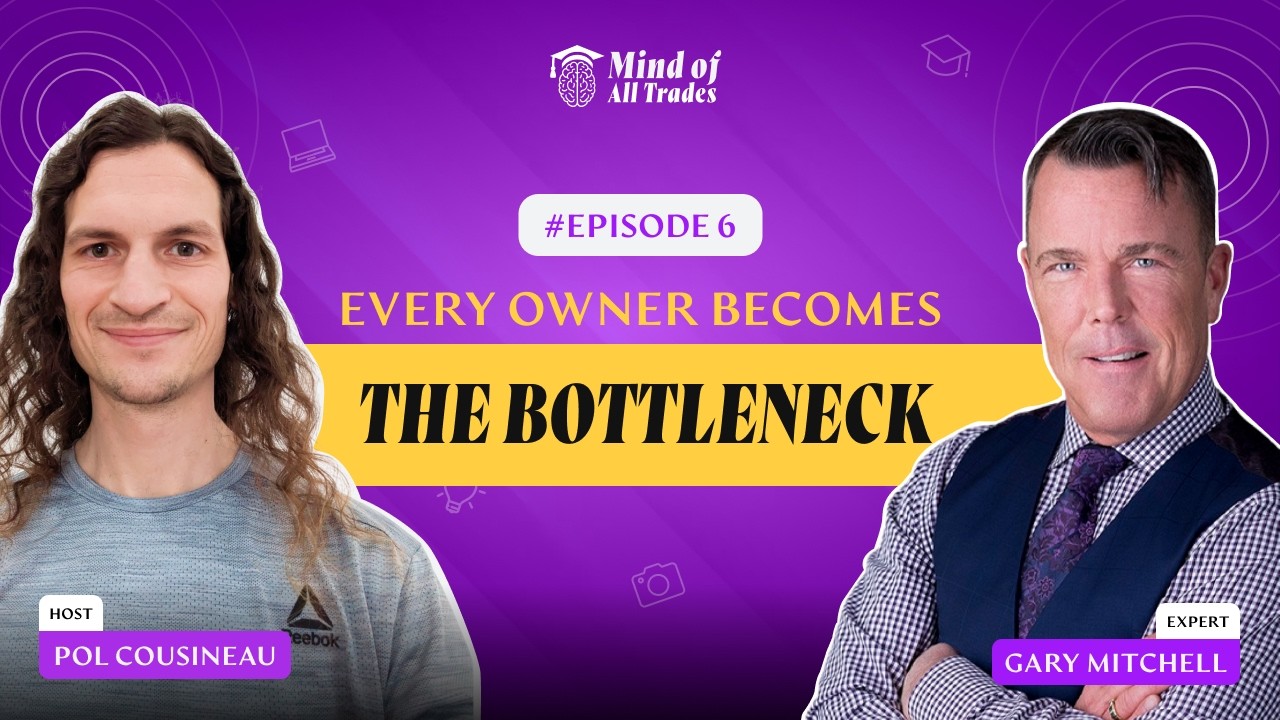
Why Letting Go of Control Gives You More of It - Gary Mitchell - Part 1 - EP 6
The Mindset That Scales Your Business
Description
“At the end of the day, you have more control over your time, your firm, your life, because it’s running smoothly.” That’s Gary Mitchell on the irony at the heart of what he calls The AND Approach.
Gary trained as an actor and singer, ran for parliament (and, in his words, thankfully lost), then spent more than 20 years coaching law firm owners exclusively. In this episode, he and Pol Cousineau talk about why so many owners become the biggest bottleneck in their own business, how to let go of control without letting standards slip, and why the people and systems you build are what finally give you your time back. The examples come from law firms, but the lessons carry straight over to any educational business with a team.
In this episode, you’ll hear:
- How running a campaign for a first-time candidate led Gary to coaching law firm owners
- Why trying to control everything creates a culture of dependence and makes you the bottleneck
- The mistake Gary found in his own book after eight rounds of editing, and what it says about perfectionism
- Why Gary tells clients to hire attitude over resume, every time
- What McDonald’s can teach you about systems, onboarding, and getting new hires productive faster
- The question that shows whether your business could run for two weeks without you
Chapters:
03:48 – From Acting and Politics to Coaching Law Firms
09:59 – Understanding the Lawyer Mind
13:16 – Managing Your Team’s Time Without Spyware
18:55 – Perfectionism and Why You Can’t Do It All Alone
23:01 – Starting With the Team You Have
31:00 – Your Right-Hand Person and the Freedom to Step Away
35:09 – Digging Into the AND Approach
41:23 – Asking Your Team What They Actually Want
46:12 – Systems, Processes, and Scaling
About Gary Mitchell
Gary Mitchell is a law firm architect, business coach, and the founder of OnTrac Coach. Since 2005, OnTrac Coach has helped law firm owners create systems and processes to scale their firms for growth, increase revenues and profits, develop best leadership practices, build extraordinary teams, and gain more freedom. Gary has twice been named a top 10 coach to law firms in North America and is the author of four books, most recently The AND Approach: How to Grow Your Law Firm AND Gain More Freedom. Before coaching, he trained as an actor and singer and performed all over the world.
Chapter workbooks for The AND Approach are now available on Gary’s website, and he is launching The AND Approach Law Firm Growth Masterclass and The AND Approach Podcast.
Check out The AND Approach book written by Gary Mitchell: https://ontraccoach.com/the-and-approach/
Connect with Gary:
- Website: https://ontraccoach.com/
- LinkedIn: https://www.linkedin.com/company/ontrac-coach/
- Facebook: https://www.facebook.com/ontraccoach
- YouTube: https://www.youtube.com/ontraccoach/
- Instagram: https://www.instagram.com/theandapproach/
Want to be a guest on Mind of All Trades? Apply here: https://mindofalltrades.com/podcast-application
Follow Mind of All Trades:
- YouTube: https://www.youtube.com/@MindofAllTrades
- Spotify: https://open.spotify.com/show/4MixC1mfhhUVIOFO1mywUc
- Apple Podcasts: https://podcasts.apple.com/us/podcast/mind-of-all-trades/id6807196830
- Instagram: https://www.instagram.com/mindofalltrades/
- Amazon Music: https://music.amazon.com/podcasts/32ce7fa4-4473-4c53-9256-7fca60e47331/mind-of-all-trades
- LinkedIn: https://www.linkedin.com/company/mind-of-all-trades/
Theme music by Breakmaster Cylinder.
Also Listen On


Transcript
Click to read the transcript
[00:00:00] Gary Mitchell: “You can have it all,
[00:00:02] you just can’t do it
[00:00:02] all on your own.”
[00:00:04] Pol Cousineau: I’ve there
[00:00:04] multiple times.
[00:00:05] I will be there again.
[00:00:07] Gary Mitchell: Here’s the biggest thing: perfectionism does not exist.
[00:00:12] There will never be perfect.
[00:00:14] Strive for excellence, absolutely.
[00:00:16] Pol Cousineau: it’s like having your cake
[00:00:18] and eating it too.
[00:00:19] It sounds too good
[00:00:20] to be true.
[00:00:21] Gary Mitchell: you have more control
[00:00:23] over your time,
[00:00:24] your firm, your life,
[00:00:27] because it’s running smoothly.
[00:00:28] You’re not trying
[00:00:29] to do everything.
[00:00:30]
[00:00:37] Pol Cousineau: Welcome to Mind of All Trades, the podcast where edupreneurs turn knowledge into impact. I’m your host, Pol Cousineau, and together we explore the craft and commerce of educational businesses, we look at the strategy, we look at the systems, and we look at the real implementation work that has to happen behind the scenes.
[00:00:58] Before we dive in, make sure you subscribe so you don’t miss future episodes. We’ll be sharing practical guides, conversations, and examples for edupreneurs who are building real momentum in their business, and for coaches, course creators, podcasters, and membership site owners who need help with the tech behind the business.
[00:01:17] Check out The Digital Navigator. The Digital Navigator helps with fully managed websites, funnels, analytics, automations, and ongoing tech support. So instead of having a bunch of disconnected tools, your systems can work together, and you can spend more of your time focused on the business, the offer, and the people you serve.
[00:01:38] You can learn more at thedigitalnavigator.com. Now, let’s jump into today’s episode.
[00:01:45] and today we have an amazing guest. Gary Mitchell is a self-described law firm architect and business coach with 30-plus years in business and 20-plus years coaching law firm owners exclusively.
[00:01:58] Yes, those numbers are accurate. Twice named a top 10 coach to law firms in North America, author of four books, the newest, ” The AND Approach: How to Grow Your Law Firm and Gain More Freedom,” carries his signature idea, reject either/or thinking, because you can build a thriving firm and have a life. Don’t worry, the concepts are going to be transposable to you as an educational business owner.
[00:02:29] His background is in communication, politics, and business development, and he originally trained as an actor and singer and performed worldwide, which still shapes how he communicates and teaches. This is an interesting career transition, I have to say so. Gary is the founder of OnTrack Coach, which is a coaching and advisory practice serving law firm owners exclusively since 2005, from solo practitioners to senior partners at international firms.
[00:03:00] It helps owners build the systems, leadership, and business development that led, that let a firm scale profitably while the owner reclaims time and freedom. Offerings include its accelerator coaching tracks, group coaching, consulting, speaking, four books, and a mobile app. They’re now expanding into a cohort master class, a podcast, and workbooks built around the AND approach.
[00:03:28] You can learn more about Gary’s work and OnTrack Coach at ontrackcoach.com. We’ll also have this link inside of our show notes. Welcome to the show, Gary.
[00:03:39] Gary Mitchell: It’s my pleasure, Pol. I think, I don’t think there’s anything left to, to say about my background and how I got here. You did it all.
[00:03:48] Pol Cousineau: I, I’ve been practicing introductions and making them interesting. What I find that is going to be amazing for our listeners is how much experience you have, not only in business, but in education, because you’ve used so many mediums of training and transmitting information to people. And I think that that would be a good starting point, is just sharing kinda like how you started on this path and then how that expanded
[00:04:18] Gary Mitchell: Okay, that’s a good, that’s a good place to start. I was reflecting, um, some time ago how I got here, right? Um, and when I look back to, uh Well, even, even, uh, middle school, even elementary school, I was always fascinated with people. So I always gravitated to subjects like history, uh, sociology. Uh, as I got a little bit older, politics. As I got a little bit older, marketing, business, entrepreneurship. So it, it really does… Like when you go back and reflect, you can see how the path forward was being formed. Everything I’ve ever done in whatever medium I was in was always around people. I mean, one host said to me a couple weeks ago, he said, “Uh, do you find that the acting training helps you in presenting and, and being more outgoing?” I said, “I do, but I was outgoing before the acting training.” I think the b- the benefit of the acting training is the study of people, really, because you have to, to embody a character, you have to really get in there and understand their personality, what motivates them, their challenges, what they love. I mean, that’s, that’s like business.
[00:05:27] If you’re good at what you do as an educator, you need to know who you’re in front of. You need to know your people. So, and then politics, I mean, that’s also the study of people and communicating and relationship building. So all of these things are really related. Um, I think the turning point came after I ran for parliament, and thankfully lost. I, I mean
[00:05:49] that very
[00:05:50] Pol Cousineau: funny.
[00:05:51] Gary Mitchell: I mean that very sincerely. Thankfully, I lost. That was in 2004. I had the opportunity and privilege of, uh, running a campaign for a lawyer. And Pol, it was like an artist with a blank canvas. Zero experience, double masters in, um, oh my God, mining and, uh, law. So you’re talking double intellectual, okay?
[00:06:15] Uh, geology and law. Uh, no political experience, no speaking experience, no networking experience, none of it. Zero. Blank. Okay? And I mean, I love this stuff. I was a political junkie growing up, you know, putting up signs and door-knocking with my father from the age of nine, listening to the conversations, right?
[00:06:34] Watching the news, always. Again, interaction, human study, uh, communication, all of those skills. So during this transformation that occurred with the candidate, I had a life and,
[00:06:46] and career a- aha moment. I was like, I’d always been the guy, and now I’m the guy behind the guy, the guy behind the curtain. And to watch a transformat- literal transformation of another person due in part, I can’t take all credit of course, but due in part to my guidance, my mentorship, my coaching, um, my experience, and it was phenomenal.
[00:07:10] So that was one. Second, his best friend, also a lawyer, pulls me aside after a campaign meeting one day. He says, “Gary, you really need to look at the legal industry. I’m blown away by what you’ve been able to do with-” Named candidate, and they really need help with business, like people skills, communication skills, uh, leadership, networking, all of that stuff, which again, they’re all transferable skills.
[00:07:36] And for your listeners, very transferable in educational businesses, right? Communicating, it’s number
[00:07:42] one. Listening. Listening, reacting, communicating. Um, so I think, you know, I’m, I’m very grateful for the path that was pre- was presented to me and that I chose to take, because it’s never boring. I mean, one of the things, one of the things I’ve gotten into over the years has expanded because of learning about more challenges.
[00:08:03] In the early days it was just about business development, right? So then I’m working with smaller firms, and now it’s about leadership and HR and, um, operations. And, um, the clients tend to really dislike, and that’s a mild term, uh, HR and marketing. They find it very frustrating. Let’s face it, the human component of any business is always the most challenging,
[00:08:26] right?
[00:08:27] Technology is always improving. Technology, even for nerds, are… Actually, no, tech, what would I call it? Tech, uh, hmm, not good. Um, it’s, it’s always… That’s far easier than the human interaction, right?
[00:08:43] And lawyers have, lawyers have difficulty with that because of the way they think, and the way they think is why we hire them. It’s not a bad thing. So I don’t try to change how they lawyer. I, I help develop them as business people with more of an entrepreneurial mindset, more collaboration, creativity, um, taking some risks. Calculated risks, right? Uh, but it’s always fascinating, and it’s never, it’s never the same because each client I have is a, is an individual,
[00:09:12] right?
[00:09:12] Pol Cousineau: the human component has so many variables, and then I think about other systems might be more predictable. So I have an accounting background myself. That’s what I studied in school. So that gives very clear, defined rules, and then once you go into marketing or HR, right, as you mentioned, you can’t plug it in a perfect formula.
[00:09:34] Now, there are indicators that say, “Hey, if you do A, you might upset everyone.” Like there’s, right, there’s certain rules of etiquette and how to formulate, and I found for me, learning the correct choice of word has been very important for that human component. So h- so how are you helping the lawyers adapt to that human component?
[00:09:56] ‘Cause you said yourself for them it can be very challenging.
[00:09:59] Gary Mitchell: Well, first of all, I, uh, it’s in the book too, I talk about the lawyer mind, and I can sum it up like this. I always like to have some humor in… Uh, lawyers are very, like accountants, I- also accountants, architects, engineers, all highly intelligent intellectual beings with a craft, okay? That is always left brain function focused. It’s like your left brain has had Olympian level training, right? From an early age, your personality trait gravitates to it, and then everything you study, it’s left brain function, left brain function, left brain function. The trouble is that most business people need the right brain functions to, uh, function at a very high level to be good, to be outstanding, to be excellent. So it’s like the left brain has had, uh, Olympian level tr- uh, training and the right brain has been on the couch binging Netflix.
[00:10:53] Pol Cousineau: Mm-hmm.
[00:10:54] Gary Mitchell: And so I get them off the couch like a personal trainer, and with exercises and practice, I start helping them exercise the right brain functions. Once they understand the way they think is different from the way people think in business, ’cause they may not have, they may not have come to that conclusion.
[00:11:10] They may just be frustrated that they can’t communicate what they want to or how they want to. And so understanding how their brain works as opposed to the entrepreneurial brain is one of the, one of the areas we f- we look at, right? And again, lawyers are smart, like other professionals. They’re smart. They pick this up very quickly. Um, they’ve just never been shown this path. This isn’t, this isn’t trained. This… None of this is, uh, provided for anywhere along the, the path to becoming a lawyer, let alone a law firm owner. Um, right? Most law firm owners start their own law firm because of necessity, for one,
[00:11:45] or, or they’re unhappy with where they’ve been. Um, because the, the business models are pretty far behind the mainstream of bus- most other businesses, right?
[00:11:57] Um, you know, living at, living in six-minute increments, I can’t imagine living like that. Like every six minutes, ding, you know, a thing goes off and it’s, “Okay, add that to the bill.” Uh, and that’s not all lawyers, of course, right?
[00:12:09] Um, but a
[00:12:10] Pol Cousineau: I lived through that myself, actually. When I was doing audit work, we had six-minute increments, and then at the end of the week, everything has to reconcile. And you’re not talking about, like, a 40-hour. No, it’s like 90 hours in the week to reconcile in six minutes ex- increments. And then if you get it off slightly, someone’s asking you questions.
[00:12:31] Gary Mitchell: Yes.
[00:12:32] And well, that’s a, you know what, there’s a g- perfect example. The, the docketing is a perfect example of saying things that lawyers are 80% of the time terrible at because they procrastinate it, procrastinate at it. They hate it. They loathe it. And I can understand why, right? We all have the admin tasks that we have to get to, and the things that, the things that we don’t like are the things we’re usually not the best at, and we definitely don’t enjoy. So I’ve sh- I’ve, that’s a- an area where I’ve shown junior lawyers how to get better at docketing. Get it done right away. Don’t wait till the end of the week. I mean, sometimes I’ve heard clients waiting till the end of the month or doing it, like, in two month. I’m like, “I think my brain would explode.”
[00:13:13] But anyway, we’re getting, we’re kind of getting off,
[00:13:16] Pol Cousineau: No, but I think this is interesting because a lot of people that have an educational-based business have an online team, if it’s at least one person. And then it is how do you manage the time of your team? How do you know what they’re doing? How do you keep track of that? And then within reason. So I’ve seen both extremes.
[00:13:37] On one side, people have no tracking whatsoever, and it’s a free-for-all. They don’t understand what’s happening. On the other one, people have what I call spyware, which basically just takes random screenshot of your desktop nonstop and then builds a report and it says, “Hey, Peter’s been on Facebook for an hour and 32 minutes this week.
[00:13:55] You should go and talk to him.” And this is a challenge of educational business owners, is, is how to manage and get ahold of what’s happening with the time and their team
[00:14:05] Gary Mitchell: It’s a, it’s a challenge for all business owners, but here’s one of the things. Um, one of the components, one of the, part of the formula of achieving the and approach, growing your business and gaining more freedom, it all starts with hiring the right people. That’s the first critical step. I mean, it starts with building from your own strength, right? Back in the day, I’m older than you, and back in the day, business gurus professed that you need to pick up your socks. You need to f- fix your weaknesses,
[00:14:31] right? Then along c- comes Steve Jobs, my ultimate business leadership organizational guru. Ultimate. Ultimate. And he says… He turns that upside down. He goes, “No, no, no, no, no.
[00:14:43] You don’t waste any time on your weaknesses. You focus all your effort, your time, your resources on mastering your strengths.” I say to my clients, “Let’s get you to become a Jedi.” Jedi master, Star Wars.
[00:14:56] Pol Cousineau: Yes.
[00:14:57] Gary Mitchell: Um, I have a lot of these little sayings ’cause it, it, it makes people snap right into the point I’m trying to make, right?
[00:15:03] Because we all know these, these things. Um, so you start with your own strength and systematically build your team, systematically and with intent on filling the gaps left by your weaknesses with people who are always gonna do it better, do it faster, and do it cheaper than you doing it yourself. And lawyers are known to be lone wolves. This is where their perfectionist, um, tendencies come in, and their, their need for control. So, there’s a bunch of hurdles that have to be taken, and I… Lawyers are no different than more people. I, I just think they, they… Some of the characteristics and personality traits, they’re exaggerated in lawyers and
[00:15:43] other, and other intellectual, uh, professionals. Uh, teachers, uh, professors. I have a very, very good friend who runs, uh, runs the education department at a university in Ontario. We have very, very, uh, interesting conversations. um, there’s a lot of components, but the bottom line is you don’t need to have spyware. You don’t need to, or nor should you, micromanage your team when you have the right people. When you have the right people, they are coming to you with ideas, suggestions. Sometimes they’re gonna make mistakes, but you allow for that. You allow a culture that allows for mistakes. That’s how we learn.
[00:16:24] We don’t learn with our successes. Far too many times lawyers will have demand so much control that they unintentionally create a culture of reliance, therefore becoming the number one bottleneck to growth. Everything has to pass through them. I’m sure you’ve experienced in the growth of your own business. I have.
[00:16:43] I think every entrepreneur, every business owner at one time has been the bottleneck, the biggest bottleneck to their growth, to their happiness, to their freedom. I mean, personally speaking, I’m at the, uh, beginning, yeah, I’m at the beginning of the Gen X generation. Uh, I do care to have a life outside of
[00:17:05] business. I love my business. I love… I’m a serial entrepreneur, Pol. I was- I started my first business at 25 in Toronto, and I just, like, dove right in. I love this stuff. I love building and creating. Now I get to help others build and create, and it’s never, it’s never boring. Um, but I do want a life. So these are just some of the strategies that I use in the formula that I’ve basically got. It starts with mindset, leadership, right? Getting the right people, getting them in the right roles, giving them the right direction,
[00:17:38] Pol Cousineau: Mm-hmm.
[00:17:38] Gary Mitchell: and then plugging them into the right systems and templates and pressing play. Plug and play. Plug the right people into the right systems with the right direction and repeat. That’s creating capacity. That is lessening the amount of tasks on your desk, freeing you up. But guess what’s happening at the same time? The and approach. You’re growing your business
[00:18:02] Pol Cousineau: Ah, right. So you’re not sacrificing that growth by implementing those systems. And I think removing yourself as the bottleneck is important, and you alluded to it. I’ve been there multiple times. I will be there again. And then it’s, for me, it’s understanding what is the risk.
[00:18:19] Gary Mitchell: Right
[00:18:20] Pol Cousineau: I have people that I work with, and they have their team send them every single thumbnail, image, social post, email, et cetera.
[00:18:28] But the reality is the impact is pretty minimal if there’s a small difference in one of these. And a lot of times it can still be on brand, on voice, and it’s a matter of nuance. Like A and B are not necessarily bad. They’re both aligned. You would have said A, of course, you’re a different person. But it’s learning to trust the other person to complete the deliverable and the, the quality standards you need
[00:18:55] Gary Mitchell: Is it good enough? ‘Cause here’s the thing that, that professionals struggle with too, is that perfect- I know because I am a recovering perfectionist. I mean, you don’t write four books with holding onto perfectionism. I mean, I found… I was just re- literally, I was just reading, uh, just to set up a voi- a voice AI.
[00:19:15] I was just reading, uh, the preface the other day, and I found a mistake after eight rounds of editing I mean, my brain was ready to explode near the end. I did four rounds myself with two AI programs, then the, uh, publisher got engaged and their editing team got involved, and there’s still a mistake there. Here’s the biggest thing: perfectionism does not exist. There will never be perfect. Strive for excellence, absolutely. Uh, I, I use a lot of sports, uh, analogies in my teaching because I have the utmost respect for elite athletes. We just finished the World Cup. I mean, that is– those athletes are among the most elite on the planet. The way they train, the focus, the mindset, it’s all coming into play. Well, professionals are the same, right? To reach that highest level, it takes everything, right? And you can’t do it on your own. I mean, think of a, think of elite artists and, and, uh, athletes, they all have teams of coaches,
[00:20:17] people surrounding, helping them. I mean, I wouldn’t think to… I’ve had many coaches. Uh, I just actually had a meeting with my, my coach who coached me when I ran for parliament, um, and that’s over 20 years ago, and it’s almost like it was yesterday. And we have these c- these, uh, talks regularly, and I’ve had many mentors. Uh, nobody does it on your own. In fact, one of the inspirations for writing the book was I had the ch- opportunity to interview a very successful law firm owner in Long Island, New York. She, coming to a later stage in her career, and given the decades that she was growing this, uh, the fact that she was a female and so successful is first amazing point, okay? It just happens that women were not, uh, it was not that frequent to see women at the head of a law firm, let alone growing their own. Here’s the thing, here’s the miraculous thing, and the and.
[00:21:12] She grew, she grew a multi seven-figure law firm, and she was only in the office two days a week because she built that firm around her intention of raising her two daughters. So out of necessity, because she was stuck to that goal, she built teams, she built systems, she built a schedule around being the mother that she wanted to be. There’s no way she wanted to pass her, her kids off to a nanny and be in the office 14 hours a day. No. And she still built sev- multi seven-figure firm.
[00:21:45] So we’re sitting in the interview. She– it comes near to the end, Pol. She leans back in her chair. She says, “Gary,” and she has a big smile on her face. I will never forget this moment. She has a big smile on her face and she says, “You can have it all, you just can’t do it all on your own.” That sums it up.
[00:22:03] Pol Cousineau: That’s a big
[00:22:04] Gary Mitchell: you get nothing, if you get nothing else from my presence on your podcast, I hope your listeners get build from your strength, build an A team, be relentless in your pursuit of sourcing the best people out there. There’s a lot of great people out there. There’s a lot of mediocracy. That’s another thing. From my experience, lawyers and maybe other professionals too, wait too long or too late to hire and build their team. So the building’s already on fire, and they’re just so intent on getting a bum in a seat to do this task or that task, they’re not getting the quality from the, from the outset. They don’t give the proper direction.
[00:22:45] The person inevitably fails at the task, and the lawyer thinks to themself or the other business owner, “Oh, I should have just done it myself.” And they do, and the cycle repeats, and
[00:22:55] they never get out of that trap. It’s like a rat on that, you know, the spinning wheel.
[00:22:59] Um-
[00:23:01] Pol Cousineau: S- so how do we get out of that? Because the reality is a lot of the people listening now are going to have people in their team. They may not necessarily be A players. They may not have them in the right role. They might themselves be the bottleneck, right? So then changing things around can feel even harder because you’ve had all, you have all of this in place.
[00:23:25] So when you’re looking to, at a law firm, I’m presuming that they don’t necessarily all have an A-star team and all the systems in place, right? So w- where do we start? Because that can be intimidating, and then you decide not to do anything
[00:23:39] Gary Mitchell: Of course, and that, that’s why most don’t. And that’s why I’ve had a career for over 20 years. I mean, we go through the, the, oh, the, uh, e- economy collapse of ’08, ’09. I thought for sure that would wake law firms owners up. Nope. COVID. Nope. I’m still here, still have a career. Um, thankfully, ’cause I really love what I do. Okay. So you, you cannot do it all at once, uh, but you can do a, a series of ands, and it starts with the leader. The leader has to change the way they operate, the way they think, and the way they act. The… It all starts from the top. So instead of creating a culture of dependency and reliance, you start…
[00:24:17] First of all, you start with the team you have, Okay
[00:24:20] ‘Cause that’s who you have. And they may be a B- they may… There may be a B player that’s never been given the chance to rise up to become an A player. That’s another consideration. So that’s why it has to start with the owner of the business. So instead of having your people come to you for every decision, empower them and start, over time, ’cause it’s gonna…
[00:24:39] They’re gonna be looking at a, a change in behavior on your part, so it’s gonna take them time to go, “Whoa, what’s going on? Do I trust this?”
[00:24:46] Right? Uh, you’ve got to ask them to, “Listen, you’ve been here, you’ve been with us for 10 years. I fully trust you at coming up with a solution for this, and I look forward to f- to your ideas.” In meetings, stop talking and giving away what you’re th- what you’re thinking. Ask your team members, right? another another reference to Steve Jobs. “We don’t hire smart people so we can tell them what to do. We hire smart people so they tell us what to do.” So start with your current team, empowering them. Take the leash off, okay? My EA, uh, says to me about three months ago, four months ago, we’re in our weekly meeting, and, uh, executive assistant, for those who don’t know the acronym, EA. And she says, “Gary, I just wanna tell you how much I enjoy working with you.” My other… She has another, uh, professional service firm client, and she says, “My other client micromanages me, and it’s no fun at all,” right? “And you just, you give me free rein.” I’m like, “Well, Anna, y- like, that’s why I hired you. If it was just to do tasks, I could get a VA, outsource it. Um, it’s just mundane little things. I hired you for your brain and your attitude.” Here’s another major point I wanna make. When you are hiring, and I’ve said this for over 20 years, and Pol, uh, the longer I’m on this earth, it keeps getting proven over and over and over again. Attitude accounts for 99% of everything. So I advise clients to hire attitude over resume, attitude over experience, attitude over all.
[00:26:17] Sometimes you can get, you can get… Okay, well, there’s, it’s all in the hiring process. I’ve got a very propri- proprietary hiring process that gets you as close to, uh, zero risk.
[00:26:30] There is no such thing, right?
[00:26:33] No such thing. There is no perfect, but this will get you as close as possible to, uh, ensuring that you’ve got a person with a great attitude. They’re gonna fit into your team. They’re gonna make a valuable contribution, and they’re gonna be a part of your A-team, a part of the puzzle.
[00:26:49] This is like putting a puzzle together, right? Um, and I understand fully why lawyers are frustrated with all of this because they’ve done– they gotta take some ownership, as I’ve said, the whole rushing to hire, the not properly instructing, expecting them to just figure it out on their own, like sink or swim mentality because that’s the way they, that they were treated, unfortunately,
[00:27:10] right?
[00:27:10] I’d like to think each, each generation that comes along, we’re treating each other better, uh, giving, paying forward what we’ve learned without making them have to, you know, tread water in the lake
[00:27:20] for half an hour. not, not everyone is like that. So i-in the long run, I help them understand that these are all investments, investments of your time, investments of your, of your being and your experience. But when you have the right people, you take the right steps, this slowly changes the culture. And guess– Here’s another thing. Uh, for those who are listening going, “Well, what do you do, what do you do about the duds?” What eventually happens, Pol, is that those people will self-select and leave. They will not be comfortable in this new culture because c-certain people are thriving, and they don’t feel comfortable.
[00:27:57] They don’t feel comfortable working in a team. Um, they’re not comfortable with coming up with ideas, uh, and they’re not in the right place, and they will self-select and leave, and not always. Sometimes you may have to make some tough decisions, but the team you have today may not be the team you have to grow over the next five years.
[00:28:16] It does happen. I mean, we
[00:28:18] have to be realistic. And you can’t go in there and just turn the whole apple cart, cart over all at once. You’ll be left with nothing,
[00:28:25] Pol Cousineau: Yeah, I’ve heard that one too. They say, “I need to replace my whole team.” I s- but then there’s no more institutional knowledge. H- how are you gonna get things done? That doesn’t make any sense. This is more of a reaction or a frustration to something, but you don’t wanna do the self-destruct button
[00:28:40] Gary Mitchell: No. No, you can’t, and it, it would self-destruct. So y-you, you have to, again, very str- take a dep- see, take a breath. One of the things is, and this is another and, so I was working with a, a firm owner years ago. He, uh, he was quite young. He never got back, hired back after articling, so he went out and created his own law firm, well, out of necessity, right? Uh, so he built it. I think he was about 34. He had five lawyers working for him already, which is outstanding. Um, and he brought me in to create a path to partnership for his junior lawyers ’cause they were typical millennials, and they were asking, “What’s my future here? Can you show me why I should stay, why I should invest my career in you and this firm?” So I thought, “Wow, this is, this is an and approach, right?” He is growing his firm and creating a culture of opportunity, uh, career growth for the younger, uh, lawyers, right? That’s gonna increase retention, uh, for sure, ’cause they can see a path. Uh, it’s gonna take some of the responsibility off his plate. So as you’re delegating some of that responsibility off, they are earning, along the way, the path to partnership, freeing up your time, allowing you to sit back, take a beat, take a minute, and think strategically, “What next?
[00:29:54] Who next? How can I take ownership for whatever I can do in this?” Right? “How can I instruct this person better? How can I mentor this person better? What else can I take control of, can I do?” And sooner or later, you figure out whether that person is gonna be, uh, staying with you and movable or not, and then you look at the, the most critical functions, and you start at the most critical, the m- the one that you cannot afford to not replace, right? Um, in most cases, like, the most critical role in a law- in a smaller growing law firm is, like, the office manager,
[00:30:34] which is basically a-akin to the CEO, okay? This is the law firm owner’s right-hand man, or person I should say. Um, and you have to have someone extraordinary. Uh, project management skills, HR skills, uh, technical skills, operation skills. This is a systems-driven person, a solutions-driven person. But I know they’re out there ’cause I’ve worked with several of them.
[00:30:58] Pol Cousineau: Yes.
[00:30:59] Gary Mitchell: they do exist.
[00:31:00] Pol Cousineau: Yes. And it’s interesting because in the Mind of All Trades model, I take a look at there’s the visionary founder, and then there’s an operator implementer. That key right-hand person, which is essentially that role that you’re describing in the law firm, and that person is the linchpin of everything else that happens, is the most vital role.
[00:31:21] And what I see often is people try to still micromanage that role, but you really need to give them the room to take over and then work their magic
[00:31:30] Gary Mitchell: Well, I’ve told Anna, uh, my vision for her is that she’s running the company a couple of years from now. It literally, like, all I wanna do is do this, coach, write, speak. That’s it. I don’t wanna do anything else because I think I’ve earned it at this stage, and that’s what- that’s my point with the law firm owners or any other business owner. You have earned the right to have a life. You have put your blood, sweat, and tears into your business for how, how long? 10, 20, 30 more years.
[00:31:59] You deserve to fully enjoy the fruit of your labor. I will show you how. This has become my mission, Pol. It literally has. I mean, 80… Over 80% of our G- GP- GDP in the US and Canada is small, small business.
[00:32:15] Pol Cousineau: Exactly
[00:32:16] Gary Mitchell: We are the economic driver for our entire economies, right? Should we not enjoy the fruit of our labor, enjoy the quality of life? I mean, for some people, sure, it, it literally is the car, it is the house, it is the whatever. Um, I want life. I want experience. My and, my why, is bucket list travel,
[00:32:36] right? Um, I’ve spent the winters in Puerto Vallarta for years, and now I’m like, “Okay, well, I ain’t getting any younger, so I better look at my bucket list and start ticking them off.” And so next winter, I’m not going back there. I’m gonna be looking at different parts of South America, Central America, uh, parts of Asia, Europe, and I, I will work and grow my business. That’s my and. For others, it’s, um, some of the really entrepreneurial clients I’ve had over the years are really… They- they’ve got other entrepreneurial ideas, so they wanna step aside from running the law firm day to day and go and follow other business aspirations, which
[00:33:10] is cool. Very cool. Uh, for some, it’s personal aspirations. Like, I’ve had clients that were training to climb, um, Kilimanjaro, right? Um, it could be skydiving. It could be laying on a beach, right? I mean, it’s not for me to, to dictate what your why is or what your and is. I’m here to show you that you can do it, and you can grow your law firm. I’ve got a master class coming up on Tuesday, and one of the first questions I’m asking the participants is, “If you were to go on vacation today for two weeks with no email or text access, what would happen?” I expect… Lawyers have poker face. They do. But I expect when I see the reaction on their face to that question, I’m gonna see some wincing,
[00:33:58] right? I, I really do. I don’t think they’re gonna be able to hide that, uh, ’cause they know what’s gon- what would happen, and I know what would happen. In most cases, uh, nothing would move forward. It would, it would completely come to a halt because they, again, unintentionally thinking, uh, this is the way to remain in control as keeping that leash and that tight, uh, hold on your people. It’s the complete opposite. The irony, Pol,
[00:34:25] Pol Cousineau: Yes
[00:34:27] Gary Mitchell: this and approach, at the end of the day, you have more control over your time, your firm, your life, because it’s running smoothly. You’re not trying to do everything on your own,
[00:34:39] right? That’s the irony of all of this.
[00:34:41] Um, talking to a for- former client yesterday, he had his own firm, uh, grew, grew so successfully, he had to be, uh, absorbed by a national firm.
[00:34:51] He went and worked for the national firm for seven years, then he went to an international firm, hated it. Now he’s back on, on his own. He spends the winters on Maui and the summer on the west coast of Vancouver Island.
[00:35:03] Two, two ocean fronts. He still has a million-dollar practice. That’s and approach right there,
[00:35:09] Pol Cousineau: Yeah.
[00:35:11] So I, it’s interesting now ’cause we keep talking about the and approach, right? So can we dig a little bit deeper in that? Because that’s also your book, that’s your system, you know, and we, we keep talking and referencing about it, and I’m sure the audience saying, “Okay, but how do we do it?” Because again, it’s like having your cake and eating it too.
[00:35:29] It sounds too good to be true. And I’m sure even when you were mentioning the example about not being reachable, a lot of people right now are listening and this is, this is not going to be possible for me. I’ve been doing it. It’s difficult. I, I think the longest I’ve gone is 10 days in the mountains in Peru where there wasn’t internet.
[00:35:49] And before that I had to do a week. Before that I had to do about four days. A- a- and I’m working on it, but it seems like in the and approach, there’s really a gold mine
[00:36:02] Gary Mitchell: Yeah, well have, I, the first question I would ask, I would answer that question with a question. Have you ever had an A team where you fully trusted your people to run with it? That’s the first question. So if you haven’t, then of course you can’t, you can’t visualize this. You can’t see. It is too good to be true.
[00:36:22] But I’ve seen it over and over and over and over and over again over the years,
[00:36:27] right? Uh, I’ll use a couple of examples. Two co-founders, uh, over on, uh, Vancouver Island, uh, I, I worked with them at just, just past their first year mark, okay? So they’re one year in. Uh, we developed some systems and processes. Um, they took to that. They landed. They did well. They continued that. I recently spoke to them, well, more recently, ’cause this was over 10 years ago I worked with them. Um, I spoke to them a couple years ago, and they contin- they have now got four locations, okay? They navigated three maternity leaves. One partner went twice, the other partner went once. COVID, and a major health, uh, scare, and they continued to grow. That’s AND approach
[00:37:14] because they built the systems and the people, right?
[00:37:18] Pol Cousineau: Mm-hmm.
[00:37:19] Gary Mitchell: Again, none of this is possible unless lawyers think differently. Now, now here’s the core of this. Lawyers are trained to look for what’s wrong, the bottom line. That’s the left brain function, right?
[00:37:32] It’s the number one– That’s the number one h- thing holding them back in business. I always mention you have to have two hats if you wanna b- be truly a law firm owner entrepreneur,
[00:37:42] right? You can– There’s a lot of people out there, uh, on the outside successful, like 20 lawyers, millions coming in. They do not have a life.
[00:37:50] They are working 80 or 90 hours a week. They’re not there for their, uh, daughter’s soccer practice or their son’s baseball game, or even their anniversary dinner. Vacation? I asked him, “What would happen if you went away for two…” “Vacation? What vacation?” Right? Um, so no, the… I can see how this is a leap, but I can point to example after example after example after example.
[00:38:15] Some of the people have worked with me, uh, some have not. I’ve just become, uh, aware of their background and in awe of it, and they figured it out. Uh, most of us can’t figure this stuff out on our own. I, I, I’ve needed help. That’s why I brought on an EA,
[00:38:30] right? And I gave her, I gave her my vision from the beginning.
[00:38:32] I said also, “Anna, I’m throwing ideas out there. I’m not dictating. If in the process you’re coming up with something, you know I’m always all ears.” But she’s come up with some doozies that I wouldn’t even have thought of, and I’m like, “Oh my God, that’s awesome.” Right? But you don’t get that if you create a culture of dependence where everybody has to run every- feel they have to run everything through you. They can’t think on their feet. They can’t f- think for themselves. I want, like, like Steve Jobs said, “I want outstanding people around me.” Smarter than me. Way smarter than me,
[00:39:05] especially in areas where I’m not proficient, right? I know what my strengths are. Here’s the other thing, and you know this. The things we’re best at are the things we love the most,
[00:39:17] ’cause that’s what we’re passionate about, and we’re gonna put everything into continuing to get better at it.
[00:39:22] That’s why I say focus on your strengths, build your team around you, and, and use that same formula throughout the growth of your firm when you’re, when you’re putting the puzzle together with your team,
[00:39:32] right? Never b- never budge from that. That’s how you get the, the right people in the right roles. You know they’re functioning at the highest functioning level.
[00:39:40] And you’re not, you’re not gonna have the HR nightmares. You’re not gonna have the micromanaging. You’re not gonna have the looking over, looking over their shoulder, uh, wondering what they’re doing. You will just have really outstanding people. And if they take a 10-minute break for Facebook- Their work, their work is at such a top level, it’s, hey, they needed a break.
[00:40:01] I mean, I, I take, I take mini breaks all through my day. You think I can go at this intensity for nine hours a day? No. I have exercise breaks, I have meal planning breaks, um, tons of little breaks. Change of task, right?
[00:40:15] Change is as good as a rest. So these are all things, and at the end of the day, client, the client, this, who all this is for,
[00:40:24] they don’t, they don’t care if the lawyer spends 10 minutes taking a, a Facebook break, as long as they’re not getting billed for that 10 minutes, right, in
[00:40:32] fairness. What they care about is the outcome. They don’t care about when the work is getting done, and they don’t care about where the work is getting done, whether it’s at the lawyer’s home or in the bricks-and-mortar office, right? The, they just care about the outcomes. When you remain flexible to the needs of outstanding people, then you expand your talent pool to draw from.
[00:40:53] When you remain so rigid, so rule-focused, you have to be in the office five days a week, these are the hours, this is, right, this is how it’s done, there’s no room for innovation. There’s no room for improvement. There’s no room for individual, um, advancement, growth, learning, and you’re always gonna have your people coming to you for every, every question, every email, every decision. And, and therefore, you will never be able to take t- uh, two weeks off without access to your t- uh, texts or emails. Impossible
[00:41:23] Pol Cousineau: And being attentive to their needs can also be asking them. So my director of operations, Kathleen, she’s my right hand. She’s b- she
[00:41:31] amazing. And then I had a discussion with her and I said, “Well, what would you want that would make you happier? What can I do for you? Do you want help with, uh, healthcare? Do you want more money?
[00:41:43] What do you want?” And then she said, “I want more time with my family.” Okay, great. What does that look like? So then she said, “Well, maybe if I could have two extra days off a month so I can have extra long weekends.” I said, “Well, let’s do better than that. What if we start with that, but then in a few months we’ll make it three, and then in a few more months you’ll just work four-day weeks,
[00:42:07] right?”
[00:42:07] Gary Mitchell: Yep. Yep
[00:42:08] Pol Cousineau: that’s what she wanted. But if I didn’t ask her, I could have done any other type of measure to try to incentivize her, but it doesn’t line up with what she wants, what she needed, and I just needed to ask her
[00:42:22] Gary Mitchell: And nine out of 10 people, it won’t be money. Okay? I’ve said this before, Pol, how can I help you help me help you? Got it?
[00:42:34] Pol Cousineau: Yes.
[00:42:35] Gary Mitchell: Got, got it?
[00:42:36] So, in other words, what can I do to help you help me?
[00:42:41] Pol Cousineau: Yeah, exactly
[00:42:42] Gary Mitchell: that’s exactly what you did. That’s… I mean, I’ve always said this from the beginning, oh my God, and the, some of the reactions I’ve got, like, “When’s the last time you took your receptionist out for a coffee?” And they look at me like, “Why?” Because your r- receptionist interacts with every single client that walks in the law firm doors, and she’s done that for the past 30 years. You don’t think she might have some input for you? They go, they go and it’s like an explosion, a wealth of information, right? And they find out this receptionist is eager to, to do this and this and this, and all these extra things that that law firm owner would never have known had they not asked. So, you hit on a very important point, right? It’s the same thing with clients. Ask your clients, ask your team what do they need. They will tell you everything they need, what they truly need, right? And see, this is another… I s- it just, it drives me crazy, and this is politics and business and p- humanity in general. We always wanna go for the cucky- cutty- uh, cookie cutter,
[00:43:48] right? We’re not… No, no, no, no, no. It’s a little more, it takes a little more effort, a little more effort to individualize your approach with each of, of your key team members. But the payoff is massive, right? The loyalty. I mean, what happened after you, you started giving your director of operations extra time off?
[00:44:10] Pol Cousineau: Oh, actually she took on more projects. She started a training plan
[00:44:14] Gary Mitchell: There you
[00:44:14] Pol Cousineau: the employees because then she’s thinking, “Oh, wait, I gotta empower them so no one’s gonna bother me during my time off.” So then she started building more systems.
[00:44:25] Gary Mitchell: So that one, what, what some would, would, uh, scoff at is costing you money. No, invest it. It was an investment. And they come back, and they’re more in. They dive more in. They’re like, “How can I make this better? How can I make… How do I make this work so I get to enjoy this free time,”
[00:44:44] right? And I’m not letting Pol down.
[00:44:46] I’m not letting anyone else down in the company.” And so they get in there, and they, like you, like you just said, they
[00:44:52] create systems. They, they train more people. It’s like, it’s magical. That’s what I would say to the skeptical law firm owner. No, it isn’t too good to be true. It can be true, but you have to set all of this up with intention and not sacrifice.
[00:45:08] And, and there is some risk. There’s some risk, like one week, uh, you know, this doesn’t, it’s not all, uh, unicorns and, and rainbows, right?
[00:45:18] There’s some tough, there’s some tough things here. But when you get these things set up, um, I like to, I’m gonna use this example. Do you think McDonald’s is the most successful franchise on the planet because of their food?
[00:45:30] Pol Cousineau: No
[00:45:31] Gary Mitchell: Hmm. It’s garbage. Don’t want to get slandered, but, um, they’ve developed the system so if you’re in Hungary or you’re in Kansas, you go into a McDonald’s, you order a burger, it’s done exactly the same way every single time.
[00:45:46] Okay? Yes. Uh, their marketing doesn’t hurt either. But it’s the, it, it, the, the, the reason why they make successful franchisees is they, they, it’s a turnkey. All, all the franchise, franchisee has to do is follow the proven method. That’s what I’m talking about. So, for every task, for every… Which is so repeatable in law firms. It’s like flipping a burger. Okay, it’s, it’s a little more intellectual.
[00:46:12] Pol Cousineau: A- and now we’re going into the systems and processes part of the
[00:46:16] Gary Mitchell: Yeah. Yep. Yep. But you’re scaling. That’s scaling for growth is you’re developing systems, processes, procedures, uh, that are replic- replicable. So you’re, when you’re bringing in a new employee,
[00:46:28] that shortens the time between the moment they come on board and the, to the time it takes for them to become profitable because they’re following a proven system. The clients are happy ’cause it doesn’t matter whether Bob or Irene is doing the legal work, it’s done in the same consistency at the very high standards set by the law firm owner. So they don’t need to, you know, hold on like this. They have the right people, they have the right systems, right? So they can still achieve that excellence, but without micromanaging. When you, when you micromanage, you stifle people.
[00:47:03] You stifle every part of them, their creativity, their work ethic, uh, their brain, their loyalty.
[00:47:10] You stifle everything. It’s the worst possible, uh, management, uh, approach. And unfortunately, still so many people, uh, do that approach
[00:47:21] Pol Cousineau: Well, I’m a big proponent of systems and processes. One of the things I tell my teams or, or people in my team is, “If you believe the process or the system could be done better, let a manager know and why, then we can evaluate it. And if it makes sense, we can change the system.” Because what I found is at first there was a rigidity that was added, and then everything becomes stale, and now I have to push the systems down.
[00:47:51] But by giving them that freedom, the team is continually updating, coming up with new creative ways. And then I also have been telling them, “Talk to a manager, talk to someone else,” ’cause I, I was tempted to say, “Let me know,” but then I become the bottleneck, and how can I approve all these changes in systems and processes?
[00:48:11] And a lot of them, I’m not close enough to it anymore because I’ve been delegating, so I could be making a worse call
[00:48:19] Gary Mitchell: Yes.
[00:48:19] Pol Cousineau: than their manager
[00:48:21] Gary Mitchell: No, that’s a good point, and that’s what I’m ta- talking about creating a culture of innovation and collaboration. It never stops. It never stops getting better because, you know, you have one person… Uh, say you have one person coming in, and they’re coming from a different industry, and they have a totally different angle on the system, and they come up with this idea, and all of a sudden it’s like, it was good to begin with, and now it’s great,
[00:48:44] right?
[00:48:45] I mean, I love… But I… See, I love that. I love the collaborative approach. Um, my, my philosophy, and I try to impress this upon the clients, is I don’t have to be the one to get it right as long as we get it right, okay? So I’m often the f- the person who will throw an idea out there to get the brainstorming going. Is it the final idea? 99% of the time, no.
[00:49:12] Pol Cousineau: Yeah
[00:49:13] Gary Mitchell: uh, but someone has to start it, and I’m not afraid of that, right? I’ll give you an example. I was branding a, a firm last year, and I came up with what I thought was a good name, okay? Um, within a day, the most recent hire, very junior associate, threw out a, a different name, and both the owner and I went, “That’s even better.”
[00:49:34] Boom. And that’s what we landed with.
[00:49:36] Um, so you’re following that. You’re following that. You’re following… You are following the and approach because you’re not just growing, you’re empowering your people to continuously make improvements and fine-tune the systems. That’s awesome. That will ensure your people are always engaged. You’re always improving the systems, which means your clients are gonna remain happy, which means you’ve got solid, um, repeatable business, and that, that bodes well for growth as well. So it’s and, and, and, and. I’m sorry to be like a broken record.
[00:50:08] Pol Cousineau: Oh, that’s okay. I, I love it. I love that.
[00:50:11]
[00:50:13] Gary Mitchell: I don’t know
[00:50:14] too many lawyers
[00:50:15] that can sit down
[00:50:16] and read
[00:50:16] a 300-plus page book
[00:50:18] in their spare time.
[00:50:20] Pol Cousineau: And how are you
[00:50:22] blending that accountability
[00:50:23] in these higher-end offers?
[00:50:25] Gary Mitchell: By the end of the meeting, everyone will commit.
[00:50:28] Pol Cousineau: I find that
[00:50:29] when you set
[00:50:29] too many goals
[00:50:31] and you fail,
[00:50:32] it can have
[00:50:33] a demotivating impact.
[00:50:35] Gary Mitchell: Do one and do it
[00:50:36] really, really well, right?
[00:50:38] Let’s get,
[00:50:38] let’s get a quick win.
[00:50:40] Let’s get a win.
[00:50:41] Pol Cousineau: Who are your A players,
[00:50:43] and who could be potential leaders?
Highlights & Timestamps
00:03:48 – From Acting and Politics to Coaching Law Firms
00:09:59 – Understanding the Lawyer Mind
00:13:16 – Managing Your Team’s Time Without Spyware
00:18:55 – Perfectionism and Why You Can’t Do It All Alone
00:23:01 – Starting With the Team You Have
00:31:00 – Your Right-Hand Person and the Freedom to Step Away
00:35:09 – Digging Into the AND Approach
00:41:23 – Asking Your Team What They Actually Want
00:46:12 – Systems, Processes, and Scaling

About Host
Pol is a strategist and mentor who’s helped countless educators and entrepreneurs scale their businesses with clarity and ease.
From running a data-driven digital agency to co-founding an eLearning platform, he brings both technical expertise and heart-centered leadership.
With Mind of All Trades, Pol brings those lessons to the mic… helping you learn what it really takes to succeed online.
Recent Episodes
Fear Is the Poison of Any Workplace - Bruno Cignacco - Part 2 - EP 13 –
S1 Ep13

Pol Cousineau
October 29, 2026
“Fear is the venom, the poison of any work environment.” Bruno Cignacco says it is the first thing a leader should look for.
In Part 2, Bruno and Pol Cousineau get practical about what a compassionate business looks like day to day. Bruno explains why qualitative factors like kindness and cooperation should come before the numbers, how an anonymous survey can show whether your team is working in fear, and why serving customers is different from selling to them. They also cover why high tech needs high touch, what Trader Joe’s kept when others automated, how fully online teams can build trust, and the one question Bruno asks himself every morning.
In this episode, you’ll hear:
- Why qualitative factors like kindness and cooperation should come before the numbers
- How to find out if your team is working in fear, using anonymous surveys and suggestion boxes
- Why fear makes people defensive, less creative, and worse at serving customers
- Serving versus selling: finding out what customers need and giving more than they expect
- High tech and high touch: why customers still need to reach a real person after they buy
- What Trader Joe’s kept when other grocers moved to self-checkout
- A weekly social hour for online teams, and why knowing the person matters more than the role
- The second edition of The Art of Compassionate Business, and the question Bruno asks every morning
Chapters:
00:00 – Coming Up and Intro
02:40 – Measuring Compassion: Qualitative vs. Quantitative
11:28 – Fear in the Workplace, Groupthink and Serving vs. Selling
24:16 – Experience Engineering: High Tech Needs High Touch
30:38 – Test Your Own Customer Experience
33:11 – Trader Joe’s: Why Real People Beat Self-Checkout
38:46 – Keeping Remote Teams Connected
44:30 – Why Social Time Boosts Productivity
48:28 – The Second Edition and What COVID Changed
55:17 – Closing Advice: Add Value to Every Stakeholder
About Bruno Cignacco
Bruno Cignacco has run his international consultancy since 1993. He is an international business consultant, TEDx speaker, university lecturer, and bestselling author with more than 30 years of experience advising and training hundreds of companies worldwide on international trade, marketing, negotiation, and compassionate business. He is a Senior Fellow of the Higher Education Academy in the UK, and in 2024 he was named by World’s Leaders Magazine as one of the world’s most transformational leaders changing the face of business. Bruno teaches that companies can be profitable and compassionate at the same time, and he is based in London.
Bruno’s book, The Art of Compassionate Business: Main Principles for the Human-Oriented Enterprise, is published by Routledge.
Check out The Art of Compassionate Business, written by Bruno Cignacco: https://www.routledge.com/The-Art-of-Compassionate-Business-Main-Principles-for-the-Human-Oriented-Enterprise/Cignacco/p/book/9781032445427
Connect with Bruno:
- Website: https://brunocignacco.com/
- LinkedIn: https://www.linkedin.com/in/dr-bruno-roque-cignacco-sfhea-0609317/
Want to be a guest on Mind Of All Trades? Apply here: https://mindofalltrades.com/podcast-application
Visit The Digital Navigator: https://thedigitalnavigator.com/
Follow Mind Of All Trades:
- YouTube: https://www.youtube.com/@MindofAllTrades
- Spotify: https://open.spotify.com/show/4MixC1mfhhUVIOFO1mywUc
- Apple Podcasts: https://podcasts.apple.com/us/podcast/mind-of-all-trades/id6807196830
- Instagram: https://www.instagram.com/mindofalltrades/
- Amazon Music: https://music.amazon.com/podcasts/32ce7fa4-4473-4c53-9256-7fca60e47331/mind-of-all-trades
- LinkedIn: https://www.linkedin.com/company/mind-of-all-trades/
Theme music by Breakmaster Cylinder.
Listen Now
Profit and Compassion Aren't Opposites - Bruno Cignacco - Part 1 - EP 12 –
S1 Ep12
Pol Cousineau
October 26, 2026
“By caring for them, you’re caring for your business.” Bruno Cignacco has spent years researching companies that are both compassionate and highly profitable.
In Part 1, Bruno and Pol Cousineau put a big question to the test: can a company be compassionate and profitable at the same time? Bruno explains the principles behind it, from social reciprocity and respecting people’s autonomy to treating the human being as the most important resource in any business, and why Patagonia ran an ad telling customers not to buy its jacket. They close on a free, actionable tip any business can use: read your reviews, look for the patterns, and learn from the companies in your space with the best ones.
In this episode, you’ll hear:
- Why profit and compassion aren’t incompatible, and what Bruno’s research found
- Social reciprocity: why people who are cared for give their best in return
- Respecting autonomy instead of micromanaging employees or hard-selling customers
- Why the human being is the most important resource in any business
- What Patagonia’s “do not buy this jacket” ad says about long-term thinking
- Under promise, over deliver, and why one weak department can undo the rest
- A free research tip: read your reviews, find the patterns, and study the companies with the best ones
Chapters:
00:00 – Coming Up and Intro
02:30 – How Profit and Compassion Intersect
10:42 – Patagonia and the “Do Not Buy This Jacket” Ad
19:40 – When Bad Practices Catch Up With You
27:09 – When One Department Ruins the Customer Experience
34:19 – The Zero-Cost Tip: Read Your Reviews
42:22 – No Feedback Means Flying Blind
About Bruno Cignacco
Bruno Cignacco has run his international consultancy since 1993. He is an international business consultant, TEDx speaker, university lecturer, and bestselling author with more than 30 years of experience advising and training hundreds of companies worldwide on international trade, marketing, negotiation, and compassionate business. He is a Senior Fellow of the Higher Education Academy in the UK, and in 2024 he was named by World’s Leaders Magazine as one of the world’s most transformational leaders changing the face of business. Bruno teaches that companies can be profitable and compassionate at the same time, and he is based in London.
Bruno’s book, The Art of Compassionate Business: Main Principles for the Human-Oriented Enterprise, is published by Routledge.
Check out The Art of Compassionate Business, written by Bruno Cignacco: https://www.routledge.com/The-Art-of-Compassionate-Business-Main-Principles-for-the-Human-Oriented-Enterprise/Cignacco/p/book/9781032445427
Connect with Bruno:
- Website: https://brunocignacco.com/
- LinkedIn: https://www.linkedin.com/in/dr-bruno-roque-cignacco-sfhea-0609317/
Want to be a guest on Mind Of All Trades? Apply here: https://mindofalltrades.com/podcast-application
Follow Mind Of All Trades:
- YouTube: https://www.youtube.com/@MindofAllTrades
- Spotify: https://open.spotify.com/show/4MixC1mfhhUVIOFO1mywUc
- Apple Podcasts: https://podcasts.apple.com/us/podcast/mind-of-all-trades/id6807196830
- Instagram: https://www.instagram.com/mindofalltrades/
- Amazon Music: https://music.amazon.com/podcasts/32ce7fa4-4473-4c53-9256-7fca60e47331/mind-of-all-trades
- LinkedIn: https://www.linkedin.com/company/mind-of-all-trades/
Theme music by Breakmaster Cylinder.
Listen Now
Give Your Students Room to Fail - David Fradin - Part 2 - EP 11 –
S1 Ep11
Pol Cousineau
October 22, 2026
“People are not liabilities, they’re assets, yet they show up in the P&L as a liability.” It’s the argument Dave Packard made in the early 1980s, and David Fradin says most companies still haven’t taken it on board.
In Part 2, David and Pol Cousineau get into how David trains other trainers to deliver his courses, and why so many companies now treat training as an expense to cut. Pol brings his accounting lens to the P&L problem, and David explains why the only time he gets called is when product failures start hitting the bottom line. They also cover why David uses historical examples instead of current ones, what partnership disputes taught him about keeping control of a company you start, and his one piece of advice for anyone teaching: make the class fun.
In this episode, you’ll hear:
- How David trains trainers: observe the course, teach it while he observes, then get signed off
- Why David sells to both the training department and the leader who owns the P&L
- Why companies treat training as an expense, and the Dave Packard argument against it
- Why urgency, usually from product failures, is what gets David hired
- Why he uses historical examples instead of current ones
- What partnership disputes taught him about keeping control of your company
- Shared values, decisions close to the customer, and understanding culture in global markets
Chapters:
00:00 – Coming Up and Recap
02:37 – Training the Trainers to Multiply Yourself
05:21 – Landing Corporate Training Clients
09:55 – Training on the P&L: Expense or Asset
14:26 – How Corporate Training Deals Work
18:38 – Retention Tricks and the Cisco Feedback Culture
21:46 – Use Examples From History, Not Hype
25:59 – Partnerships Gone Wrong: Never Lose Control
30:14 – Flat Fees and Shared Values Instead of Partners
35:44 – Running a Global Team Across Cultures
42:46 – Training Mandates and Closed Markets
About David Fradin
David Fradin is the founder and president of Spice Catalyst, a worldwide product management and product marketing training, consulting, and assessment organization. He spent more than 47 years across 75-plus products and services at 25 organizations and 11 startups, starting as a classically trained Hewlett-Packard product manager before Apple recruited him to bring the first hard disk drive to market on a personal computer. At Apple, he rose to Apple III group product manager and then independent business unit manager. Earlier, he pioneered environmental mediation, resolving a seven-year dispute over Lake Superior taconite tailings. He is the author of Building Insanely Great Products, Organizing and Managing Insanely Great Products, and the 796-page Successful Product Design and Management Toolkit with Wiley. He has trained product and marketing managers at Cisco, Capital One, Cognizant, Infosys, and Pitney Bowes, and sits on the board of Manipal Global Academy of IT in India.
Learn more about David’s training, courses, and books at Spice Catalyst: https://www.spicecatalyst.com
Missed part 1? Watch here: https://mindofalltrades.com/episodes/ep10-david-fradin-room-to-fail-part-1/
Connect with David:
- Website: http://www.spicecatalyst.com
- LinkedIn: https://www.linkedin.com/in/davidfradin/
Want to be a guest on Mind Of All Trades? Apply here: https://mindofalltrades.com/podcast-application
Follow Mind Of All Trades:
- YouTube: https://www.youtube.com/@MindofAllTrades
- Spotify: https://open.spotify.com/show/4MixC1mfhhUVIOFO1mywUc
- Apple Podcasts: https://podcasts.apple.com/us/podcast/mind-of-all-trades/id6807196830
- Instagram: https://www.instagram.com/mindofalltrades/
- Amazon Music: https://music.amazon.com/podcasts/32ce7fa4-4473-4c53-9256-7fca60e47331/mind-of-all-trades
- LinkedIn: https://www.linkedin.com/company/mind-of-all-trades/
Theme music by Breakmaster Cylinder.
Listen Now
Give Your Students Room to Fail - David Fradin - Part 1 - EP 10 –
S1 Ep10
Pol Cousineau
October 19, 2026
“You have to give your student enough room to fail because people tend to learn more from their failures than from their successes.” David Fradin learned that as a flight instructor, and it shapes how he designs every course he teaches.
In Part 1, David and Pol Cousineau dig into how David turned his product management training into a 796-page university-level book, and why it only came together once he found the right framework. David explains the five keys to product success behind SPICE, why he quizzes students every five to 10 minutes, and how a course workbook can become a portfolio that helps students get hired. They close on why the real money in his business is in in-person corporate training, and how he scaled it by training other trainers.
In this episode, you’ll hear:
- How a training trip to Singapore led to a 796-page book with Wiley
- The five keys to product success behind David’s SPICE framework
- Why a book stalls without a structure, and how David used his courses as the outline
- Why stories help students remember the concept
- Quizzing every five to 10 minutes, and what it does for retention
- Giving students room to fail, and the flight-training method behind his exercises
- Why the real money is in in-person training, and how training other trainers helped him scale
Chapters:
00:00 – Coming Up and Intro
03:50 – How a 796-Page Textbook Came to Be
08:45 – How the SPICE Framework Unlocked the Book
15:00 – Just Sit Down and Write
22:41 – Structure First, Outline Second
26:41 – Storytelling and Starting With a Framework
29:36 – Calling Out the Competition
33:11 – Creating Online Courses and Quizzes
36:55 – Workbooks, Exercises, and Room to Fail
42:42 – Workbooks as a Portfolio and the Limits of Udemy
46:56 – Where the Real Money Is: In-Person Training
About David Fradin
David Fradin is the founder and president of Spice Catalyst, a worldwide product management and product marketing training, consulting, and assessment organization. He spent more than 47 years across 75-plus products and services at 25 organizations and 11 startups, starting as a classically trained Hewlett-Packard product manager before Apple recruited him to bring the first hard disk drive to market on a personal computer. At Apple, he rose to Apple III group product manager and then independent business unit manager. Earlier, he pioneered environmental mediation, resolving a seven-year dispute over Lake Superior taconite tailings. He is the author of Building Insanely Great Products, Organizing and Managing Insanely Great Products, and the 796-page Successful Product Design and Management Toolkit with Wiley. He has trained product and marketing managers at Cisco, Capital One, Cognizant, Infosys, and Pitney Bowes, and sits on the board of Manipal Global Academy of IT in India.
Learn more about David’s training, courses, and books at Spice Catalyst: https://www.spicecatalyst.com
Want to be a guest on Mind Of All Trades? Apply here: https://mindofalltrades.com/podcast-application
Follow Mind Of All Trades:
- YouTube: https://www.youtube.com/@MindofAllTrades
- Spotify: https://open.spotify.com/show/4MixC1mfhhUVIOFO1mywUc
- Apple Podcasts: https://podcasts.apple.com/us/podcast/mind-of-all-trades/id6807196830
- Instagram: https://www.instagram.com/mindofalltrades/
- Amazon Music: https://music.amazon.com/podcasts/32ce7fa4-4473-4c53-9256-7fca60e47331/mind-of-all-trades
- LinkedIn: https://www.linkedin.com/company/mind-of-all-trades/
Theme music by Breakmaster Cylinder.
Listen Now
Stop Being the Hero of Your Business - Bill Flynn - Part 2 - EP 9 –
S1 Ep9
Pol Cousineau
October 15, 2026
“The question you should be asking is: why did this decision reach me?” It’s the question at the center of what Bill Flynn calls decision capital.
In Part 2, Bill and Pol Cousineau dig into the hero trap: why leaders who were rewarded for years for having the answer end up as the bottleneck in their own business, and why pulling back can leave the team feeling abandoned. Bill explains his three leadership identities, the vacation test, and what a Navy submarine captain learned when he stopped giving orders. They close on why Bill sets standards instead of giving feedback, and the two steps he recommends for educational business owners stuck in the weeds.
In this episode, you’ll hear:
- Why being the hero who always has the answer becomes a trap as your business grows
- Bill’s three leadership identities: controller, builder, and architect
- The vacation test, starting with a vacation from a single meeting
- Decision capital, and the exercise that shows which decisions actually need you
- How intent-based leadership turned the worst submarine in the US Navy into the best
- Pre-mortems, after-action reviews, and milestones that keep projects on track
- Why Bill sets standards instead of giving feedback, and how red, yellow, green check-ins work
Chapters:
02:33 – How Bill’s Books Help Him Reach a Million Lives
05:24 – The Idea Behind The Hero Trap: Controller, Builder, Architect
12:09 – Escaping the Hero Trap: Stop Making Every Decision
20:36 – Turn the Ship Around: Let Your Team Decide
25:33 – Making Failure Okay: After-Action Reviews and Pre-Mortems
30:10 – Milestones: Checking In Without Micromanaging
33:32 – “How Do You Know?”: Testing Your Assumptions
40:25 – Which Metrics Matter: Leading Indicators and Red, Yellow, Green
45:59 – Setting Standards, Outcomes, and Checklists
49:39 – Advice for Educational Business Owners: Vision First, Then Audit Your Offers
54:37 – Where to Find Bill and The Hero Trap
About Bill Flynn
Bill Flynn is the founder of Catalyst Growth Advisors and an executive coach, speaker, and advisor to CEOs of scaling companies. He teaches management science to CEOs and their leadership teams so they can take the guesswork out of growth. Bill brings more than 30 years of operating experience as an eight-time VP of sales, two-time CMO, and general manager of a $100 million-plus division, across 10 startups, two IPOs, and seven acquisitions. He is a member of Marshall Goldsmith’s MG100 coaching community, and his writing has appeared in Harvard Business Review, Training Magazine, and ATD. He is the author of Further Faster and is based in Greater Boston.
Bill’s new book, The Hero Trap, comes out in October 2026 and is available to pre-order on Amazon. It centers on his core idea: great leaders build organizations that make their own indispensability unnecessary.
Check out The Hero Trap book written by Bill Flynn: https://catalystgrowthadvisors.com/the-hero-trap/
Connect with Bill:
Website: https://catalystgrowthadvisors.com/
LinkedIn: https://www.linkedin.com/in/billflynnpublic
Want to be a guest on Mind Of All Trades? Apply here: https://mindofalltrades.com/podcast-application
Follow Mind Of All Trades:
- YouTube: https://www.youtube.com/@MindofAllTrades
- Spotify: https://open.spotify.com/show/4MixC1mfhhUVIOFO1mywUc
- Apple Podcasts: https://podcasts.apple.com/us/podcast/mind-of-all-trades/id6807196830
- Instagram: https://www.instagram.com/mindofalltrades/
- Amazon Music: https://music.amazon.com/podcasts/32ce7fa4-4473-4c53-9256-7fca60e47331/mind-of-all-trades
- LinkedIn: https://www.linkedin.com/company/mind-of-all-trades/
Theme music by Breakmaster Cylinder.
Listen Now
Customers Don't Buy, They Hire - Bill Flynn - Part 1 - EP 8 –
S1 Ep8
Pol Cousineau
October 12, 2026
“People do not buy products and services from you. They hire them to get a certain job or set of jobs done for them.” It’s the idea at the center of how Bill Flynn now teaches CEOs to sell.
In Part 1, Bill and Pol Cousineau dig into why most companies sell on the supply side while their customers buy on the demand side. Bill explains how studying decision science took him from struggling in his first sales job to being the number one or two salesperson everywhere he went, what a dining room table taught one condo developer about why people don’t buy, and how to interview customers so they tell you things they didn’t know they knew. They close on the three things thriving businesses get right, and why cash should be your primary financial metric.
In this episode, you’ll hear:
- How Bill built a solo advisory business he works about 30 days a year
- Why he chose Scaling Up over EOS, and why selling takes both competence and confidence
- How studying decision-making turned his sales results around
- Jobs to Be Done and Demand Side Sales 101: why customers hire products instead of buying them
- The functional, social, and emotional reasons behind every purchase
- How to interview customers like an investigative journalist
- The three things thriving businesses get right: teams, systems, and cash
Chapters:
00:00 – Coming Up and Intro
03:43 – A One-Person Business Built Around 100 Days a Year
07:12 – Choosing an Expertise: Scaling Up vs. EOS
10:33 – Competence, Confidence, and Learning to Sell
17:58 – Jobs to Be Done: Why Customers Hire You
22:25 – Applying Jobs to Be Done to Training
25:37 – Turning Customer Needs Into Your Message
31:59 – Customer Discovery and Designing for What They Want
38:29 – Fewer Features, Fewer Bonuses, Clearer Language
41:36 – Bending the Curve: Why Most Businesses Struggle
48:51 – Getting Better and Aiming for a Million Lives
About Bill Flynn
Bill Flynn is the founder of Catalyst Growth Advisors and an executive coach, speaker, and advisor to CEOs of scaling companies. He teaches management science to CEOs and their leadership teams so they can take the guesswork out of growth. Bill brings more than 30 years of operating experience as an eight-time VP of sales, two-time CMO, and general manager of a $100 million-plus division, across 10 startups, two IPOs, and seven acquisitions. He is a member of Marshall Goldsmith’s MG100 coaching community, and his writing has appeared in Harvard Business Review, Training Magazine, and ATD. He is the author of Further Faster and is based in Greater Boston.
Bill’s new book, The Hero Trap, comes out in October 2026. Like Further Faster, it centers on his core idea: great leaders build organizations that make their own indispensability unnecessary.
Check out The Hero Trap book written by Bill Flynn: https://catalystgrowthadvisors.com/the-hero-trap/
Connect with Bill:
Website: https://catalystgrowthadvisors.com/
LinkedIn: https://www.linkedin.com/in/billflynnpublic
Want to be a guest on Mind Of All Trades? Apply here: https://mindofalltrades.com/podcast-application
Follow Mind Of All Trades:
- YouTube: https://www.youtube.com/@MindofAllTrades
- Spotify: https://open.spotify.com/show/4MixC1mfhhUVIOFO1mywUc
- Apple Podcasts: https://podcasts.apple.com/us/podcast/mind-of-all-trades/id6807196830
- Instagram: https://www.instagram.com/mindofalltrades/
- Amazon Music: https://music.amazon.com/podcasts/32ce7fa4-4473-4c53-9256-7fca60e47331/mind-of-all-trades
- LinkedIn: https://www.linkedin.com/company/mind-of-all-trades/
Theme music by Breakmaster Cylinder.
Listen Now
View More
0 Comments