


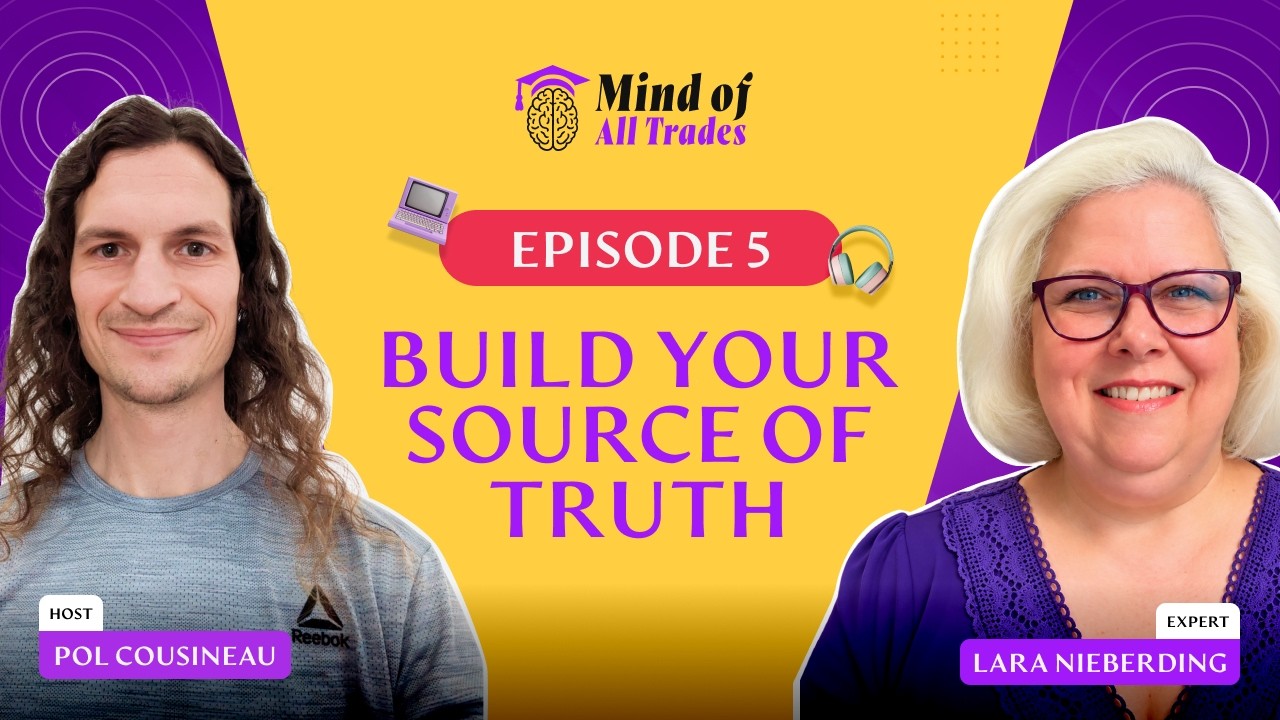
The System That Keeps Your Business Running Without You - Lara Nieberding - Part 2 - EP 5
The Mindset That Scales Your Business
Description
“There is a time and a place for AI, and there is still a place and a need for an OBM in your business.” That’s Lara Nieberding’s own answer to the question Part 1 left hanging, and in Part 2, she and Pol get into exactly why.
This part picks up right where Part 1 ended: the actual system Lara builds so a business doesn’t depend on any one person’s memory. She walks through her “source of truth” method, the tools stack she relies on, how she manages a founder who never stops having new ideas, and how to structure a team meeting that doesn’t turn into a fight. Then, toward the end, she gets personal about something that’s affected her directly: what AI is already changing about her own industry, and what she believes still can’t be replaced.
In this episode, you’ll hear:
- Why Lara tells AI the exact same thing she’d tell her own team
- The tools stack that keeps everything (and everyone) connected
- How to manage a founder who never stops having new ideas
- How to structure a team meeting that doesn’t turn into a fight
- What AI already took from Lara, and what she believes still can’t be replaced
About Lara Nieberding
Lara is a Certified Online Business Manager and the founder of Encore OBM. In her own words: her job is to make sure the right things (planning) get done in the right way (systems), at the right time (project management), by the right people (team management). She works primarily with business, marketing, and life coaches who offer online courses and programs.
Connect with Lara:
- Company: Encore OBM
- LinkedIn: linkedin.com/in/laranieberding
Follow Mind of All Trades:
- YouTube: youtube.com/@MindofAllTrades
- Spotify: open.spotify.com/show/4MixC1mfhhUVIOFO1mywUc
- Apple Podcasts: podcasts.apple.com/us/podcast/mind-of-all-trades/id6807196830
- Instagram: instagram.com/mindofalltrades
- Amazon Music: music.amazon.com/podcasts/32ce7fa4-4473-4c53-9256-7fca60e47331/mind-of-all-trades
- LinkedIn: linkedin.com/company/mind-of-all-trades
Apply to be a guest here: https://mindofalltrades.com/podcast-application/
Join our membership waitlist: https://mindofalltrades.com/membership/
Theme music by Breakmaster Cylinder.
Also Listen On


Transcript
Click to read the transcript
[00:00:00] Pol Cousineau: One of the things
[00:00:00] that I’m observing
[00:00:01] is the need
[00:00:02] for an orchestrator.
[00:00:04] Lara Nieberding: this year,
[00:00:05] I was let go
[00:00:06] from that position
[00:00:08] because AI does it all now.
[00:00:10] Pol Cousineau: And there is
[00:00:10] a real cost
[00:00:12] of making them
[00:00:12] constantly analyze
[00:00:14] what is going on
[00:00:15] that’s not moving the needle.
[00:00:17] Lara Nieberding: the founder gets invited
[00:00:18] to a speaker summit,
[00:00:20] and they wanna do
[00:00:21] a free giveaway.
[00:00:22] They wanna participate
[00:00:23] in the summit.
[00:00:24] Pol Cousineau: visionary, right?
[00:00:25] There’s a reason
[00:00:25] why they’re the visionary.
[00:00:26] Lara Nieberding: It’s just that magic aura
[00:00:28] that happens
[00:00:29] when a business founder
[00:00:30] is excited about something.
[00:00:32] it just all seems…
[00:00:33] and that’s where
[00:00:33] proper planning comes.
[00:00:35]
[00:00:42] Pol Cousineau: Welcome to Mind of All Trades, the podcast where edupreneurs turn knowledge into impact. I’m your host, Pol Cousineau, and together we explore the craft and commerce of educational businesses, we look at the strategy, we look at the systems, and we look at the real implementation work that has to happen behind the scenes.
[00:01:02] Before we dive in, make sure you subscribe so you don’t miss future episodes. We’ll be sharing practical guides, conversations, and examples for edupreneurs who are building real momentum in their business, and for coaches, course creators, podcasters, and membership site owners who need help with the tech behind the business.
[00:01:22] Check out The Digital Navigator. The Digital Navigator helps with fully managed websites, funnels, analytics, automations, and ongoing tech support. So instead of having a bunch of disconnected tools, your systems can work together, and you can spend more of your time focused on the business, the offer, and the people you serve.
[00:01:42] You can learn more at thedigitalnavigator.com. Now let’s jump into today’s episode.
[00:01:49] In part one, Lara Nieberding walked us through what it actually takes to keep a business running when the person who built it isn’t the one holding it together every day. We heard how she deliberately gives some clients a deadline that isn’t the real deadline, how to tell whether a founder and an operator are actually a good fit, and what happens when a launch falls apart mid-campaign.
[00:02:13] She also got into something most of us don’t like to think about, the actual contingency plan for what happens if you disappear. In this part, we get into the system that makes all of that possible. Lara explains what she calls her source of truth, how she structures documentation so nothing depends on any one person’s memory, and how her own team actually communicates day-to-day.
[00:02:39] And toward the end, she gets personal about something that’s affected her directly, what AI is already changing about her own industry, and what that means for anyone doing this kind of work. Let’s get into it.
[00:02:53] And you use the term source of truth, which you used that earlier as well for the project management system. So I can see a pattern now, and then it is determining in the business what are these sources of truth. Because as everyone works on things, there could be, uh, slight differences. So then someone needs to know, okay, well, if things don’t align, which one do I base it, uh, on?
[00:03:20] And as I’m seeing a lot more work with AI, I tell the AI, “These are your sources of truths.” So in your example, if I was training like a ChatGPT or a Claude or something like this, I would say look for a… What did you call it? A notebook?
[00:03:39] Lara Nieberding: Yes, in Teamwork it’s referred to a notebook, but it
[00:03:42] could be a document in ClickUp
[00:03:44] Pol Cousineau: Exactly. So I would say look for this notebook, this will be the source of truth. And then I tell it also, “Oh, in the project management system,” let’s say Teamwork, “these are how programs are organized. Oh, this is the area that tasks haven’t been organized.” And now it knows all of this, and then it can help you as well.
[00:04:05] So essentially, I’m just telling the AI the same thing that you would be telling the team, right? And then if you’re not available, let’s say it’s 4:00, right? And someone else is working on things, then they can go back to that source of truth, access it, or if it’s a AI-enabled company, they can just ask the AI tool, and then that will find the source of truth.
[00:04:25] The other thing that I like is in project management systems, they all have a search functionality now. So in all of them, I would presume you can just type that tag number, in our example, in the search box, and then it can show you the task or the areas where it came up. “Aha, now I see the link to that source of truth.
[00:04:45] Let me click on that, and now I get the information and the context.” So it’s not so much about memorizing everything, but it’s about knowing where to find things when you need them
[00:04:55] Lara Nieberding: Yes. Yes. And I am a big, um, file name convention, like stickler. Not for other people, but I hold myself to a standard of, okay, if the acronym for the program is LAN, and we’re gonna use that to s- do as a project name, LAN, uh, you know, to be consistent across all of the platforms. So, if an acronym is being used, it shouldn’t be ANL somewhere else or NAL in other places.
[00:05:33] You need to use the same files so that you can track things acro- ’cause we’re still using multiple platforms. So, if the program is, you know, Your Next Success Step, which would be what? YNSS, you know?
[00:05:52] So, in the program, I always spell it out because students don’t always know what the acronym is. Even though the founder has referred to it as the acronym the whole time, when people go into their, uh, program, their dashboard, they might not always remember.
[00:06:10] They’re thinking of the content. And so, you know, I make sure that the name of the program that’s in the knowled- in the, uh, membership is the same that’s in the project. And then when you’re going through marketing emails, I will always have a little something that refers to that. And if we’re using acronyms, I make sure it’s in the notebook so that the…
[00:06:33] If it’s ref- if everything starts with LAN, you can travel through your platforms and see how everything is connected. But if you’re using all different types of ways to refer to it, it just makes it more confusing for everyone. And I did have a client, uh, the one that I worked with whose business has been around for ages. You know, there were team members who only used acronyms 10 years ago. So, when I set up notebooks during my working time there, I made sure to outline all the acronyms. Oh, we used to call it, you know, YNSS, and then it became YNS, and then it, now it’s this whole new thing, because the program would morph and change and, and becau- it was the same content, but the way we referred to it changed because maybe there was an adjustment or an update to it.
[00:07:27] So, I’m a stickler for like, oh my goodness, let’s keep things consistent.
[00:07:33] Pol Cousineau: And in your example, imagine if there’s a customer service rep that onboards and they have no idea what those acronyms are, right? They have to be able to find the history and being able to serve the students. And then the students themselves may also not know, right? So it, it brings clarity to everything, and again, it’s like that ease for your team, and it’s also something that the less mental bandwidth your team needs to spend on things that they don’t need to, the more they can focus on what really matters.
[00:08:01] And there is a real cost of making them constantly analyze what is going on that’s not moving the needle. Now, you mentioned multiple platforms, so I’d be curious, what are some of the platforms that you’ve seen in different stacks as you’ve been working with these businesses? You could maybe pick one example if you want.
[00:08:24] Lara Nieberding: So a common stack would be I have the most experience with Infusionsoft, which has now become Keap. Um, and so consistency would be, you know, identify, identifying the program in Teamwork, then Infusionsoft, all the tags, acronyms, they need to be consistent from your project management to your CRM, which would be like Infusionsoft, and then the membership site, which could be, uh, LearnDash or Thinkific or something like that. Um, Adevnt is often in the tech stack as well. Uh, some of the platforms aren’t as sophisticated as our sponsors’ platforms, so we have to connect things,
[00:09:20] Pol Cousineau: And Add Event, that cre- that one creates like a little calendar link, and then people can click and then add them to their calendar, which I have to say, if your platform doesn’t have anything like that, that one is really, really good. And then there’s a cousin now called, uh, I think it’s AddCal, and that one does something similar to Add Event because, uh…
[00:09:40] Yeah, addcal.co is the other one. Because somehow Add Event pricing skyrocketed for that function, right? As it’s solving a real need in the market, because people otherwise, they’re not gonna remember. I still see some people that just send an email and he s- they say, “Hey, here’s all your dates and all your links,” and then they wonder why half the students don’t show up on time and all of these things.
[00:10:04] And if you have time zones, it is important to give them a calendar link
[00:10:07] Lara Nieberding: Yes.
[00:10:08] Yes. And at event, Once they developed it and it worked really well, the clients that I’ve worked with saw an increase in attendance to their free webinars, and that was just amazing. So we would– It was really nice to put the add event, uh, link on the thank you page in a follow-up email, so they had multiple opportunities to add it to their calendar, and we saw really good attendance rates from that because it was just a click and it’s on their calendar.
[00:10:40] And then they get their own notifications on their own… We didn’t have to think about when we’re sending out the reminder to get them to go. Their calendar notifications notify them of when the webinar is. So that, that was really, really good.
[00:10:55] Pol Cousineau: And it shows in their time zone on top of that.
[00:10:58] So that’s another common thing that can be really difficult is these darn time zone changes. That solves that, that problem. Now, have you found that most people are still using Zoom, or are you seeing other type of video platforms for the calls?
[00:11:14] Lara Nieberding: So far Zoom is still the most popular. And I have to say that in my experience it really has worked the best
[00:11:23] Pol Cousineau: Yeah, yeah. I still find Zoom is amazing. It works really great. And I don’t know, sometimes I see people experiment with other platforms like the, the Google Hangout. There was a phase when people were starting to move with that, but it, it’s been horrible. I would never use that for a webinar that my revenue depends on or for fulfillment for, like, actual client deliverable, course deliverab- deliverability, et cetera.
[00:11:53] There’s Microsoft Teams, but that one I only tend to see for internal meetings, not for client-facing. But nonetheless, I don’t know why, but like oftentimes you need to update the app or you need to download things, and then 10 minute passes by that time. So only for that reason, I don’t like Teams because someone needs to be able to click the link and then start.
[00:12:17] And like for Zoom, it’ll just load in the browser if they don’t have access to that. So I think that one is an easy win. The other thing I’ve been seeing, and I wonder if you saw the same thing, is moving a bit away from livestream inside the social media platforms. There used to be a big fad around that, and I’m not seeing that as much anymore.
[00:12:38] Lara Nieberding: I think L- let me just make one more comment about Zoom. For
[00:12:44] the clients that I work with, Zoom is affordable. And for the clients that I work with, they’re not interested in technology the way, like maybe I would be. So Zoom is extremely easy for them to implement, run on their own, and be successful at it right away, and it’s affordable within their budgets. Something like Teams is great for corporations, but when I worked with a s- a client that had a small team, multiple clients, oh, we just could not get Teams to work because it wasn’t designed for the type of work that my clients do. So So that’s why Zoom is quite popular with the clients that I work with.
[00:13:30] And then I’m sorry, could you please repeat your question?
[00:13:33] Pol Cousineau: Oh, well, we were having a conversation and now we were talking about other tools and if people were using more like livestream or not in social, because what I noticed there was a fad around that,
[00:13:44] and then that kind of, I see it shifting. I, I see that a lot less now
[00:13:49] Lara Nieberding: I think that is because Facebook changed. Facebook really cracked down on that, and for my clients, they needed to be extremely tech-savvy to get the live stream to work. There was third-party, um, services like StreamYard that you needed to have. It wasn’t one click… In the– Back in the day, you could just click on Zoom and there would be this option, “Do you wanna s- you know, stream live on Facebook?”
[00:14:22] And you could say yes, you could pick the group that you wanted to be in, and Facebook said, “No, we don’t want that.” So it’s almost impossible to use a platform that the client, m- you know, my client is comfortable with. They either have to just do it in Facebook, which some of the clients aren’t comfortable with that. They wanna do it on Zoom.
[00:14:45] So you have to
[00:14:46] Pol Cousineau: quality is lower in there. It can be hard to grab the video, right? And then
[00:14:52] I, I know what you mean now with the connections, ’cause it’s like it want keys and other types of things. All of a sudden it resets, but now you have hundreds of people waiting for you, and then they’re anxious.
[00:15:03] And then even if they can do it, their energy’s all frazzled,
[00:15:07] right, when they start
[00:15:09] Lara Nieberding: Exactly. And then, um, I know that if you stream to your profile, Facebook won’t let you keep those forever anymore. You have to download them, save them to an album, move them, move them off the platform. So I don’t think Facebook has cracked down in groups. So if you stream within a group, I don’t think it will delete that, but there’s a chance they will do that.
[00:15:35] I guess they’re– I don’t know. I don’t wanna guess while they’re, why they’re do- I have my own theories about why they might be doing that, but here nor there, Facebook has cracked down on what you can actually integrate with, um, and it makes it hard for, you know, my type of clients.
[00:15:54] Pol Cousineau: Yeah, and then are there any other tools or platform that you think, ” Oh, Pol, like we really need to mention that for our audience,” or would that kind of cover the main, the main ones that we’ve discussed?
[00:16:05] Lara Nieberding: Um, let me think. What’s it teamwork? Something like that I mean, I think those are– I feel like those are the foundations of a business. You have a project management, some sort of, uh, instant message tool such as Slack, then, um, some sort of CRM with Uh, what’s it called? So like a pipeline, you wanna be able to track your sales, and then a learning management system such as Nolex or Thinkific, et cetera.
[00:16:44] So there’s– I think for the clients that I work with… Oh, and something like Google. Almost all of my clients love Google Workspace, which I do too. So Google Workspace for managing the email domain. We use Google Drive for documents and sharing and collaboration. We still– Like, sometimes clients will create things in Word, but we’ll save them in Google so that the team can access them.
[00:17:08] We’ll put the links in a notebook in the teamwork, in the project management system so that we can track what we’re doing. So the, so that’s kind of the foundational piece is Google Workspace. Then you have your project management tool, then you have your CRM and your learning management system. So that’s, for my clients, that’s their foundation
[00:17:29] Pol Cousineau: You mentioned Google Workspace, and you’re right about that one. Not everyone uses it, but normally when they start using it, they’re like, “Oh, this is magic.” And I would say a lot of them do. If you’re not using Google Workspace, what you wanna take a look at is if you update… Because there’s a storage, right, with Google Drive.
[00:17:49] If you want to modify files or edit, does the entire team get access to the changes? So one of the breakpoints I see is teams exchanging Word docs. And whenever we work with clients, we say, “Okay, but if you send us a Word doc, we will convert it into a Google Doc, and this is going to be where it lives.”
[00:18:09] Why? Because two days later, uh, the founder changed a line on the headline, and now there’s version control, and in the project management system, the Google link can stay the same, and you can just say, “Hey, be careful the cha- like, there was a header change. Just make sure it aligns.” But if it’s a doc, now you need to deattach and reattach new files, and there might be six tasks referencing that same document, and then that creates another possible drift and nightmare.
[00:18:40] So whether you like Google products or not, I don’t think that’s what’s important, is that any changes are in real time and the entire team can access that, uh, is very, very important, especially as the business grows and there’s going to be more balls in the air
[00:18:59] Lara Nieberding: Yes. I have a quick story about that. So, um, I was working with a client who’s been in business for a long time, and, you know, it’s very popular to do a weekly newsletter that’s an ezine, emailed newsletter. And so the team that worked with the client prior to my joining the team used one Google Doc, and what they would do is they would, um, put the section headers in, the client would go and add the content, the team would set it up, it would get published.
[00:19:34] Once it got published, the team would delete all of that, and then they would… The client would… They would let the client know the Google Doc was prepared. So what you had was this overwrite. So then I joined the team, and we did, uh, weekly ezines in their own Google Docs. So each ezine had its own document, not reusing one. So then we had a team member join, and they were in charge of updating the blog. And they asked me for all of those newsletters that the team before me had done in one single doc, because they weren’t all blog posts, and they needed to be formatted, and we needed to review the content. And I went in to Google Doc version, and there was three years of newsletters, because I could see the versions, and you can click on that version, and you can see exactly what was written for that newsletter.
[00:20:35] Pol Cousineau: I think most people are not aware of that version feature inside of a Google Doc
[00:20:40] Lara Nieberding: It’s so handy.
[00:20:42] Pol Cousineau: Yes. So i-i-if you’re not aware, there is an area you can click on versions, and then you see all the date stamps and everything that’s changed. And, uh, this is awesome because I was expecting a horror story as you were describing the deletion, and I started my professional career as an accountant, so I don’t wanna delete anything.
[00:21:02] I always, “No, no, we’ll move that into archive, and we’ll move that over there, but we will never delete anything.” I was like, “No, please, please don’t override.” And it’s funny because one of the reasons I think they may be doing it is like, oh, the link stays stable. But what I found is that if that’s the case, you can just link to a folder instead and then just say how to find the latest version in the folder because your folder link can stay stable, right?
[00:21:28] While each new doc would get a new URL, but it doesn’t matter if the explanations are, are properly there. So I would suspect that it was driven to compensate for other shortcomings of the system.
[00:21:41] Lara Nieberding: Yes. Yes.
[00:21:44] Pol Cousineau: So that leads me to something else, which is, uh, change management. And founders, by their nature, they tend to be visionary, have lots of ideas, they’re moving, right? All of these things happen nonstop. So how do you work with that energy of these constant changes and ideas that might be coming your way or bypassing you even and be shared with the team?
[00:22:08] Uh, how do you deal with that?
[00:22:11] Lara Nieberding: Exactly. So
[00:22:13] I encourage the founder to write it down somewhere, either in Slack or an email, where- whatever their comfort zone, you know, wherever they’re comfortable sharing things. So I like to collect them all in a container in the project management system so that I can gently encourage that. “Yes, we can do that in quarter three,” or, “We have time at the end of quarter two to do that.”
[00:22:40] Or, “Hey, this is a great idea, founder, but here are the resources necessary to implement that. Do you wanna put a halt on what we’re working on now and you wanna move to that, or can we put this to next year?” So there’s a balance between letting the founder feel confident that we haven’t squashed their idea, but putting it in perspective and letting them know where it would fit in the flow. And so, uh, s- some founders have been very gung-ho on an idea and will hire a team to implement that idea while the current team is doing the things that keep the business running, the programs that need… You know, the staple, uh, programs that need to bring the revenue in. Um, sometimes founders have just been like, “Oh, yeah, I just wanted to get it off my mind.
[00:23:28] I was really excited about it. Just put it on the list. We’ll deal with it later.” Um, and some founders are like, they review their marketing plan and they’re like, “Okay, I, I have these ideas and this is how they fit into the plan.” So it depends on how, how organized the founder is, but I try not to lose sight of all the little things, because sometimes I’ve worked with founders that have a lot of ideas, and we’ve woven those ideas into current plans.
[00:23:55] “Oh, if we just modify this plan a little bit, we can incorporate that new thing that, the new technology that happened or the, the new way of marketing something came up and…” You know, tho- so I try to… That’s where the rapport and boundaries come in as well, is that weekly meeting, the, uh, capturing of the ideas, returning to them.
[00:24:17] Some clients, founders like having a quarterly business meeting, so the team will get together once a quarter, we’ll review what was successful for the previous, the q- current quarter that we’re in, what we’re gonna do in the future, and that’s an- another way where we can incorporate those ideas and say, “Hey, what do we think?
[00:24:38] Is this worth pursuing?” Or, “Maybe it was a good idea at the time, but we’re not gonna do that. It turned out not to be something we wanna pursue.” So those are the different ways of really capturing the energy without stifling the founder and their creativity and that’s why we like working with them, because they have those great ideas.
[00:24:56] They have this great vision. I’ve worked with founders that, uh, I was hired to work on business A, and then they went to a training, they got a business coach, and now they’re gonna start a whole new business. Okay, well let me help you start that. You know, let’s get you a team. Let’s get you… You know, I’ve worked with founders that have three businesses, and I work in all three businesses.
[00:25:20] So I try to be that foundation and boundaries that they like, but it doesn’t stifle them or make them have to think of all the things that go into all the ideas.
[00:25:32] Pol Cousineau: Yeah, and part of what I’m hearing is also understanding the resources available, and then if there’s decisions that need to be made. So it’s like, okay, we can do this idea, but here’s maybe we’re gonna have to cut a little bit on this project, or we need to tone it down, or we’ll do it but in two months because right now the team is working on this.
[00:25:54] And then giving options and choices, because the visionary is not normally thinking, “Okay, I’ve got 30 hours of my dev, I’ve got 20 hours of my copywriter,” right? They’re not managing at that level, nor is that a context that leads to innovation. When I try to think about my ideas, I put aside these other operator tools so that I can think and not be boggled down.
[00:26:19] There’s something that happens to the mind when you’re trying to put it into that very organized fashion that stifles that innovation. Now, what I do hear, though, with the operators that I talk to is it can be very difficult to have that conversation with the founder visionary. Like, they feel like, how do I tell them no?
[00:26:44] Which I think it’s not necessarily a no that you’re telling them, but it i- it can be a difficult conversation, especially for people that are a bit new to the field. I’m thinking maybe a virtual assistant or a business manager that has, like, one to three years of experience. Is there any advice that you could give them or even the founder to open up the door for those conversations?
[00:27:07] Because everyone wins when that happens.
[00:27:11] Lara Nieberding: One thing is I think team meetings where the, where the founder and the operator and/or the team is meeting, you have structure to talk it out so that it doesn’t feel like you’re saying no. “Oh, that’s a great idea, founder.” As an oper- a new operator, “Oh, that’s a great idea, founder. I’m thinking of…” And then list the things you’re thinking of. Does this fit with your vision? D- you know, do you wanna expand the team or do we need to expand the budget? Et cetera. Like, uh, phrase it as questions, recommendations. And I am not– I am direct I am authentically direct, but I’m not militant. So depending on the rapport that I have with the client, there are times where I have said to the founder, “No, we’re not gonna do it, and here’s why.” And in those moments, they know me well enough that the no is not rude or disrespectful, but I’d rather be forthright and then give my reasons, back it up. I’m not just making it up of why I’m saying… Like, I’m not saying no because I don’t wanna do it. I’m saying no for, because I’m always thinking about the business. So for a new operator, a way to phrase that is, “I’m looking at what’s in the best interest of the business, and I have questions about implementing your idea at this moment because of these reasons.” And that’s a polite way of saying no. Um, and then when I said I’m not militant, I’m also not the business owner. And if a founder is adamant that we’re going to do XYZ, I back off and we do it, because the business succeeds and fails by the vision of the founder. It, it’s really not what I’m doing, that I support the success and I might be participating in the failure, but hopefully we’re succeeding together. But in the end, I don’t double-cross a founder.
[00:29:25] If a founder really has their heart set and they’re super excited about something and I’ve presented my perspective and they’re like, “But, but, but I really wanna do this.” A lot of… So an example of that will be the founder has presented their marketing plan. We’re doing the launch. We’re on time. Things are running.
[00:29:45] We’re generating revenue. And then the founder gets invited to a speaker summit, and they wanna do a free giveaway. They wanna participate in the summit. Even though we’re in the middle of a launch, they wanna be in the summit because it would expand their audience, it gets them in front of new eyeballs, and that’s where I’ll say, “I’ll look at what the business is doing, what the resources the team can provide.” And sometimes I say, “Oh, that would be great if we could get you in front of that audience. That would support the success of the business.” And other times I have said I think that’s great. Do you think that summit will be offered again next quarter or ne- in the next three months? Could you participate in the next round of that summit?” And if they say no and they’re super excited, I’m like, “Okay, team, let’s gather up. Who can do what, when, and where? And let’s see how we can make this work.” And sometimes it res- it results in overtime for us as a team, and other times, for some reason, I don’t know how it happens, but somehow all the pieces come together and it just, it just works in one way or the…
[00:30:59] It’s something I can’t explain. It’s just that magic aura that happens when a business founder is excited about something, it just all seems… And that’s where proper planning comes. That’s where, as an operator, making sure the right things are done, you know, in the right way, at the right time, by the right people, you set that up for the founder so that you can do things like this
[00:31:25] Pol Cousineau: That makes sense. And also once that conversation is had is, okay, maybe it, I push back and the founder insists, and like you said, there’s a reason, right, why they’ve been successful. Then it’s internally accepting, okay, we’re going with their ideas, and now you become a team player. And I feel it’s important not to kinda go in it like dragging your feet or with pessimism and all those things, right?
[00:31:55] Once the decision’s been made, as a team, we need to bring in that optimistic energy and realizing, hey, they have a different perspective, and now we’ve made a decision. We’re supposed to be cohesive in here, and now we give it all our goal. And let’s say that the person was right and it didn’t end up working.
[00:32:14] Well, there’s no at the end, “Hey, look, I told you we shouldn’t have done that.” Now, if there’s a debrief, obviously it can come politely in the debrief, but you don’t become the naysayer because what you’re going to do then is stifle the energy of the founder and visionary. And the, the reality is they’re not going to hit a home run every time, but they don’t need to either.
[00:32:35] And then selfishly, if you’re the naysayer, eventually no one wants to work with that person. So there’s a way of having that optimistic energy as you’re presenting a contrasting view and then letting go of that.
[00:32:48] Lara Nieberding: Yes. Yes, exactly
[00:32:50] Pol Cousineau: Yeah. So I’m curious now as, uh, we’re reaching the end of our conversation, you’ve been in this industry for so long.
[00:32:58] Uh, what do you see for the future of educational businesses or for these operators that might be operating, right, in, in these businesses? What do you think the future has in store for us?
[00:33:12] Lara Nieberding: Uh, that’s an emotional response to that because I, I’d like to reference an article, or, uh, I’m sorry, I can’t remember the source. But the story goes that back in the 1800s, I think it was in New York City, you would have people that when it snowed, they were the sidewalk sweepers, and they would sweep the snow off the sidewalks or, or make paths to the carriages so that, you know, uh, high society, when they came out, they would not have to get their shoes wet or hems to their dresses soaked and dirty. And over the years, that job was eliminated, and so there were no more sidewalk sweepers. And so I… That’s what I’m carrying right now, is the future for my role is very limited. And I’m not being pessimistic. I’m trying to be objective. Um, you know, in the near future, AI– I mean, right now, I’m already feeling the crunch. All of the skills that I have accumulated over the years throughout my career, people don’t need anymore because AI can do everything I can do. So my advice to people that have the same characteristics that I do, that really have that operator just DNA in them, I think founders still need support. So I would say focus on keeping AI in line. Focus on really knowing how to get AI to do what you need it to do. Um, I, I wouldn’t be surprised if in the next, oh gosh, two to five years, there’s no need for an OBM. It’s all gonna be automated. And I think new entrepreneurs, it’s gonna be a great boom for them because a founder will have an idea. They’re gonna go to their AI agent, and the AI agent is gonna be like, “Here’s your business plan, marketing plan. Here’s your project plan. Here’s your program.” Everything’s gonna be mapped out, so it’ll be much easier and efficient for entrepreneurs to start and be successful in, in the businesses that they create. And the people of the 1800s who were sidewalk sweepers or who wanted and needed sidewalk sweepers, they could not predict that I would be an online business manager in the year 2000. They couldn’t fathom that. So for operators, I think we need to learn how to be a salmon upstream, learn how the river flows, learn what AI is going to do, and then who knows?
[00:36:27] I never thought of myself as an entrepreneur. I, I don’t think up creative ideas to start a business, but that might be what I need to do in order to be able to pay the bills, is to think about how, how does this industry flex and flow. And an example would be, again, I’m not being pessimistic. I’m trying to be objective about what my reality looks like. And I am an active member of the International Association of Online Business Managers. I have been an active member since 2011, and I wanna say, hmm, let’s say within the past five years, the association was the only one that offered a certification in online business managers. So about five years ago…
[00:37:24] The, the certification has been around for years. That’s not what I meant. What I meant was, in the past five years, I’ve been on the committee That certifies people. So I was a reviewer, and I would review the credentials and then decide did that person pass and did they become an OBM. And this year, I was let go from that position because AI does it all now. AI– So the training is out there, people still get certified, but now it’s AI that reviews the credentials to, to, to determine if they earn or not. So that’s why I’m coming at this, and I’m seeing job opportunities just less and less for the skillsets that I, that I, have, I can apply to less positions because now they’re looking for different skillsets than what I have.
[00:38:20] Pol Cousineau: Things are definitely changing. One of the things that I’m observing is the need for an orchestrator. So when I think about the implementer, a lot of the job, and I’m sure that people listening to this interview would agree, we’ve been talking about orchestration. And what happens is that the AI can enhance creating tagging or writing emails or sequencing, but there still needs to be a certain coordination, orchestration, or when you were giving the example of the entrepreneur has a whole business plan and marketing plan and all these execution But someone needs to guide the team to then take action on that.
[00:39:07] And it is possible that the output per person increases significantly as this tooling exists. And who knows, right? What will be happen. One of my current suspicion, which, hey, if you ask me in two weeks, my position could change. Things are evolving so much. But is that there will be less opportunities, like if we take the total head count in our industry, but there’s going to be more elite type opportunities.
[00:39:37] So I’m just making this up. Maybe out of a job pool, there was 10% that had the elite and then 90% were run-of-the-mill. “Okay, I’m sequencing emails in this system. I’m putting recordings together.” Well, maybe now it’ll go to 25% elite, but then there’s a 50% at the top that’s being cut, and now that pie is half.
[00:40:00] But the people that are proficient with the AI, with coordination, with these other tools will become more valuable. So I feel like there’s something like this which will manifest itself in the future. Uh, I am very optimistic in my life. I had a conversation last night. It says, yeah, I’m a pretty much eternal optimistic, so I, I try to look at the silver lining, and that could just be my natural tendency.
[00:40:28] But with the, uh, sidewalk sweepers, which is a very interesting example, uh, in New York… I mean, back in, in Quebec from where I grew up, man, the mountains are giant, right? You’d have so much work being the, the sidewalk sweepers. We didn’t know, or they didn’t know, ‘ cause we weren’t there, they didn’t know what would replace that.
[00:40:48] But society has moved on, right? And there’s new roles that have developed and expanded, and it’s to realize that retooling yourself and embracing the educational philosophy in your life and career is what will grant you that security. I love learning. That’s why I’m also involved in this industry. This is why I’m hosting this podcast, and I constantly research and learn.
[00:41:13] So if you have that tendency, I believe that you’re going to be okay. But if you say, “Hey, you know what?” I’m good now, I’ve learned my skills, I don’t wanna take on these new things,” then you’re probably gonna be the sidewalk sweeper.
[00:41:30] Lara Nieberding: Yes.
[00:41:34] Pol Cousineau: Uh, it was so lovely having you, Lara, on the podcast and on Mind of All Trades. I’ll make sure that I have details to contact you inside of the show notes, as well as links to some of what we talked about and some of these tools. So much information that you shared that will be useful for both the founders and the implementers, and really helping understand how we can improve these educational businesses, which for me is so important because this is a way to make an impact in society.
[00:42:09] We’re enacting real transformation, changing real lives. And as you’re listening to this and you’re involved in this industry, you’re making real change no matter what your role is because of bigger vision that you’re supporting. And I really believe that education is how you can elevate society and give more opportunities to people.
[00:42:31] It’s been such a delight having you
[00:42:33] Lara Nieberding: Thank you so much, Pol. I really enjoyed our conversation
[00:42:37] Pol Cousineau: Thanks for listening to Mind of All Trades. Don’t forget to subscribe, review, and share. Join our community at mindofalltrades.com to grow your learning business with the people who get it. Our music is by the mysterious Breakmaster Cylinder.
Highlights & Timestamps
00:02:53 – Teaching AI Your Source of Truth
00:08:01 – The Tools Stack
00:17:29 – Protecting Your Work With Version Control
00:21:44 – Managing a Founder’s Constant New Ideas
00:27:11 – Structuring Team Meetings That Work
00:32:52 – The Future of the Industry (and AI)

About Host
Pol is a strategist and mentor who’s helped countless educators and entrepreneurs scale their businesses with clarity and ease.
From running a data-driven digital agency to co-founding an eLearning platform, he brings both technical expertise and heart-centered leadership.
With Mind of All Trades, Pol brings those lessons to the mic… helping you learn what it really takes to succeed online.
Recent Episodes
Fear Is the Poison of Any Workplace - Bruno Cignacco - Part 2 - EP 13 –
S1 Ep13

Pol Cousineau
October 29, 2026
“Fear is the venom, the poison of any work environment.” Bruno Cignacco says it is the first thing a leader should look for.
In Part 2, Bruno and Pol Cousineau get practical about what a compassionate business looks like day to day. Bruno explains why qualitative factors like kindness and cooperation should come before the numbers, how an anonymous survey can show whether your team is working in fear, and why serving customers is different from selling to them. They also cover why high tech needs high touch, what Trader Joe’s kept when others automated, how fully online teams can build trust, and the one question Bruno asks himself every morning.
In this episode, you’ll hear:
- Why qualitative factors like kindness and cooperation should come before the numbers
- How to find out if your team is working in fear, using anonymous surveys and suggestion boxes
- Why fear makes people defensive, less creative, and worse at serving customers
- Serving versus selling: finding out what customers need and giving more than they expect
- High tech and high touch: why customers still need to reach a real person after they buy
- What Trader Joe’s kept when other grocers moved to self-checkout
- A weekly social hour for online teams, and why knowing the person matters more than the role
- The second edition of The Art of Compassionate Business, and the question Bruno asks every morning
Chapters:
00:00 – Coming Up and Intro
02:40 – Measuring Compassion: Qualitative vs. Quantitative
11:28 – Fear in the Workplace, Groupthink and Serving vs. Selling
24:16 – Experience Engineering: High Tech Needs High Touch
30:38 – Test Your Own Customer Experience
33:11 – Trader Joe’s: Why Real People Beat Self-Checkout
38:46 – Keeping Remote Teams Connected
44:30 – Why Social Time Boosts Productivity
48:28 – The Second Edition and What COVID Changed
55:17 – Closing Advice: Add Value to Every Stakeholder
About Bruno Cignacco
Bruno Cignacco has run his international consultancy since 1993. He is an international business consultant, TEDx speaker, university lecturer, and bestselling author with more than 30 years of experience advising and training hundreds of companies worldwide on international trade, marketing, negotiation, and compassionate business. He is a Senior Fellow of the Higher Education Academy in the UK, and in 2024 he was named by World’s Leaders Magazine as one of the world’s most transformational leaders changing the face of business. Bruno teaches that companies can be profitable and compassionate at the same time, and he is based in London.
Bruno’s book, The Art of Compassionate Business: Main Principles for the Human-Oriented Enterprise, is published by Routledge.
Check out The Art of Compassionate Business, written by Bruno Cignacco: https://www.routledge.com/The-Art-of-Compassionate-Business-Main-Principles-for-the-Human-Oriented-Enterprise/Cignacco/p/book/9781032445427
Connect with Bruno:
- Website: https://brunocignacco.com/
- LinkedIn: https://www.linkedin.com/in/dr-bruno-roque-cignacco-sfhea-0609317/
Want to be a guest on Mind Of All Trades? Apply here: https://mindofalltrades.com/podcast-application
Visit The Digital Navigator: https://thedigitalnavigator.com/
Follow Mind Of All Trades:
- YouTube: https://www.youtube.com/@MindofAllTrades
- Spotify: https://open.spotify.com/show/4MixC1mfhhUVIOFO1mywUc
- Apple Podcasts: https://podcasts.apple.com/us/podcast/mind-of-all-trades/id6807196830
- Instagram: https://www.instagram.com/mindofalltrades/
- Amazon Music: https://music.amazon.com/podcasts/32ce7fa4-4473-4c53-9256-7fca60e47331/mind-of-all-trades
- LinkedIn: https://www.linkedin.com/company/mind-of-all-trades/
Theme music by Breakmaster Cylinder.
Listen Now
Profit and Compassion Aren't Opposites - Bruno Cignacco - Part 1 - EP 12 –
S1 Ep12
Pol Cousineau
October 26, 2026
“By caring for them, you’re caring for your business.” Bruno Cignacco has spent years researching companies that are both compassionate and highly profitable.
In Part 1, Bruno and Pol Cousineau put a big question to the test: can a company be compassionate and profitable at the same time? Bruno explains the principles behind it, from social reciprocity and respecting people’s autonomy to treating the human being as the most important resource in any business, and why Patagonia ran an ad telling customers not to buy its jacket. They close on a free, actionable tip any business can use: read your reviews, look for the patterns, and learn from the companies in your space with the best ones.
In this episode, you’ll hear:
- Why profit and compassion aren’t incompatible, and what Bruno’s research found
- Social reciprocity: why people who are cared for give their best in return
- Respecting autonomy instead of micromanaging employees or hard-selling customers
- Why the human being is the most important resource in any business
- What Patagonia’s “do not buy this jacket” ad says about long-term thinking
- Under promise, over deliver, and why one weak department can undo the rest
- A free research tip: read your reviews, find the patterns, and study the companies with the best ones
Chapters:
00:00 – Coming Up and Intro
02:30 – How Profit and Compassion Intersect
10:42 – Patagonia and the “Do Not Buy This Jacket” Ad
19:40 – When Bad Practices Catch Up With You
27:09 – When One Department Ruins the Customer Experience
34:19 – The Zero-Cost Tip: Read Your Reviews
42:22 – No Feedback Means Flying Blind
About Bruno Cignacco
Bruno Cignacco has run his international consultancy since 1993. He is an international business consultant, TEDx speaker, university lecturer, and bestselling author with more than 30 years of experience advising and training hundreds of companies worldwide on international trade, marketing, negotiation, and compassionate business. He is a Senior Fellow of the Higher Education Academy in the UK, and in 2024 he was named by World’s Leaders Magazine as one of the world’s most transformational leaders changing the face of business. Bruno teaches that companies can be profitable and compassionate at the same time, and he is based in London.
Bruno’s book, The Art of Compassionate Business: Main Principles for the Human-Oriented Enterprise, is published by Routledge.
Check out The Art of Compassionate Business, written by Bruno Cignacco: https://www.routledge.com/The-Art-of-Compassionate-Business-Main-Principles-for-the-Human-Oriented-Enterprise/Cignacco/p/book/9781032445427
Connect with Bruno:
- Website: https://brunocignacco.com/
- LinkedIn: https://www.linkedin.com/in/dr-bruno-roque-cignacco-sfhea-0609317/
Want to be a guest on Mind Of All Trades? Apply here: https://mindofalltrades.com/podcast-application
Follow Mind Of All Trades:
- YouTube: https://www.youtube.com/@MindofAllTrades
- Spotify: https://open.spotify.com/show/4MixC1mfhhUVIOFO1mywUc
- Apple Podcasts: https://podcasts.apple.com/us/podcast/mind-of-all-trades/id6807196830
- Instagram: https://www.instagram.com/mindofalltrades/
- Amazon Music: https://music.amazon.com/podcasts/32ce7fa4-4473-4c53-9256-7fca60e47331/mind-of-all-trades
- LinkedIn: https://www.linkedin.com/company/mind-of-all-trades/
Theme music by Breakmaster Cylinder.
Listen Now
Give Your Students Room to Fail - David Fradin - Part 2 - EP 11 –
S1 Ep11
Pol Cousineau
October 22, 2026
“People are not liabilities, they’re assets, yet they show up in the P&L as a liability.” It’s the argument Dave Packard made in the early 1980s, and David Fradin says most companies still haven’t taken it on board.
In Part 2, David and Pol Cousineau get into how David trains other trainers to deliver his courses, and why so many companies now treat training as an expense to cut. Pol brings his accounting lens to the P&L problem, and David explains why the only time he gets called is when product failures start hitting the bottom line. They also cover why David uses historical examples instead of current ones, what partnership disputes taught him about keeping control of a company you start, and his one piece of advice for anyone teaching: make the class fun.
In this episode, you’ll hear:
- How David trains trainers: observe the course, teach it while he observes, then get signed off
- Why David sells to both the training department and the leader who owns the P&L
- Why companies treat training as an expense, and the Dave Packard argument against it
- Why urgency, usually from product failures, is what gets David hired
- Why he uses historical examples instead of current ones
- What partnership disputes taught him about keeping control of your company
- Shared values, decisions close to the customer, and understanding culture in global markets
Chapters:
00:00 – Coming Up and Recap
02:37 – Training the Trainers to Multiply Yourself
05:21 – Landing Corporate Training Clients
09:55 – Training on the P&L: Expense or Asset
14:26 – How Corporate Training Deals Work
18:38 – Retention Tricks and the Cisco Feedback Culture
21:46 – Use Examples From History, Not Hype
25:59 – Partnerships Gone Wrong: Never Lose Control
30:14 – Flat Fees and Shared Values Instead of Partners
35:44 – Running a Global Team Across Cultures
42:46 – Training Mandates and Closed Markets
About David Fradin
David Fradin is the founder and president of Spice Catalyst, a worldwide product management and product marketing training, consulting, and assessment organization. He spent more than 47 years across 75-plus products and services at 25 organizations and 11 startups, starting as a classically trained Hewlett-Packard product manager before Apple recruited him to bring the first hard disk drive to market on a personal computer. At Apple, he rose to Apple III group product manager and then independent business unit manager. Earlier, he pioneered environmental mediation, resolving a seven-year dispute over Lake Superior taconite tailings. He is the author of Building Insanely Great Products, Organizing and Managing Insanely Great Products, and the 796-page Successful Product Design and Management Toolkit with Wiley. He has trained product and marketing managers at Cisco, Capital One, Cognizant, Infosys, and Pitney Bowes, and sits on the board of Manipal Global Academy of IT in India.
Learn more about David’s training, courses, and books at Spice Catalyst: https://www.spicecatalyst.com
Missed part 1? Watch here: https://mindofalltrades.com/episodes/ep10-david-fradin-room-to-fail-part-1/
Connect with David:
- Website: http://www.spicecatalyst.com
- LinkedIn: https://www.linkedin.com/in/davidfradin/
Want to be a guest on Mind Of All Trades? Apply here: https://mindofalltrades.com/podcast-application
Follow Mind Of All Trades:
- YouTube: https://www.youtube.com/@MindofAllTrades
- Spotify: https://open.spotify.com/show/4MixC1mfhhUVIOFO1mywUc
- Apple Podcasts: https://podcasts.apple.com/us/podcast/mind-of-all-trades/id6807196830
- Instagram: https://www.instagram.com/mindofalltrades/
- Amazon Music: https://music.amazon.com/podcasts/32ce7fa4-4473-4c53-9256-7fca60e47331/mind-of-all-trades
- LinkedIn: https://www.linkedin.com/company/mind-of-all-trades/
Theme music by Breakmaster Cylinder.
Listen Now
Give Your Students Room to Fail - David Fradin - Part 1 - EP 10 –
S1 Ep10
Pol Cousineau
October 19, 2026
“You have to give your student enough room to fail because people tend to learn more from their failures than from their successes.” David Fradin learned that as a flight instructor, and it shapes how he designs every course he teaches.
In Part 1, David and Pol Cousineau dig into how David turned his product management training into a 796-page university-level book, and why it only came together once he found the right framework. David explains the five keys to product success behind SPICE, why he quizzes students every five to 10 minutes, and how a course workbook can become a portfolio that helps students get hired. They close on why the real money in his business is in in-person corporate training, and how he scaled it by training other trainers.
In this episode, you’ll hear:
- How a training trip to Singapore led to a 796-page book with Wiley
- The five keys to product success behind David’s SPICE framework
- Why a book stalls without a structure, and how David used his courses as the outline
- Why stories help students remember the concept
- Quizzing every five to 10 minutes, and what it does for retention
- Giving students room to fail, and the flight-training method behind his exercises
- Why the real money is in in-person training, and how training other trainers helped him scale
Chapters:
00:00 – Coming Up and Intro
03:50 – How a 796-Page Textbook Came to Be
08:45 – How the SPICE Framework Unlocked the Book
15:00 – Just Sit Down and Write
22:41 – Structure First, Outline Second
26:41 – Storytelling and Starting With a Framework
29:36 – Calling Out the Competition
33:11 – Creating Online Courses and Quizzes
36:55 – Workbooks, Exercises, and Room to Fail
42:42 – Workbooks as a Portfolio and the Limits of Udemy
46:56 – Where the Real Money Is: In-Person Training
About David Fradin
David Fradin is the founder and president of Spice Catalyst, a worldwide product management and product marketing training, consulting, and assessment organization. He spent more than 47 years across 75-plus products and services at 25 organizations and 11 startups, starting as a classically trained Hewlett-Packard product manager before Apple recruited him to bring the first hard disk drive to market on a personal computer. At Apple, he rose to Apple III group product manager and then independent business unit manager. Earlier, he pioneered environmental mediation, resolving a seven-year dispute over Lake Superior taconite tailings. He is the author of Building Insanely Great Products, Organizing and Managing Insanely Great Products, and the 796-page Successful Product Design and Management Toolkit with Wiley. He has trained product and marketing managers at Cisco, Capital One, Cognizant, Infosys, and Pitney Bowes, and sits on the board of Manipal Global Academy of IT in India.
Learn more about David’s training, courses, and books at Spice Catalyst: https://www.spicecatalyst.com
Want to be a guest on Mind Of All Trades? Apply here: https://mindofalltrades.com/podcast-application
Follow Mind Of All Trades:
- YouTube: https://www.youtube.com/@MindofAllTrades
- Spotify: https://open.spotify.com/show/4MixC1mfhhUVIOFO1mywUc
- Apple Podcasts: https://podcasts.apple.com/us/podcast/mind-of-all-trades/id6807196830
- Instagram: https://www.instagram.com/mindofalltrades/
- Amazon Music: https://music.amazon.com/podcasts/32ce7fa4-4473-4c53-9256-7fca60e47331/mind-of-all-trades
- LinkedIn: https://www.linkedin.com/company/mind-of-all-trades/
Theme music by Breakmaster Cylinder.
Listen Now
Stop Being the Hero of Your Business - Bill Flynn - Part 2 - EP 9 –
S1 Ep9
Pol Cousineau
October 15, 2026
“The question you should be asking is: why did this decision reach me?” It’s the question at the center of what Bill Flynn calls decision capital.
In Part 2, Bill and Pol Cousineau dig into the hero trap: why leaders who were rewarded for years for having the answer end up as the bottleneck in their own business, and why pulling back can leave the team feeling abandoned. Bill explains his three leadership identities, the vacation test, and what a Navy submarine captain learned when he stopped giving orders. They close on why Bill sets standards instead of giving feedback, and the two steps he recommends for educational business owners stuck in the weeds.
In this episode, you’ll hear:
- Why being the hero who always has the answer becomes a trap as your business grows
- Bill’s three leadership identities: controller, builder, and architect
- The vacation test, starting with a vacation from a single meeting
- Decision capital, and the exercise that shows which decisions actually need you
- How intent-based leadership turned the worst submarine in the US Navy into the best
- Pre-mortems, after-action reviews, and milestones that keep projects on track
- Why Bill sets standards instead of giving feedback, and how red, yellow, green check-ins work
Chapters:
02:33 – How Bill’s Books Help Him Reach a Million Lives
05:24 – The Idea Behind The Hero Trap: Controller, Builder, Architect
12:09 – Escaping the Hero Trap: Stop Making Every Decision
20:36 – Turn the Ship Around: Let Your Team Decide
25:33 – Making Failure Okay: After-Action Reviews and Pre-Mortems
30:10 – Milestones: Checking In Without Micromanaging
33:32 – “How Do You Know?”: Testing Your Assumptions
40:25 – Which Metrics Matter: Leading Indicators and Red, Yellow, Green
45:59 – Setting Standards, Outcomes, and Checklists
49:39 – Advice for Educational Business Owners: Vision First, Then Audit Your Offers
54:37 – Where to Find Bill and The Hero Trap
About Bill Flynn
Bill Flynn is the founder of Catalyst Growth Advisors and an executive coach, speaker, and advisor to CEOs of scaling companies. He teaches management science to CEOs and their leadership teams so they can take the guesswork out of growth. Bill brings more than 30 years of operating experience as an eight-time VP of sales, two-time CMO, and general manager of a $100 million-plus division, across 10 startups, two IPOs, and seven acquisitions. He is a member of Marshall Goldsmith’s MG100 coaching community, and his writing has appeared in Harvard Business Review, Training Magazine, and ATD. He is the author of Further Faster and is based in Greater Boston.
Bill’s new book, The Hero Trap, comes out in October 2026 and is available to pre-order on Amazon. It centers on his core idea: great leaders build organizations that make their own indispensability unnecessary.
Check out The Hero Trap book written by Bill Flynn: https://catalystgrowthadvisors.com/the-hero-trap/
Connect with Bill:
Website: https://catalystgrowthadvisors.com/
LinkedIn: https://www.linkedin.com/in/billflynnpublic
Want to be a guest on Mind Of All Trades? Apply here: https://mindofalltrades.com/podcast-application
Follow Mind Of All Trades:
- YouTube: https://www.youtube.com/@MindofAllTrades
- Spotify: https://open.spotify.com/show/4MixC1mfhhUVIOFO1mywUc
- Apple Podcasts: https://podcasts.apple.com/us/podcast/mind-of-all-trades/id6807196830
- Instagram: https://www.instagram.com/mindofalltrades/
- Amazon Music: https://music.amazon.com/podcasts/32ce7fa4-4473-4c53-9256-7fca60e47331/mind-of-all-trades
- LinkedIn: https://www.linkedin.com/company/mind-of-all-trades/
Theme music by Breakmaster Cylinder.
Listen Now
Customers Don't Buy, They Hire - Bill Flynn - Part 1 - EP 8 –
S1 Ep8
Pol Cousineau
October 12, 2026
“People do not buy products and services from you. They hire them to get a certain job or set of jobs done for them.” It’s the idea at the center of how Bill Flynn now teaches CEOs to sell.
In Part 1, Bill and Pol Cousineau dig into why most companies sell on the supply side while their customers buy on the demand side. Bill explains how studying decision science took him from struggling in his first sales job to being the number one or two salesperson everywhere he went, what a dining room table taught one condo developer about why people don’t buy, and how to interview customers so they tell you things they didn’t know they knew. They close on the three things thriving businesses get right, and why cash should be your primary financial metric.
In this episode, you’ll hear:
- How Bill built a solo advisory business he works about 30 days a year
- Why he chose Scaling Up over EOS, and why selling takes both competence and confidence
- How studying decision-making turned his sales results around
- Jobs to Be Done and Demand Side Sales 101: why customers hire products instead of buying them
- The functional, social, and emotional reasons behind every purchase
- How to interview customers like an investigative journalist
- The three things thriving businesses get right: teams, systems, and cash
Chapters:
00:00 – Coming Up and Intro
03:43 – A One-Person Business Built Around 100 Days a Year
07:12 – Choosing an Expertise: Scaling Up vs. EOS
10:33 – Competence, Confidence, and Learning to Sell
17:58 – Jobs to Be Done: Why Customers Hire You
22:25 – Applying Jobs to Be Done to Training
25:37 – Turning Customer Needs Into Your Message
31:59 – Customer Discovery and Designing for What They Want
38:29 – Fewer Features, Fewer Bonuses, Clearer Language
41:36 – Bending the Curve: Why Most Businesses Struggle
48:51 – Getting Better and Aiming for a Million Lives
About Bill Flynn
Bill Flynn is the founder of Catalyst Growth Advisors and an executive coach, speaker, and advisor to CEOs of scaling companies. He teaches management science to CEOs and their leadership teams so they can take the guesswork out of growth. Bill brings more than 30 years of operating experience as an eight-time VP of sales, two-time CMO, and general manager of a $100 million-plus division, across 10 startups, two IPOs, and seven acquisitions. He is a member of Marshall Goldsmith’s MG100 coaching community, and his writing has appeared in Harvard Business Review, Training Magazine, and ATD. He is the author of Further Faster and is based in Greater Boston.
Bill’s new book, The Hero Trap, comes out in October 2026. Like Further Faster, it centers on his core idea: great leaders build organizations that make their own indispensability unnecessary.
Check out The Hero Trap book written by Bill Flynn: https://catalystgrowthadvisors.com/the-hero-trap/
Connect with Bill:
Website: https://catalystgrowthadvisors.com/
LinkedIn: https://www.linkedin.com/in/billflynnpublic
Want to be a guest on Mind Of All Trades? Apply here: https://mindofalltrades.com/podcast-application
Follow Mind Of All Trades:
- YouTube: https://www.youtube.com/@MindofAllTrades
- Spotify: https://open.spotify.com/show/4MixC1mfhhUVIOFO1mywUc
- Apple Podcasts: https://podcasts.apple.com/us/podcast/mind-of-all-trades/id6807196830
- Instagram: https://www.instagram.com/mindofalltrades/
- Amazon Music: https://music.amazon.com/podcasts/32ce7fa4-4473-4c53-9256-7fca60e47331/mind-of-all-trades
- LinkedIn: https://www.linkedin.com/company/mind-of-all-trades/
Theme music by Breakmaster Cylinder.
Listen Now
View More
0 Comments