



Most People Are Failing Way More Than You Think - Alan Lazaros - EP 3
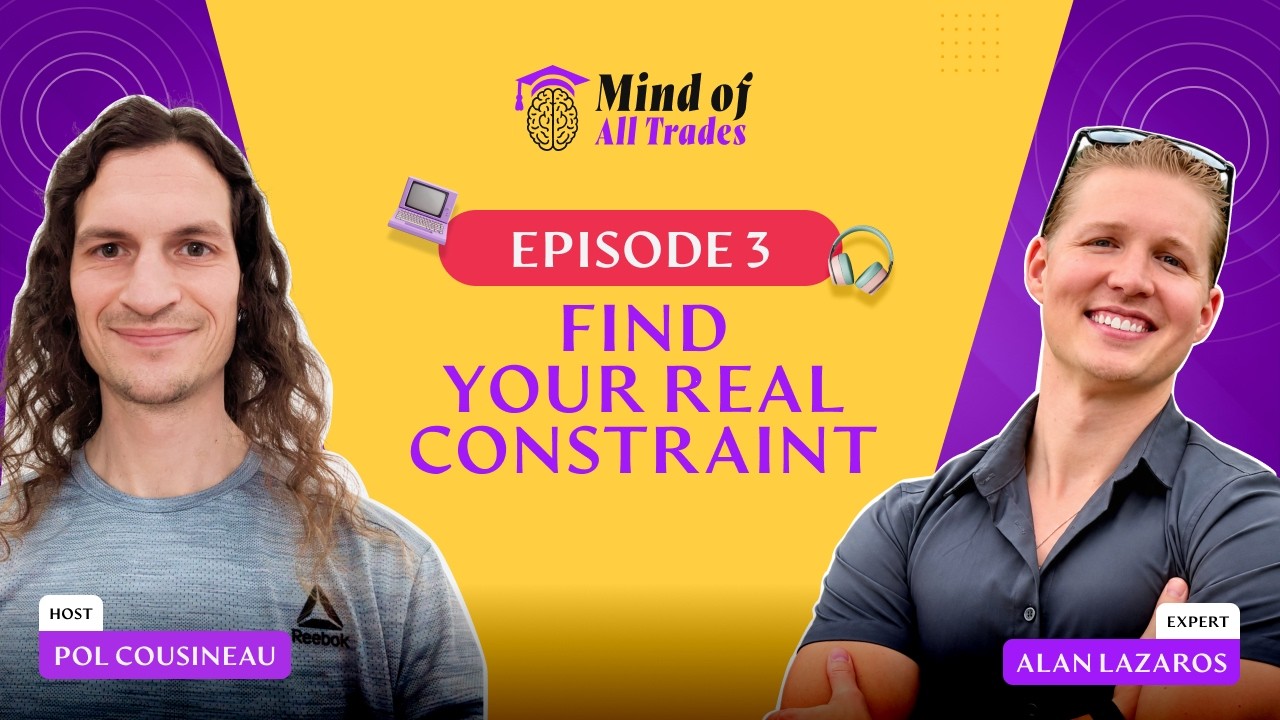
The Mindset That Scales Your Business
Description
Most people are just cowards, including himself. That’s Alan Lazaros’ actual claim on this episode, and he means it as an invitation, not an insult: fear is usually the real reason people don’t execute, not a lack of knowledge or effort.
Alan is the co-founder of Next Level University, where he offers weekly meetups and one-on-one and group coaching. He also co-hosts the Next Level University podcast, a global top 100 self-improvement show with more than 2,500 episodes and listeners in over 175 countries. He left a stable corporate path (he holds a BS in computer engineering and an MBA) to build a single podcast into a company with a 23-person global team, and says he’s helped generate more than $15 million in revenue for his own coaching clients. In this episode, he walks through his Constraint Theory framework: why chasing more effort is usually the wrong move, and why the real unlock is identifying the one thing actually limiting your growth.
In this episode, you’ll hear:
- Why “you are already enough” might be the worst advice you’ve been given
- How to actually find your constraint, instead of guessing at it
- Why most businesses aren’t measuring the things that matter, and what to track instead
- How to build a leaderboard culture with real titles, roles, and accountability
- The one metric (“true north”) Alan uses to guide every decision on his team
- Why courage, not competence, is usually the real thing holding people back
About Alan Lazaros
Alan is the CEO of Next Level University, a podcast about personal and professional development. He’s also a business coach who helps people achieve their goals by tracking habits and making decisions based on data. If there’s one thing he wants you to take away from this episode, it’s the importance of habits and the compound effect in reaching your goals.
Check out Alan’s own show and connect with him:
- Next Level University podcast: nextleveluniverse.com
- YouTube: youtube.com/@NextLevelUniversity
- Instagram: instagram.com/alazaros88
- Facebook: facebook.com/alan.lazaros
- LinkedIn: linkedin.com/in/alanlazarosllc
Follow Mind of All Trades:
- YouTube: youtube.com/@MindofAllTrades
- Spotify: open.spotify.com/show/4MixC1mfhhUVIOFO1mywUc
- Apple Podcasts: podcasts.apple.com/us/podcast/mind-of-all-trades
- Instagram: instagram.com/mindofalltrades
- Amazon Music: music.amazon.com — Mind of All Trades
- LinkedIn: linkedin.com/company/mind-of-all-trades
Theme music by Breakmaster Cylinder.
Also Listen On


Transcript
Click to read the transcript
[00:00:00] Alan Lazaros: I think that
[00:00:00] you’re not enough.
[00:00:01] I think you have
[00:00:01] to get better,
[00:00:02] and I think that
[00:00:03] the moment you think
[00:00:03] you’re enough,
[00:00:04] you’re not going to
[00:00:05] succeed at the next level.
[00:00:06] Pol Cousineau: And my hunch is
[00:00:08] there is something uncomfortable
[00:00:10] that is preventing
[00:00:11] them from doing it.
[00:00:11] And I suspected
[00:00:12] there might be
[00:00:13] a social anxiety
[00:00:14] Alan Lazaros: Courage is probably
[00:00:15] the issue there.
[00:00:16] There’s probably a fear.
[00:00:19] most people are just cowards,
[00:00:20] including myself.
[00:00:21] Like we’re just afraid.
[00:00:22] Afraid of success,
[00:00:23] afraid of failure,
[00:00:24] afraid not to fit in,
[00:00:25] afraid to call it out,
[00:00:26] afraid to express your truth,
[00:00:27] Remember, the tallest tree
[00:00:28] always gets chopped down the most.
[00:00:30] Pol Cousineau: The message around fear
[00:00:32] really resonates with me.
[00:00:33] I’ve lived and I continue
[00:00:35] to live with fear
[00:00:36] throughout my whole life.
[00:00:37]
[00:00:44] Pol Cousineau: Welcome to Mind of All Trades, the podcast where edupreneurs turn knowledge into impact. I’m your host, Pol Cousineau, and together we explore the craft and commerce of educational businesses. We look at the strategy, we look at the systems, and we look at the real implementation work that has to happen behind the scenes.
[00:01:04] Before we dive in, make sure you subscribe so you don’t miss future episodes. We’ll be sharing practical guides, conversations, and examples for edupreneurs who are building real momentum in their business, and for coaches, course creators, podcasters, and membership site owners who need help with the tech behind the business.
[00:01:24] Check out The Digital Navigator. The Digital Navigator helps with fully managed websites, funnels, analytics, automations, and ongoing tech support. So instead of having a bunch of disconnected tools, your systems can work together, and you can spend more of your time focused on the business, the offer, and the people you serve.
[00:01:45] You can learn more at thedigitalnavigator.com. Now, let’s jump into today’s episode.
[00:01:51] and today’s guest is Alan Lazaros, co-founder of Next Level University, where they offer weekly meetups and one-on-one and group coaching. Alan also co-hosts the Next Level University podcast, a global top 100 self-improvement podcast alongside Kevin.
[00:02:10] The show has more than 2,500 episodes, yes, you heard that right, and listeners in over 175 countries. He holds a BS in computer engineering and an MBA. He left a stable corporate path to build what started as a single podcast into a company with a global team of 23 people. Along the way, he says he’s helped generate more than $15 million in revenue for his own coaching clients.
[00:02:39] Alan teaches that success isn’t a secret. It’s a system built on habits and data-driven decisions. You can connect with Alan through his website, nextleveluniverse.com. Welcome to the show, Alan.
[00:02:53] Alan Lazaros: Whoa, great intro. Thank you very much for having me. I am honored. I always say, “Alan, no matter how good things start to go, don’t forget when it was crickets and no one cared.” So thank you for having me. I really appreciate it. You were very graceful. I was on a, with a coaching client, so I was a little late to our meeting here, but I’m, I’m really honored, and I appreciate it.
[00:03:14] Pol Cousineau: I’m excited because you’ve really built a huge team around Next Level University and the Next Level Universe website. And this is something that we like to dive deep at Mind of All Trades, is understanding how are those operations, like what is it behind the scene of the educational business, and I thought that you would have just a wealth of knowledge for us
[00:03:38] Alan Lazaros: Mm-hmm. Yeah, so I think leadership is– uh, we talked about this off air. Leadership, I think, is the biggest competitive advantage in the future, and it’s leading people. And I think that that is the hardest thing to do, particularly I have a fully virtual team, right? So, so none of us are in person. So how do you keep– how do you optimize individuals, teams, and businesses on the internet when you aren’t seeing them day-to-day in person?
[00:04:02] And I have systems and what I call a runway, quote-unquote runway, uh, that I do seconds, minutes, hours, days, weeks, months, quarters, years, decades. And my runway, I think every company needs a runway. It needs some sort of a structure. Too much structure and you get bogged down. Too little structure and it’s, it’s chaos
[00:04:21] Pol Cousineau: Hmm. So the runway helps to set a certain pace? ‘Cause you mentioned all these different frequencies of intervals
[00:04:27] Alan Lazaros: Exactly. Yeah, so, so my runway is one podcast episode per day. I have a book club that I do every week. I have a masterclass I do every month. We have a group coaching program every 12 weeks, every quarter, and then we have a Next Level Hope Foundation event every year, and that’s a charity event. I also have internal– So those are the external runways, that’s like the products and services, and then I have an internal runway with the team where we do biweekly team huddles where every single director is on the huddle live, and then we review each department.
[00:05:00] Right now, we have 13 departments, and we do green, yellow, red on– Green means we are green and growing, yellow means we’re coasting, and red means we’re sucking. And it’s, it’s basically we do green, yellow, red for all 13 departments, and then we do a most important improvement, and we kind of cross-pollinate and discuss where the bottlenecks are.
[00:05:19] Because m- my whole company, my coaching too, is built on constraint theory, and I think this is one of the reasons why, why I f- seem really negative to, to a lot of people. Constraint theory, th- the internet seems to be convinced lately that you’re already enough and, and, you know, you’re already good enough and, and, you know, you’re doing great and all that stuff.
[00:05:42] I actually don’t agree with any of that. I think that you’re not enough. I think you have to get better, and I think that the moment you think you’re enough, you’re not going to succeed at the next level. I, I think that success makes life harder, not easier, but you handle hard better. And so my whole system, my whole company is built on the idea of constraint theory, which is there’s always a greatest limiting factor. And it, it can be per- people, it can be, uh, internal inside of you, like maybe you’re a coward. I, I was definitely a coward in my early 30s. Uh, it could be– But, but the point is, is that the reason you’re not more successful is not because you don’t believe enough in what you already believe. The reason you’re not more successful is because there’s a constraint.
[00:06:23] It’s a person, place, thing, or idea that is just bottlenecking the whole company. And my job is to constantly identify the constraint and rectify the constraint every single day, and that’s what I do with my clients, that’s what I do with my team, and that’s what I do with myself and my own life. Like lately, my biggest constraint is my time.
[00:06:41] Okay, so how do I get back more time? How do I buy back more time?
[00:06:45] Pol Cousineau: Right. So even before going to your constraint, how do listeners find out what their constraint is, right? ‘Cause if they buy into that but you find the right, the wrong one, you might be working on the wrong thing is what I’m thinking
[00:06:59] Alan Lazaros: So you can’t find a constraint until after you set a goal. A- and so that’s the first step. Uh, so what I’ve found out is that I’ve been coaching for 11 years, and I’ve, I’ve found these patterns that I notice. One of them is if you have higher self-belief, you’ll have higher goals. If you have higher goals, you’ll have to have, you’ll have to identify and rectify constraints.
[00:07:21] So, for example, if you and I have no goals, there are no constraints.
[00:07:26] Pol Cousineau: That makes sense ’cause there’s nothing stopping us from achieving nothing.
[00:07:29] Alan Lazaros: Exactly. If you and I wanna go for a run and I say we wanna run a six-minute mile, my constraint is my right knee. See? You can’t identify a constraint when you don’t have any goals. That’s why I’m so frustrated that the internet is trying to convince you you’re already enough.
[00:07:43] Enough for what? Enough, like intrinsically, sure. But if you have goals, like if you have a dream and you’re a kid to be in the NBA, only .017% of all people even have a chance to play D1 starter. So, so you’re not enough. That, that’s so not accurate. It’s, it’s– As an engineer, it’s, it’s offensive. I’m not enough either.
[00:08:07] W- like if I wanna get to the next level, I have to identify the constraints. So, so to answer your original question about the listeners, how do they identify their constraint? It all depends on their goal. And this is why podcasting is so hard for me versus coaching, because when we’re coaching, I know your goals, I know your circumstances, I know your limiting factors, I know your internal and external.
[00:08:26] I can ask questions. I was just on with a client earlier, that’s why I was late to this, and he has a team of seven, and we… What are your goals? Okay. These are the constraints. Okay. Leadership. All right, this person, I’m meeting with her tomorrow, is or is not doing her job well. Okay, why not? We gotta figure out why.
[00:08:43] We gotta constantly identify and rectify the constraints inside the company, inside the individuals at the company. So if a listener wants to get started on this, they have to say, “Okay, what’s your most important goal?” We just finished a 10 pounds in 10-week challenge. It’s a good example. So it was July 1st to February 8th.
[00:09:02] We weighed in yesterday, and the idea was to lose 10 pounds in 10 weeks, which means you need a 500-calorie deficit on average every day for 70 days straight. I hit 190 on the dot. I had to cut a little bit of water. But if you have that goal, this is the point. If your goal is to gain 10 pounds in 10 weeks, eating more is a good thing.
[00:09:25] If your goal is to lose 10 pounds in 10 weeks, eating more is now a constraint. It’s a bad thing. It’s destructive, not constructive. So to answer your question, it’s, it’s kind of I can’t answer it because I don’t know their goals.
[00:09:37] Pol Cousineau: Hmm. But it at least starts with that goal, and then from that moment on, it seems like there’s an evaluation, right, of strengths and weaknesses to then try to find out, okay, well, between all the parameters, which one would actually hold you back? Like, I’m trying to think about something that’s simpler. I was doing some training so I could actually dance longer.
[00:10:00] It’s kind of a funny thing. Well, the constraint was my cardiovascular system and my recovery, right? So then I did jump rope training very specifically hitting, right, those blasts, like going intense and not and HIIT type training. But it’s because I identified that weakness
[00:10:17] Alan Lazaros: So your v- your VO2 max is the constraint. And, and the goal should be based on that, which is… So the, the goal– What’s the goal of the goal? So your goal is to, uh, do better trainings to have a bigger impact. Okay. The constraint is I can’t dance long enough. Okay. Why? Because your VO2 max is too low to sustain the rate that you’re at.
[00:10:40] So, so what, what I would have you measure is VO2 max. It’s probably for you, I don’t know what it is, maybe it’s 40, right? Maybe you need to get to 50. So now you have to train. Jump rope training increases your VO2 max over time, and now you are more capable. And I think that that– I think that’s why as an engineer, I, I get, um… Yeah, I guess frustrated is the right word, because y- you go into companies and you, you realize that no one’s r- not no one, but there’s so, there’s so much potential. But if you don’t have clear goals that are, that are timeline and targets, you can’t identify the limiting factor, and you certainly can’t work on it.
[00:11:22] So there’s a book called “Measure What Matters” with the main consultant at the beginning at Google. And I remember my beautiful girlfriend and future wife, she recommended this book and she said, “Okay, ours, it’s objectives and key results.” And I said, “Okay, duh.” And she said, “No, Alan, for you, that’s okay, duh.
[00:11:37] But most people aren’t measuring things.” So every client, I have 48 now, we measure every team, if we’re gonna talk about leadership, you need a title, you need a DRI, and a KPI. So a title is I’m the CEO. Okay. What am I responsible for? DRI, this is a Steve Jobs thing. What’s the directly responsible individual?
[00:11:54] What’s one sentence of my job? My job is to grow the, the Next Level University company by 41% year over year, which doubles the income every two years with integrity. With integrity. ‘Cause there’s a lot of way to- ways to grow a company that are not in integrity. Okay. The third one is what’s the KPI? Gross revenue. I think that the majority of companies, and this has been genuinely alarming for me, are winging it. They don’t have clear metrics. They don’t have clear measurements. Like, I always joke, what if Michael Phelps’ coach was like, “Yeah, just jump in, swim around”? It makes no sense. In sports, we measure every stat.
[00:12:32] In business, we don’t measure enough, and we have our CPA do it for us and, and it’s like you can’t make strategic decisions without measuring where you’re at and where you’re headed.
[00:12:42] Pol Cousineau: But I would even argue that the CPA, they don’t even make it do it because in the educational businesses, I’ve noticed that the accounting side is extremely weak, and most clients that I work with, I find out that, oh, their books are six months behind, three months behind. I’ve had clients that had their books and tax filings three years behind.
[00:13:03] Alan Lazaros: Угу
[00:13:04] Pol Cousineau: And oddly enough, that doesn’t ring alarm bells, but then they say, “Hey, I need more money. The company’s not profitable.” And then I look at it and I say, “Hey, wait. Somehow you bought an RV with the business funds. You’ve been traveling to all these conferences,” right? So there is money coming in, but they’re just completely oblivious
[00:13:23] Alan Lazaros: Data-driven decisions. That, that’s, that’s what I hope comes of this episode The people that really succeed, uh, sometimes they’re– I, I always playfully say either, either they’re full of it or they’re, or they’re, or they’re, uh, really strategic. Some people are really successful, I’ve found this out, and then there’s other people around them that are actually making them successful.
[00:13:47] That’s, that’s very much a thing. Okay. But most of the time, if you find someone, everyone, everyone listening, think about someone who wins at everything. They, they are successful in everything. They’re healthy, they’re wealthy, they’re in love, they’re just crushing life. I guarantee you a couple things.
[00:14:05] Number one, they’re not winging it. Number two, behind the scenes, they are failing way more than you think. I have a client who applied to 140 jobs. She got an aligned great dream job, but she applied to 140 jobs. She got 30 people to respond, she got 10 interviews, and she got one job offer. You don’t see the 140 failures, you’re seeing the one job offer and, and the Instagram post about it.
[00:14:34] And so if nothing else comes of me ranting here, I hope no– like, you stop winging it. That’s what I’ve found is like… And again, I’m an engineer, I’m a little excessive, I’m esoteric, I get it, but you’re not gonna win and wing it. You, you need to make data-driven decision-making, strategic decision-making based on actual data, not based on your feelings.
[00:14:56] The joke I always make is every time I’ve ever swam in the ocean, I felt like I was gonna get eaten by a shark. My f- your feelings are lying all the time, okay? I’ve never been eaten by a shark, obviously. If you research the stats, less than one shark death per year in the entire US, that’s 350 million people.
[00:15:17] There’s large coasts. Everyone feels like they’re gonna get eaten by a shark when they’re in the ocean. Your feelings are not accurate. As an engineer, the reason you’re not successful is errors in thinking, irrationality, making decisions based on feelings, not your, your rational brain. And, and yes, listen to your heart, but don’t forget to listen to your brain.
[00:15:38] You need, you need to reconcile logic and emotion. And, and what I’ve found is that numbers help you be more rational, and, and I think every company needs an engineer in their corner. Because y- you feel like you’re winning, you feel like you’re losing. Neither one is true. You’re at exactly this p- spot, and I think we’re all kinda like a self-driving car with inaccurate maps, and we keep driving off a cliff thinking it’s a road, when in reality it’s like MapQuest back in the day.
[00:16:10] You never get there. A- and, and that’s really what it is. You have to understand yourself, others in the world, and, and you have to have updated data about yourself, others in the world, and then you have to constantly find errors in thinking, and you have to constantly make rational decisions based on data and numbers and metrics.
[00:16:27] And, and if you’re winging it, you are going to lose. Unless your subconscious and unconscious is in not winging it, which some people do. Some people are really successful but don’t actually consciously know why, and then they’re teaching you a course or whatever, and some of your listeners may be. It, it– You, you have to dissect, like, why your decision-making paradigm is aligned the way that it is to figure out whether or not you’re actually able to sort of teach it
[00:16:55] Pol Cousineau: So I’m pretty sure that most of our listeners are not using that much data in their decisions, at least from what I can observe generally with my interactions. And it could seem very daunting to do that shift. Like, there’s something intimidating by gathering data and then using it afterwards. Like, when it comes, it’s almost like they glaze over that.
[00:17:18] And then we’re talking about leadership to get your team to actually care and act on that data when it’s already very hard for them. So what would you recommend as a way to start building in that culture or in that approach for a business that’s not doing it?
[00:17:34] Alan Lazaros: Yeah, as simple as possible. I call it a leaderboard. I have mine up over here. Uh, I hover over, it’s in Google Sheets. I hover over 23 team members. Every single team member has a title. This is identity level leadership, like CEO, CSO, COO. Okay, director of group coaching, director of book club. In the, uh, your identity, it’s when you say do your job, what is your job?
[00:17:58] It’s based on the title typically, unconsciously. Like if I’m a– Are you a runner who also weight trains or are you a weight trainer who also runs? See, identity level, it, it puts us in a box, but in this case it’s an empowering box instead of a negative one. So every team member needs a title. You’ve gotta start there.
[00:18:14] Make sure the title is appropriate for what you want of them
[00:18:17] Pol Cousineau: And do titles get reused or are they unique?
[00:18:21] Alan Lazaros: I think every company needs certain functions. So I’ll give you an example. Depending on the size of the company, the chief officer suite gets bigger, so like chief information officer, chief technology officer, chief CHRO, chief human resources officer. Like I have a small company, so it’s, it’s only 23 people, so we don’t need a, a chief technology officer.
[00:18:45] But what the three that I recommend out of the gate with every company, once you do build a team, CEO, which is the strategic visionary, CFO, finances, and then COO, operations. So the CEO is vision and strategic thinking long term, leading people. CFO is tracking the finances and making data-driven assessments of the company, and COO is making sure everyone’s doing their goddamn job. And, and, and obviously all three do all three, but that’s the triad of, of a successful company, I think. I think you need those three, and sometimes those three are all the first pers- like one person at the beginning.
[00:19:30] Pol Cousineau: Mm-hmm.
[00:19:31] Alan Lazaros: So the CEO has to be all of them until he or she has other team members. And so number one is get the titles right, and it…
[00:19:40] You can choose whatever title you want, but just be– understand that people’s identity plays into what they do and don’t do. Everything someone says, thinks, does, feels, and believes is predicated on identity. Are you a boy or a girl, a man or a woman? See, those are all different things. Are you a CEO or are you a director or are you a, a, an operator?
[00:20:01] Are you a manager or a leader? See, the- there’s such a different understanding. The label comes with it an understanding, difference in a rabbit and a tortoise, and, and then the understanding changes how we operate within that label. So that’s number one is the title has to get, has to be right. So if I were to coach your listeners, you’ve gotta have a leaderboard with all your team members on it, freelancers included, and make sure it’s hierarchical.
[00:20:27] It has to be hierarchical. People need to know who’s their boss and who’s their boss’s boss. We don’t use boss, we use leader, but at the end of the day, there needs to be some chain of command to some extent. Everyone wants a flat company now. It makes no sense. Now, I don’t believe in like y- I don’t believe in managers and managers and managers and all that stuff, but I do think companies can be less flat than they, uh, less hierarchical than they used to be.
[00:20:52] But you need to have sort of like leadership team and then like directors and then team members, and then freelancers. That’s what I would recommend. So, and then once you have the leaderboard and the list of all your team members, you need a title for each of them that they, that they know and they agree to and they buy into.
[00:21:10] Uh, one sentence of what they are responsible for, the outcome they are responsible for. So I’ll give you an example Facilitate weekly book club sessions with excellence. That’s Brandon on my team. He’s the director of book club, okay? I am book club sort of facilitating it, but he is hosting the room, making sure everyone’s there, blah, blah, blah.
[00:21:32] He’s the virtual event coordinator every single week. Okay That’s the DRI, directly responsible individual. One sentence explaining what the title is responsible
[00:21:42] Pol Cousineau: And that one sentence seems important, right? So it doesn’t get a book instead, and then it loses clarity and focus
[00:21:49] Alan Lazaros: Back to constraint theory, Einstein, the whole, like, make it as simple as possible, but not any simpler than it should be. It’s that same thing. Like, for example, I do a bunch of stuff, but what’s the, what’s the, what’s the high order bit? What’s the, what’s the most important thing that I– If I owned, I do own my company, but, like, let’s say I invested in my company and, and I was coaching me as the CEO, what would I put as my direct responsibility?
[00:22:21] What would I point at? What’s the true north? It would be grow the company by 41% year over year. So 0.1% per day leads to 9% per quarter, leads to 41% year over year, which means you double your income every two years, which gets very– You grow fast, okay? That’s, like, nearly impossible, what I just said, by the way.
[00:22:38] It’s very hard to do that. You– It’s possible, but it’s really difficult. 26%, you double your income every three years. Uh, 19%, it’s every four years. So for me, 19% is red, 26% is yellow, 41% is we are absolutely crushing it. Right now, we’re projected for 55%, which is very exciting. Okay, so grow NLU gross revenue by 41% year over year with integrity.
[00:23:03] Boom. So one title, one sentence, CEO sentence. Now, none of this matters unless you track it. KPI, key performance indicator. So the KPI rolls up to the DRI, which rolls up to the title. Now you can play chess. Now you know where the pawns are, you know where the rooks are, you know where the knights are. It’s just a metaphor.
[00:23:26] Don’t get upset that I called someone a pawn, okay? It’s a metaphor. But now you know, okay, the knight does this L thing. Kev, I need you to do that L thing, man. And you gotta know who can and can’t do each thing, ’cause not everyone’s the same capability. So if you wanna be a great leader, you need to know yourself, others, and your company, and you need to know who’s good at what, and everyone else needs to have clarity.
[00:23:51] And the way that I s- see this is I coach at least four people with big teams. I said, ” If you’re unclear about what they’re supposed to do, how the hell are they supposed to be clear on it? If I’m not clear on what my team is supposed to be doing, how are they supposed to be clear on it?” So you have to constantly be looking at, okay, here’s our, our goal, grow the company by 41% within integrity.
[00:24:16] Okay. How do I do that? I have 23 people. I have these, this human resource, people, capital, and time. Okay. I’m gonna leverage people, I’m gonna leverage capital, I’m gonna leverage time. Okay. My… I’m gonna use my time to lead these people to achieve these goals. We make more money, then I reinvest that money into even more people or give people raises who are doing great, and, and that’s supposed to snowball.
[00:24:39] And again, that’s why podcasting’s so difficult, because I’m trying to condense a year’s worth of coaching into one show. But unless we get tangible with your team and your company and your industry and your titles and DRIs and KPIs, you’re just gonna be like, “This is too overwhelming. I’m not even gonna start.”
[00:24:58] So you gotta start small and just optimize individuals, teams toward common goals and sort of rally the team and orient the team underneath the goals of the company
[00:25:11] Pol Cousineau: Now you mentioned the KPIs, so those are the targets that we can measure. Are you giving them just one or multiple?
[00:25:18] Alan Lazaros: Three is the max. Uh, uh, that’s– I don’t wanna say that’s a lie. I, I, I try to roll everything up under three. And So if I were to give you my runway for individuals, the, it starts with a title. We’ve already talked about that. Then I don’t wanna complexify this too much, but I’m gonna give you this. So, so title, then it’s top three priorities per quarter. So Q3 ends in 21 days I do 12-week increments for goals So, so title, then it’s top three priorities. Then there’s three KPIs under each priority, and then those roll up to goals, which is basically just a KPI in the future.
[00:26:10] Pol Cousineau: Угу
[00:26:11] Alan Lazaros: Like, what do you want to grow that KPI to? 10 pounds in 10 weeks is a, is a goal. The KPI is tracking your weight and your calories. You see? Okay. A- and then I have top three habits, which is what’s the most important habit morning, afternoon, evening for each of those priorities. And then I have a most important skill, and this is basically just like, what’s the one thing that changes everything?
[00:26:34] So for me, it’s effective communication. I’m a coach, trainer, and podcaster. If I learn how to communicate more effectively, and if you zoom into effective communication like storytelling, that’s gonna make everything better. What’s the one biggest constraint towards your most important goal, and what’s the skill gap?
[00:26:51] Like, what’s the skill that you don’t have? And skill is meta-skill, skill, sub-skill, and it’s like a, a meta-skill is thinking about your thinking, a skill is effective communication in real time, and a sub-skill is storytelling within effective communication, which is three-act structure and that kind of thing.
[00:27:08] And so, but basically that’s what you have to do. You- your skill rolls up to your habits, your habits roll up to your KPIs, your KPIs roll up to your goals, your goals roll up to your priorities, your priorities roll up to your ultimate title of what you’re responsible for, and that’s how I have it set up.
[00:27:27] Because otherwise, everybody’s kind of off the rails all the time, and I think sports is the best metaphor for this. Like, sports have the structure necessary where it’s enough structure to keep people accountable, but not so much that it bottlenecks them. Like, if you’re a pitcher in the, in the MLB, you have a very different focus than a, uh, I don’t know, third baseman.
[00:27:57] However, you both have certain things that you both have to be on point with. You both have to show up on time. You both… So there’s commonalities between base– like M- MLB, NBA, NFL. There’s so many commonalities, but there’s so many differences and nuances too, and I think the same is true for companies, and even if it’s nonprofits or charities, like these are all organizations.
[00:28:21] What is an organization? It’s, it’s a group of people toward a common cause that needs to sort of track and stay accountable towards achieving that. And I really don’t think we learned in school, to the point of my, why I started this company 11 years ago, what you’ll never learn in school but desperately need to know.
[00:28:37] Like, I don’t think we learned in school how to, how to build successful teams and organizations, and then the people that do know it aren’t necessarily out teaching it.
[00:28:53] Pol Cousineau: Yeah. What you’re sharing here, it makes me think of how people might work hard, but it’s not moving towards their goal, and they’re not focused on the right thing, and, and it’s not being measured. I’m thinking of a recent example. There’s someone that had a marketing position, and it’s another business that I’m working with.
[00:29:13] And then I kept saying, “We need to get some videos up.” Like, there’s… You guys have a whole production room. There’s all these people that are available, yet somehow there’s, like, one video a month that I’m seeing getting produced. And where is your audience? They said, “On Instagram.” And where is the competitor taking their market shares?
[00:29:33] From Instagram. I said, “Well, the answer is pretty clear, right? We gotta get the videos going.” But somehow there’s, there was always something preventing the person from making those videos, and then everyone would say, “Oh, but they’re working really hard.” And I was like, “Yeah, but it’s unclear to me where their time is going,” ’cause I’m not doubting the effort of the person,
[00:29:56] Alan Lazaros: Yeah
[00:29:57] Pol Cousineau: but they weren’t spending their air- like, their efforts in the right area.
[00:30:02] And my hunch is there is something uncomfortable that is preventing them from doing it. And I suspected there might be a social anxiety ’cause they would have to interact with everyone else, make the video production. But that was a guess.
[00:30:16] Alan Lazaros: Courage is probably the issue there. There’s probably a fear. Uh, we actually have a client who I was on with earlier, and he is awesome at running his company, but he’s not He’s scared of being the face of the company. And, and I basically said, “We can’t do our job of generating leads for you and your company unless you do your job of, like, being the face of the brand.” And I’ve found that there’s two types of constraints to go back to top here. There’s external constraints, which is that team member has the wrong title with the wrong KPI toward the wrong DRI. Okay, that’s external. But an internal constraint is that person lacks courage. For me, the biggest constraint is courage.
[00:31:12] I don’t wanna talk about any of this. I– As an engineer, nobody even likes you. They just want you to shut up and leave them alone and then go do the work. I’m a very loud engineer because I want to help people with things. Like, here’s another thing I don’t wanna share. Most people walk around thinking they’re really smart.
[00:31:33] When you go to engineering school, you realize that most people aren’t, okay? Engineers are really freaking smart, and, and we walk around with a lot of the answers, but nobody asks. And so I’m this, like, preachy, coachy engineer who looks like a Ken doll. Like, it’s not a good look. But I, I would rather be courageous and, and help people than, like, sit behind a desk and just win by myself.
[00:31:59] Like, I easily could just go trade and finance. Like, I had a, I had a large successful portfolio when I was young. Uh, like, investing to me isn’t difficult. I, I chose a career that, that I believe in deeply but I kinda hate, and I’ll explain. I love coaching ’cause it’s behind the scenes and it’s safe, and I basically get paid to tell people what I think.
[00:32:22] But in public, I don’t let… Like, imagine me at a barbecue. ” What are your biggest constraints today?” Like, uh, it’s the worst, right? So, so the social world for me, I’m not interested. I like coaching ’cause it’s private, behind the scenes, and you literally pay me for what I actually think, not for the niceties.
[00:32:39] And, and most of the reason people aren’t successful, as I already mentioned, is because they’re actually not competent. They’re not capable. They’re not, like, measuring the right things. They’re actually wildly inadequate in many regards. Like, that’s the real reason, but no one wants to talk about that ’cause now you’re mean But, but if I actually– Do you wanna achieve your goals or do you want me to be nice? Because no one ever reached their full potential without someone helping them identify their blind spots and their inadequacies and working on it. Like Michael Jordan wasn’t like, “Ah, you know, I guess I’ll just hang out and hopefully win a tr- a trophy.” Like he, he every single day was like, “Where am I failing?
[00:33:21] Where am I sucking? Where am I the worst? How do I get better? Like, what is the problem? Is it that team member? Is it me? What is the deal?” And I think that like a Tom Brady or a Michael Phelps, like it’s another good example, Serena Williams, they are constantly looking at where they suck. They are constantly looking for the constraint. And if you want a friend, that’s not what you want most likely. If you want a coach, they’re gonna basically identify everywhere you’re failing, and you’re gonna feel like a failure because I’d rather fail at a big game than win at a small one. That’s the small f- fish, big ocean versus the big fish, small pond.
[00:33:56] And I think a lot of people really are a big fish in a small pond, and they feel smart. It’s like there’s levels. There’s levels, right? Everyone feels good at T-ball. You know? Every– I would much rather lose at Major League Baseball than play T-ball and feel like a winner. But most people would rather feel good than actually get better, and that’s probably the biggest…
[00:34:17] But to, to bring this, land this plane, it’s courage. Like most people are just cowards, including myself. Like we’re just afraid. Afraid of success, afraid of failure, afraid not to fit in, afraid to call it out, afraid to express your truth, afraid you’re gonna say something wrong, afraid you’re gonna look dumb, afraid you’re gonna be smarter than and people are gonna hate you, afraid you’re gonna…
[00:34:35] Remember, the tallest tree always gets chopped down the most. There’s a lot, a lot of courage that it takes to actually make meaningful change in this world, like tremendous, and I think that’s the internal constraint for most of us is some s- it’s either humility, courage, or vulnerability. That’s what I’ve found.
[00:34:53] And the external constraints are just you don’t measure, you’re not consistent, you don’t have systems. And, and so I can help anybody. What I’ve learned is the people who are actually humble enough to ask, like you, this has been a pleasure so far, uh, those are the people I wanna help. Anyone who thinks they’re better than they are is nearly impossible to help.
[00:35:13] ‘Cause if you already think you’re great and you’re, and you’re losing, there’s nothing worse than someone who’s losing s- and still thinks they’re great and feels good about it. It’s like you– I can’t help you. I can’t help that person. The, the person you can help is the person who just ate a bunch of humble pie and they’re like, “Yo, I’m a mess.
[00:35:31] I need some help.” That is the person I’m looking for
[00:35:34] Pol Cousineau: The message around fear really resonates with me. I’ve lived and I continue to live with fear throughout my whole life. It’s been such a strong emotion, and what I found is I can be afraid and still take action. And something that has helped me is thinking, okay, if it wasn’t for this fear or if I wasn’t the one that had to do it, what would I do?
[00:35:58] So let’s say I have to let someone go. If I wasn’t the one that had to let them go, what would I do? And I’m like, “Oh, yeah, I would say let, let them go,” right? So I’m like, “Okay, you gotta get in there, Pol. Now you just gotta do the hard work. Now you’re really afraid, but that’s okay.”
[00:36:12] Alan Lazaros: it’s the worst, man. Letting someone go is the worst.
[00:36:15] Pol Cousineau: Exactly, right? So I, I really appreciate the time that we’ve had together. This was very condensed, and I wanted to jump straight in, which you did, and I really appreciate that. For our listeners, I wanna remind people that they can connect with you through nextleveluniverse.com, and from there they can see some of your coaching programs and they can also get access to the podcast, which I definitely encourage.
[00:36:41] At over 2,500 episodes, there is a lot of gems there. Is there something you wanna share before you head out?
[00:36:48] Alan Lazaros: Uh, just thank you. This was wonderful, man. This was great. I, I, I feel respected, I feel appreciated, I feel celebrated by you in particular, and that is not always the case. So thank you for having me. It’s an honor. I appreciate it. And for anyone who did listen, I just, just take whatever it is… I say this before every group coaching session.
[00:37:04] We do 12-week program. We’ve been doing it for 23 groups, which is like five-plus years now. I say, “I don’t ask you to like me. I don’t ask you to like the content. I do ask you to get better. And, and I’m here to prioritize you getting better because when you get better, the world gets better. When you get better, your future gets brighter.”
[00:37:21] And the world needs more deeply fulfilled, goal-achieving, conscientious adults that, that have a bright future, because the opposite is nihilism and hopelessness. So thank you for letting me be a part of that, man. I appreciate it. Reach out anytime. This was a genuine pleasure and, uh, until next time
[00:37:37] Pol Cousineau: Yes. Until next time, thank you for coming on Mind of All Trades.
[00:37:42]
[00:37:44] Alright. Let’s talk about The Digital Navigator in more detail. This platform is designed specifically for digital entrepreneurs who want to run their business without getting stuck in the tech weeds. We all know how overwhelming it can be to juggle websites, email automation, funnels, CRM systems, analytics, and so much more.
[00:38:08] Every tool can feel like a separate job in itself, and most small teams or solo business owners end up wasting hours trying to make everything work together. The Digital Navigator solves that problem. Their team handles everything, from building and maintaining your website to managing your email marketing, optimizing conversions, setting up analytics dashboards, and even creating advanced automations.
[00:38:37] Basically, they become your tech department, so you don’t have to hire, train, or troubleshoot yourself. And here’s where it gets really exciting. They offer the Diamond Plan, which is a fully managed system for serious online business owners. This plan isn’t just hosting or maintenance. It’s a complete solution that replaces ninety-five to one hundred percent of the software tools you use today.
[00:39:06] That includes your website platform, email marketing automation, analytics, CRM, affiliate management, e-commerce, and even custom development hours for tweaks or new features. With the Diamond Plan, you get a professionally managed website and marketing system, advanced automations for email, funnels, and customer journeys, analytics dashboards that give you real insights, dedicated development hours to customize your tools to your exact needs, and ongoing expert support so nothing breaks or slows you down.
[00:39:46] It’s like having an entire team of developers, marketers, and tech specialists without hiring in-house. The plan is designed for course creators, membership site owners, coaches, and podcasters who wanna save time, reduce headaches, and scale faster. If you’ve been struggling with juggling too many platforms, missed deadlines, or tech that never quite works together, the Diamond Plan is built for you.
[00:40:15] You can check out all the details at thedigitalnavigator.com/pricing and see how it could completely change the way you run your business. You can also schedule a consultation with the team to learn more about the Diamond Plan and clarify any questions you might have The Digital Navigator has over 10 years of experience providing tech and marketing solutions to edupreneurs and course creators like you and has helped grow their businesses to over six figures.
[00:40:47] Seriously, for anyone looking to focus on content, growth, and revenue without getting bogged down by tech, this is a real game changer.
Highlights & Timestamps
[03:38] – Constraint Theory: Why “You’re Enough” Is the Wrong Message
[06:45] – How to Find Your Constraint
[11:34] – Why You Have to Measure Everything
[17:34] – Building the Leaderboard: Titles and Roles
[23:06] – Tracking the Right KPIs
[28:51] – The Real Reason People Don’t Execute: Courage

About Host
Pol is a strategist and mentor who’s helped countless educators and entrepreneurs scale their businesses with clarity and ease.
From running a data-driven digital agency to co-founding an eLearning platform, he brings both technical expertise and heart-centered leadership.
With Mind of All Trades, Pol brings those lessons to the mic… helping you learn what it really takes to succeed online.
Recent Episodes
Fear Is the Poison of Any Workplace - Bruno Cignacco - Part 2 - EP 13 –
S1 Ep13

Pol Cousineau
October 29, 2026
“Fear is the venom, the poison of any work environment.” Bruno Cignacco says it is the first thing a leader should look for.
In Part 2, Bruno and Pol Cousineau get practical about what a compassionate business looks like day to day. Bruno explains why qualitative factors like kindness and cooperation should come before the numbers, how an anonymous survey can show whether your team is working in fear, and why serving customers is different from selling to them. They also cover why high tech needs high touch, what Trader Joe’s kept when others automated, how fully online teams can build trust, and the one question Bruno asks himself every morning.
In this episode, you’ll hear:
- Why qualitative factors like kindness and cooperation should come before the numbers
- How to find out if your team is working in fear, using anonymous surveys and suggestion boxes
- Why fear makes people defensive, less creative, and worse at serving customers
- Serving versus selling: finding out what customers need and giving more than they expect
- High tech and high touch: why customers still need to reach a real person after they buy
- What Trader Joe’s kept when other grocers moved to self-checkout
- A weekly social hour for online teams, and why knowing the person matters more than the role
- The second edition of The Art of Compassionate Business, and the question Bruno asks every morning
Chapters:
00:00 – Coming Up and Intro
02:40 – Measuring Compassion: Qualitative vs. Quantitative
11:28 – Fear in the Workplace, Groupthink and Serving vs. Selling
24:16 – Experience Engineering: High Tech Needs High Touch
30:38 – Test Your Own Customer Experience
33:11 – Trader Joe’s: Why Real People Beat Self-Checkout
38:46 – Keeping Remote Teams Connected
44:30 – Why Social Time Boosts Productivity
48:28 – The Second Edition and What COVID Changed
55:17 – Closing Advice: Add Value to Every Stakeholder
About Bruno Cignacco
Bruno Cignacco has run his international consultancy since 1993. He is an international business consultant, TEDx speaker, university lecturer, and bestselling author with more than 30 years of experience advising and training hundreds of companies worldwide on international trade, marketing, negotiation, and compassionate business. He is a Senior Fellow of the Higher Education Academy in the UK, and in 2024 he was named by World’s Leaders Magazine as one of the world’s most transformational leaders changing the face of business. Bruno teaches that companies can be profitable and compassionate at the same time, and he is based in London.
Bruno’s book, The Art of Compassionate Business: Main Principles for the Human-Oriented Enterprise, is published by Routledge.
Check out The Art of Compassionate Business, written by Bruno Cignacco: https://www.routledge.com/The-Art-of-Compassionate-Business-Main-Principles-for-the-Human-Oriented-Enterprise/Cignacco/p/book/9781032445427
Connect with Bruno:
- Website: https://brunocignacco.com/
- LinkedIn: https://www.linkedin.com/in/dr-bruno-roque-cignacco-sfhea-0609317/
Want to be a guest on Mind Of All Trades? Apply here: https://mindofalltrades.com/podcast-application
Visit The Digital Navigator: https://thedigitalnavigator.com/
Follow Mind Of All Trades:
- YouTube: https://www.youtube.com/@MindofAllTrades
- Spotify: https://open.spotify.com/show/4MixC1mfhhUVIOFO1mywUc
- Apple Podcasts: https://podcasts.apple.com/us/podcast/mind-of-all-trades/id6807196830
- Instagram: https://www.instagram.com/mindofalltrades/
- Amazon Music: https://music.amazon.com/podcasts/32ce7fa4-4473-4c53-9256-7fca60e47331/mind-of-all-trades
- LinkedIn: https://www.linkedin.com/company/mind-of-all-trades/
Theme music by Breakmaster Cylinder.
Listen Now
Profit and Compassion Aren't Opposites - Bruno Cignacco - Part 1 - EP 12 –
S1 Ep12
Pol Cousineau
October 26, 2026
“By caring for them, you’re caring for your business.” Bruno Cignacco has spent years researching companies that are both compassionate and highly profitable.
In Part 1, Bruno and Pol Cousineau put a big question to the test: can a company be compassionate and profitable at the same time? Bruno explains the principles behind it, from social reciprocity and respecting people’s autonomy to treating the human being as the most important resource in any business, and why Patagonia ran an ad telling customers not to buy its jacket. They close on a free, actionable tip any business can use: read your reviews, look for the patterns, and learn from the companies in your space with the best ones.
In this episode, you’ll hear:
- Why profit and compassion aren’t incompatible, and what Bruno’s research found
- Social reciprocity: why people who are cared for give their best in return
- Respecting autonomy instead of micromanaging employees or hard-selling customers
- Why the human being is the most important resource in any business
- What Patagonia’s “do not buy this jacket” ad says about long-term thinking
- Under promise, over deliver, and why one weak department can undo the rest
- A free research tip: read your reviews, find the patterns, and study the companies with the best ones
Chapters:
00:00 – Coming Up and Intro
02:30 – How Profit and Compassion Intersect
10:42 – Patagonia and the “Do Not Buy This Jacket” Ad
19:40 – When Bad Practices Catch Up With You
27:09 – When One Department Ruins the Customer Experience
34:19 – The Zero-Cost Tip: Read Your Reviews
42:22 – No Feedback Means Flying Blind
About Bruno Cignacco
Bruno Cignacco has run his international consultancy since 1993. He is an international business consultant, TEDx speaker, university lecturer, and bestselling author with more than 30 years of experience advising and training hundreds of companies worldwide on international trade, marketing, negotiation, and compassionate business. He is a Senior Fellow of the Higher Education Academy in the UK, and in 2024 he was named by World’s Leaders Magazine as one of the world’s most transformational leaders changing the face of business. Bruno teaches that companies can be profitable and compassionate at the same time, and he is based in London.
Bruno’s book, The Art of Compassionate Business: Main Principles for the Human-Oriented Enterprise, is published by Routledge.
Check out The Art of Compassionate Business, written by Bruno Cignacco: https://www.routledge.com/The-Art-of-Compassionate-Business-Main-Principles-for-the-Human-Oriented-Enterprise/Cignacco/p/book/9781032445427
Connect with Bruno:
- Website: https://brunocignacco.com/
- LinkedIn: https://www.linkedin.com/in/dr-bruno-roque-cignacco-sfhea-0609317/
Want to be a guest on Mind Of All Trades? Apply here: https://mindofalltrades.com/podcast-application
Follow Mind Of All Trades:
- YouTube: https://www.youtube.com/@MindofAllTrades
- Spotify: https://open.spotify.com/show/4MixC1mfhhUVIOFO1mywUc
- Apple Podcasts: https://podcasts.apple.com/us/podcast/mind-of-all-trades/id6807196830
- Instagram: https://www.instagram.com/mindofalltrades/
- Amazon Music: https://music.amazon.com/podcasts/32ce7fa4-4473-4c53-9256-7fca60e47331/mind-of-all-trades
- LinkedIn: https://www.linkedin.com/company/mind-of-all-trades/
Theme music by Breakmaster Cylinder.
Listen Now
Give Your Students Room to Fail - David Fradin - Part 2 - EP 11 –
S1 Ep11
Pol Cousineau
October 22, 2026
“People are not liabilities, they’re assets, yet they show up in the P&L as a liability.” It’s the argument Dave Packard made in the early 1980s, and David Fradin says most companies still haven’t taken it on board.
In Part 2, David and Pol Cousineau get into how David trains other trainers to deliver his courses, and why so many companies now treat training as an expense to cut. Pol brings his accounting lens to the P&L problem, and David explains why the only time he gets called is when product failures start hitting the bottom line. They also cover why David uses historical examples instead of current ones, what partnership disputes taught him about keeping control of a company you start, and his one piece of advice for anyone teaching: make the class fun.
In this episode, you’ll hear:
- How David trains trainers: observe the course, teach it while he observes, then get signed off
- Why David sells to both the training department and the leader who owns the P&L
- Why companies treat training as an expense, and the Dave Packard argument against it
- Why urgency, usually from product failures, is what gets David hired
- Why he uses historical examples instead of current ones
- What partnership disputes taught him about keeping control of your company
- Shared values, decisions close to the customer, and understanding culture in global markets
Chapters:
00:00 – Coming Up and Recap
02:37 – Training the Trainers to Multiply Yourself
05:21 – Landing Corporate Training Clients
09:55 – Training on the P&L: Expense or Asset
14:26 – How Corporate Training Deals Work
18:38 – Retention Tricks and the Cisco Feedback Culture
21:46 – Use Examples From History, Not Hype
25:59 – Partnerships Gone Wrong: Never Lose Control
30:14 – Flat Fees and Shared Values Instead of Partners
35:44 – Running a Global Team Across Cultures
42:46 – Training Mandates and Closed Markets
About David Fradin
David Fradin is the founder and president of Spice Catalyst, a worldwide product management and product marketing training, consulting, and assessment organization. He spent more than 47 years across 75-plus products and services at 25 organizations and 11 startups, starting as a classically trained Hewlett-Packard product manager before Apple recruited him to bring the first hard disk drive to market on a personal computer. At Apple, he rose to Apple III group product manager and then independent business unit manager. Earlier, he pioneered environmental mediation, resolving a seven-year dispute over Lake Superior taconite tailings. He is the author of Building Insanely Great Products, Organizing and Managing Insanely Great Products, and the 796-page Successful Product Design and Management Toolkit with Wiley. He has trained product and marketing managers at Cisco, Capital One, Cognizant, Infosys, and Pitney Bowes, and sits on the board of Manipal Global Academy of IT in India.
Learn more about David’s training, courses, and books at Spice Catalyst: https://www.spicecatalyst.com
Missed part 1? Watch here: https://mindofalltrades.com/episodes/ep10-david-fradin-room-to-fail-part-1/
Connect with David:
- Website: http://www.spicecatalyst.com
- LinkedIn: https://www.linkedin.com/in/davidfradin/
Want to be a guest on Mind Of All Trades? Apply here: https://mindofalltrades.com/podcast-application
Follow Mind Of All Trades:
- YouTube: https://www.youtube.com/@MindofAllTrades
- Spotify: https://open.spotify.com/show/4MixC1mfhhUVIOFO1mywUc
- Apple Podcasts: https://podcasts.apple.com/us/podcast/mind-of-all-trades/id6807196830
- Instagram: https://www.instagram.com/mindofalltrades/
- Amazon Music: https://music.amazon.com/podcasts/32ce7fa4-4473-4c53-9256-7fca60e47331/mind-of-all-trades
- LinkedIn: https://www.linkedin.com/company/mind-of-all-trades/
Theme music by Breakmaster Cylinder.
Listen Now
Give Your Students Room to Fail - David Fradin - Part 1 - EP 10 –
S1 Ep10
Pol Cousineau
October 19, 2026
“You have to give your student enough room to fail because people tend to learn more from their failures than from their successes.” David Fradin learned that as a flight instructor, and it shapes how he designs every course he teaches.
In Part 1, David and Pol Cousineau dig into how David turned his product management training into a 796-page university-level book, and why it only came together once he found the right framework. David explains the five keys to product success behind SPICE, why he quizzes students every five to 10 minutes, and how a course workbook can become a portfolio that helps students get hired. They close on why the real money in his business is in in-person corporate training, and how he scaled it by training other trainers.
In this episode, you’ll hear:
- How a training trip to Singapore led to a 796-page book with Wiley
- The five keys to product success behind David’s SPICE framework
- Why a book stalls without a structure, and how David used his courses as the outline
- Why stories help students remember the concept
- Quizzing every five to 10 minutes, and what it does for retention
- Giving students room to fail, and the flight-training method behind his exercises
- Why the real money is in in-person training, and how training other trainers helped him scale
Chapters:
00:00 – Coming Up and Intro
03:50 – How a 796-Page Textbook Came to Be
08:45 – How the SPICE Framework Unlocked the Book
15:00 – Just Sit Down and Write
22:41 – Structure First, Outline Second
26:41 – Storytelling and Starting With a Framework
29:36 – Calling Out the Competition
33:11 – Creating Online Courses and Quizzes
36:55 – Workbooks, Exercises, and Room to Fail
42:42 – Workbooks as a Portfolio and the Limits of Udemy
46:56 – Where the Real Money Is: In-Person Training
About David Fradin
David Fradin is the founder and president of Spice Catalyst, a worldwide product management and product marketing training, consulting, and assessment organization. He spent more than 47 years across 75-plus products and services at 25 organizations and 11 startups, starting as a classically trained Hewlett-Packard product manager before Apple recruited him to bring the first hard disk drive to market on a personal computer. At Apple, he rose to Apple III group product manager and then independent business unit manager. Earlier, he pioneered environmental mediation, resolving a seven-year dispute over Lake Superior taconite tailings. He is the author of Building Insanely Great Products, Organizing and Managing Insanely Great Products, and the 796-page Successful Product Design and Management Toolkit with Wiley. He has trained product and marketing managers at Cisco, Capital One, Cognizant, Infosys, and Pitney Bowes, and sits on the board of Manipal Global Academy of IT in India.
Learn more about David’s training, courses, and books at Spice Catalyst: https://www.spicecatalyst.com
Want to be a guest on Mind Of All Trades? Apply here: https://mindofalltrades.com/podcast-application
Follow Mind Of All Trades:
- YouTube: https://www.youtube.com/@MindofAllTrades
- Spotify: https://open.spotify.com/show/4MixC1mfhhUVIOFO1mywUc
- Apple Podcasts: https://podcasts.apple.com/us/podcast/mind-of-all-trades/id6807196830
- Instagram: https://www.instagram.com/mindofalltrades/
- Amazon Music: https://music.amazon.com/podcasts/32ce7fa4-4473-4c53-9256-7fca60e47331/mind-of-all-trades
- LinkedIn: https://www.linkedin.com/company/mind-of-all-trades/
Theme music by Breakmaster Cylinder.
Listen Now
Stop Being the Hero of Your Business - Bill Flynn - Part 2 - EP 9 –
S1 Ep9
Pol Cousineau
October 15, 2026
“The question you should be asking is: why did this decision reach me?” It’s the question at the center of what Bill Flynn calls decision capital.
In Part 2, Bill and Pol Cousineau dig into the hero trap: why leaders who were rewarded for years for having the answer end up as the bottleneck in their own business, and why pulling back can leave the team feeling abandoned. Bill explains his three leadership identities, the vacation test, and what a Navy submarine captain learned when he stopped giving orders. They close on why Bill sets standards instead of giving feedback, and the two steps he recommends for educational business owners stuck in the weeds.
In this episode, you’ll hear:
- Why being the hero who always has the answer becomes a trap as your business grows
- Bill’s three leadership identities: controller, builder, and architect
- The vacation test, starting with a vacation from a single meeting
- Decision capital, and the exercise that shows which decisions actually need you
- How intent-based leadership turned the worst submarine in the US Navy into the best
- Pre-mortems, after-action reviews, and milestones that keep projects on track
- Why Bill sets standards instead of giving feedback, and how red, yellow, green check-ins work
Chapters:
02:33 – How Bill’s Books Help Him Reach a Million Lives
05:24 – The Idea Behind The Hero Trap: Controller, Builder, Architect
12:09 – Escaping the Hero Trap: Stop Making Every Decision
20:36 – Turn the Ship Around: Let Your Team Decide
25:33 – Making Failure Okay: After-Action Reviews and Pre-Mortems
30:10 – Milestones: Checking In Without Micromanaging
33:32 – “How Do You Know?”: Testing Your Assumptions
40:25 – Which Metrics Matter: Leading Indicators and Red, Yellow, Green
45:59 – Setting Standards, Outcomes, and Checklists
49:39 – Advice for Educational Business Owners: Vision First, Then Audit Your Offers
54:37 – Where to Find Bill and The Hero Trap
About Bill Flynn
Bill Flynn is the founder of Catalyst Growth Advisors and an executive coach, speaker, and advisor to CEOs of scaling companies. He teaches management science to CEOs and their leadership teams so they can take the guesswork out of growth. Bill brings more than 30 years of operating experience as an eight-time VP of sales, two-time CMO, and general manager of a $100 million-plus division, across 10 startups, two IPOs, and seven acquisitions. He is a member of Marshall Goldsmith’s MG100 coaching community, and his writing has appeared in Harvard Business Review, Training Magazine, and ATD. He is the author of Further Faster and is based in Greater Boston.
Bill’s new book, The Hero Trap, comes out in October 2026 and is available to pre-order on Amazon. It centers on his core idea: great leaders build organizations that make their own indispensability unnecessary.
Check out The Hero Trap book written by Bill Flynn: https://catalystgrowthadvisors.com/the-hero-trap/
Connect with Bill:
Website: https://catalystgrowthadvisors.com/
LinkedIn: https://www.linkedin.com/in/billflynnpublic
Want to be a guest on Mind Of All Trades? Apply here: https://mindofalltrades.com/podcast-application
Follow Mind Of All Trades:
- YouTube: https://www.youtube.com/@MindofAllTrades
- Spotify: https://open.spotify.com/show/4MixC1mfhhUVIOFO1mywUc
- Apple Podcasts: https://podcasts.apple.com/us/podcast/mind-of-all-trades/id6807196830
- Instagram: https://www.instagram.com/mindofalltrades/
- Amazon Music: https://music.amazon.com/podcasts/32ce7fa4-4473-4c53-9256-7fca60e47331/mind-of-all-trades
- LinkedIn: https://www.linkedin.com/company/mind-of-all-trades/
Theme music by Breakmaster Cylinder.
Listen Now
Customers Don't Buy, They Hire - Bill Flynn - Part 1 - EP 8 –
S1 Ep8
Pol Cousineau
October 12, 2026
“People do not buy products and services from you. They hire them to get a certain job or set of jobs done for them.” It’s the idea at the center of how Bill Flynn now teaches CEOs to sell.
In Part 1, Bill and Pol Cousineau dig into why most companies sell on the supply side while their customers buy on the demand side. Bill explains how studying decision science took him from struggling in his first sales job to being the number one or two salesperson everywhere he went, what a dining room table taught one condo developer about why people don’t buy, and how to interview customers so they tell you things they didn’t know they knew. They close on the three things thriving businesses get right, and why cash should be your primary financial metric.
In this episode, you’ll hear:
- How Bill built a solo advisory business he works about 30 days a year
- Why he chose Scaling Up over EOS, and why selling takes both competence and confidence
- How studying decision-making turned his sales results around
- Jobs to Be Done and Demand Side Sales 101: why customers hire products instead of buying them
- The functional, social, and emotional reasons behind every purchase
- How to interview customers like an investigative journalist
- The three things thriving businesses get right: teams, systems, and cash
Chapters:
00:00 – Coming Up and Intro
03:43 – A One-Person Business Built Around 100 Days a Year
07:12 – Choosing an Expertise: Scaling Up vs. EOS
10:33 – Competence, Confidence, and Learning to Sell
17:58 – Jobs to Be Done: Why Customers Hire You
22:25 – Applying Jobs to Be Done to Training
25:37 – Turning Customer Needs Into Your Message
31:59 – Customer Discovery and Designing for What They Want
38:29 – Fewer Features, Fewer Bonuses, Clearer Language
41:36 – Bending the Curve: Why Most Businesses Struggle
48:51 – Getting Better and Aiming for a Million Lives
About Bill Flynn
Bill Flynn is the founder of Catalyst Growth Advisors and an executive coach, speaker, and advisor to CEOs of scaling companies. He teaches management science to CEOs and their leadership teams so they can take the guesswork out of growth. Bill brings more than 30 years of operating experience as an eight-time VP of sales, two-time CMO, and general manager of a $100 million-plus division, across 10 startups, two IPOs, and seven acquisitions. He is a member of Marshall Goldsmith’s MG100 coaching community, and his writing has appeared in Harvard Business Review, Training Magazine, and ATD. He is the author of Further Faster and is based in Greater Boston.
Bill’s new book, The Hero Trap, comes out in October 2026. Like Further Faster, it centers on his core idea: great leaders build organizations that make their own indispensability unnecessary.
Check out The Hero Trap book written by Bill Flynn: https://catalystgrowthadvisors.com/the-hero-trap/
Connect with Bill:
Website: https://catalystgrowthadvisors.com/
LinkedIn: https://www.linkedin.com/in/billflynnpublic
Want to be a guest on Mind Of All Trades? Apply here: https://mindofalltrades.com/podcast-application
Follow Mind Of All Trades:
- YouTube: https://www.youtube.com/@MindofAllTrades
- Spotify: https://open.spotify.com/show/4MixC1mfhhUVIOFO1mywUc
- Apple Podcasts: https://podcasts.apple.com/us/podcast/mind-of-all-trades/id6807196830
- Instagram: https://www.instagram.com/mindofalltrades/
- Amazon Music: https://music.amazon.com/podcasts/32ce7fa4-4473-4c53-9256-7fca60e47331/mind-of-all-trades
- LinkedIn: https://www.linkedin.com/company/mind-of-all-trades/
Theme music by Breakmaster Cylinder.
Listen Now
View More
0 Comments