



How to Finally Have the Conversation You've Been Avoiding - Robin Quinn Keehn - Part 2 - EP 2
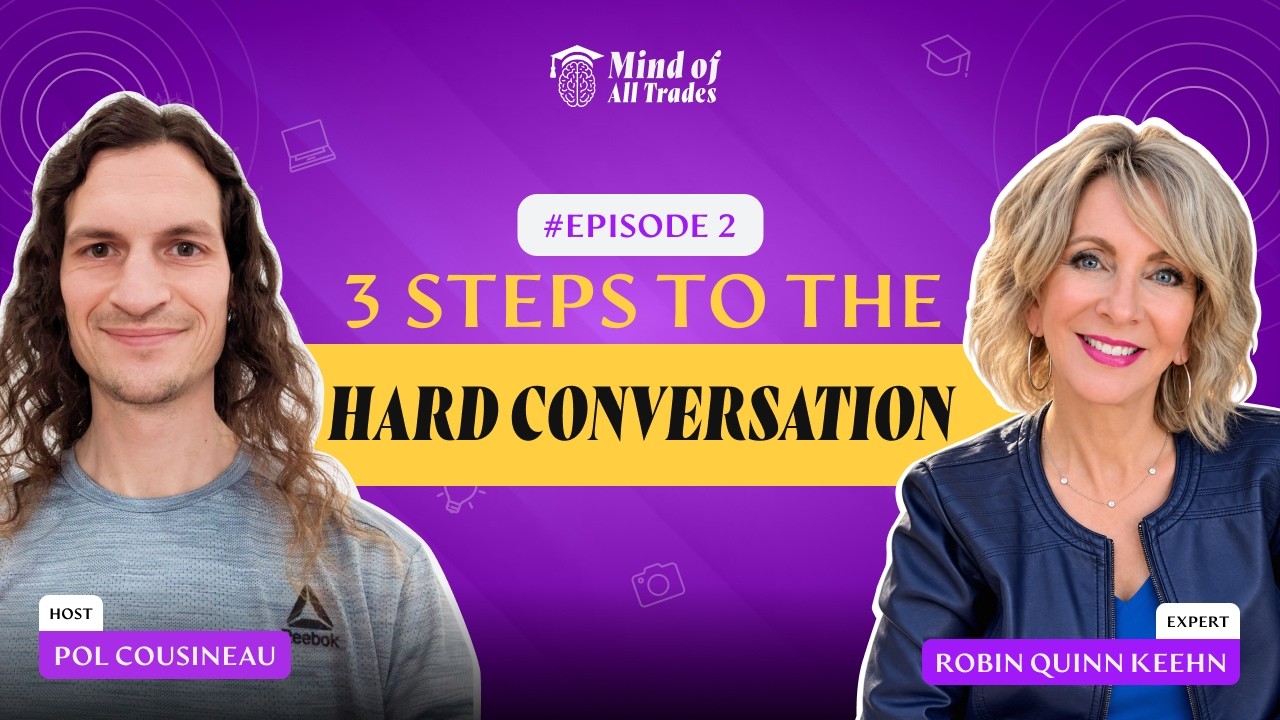
The Mindset That Scales Your Business
Description
When you decide to have a conversation, 99% committed is much harder than 100% committed.” That’s Robin Quinn Keehn, back for Part 2, and this time she’s showing us exactly how to close the loops we talked about in Part 1.
If you haven’t heard Part 1 yet, that’s where Robin introduced the idea of open loops: the tasks, decisions, promises, and conversations we leave unfinished, and what that quietly costs us. In this part, she walks through the actual method for having the conversation you’ve been avoiding, then introduces the tool she built to help you practice it first.
In Part 2, you’ll hear:
- The exact steps Robin uses to open a hard conversation, including the one line she says almost every time
- What to do when the other person gets defensive, and why that’s not a sign to stop
- Why a boundary you don’t enforce isn’t really a boundary at all
- Inside People Skillz, the app Robin built to let you rehearse a hard conversation before you have it for real, including the personal reason Pol started using it himself
- What actually changes when people track their progress, real numbers from real teams
This is Part 2 of a two-part conversation. If you missed Part 1, go back and start there first.
About Robin Quinn Keehn
Robin is the founder of People Skillz Education & Consulting. Her new book, Stop Stealing From Yourself: Close the Open Loops That Quietly Drain Your Time, Energy, and Peace, is out now.
Try the app Robin talks about in this episode:
People Skillz is a “difficult conversation simulator” where you can rehearse a hard conversation (with a partner, a boss, a parent) safely, before you ever have to have it for real. It’s free to try.
App: try.pplskillz.com
Website: pplskillz.com
Community: skool.com/peopleskillz
YouTube: @therobinquinnkeehn
Instagram: @robinquinnkeehn
Facebook: robinquinnkeehnsparks
Follow Mind of All Trades:
YouTube: youtube.com/@MindofAllTrades
Spotify: open.spotify.com/show/4MixC1mfhhUVIOFO1mywUc
Apple Podcasts: https://podcasts.apple.com/us/podcast/mind-of-all-trades/id6807196830
Instagram: instagram.com/mindofalltrades
Amazon Music: music.amazon.com/podcasts/32ce7fa4-4473-4c53-9256-7fca60e47331/mind-of-all-trades
LinkedIn: linkedin.com/company/mind-of-all-trades
Also Listen On


Transcript
Click to read the transcript
[00:00:00] Robin Quinn Keehn: When you decide
[00:00:00] to have a conversation,
[00:00:03] 99% committed
[00:00:05] is much harder than
[00:00:06] 100% committed.
[00:00:08] Pol Cousineau: Surprises are very challenging for me. I was “Oh no, I gotta prepare for this.” ”
[00:00:13] Robin Quinn Keehn: I feel closer
[00:00:14] than I’ve ever felt to him
[00:00:15] because we had the conversation.
[00:00:17] I made great progress
[00:00:19] on the emotional stamina,
[00:00:21] but I still can’t get
[00:00:21] that score better
[00:00:22] on the close.”
[00:00:23] Pol Cousineau: I went from being
[00:00:25] the highest level of anxiety
[00:00:27] you could possibly have
[00:00:28] with a medical test
[00:00:29] to being in the lowest category.
[00:00:32]
[00:00:32] Pol Cousineau: Now, I was the top of the lowest category, but I couldn’t believe
[00:00:42] Welcome to Mind of All Trades, the podcast where edupreneurs turn knowledge into impact. I’m your host, Pol Cousineau, and together we explore the craft and commerce of educational businesses, we look at the strategy, we look at the systems, and we look at the real implementation work that has to happen behind the scenes.
[00:01:02] Before we dive in, make sure you subscribe so you don’t miss future episodes. We’ll be sharing practical guides, conversations, and examples for edupreneurs who are building real momentum in their business, and for coaches, course creators, podcasters, and membership site owners who need help with the tech behind the business.
[00:01:22] Check out The Digital Navigator. The Digital Navigator helps with fully managed websites, funnels, analytics, automations, and ongoing tech support. So instead of having a bunch of disconnected tools, your systems can work together, and you can spend more of your time focused on the business, the offer, and the people you serve.
[00:01:42] You can learn more at thedigitalnavigator.com. Now, let’s jump into today’s episode.
[00:01:49] Now, if you’ve caught part one, you know Robin introduced this idea of open loops, the tasks we leave unfinished, the decisions we keep circling back to, the promises we make to ourselves and don’t keep, and the conversations we keep avoiding. She also shared her own story, building Aspire Academy into what she calls the beautiful monster, and a moment on a beach in Oregon that became the actual inspiration for her book.
[00:02:18] In this part, we get into the how. Robin’s going to walk us through exactly what it looks like to have that conversation you’ve been putting off, step by step, and then show us the tool she built to help people practice it before they ever have to have it for real. Let’s continue right where we left off.
[00:02:38] Now, I believe that the difficult conversations or challenging conversations is part of people skills and then the app that developed.
[00:02:47] How does that kinda all fit in? Because I believe that our audience can practice some of those conversations and whether it is to close those relational loops in your personal life or with your team, like I was describing earlier. Can you share a bit about that?
[00:03:02] Robin Quinn Keehn: Certainly, yeah. And so there are several steps in, in having a great conversation. The first one, and, and I’ll share the app in a minute, but the first one is to be prepared, right? Like, nobody likes to be surprised, and you should not go into a conversation that’s, that has– it’s a high-stakes conversation, right?
[00:03:19] Considered a high stakes. Just talking to somebody about nothing really in particular, who cares? You don’t need to prepare for that. But if it’s your, a loved one or a teammate or your boss or somebody where the stakes are high and you wanna be careful, you wanna be able to say the thing, but you wanna say it so there’s clarity and a back and forth, right?
[00:03:38] Then, then the first step is to prepare. Um, and you need to– When I prepare for a convers- sorry, when I prepare for a conversation like this, I think about what is my goal here? Do I want to, um… Not my goal, like as we’re talking, but at the end, I want to make sure that there’s clarity, that I have expressed myself, I have asked for a different agreement, and I’ve gotten their buy-in.
[00:04:04] That would be the ideal end of this conversation. When I get to the end, that’s what I’d like. So m- maybe you want something different, but you need to know, because if you don’t know, it’s so easy to get sidetracked in a conversation and end up in a place that’s totally dissatisfying and you’re like, “I did all that to get nowhere.”
[00:04:23] So what are you trying to do? And so, you know, I want to establish that this relationship is over, this business relationship or this other relationship, it needs to come to an end. And when I had the conversation with my friend, that was what I established. It’s either we work this out and these things are honored, or I’m done.
[00:04:43] And I just wanna say this, Pol, ’cause this thing is a big deal. When you decide to have a conversation, 99% committed is much harder than 100% committed. So if you go into a conversation and you’re not 100% committed to your outcome, you’re not gonna get what you want in the conversation. So in the big difficult conversation I had, it was like, “Hey, here’s what I’ve noticed.”
[00:05:10] So I always start with here’s… First, I ask if it’s a good time to talk. Nobody wants to be like, right? I, I hate that. Nobody wants that.
[00:05:18] Pol Cousineau: They need to get to an appointment, they have two minutes, and now you’re about to try to end the friendship, right?
[00:05:25] Robin Quinn Keehn: Right. Anything, right? So I always ask, my mom taught me that timing is everything. So I always ask, “Is this a good time? Can we talk? And if not, when can we talk?” And if they’re like, “What’s this about?” You gotta know what it’s about. You can’t just leave people hanging because that’s a bad way to enter a conversation.
[00:05:41] But let’s just say, I say, “Pol, is this a good time to talk?” And you say
[00:05:49] Pol Cousineau: Well, the natural reaction would be, “About what?” Instead of answering, ’cause if it’s, like, if it’s something small, yes, it’s a good time. If it’s too big, I might be even thinking like emotionally, what do I have after this and how would our conversation affect me? So if they say, “About what?”
[00:06:07] Robin Quinn Keehn: I need to be
[00:06:08] Pol Cousineau: How
[00:06:08] Robin Quinn Keehn: say Yeah, you need to know what it’s about.” You can’t say, “I’m upset about this.” You need to say, “I’d like to share some things about our relationship that I’ve noticed.” Gives you a chance to comprehend and tell me, “It’s not a good time. Can we talk later?” Or, or actually, “I’m just sitting here scrolling on my phone.
[00:06:31] Sure, we can talk.” But that’s the first kindness you can do, whether it’s work or, or friendship, is just ask, “Is this a good time to talk?” And be able to speak something about what you want to say, so they’re not left in this, you know, fear of… Right? There’s a lot of fear that goes into this stuff. So if you said, “Yes, it’s a good time to talk,” okay, then I’m gonna start and I’m gonna say, “So Pol, um, I’ve been noticing…”
[00:06:56] I always start with I’ve been noticing, ’cause that’s, that’s just me noticing. That’s not anything about you. “I’ve been noticing that, uh, lately when we’ve gotten together, um, oftentimes you show up late or y- you just don’t show up at all and you don’t let me know. And the impact that’s having on me is I’m starting to question whether or not the friendship is important to you. Um, what have you noticed?” Right? Like give it back to you. Let you say, ” Oh, I, I, I didn’t even think about that. Um, wow, I’m sorry. Uh, what do you wanna do about that?” Now it’s back to me. Now the ball’s back in my court and I can say, “Well, you know, it’s really important to me in a friendship that if we’re going to spend time together, that I can count on you to be there when we make plans.
[00:07:47] Because obviously I’m rearranging my schedule to be present for you and I, you know, and it’s important that you’re there if you say you’re gonna be, and I need to know that I can count on you. And so what I’m gonna ask is, moving forward in order to continue our friendship, I just need to know that, that I can count on you, that when you say you’re available, you really are, and that when you’re there with me, you’re present and you’re not on your phone or, you know, catching other people’s information as it comes in.” You know, this.
[00:08:17] Pol Cousineau: Yes,
[00:08:17] nonstop
[00:08:18] Robin Quinn Keehn: If that was an important thing, right? I might ask you for that. Um, “I need to know that I’m gonna be included. I’ve noticed sometimes when we’re with a bunch of people, I feel kind of on the outside and I’ve, I’ve felt like it, it wasn’t important for you to include me.”
[00:08:31] Pol Cousineau: and if you’re listening right now, she was pulling up her phone. So was this, right? This is the, uh, the omnipresent object that invades all social nowadays. Yeah.
[00:08:43] Robin Quinn Keehn: All relationships. Absolutely. Yeah. Thank you for that. And so I, I’ll just– And so I would say, “These are the things that I need from our friendship moving forward. And, um, if you’re not willing or able to provide those, no problem at all. I just think that we need to take a break.”
[00:08:55] Pol Cousineau: Now, do you find that people get defensive? ‘Cause could see someone being, “No, they don’t.”
[00:09:00] Robin Quinn Keehn: no, here’s what I’ve noticed. So I had a really difficult conversation with someone in business about this, and I actually wanted to end the friendship, the business relationship 100%. I was done. And because I came from what I’ve been noticing and the impact on me, you know, the impact on me is I feel like you’re crossing my boundaries.
[00:09:21] But my part in it, like if you have a part in it, you should name that too. My part in it was that I was very soft with my no because I didn’t want to hurt your feelings, and so now I’m giving you a, a real no on
[00:09:33] Pol Cousineau: Apartnit? What, what is that? A-apartnit? Oh, apartinet.
[00:09:35] Robin Quinn Keehn: part in it. My part in
[00:09:38] Pol Cousineau: Ah, okay, okay. Yeah.
[00:09:39] Robin Quinn Keehn: Yeah.
[00:09:39] my part in it. So it’s important that you say that too.
[00:09:43] So I kind of left that out of that initial conversation, but in my part in it is that there have been a couple times where I canceled on you, and you might have felt like I didn’t care either. So whatever. With this person in business, my part in it was that I had not wanted to hurt anyone’s feelings, and so I had not said, ” No more phone calls.”
[00:10:05] I had said, ” Hey, I’m super busy. I’m not available.” But that was not interpreted as a hard boundary, and so the boundary kept getting crossed. But my part in it was I softened it.
[00:10:17] And so I said that, “I softened this because I didn’t want to hurt your feelings, but what I’m letting you know now is this doesn’t work for me, and I don’t want to be involved with you in business.
[00:10:25] Our worldviews are not aligned. My work is taking me in a different direction, and so I need to end this.” And what the– what I got back, and I was prepared, I mean, it’s always great to kind of think through how somebody might respond, was, uh, disbelief initially. Like, “I thought we were great together in business.”
[00:10:44] And I, I just listened. So just listening doesn’t mean you agree. You’re not agreeing, you’re just listening. You’re not ar- you’re not arguing, you’re not saying much. You’re just letting that other person have a chance to speak, but it doesn’t mean that you agree. I– you know, “I thought we were great in business together, and I thought this was important to you, and I thought this, and I thought that.”
[00:11:04] And I said, “Okay.” That’s all I said. “Okay, I understand. I’m sure you’re a little surprised by this.” And then, then he said, “But you’re right. I, I, I did. I, I kept trying to get on your calendar and I kept messaging you and you’re right. I’m sorry.” He did not need to apologize, but that’s where he went. So at first he was a little upset and maybe a little defensive, but I just let him be that way.
[00:11:32] I didn’t try to speak over him or argue with him. I just let him be and he finally came to his own conclusion that, yeah. He, yeah, yeah. And so he said, “Well, what do you wanna do?” And I said, “I wanna end this relationship. If there’s something in the future where I see some or a reason for us to work together again, I’ll let you know.”
[00:11:52] And he was pretty quiet and he didn’t say anything for a long time and then right after I published my book he was like, “I think our work is aligned.” And I said, “Sorry, it’s not, but thanks anyway.” You know? But there’s that 100% committed, right? Now if I had been 99% committed to that outcome, I would’ve had a hard time if I was like, “Ah, I feel kind of bad.
[00:12:17] I think maybe I should be nice and I should just say okay because this is super uncomfortable. Ah.” Right? But I was 100% committed just like I was 100% committed with my friend and I said, “I need to know if you can provide these things.” And she said, “Inclusion, um, consistency, loyalty,” and actually showing up when she scheduled time to be with me.
[00:12:40] And she said, “Does it mean if, if I can’t do those things you don’t wanna be friends?” And I said, “Yeah, that’s right.” And she was like, “Whoa. Oh. Oh. But I do wanna be friends.” And I said, “Great. Then let’s, let’s, let’s see how it goes.” So but these are not easy. Obviously, Pol, you know, I feel myself sweating as I’m talking to you,
[00:13:02] Pol Cousineau: Mm-hmm. Yeah, th- none of those sound easy, and that’s why I was mentioning the defensiveness, because I could see those patterns potentially coming up. Or halfway you get persuaded, and then you let go of your goal, which is why you’re mentioning, too, that 100% commitment. I mean, I’ve seen a lot of clients that I work with, and then they wanna let go someone in their team.
[00:13:27] Not performing, there’s constant challenges. They’ve tried to address it multiple time. And somehow every time the conversation happens, they get persuaded in giving them another chance. And then we’re like, “Well, it’s been three years now, like seven chances. You said you were gonna let that person go. It’s not working.”
[00:13:47] And then somehow they go in the conversation, and then they come back, and then they say, “Hey, you know what? This is how it’s gonna be different.” And I’m like, “But it’s not. It, it won’t,” right? And it feels like that’s that 99% committed.
[00:13:59] Robin Quinn Keehn: It
[00:13:59] Pol Cousineau: And then also being able to observe the pattern, especially if the person has failed multiple times to follow through their commitments, right?
[00:14:08] If we use the example that you had with your friend, and then they don’t show up in that way, right? They don’t follow through. Well, it seems like then that’s another conversation that needs to be had so the loop can be closed, because it seemed like there was a positive resolution. Now, there doesn’t need to be any hard feelings.
[00:14:26] Of course, we can get emotional, right? It’s a longtime friend. But you’re not doing this to the other person, and I can see sometimes people think, like, it’s not the right thing to do or they’re going to be crushed if I do this, or they depend on me for their income. I can’t let this person go even though it’s the seventh time and they keep dropping the ball.
[00:14:48] Uh, I mean, I’m thinking an example in mind, and there’s these deadlines, and every time they’re working on a project for the business and putting courses together, it’s always behind. Well, you can’t run your business that way. You can’t keep creating these fires because this person is able to follow through the deadlines.
[00:15:06] So there’s a lot of challenges that happen to this. So how do you address it when it seems like you had the resolution, right? There’s that commitment, but then it shows up again. How long do you wait? How, how does that work?
[00:15:17] Robin Quinn Keehn: I don’t wait. I wouldn’t wait. So if this friend had stood me up the next time, I would’ve said, “Here’s what I’ve noticed,” you know? “Once again, I’m not, I’m not trying to upset anybody, but what I noticed was we scheduled a time to get together, we confirmed it that morning, and I waited for you for 20 minutes and you never showed up. And the impact on me is I’m not sure if you’re actually committed to our friendship even though you said you were, because we’re at one week out and it’s happening again.” W- what do you wanna say, you know? And then you have to know, what do you want? Are you willing to give them another chance, or are you just saying that, “You know, I’m sorry, but that, that’s just gotta be it for me.
[00:16:02] I’m really– My friendships are so important to me, and having friends I can count on and– is, is critical for me, you know. And I hope that you can count on me, and if I haven’t been that person, I’d love to know.” Right? I mean, you gotta figure out what that back and forth needs to be. You gotta figure it out, but you have to know going in.
[00:16:25] And maybe you say, “Okay, great.” That person says, you know, “My dog got sick last week and I was in the emergency room,” or whatever, and then you can decide if you wanna give them some– cut them some slack. But look, if you’ve drawn the line and people continue to cross it, y- I learned that in my studio. No means no, right?
[00:16:47] I, w- and with my children, oh my gosh. If you are gonna say no, you better mean no. If you’re gonna say no and then you pivot to yes or maybe, you become unreliable. People don’t know what to believe about you.
[00:17:00] Pol Cousineau: And
[00:17:01] then the line just keeps getting crossed, what I found is that other people don’t respect that line either. So using the deadline example, next thing you know, half the team is missing deadlines, right? Because there’s nothing that happens, so then it’s basically this is not important to you anymore.
[00:17:20] This is what’s being demonstrated. And then it just gets worse and worse. So it seems like once you’ve made that commitment,
[00:17:29] Robin Quinn Keehn: Yeah
[00:17:30] Pol Cousineau: you must respond if these commitments are not being followed through, or if the a- the behavior doesn’t align with what was discussed, then it needs to be brought up. Otherwise, it seems like that creates another relational loop,
[00:17:44] Robin Quinn Keehn: It, it does. And then why did you even risk things in the first place by saying something if you weren’t serious about it? Why bother wasting your breath if you don’t actually mean it? If it’s an empty threat, I learned that as a teacher. When I say this, I mean it. If I say this, but then next week I don’t follow up on it, I don’t actually mean it, like it’s too difficult to implement.
[00:18:07] And that’s why when I coach, uh, music studio owners, I’m like, “Look, do not have a requirement if you’re not willing to enforce it.” Don’t have it. Do not even bother having it. Because if you say, just making it up, if you say you must pay for next month’s lessons on the last day of the previous month, like pay April 30th for May, but then you don’t enforce that, then, then why did you say it in the first place?
[00:18:38] If you’re willing to accept payments up until the middle of May for May, then people learn. People learn that. They, they know that about you. You’ve trained them that, “Oh, I pushed a boundary. She didn’t push back. She didn’t enforce it. She didn’t impose the late fee. She doesn’t mean what she said.”
[00:18:56] Pol Cousineau: um-hmm
[00:18:57] Robin Quinn Keehn: Right?
[00:18:57] It’s the same in all aspects, with your children, with your friends, in your business. You need… And that’s why I love the 99% committed is much harder than 100, because if I’m 100% committed to my goal and my stand, then it’s very clear what the next step is. You get, you pay the late fee. One day late, you’re, you’re paying the late fee, and guess what?
[00:19:22] People go, “Oh, she means what she says.” And, and that gets translated everywhere. Everybody knows when I say something, I mean it. I’m not, I’m not, not joking.
[00:19:34] Pol Cousineau: Yeah. A- and that’s important because then people observe that. When the late fee example happened, I’m sure if other parents are having challenges, the word kind of gets out. So then if they have to pick, it’s gonna be the music fee, right? The lessons that are gonna be paid later because they say, “Hey, if I don’t pay my cell phone, that will stop, so I have to pay my cell phone.
[00:19:57] But if I don’t pay for the music lessons, that’s okay. They’ll continue. I’ll pay two weeks late. I’ve seen it happen over and over again for all these other families, and then I can go not only even beyond the boundary,” the boundary, like you said, never even existed. wasn’t really there
[00:20:13] Robin Quinn Keehn: And it, and it translates then too, because they see your other boundaries and they go, “Well, she’s not enforcing this. I bet I can do this and she won’t enforce it either, and she’s not gonna enforce this.” I just see it as the way we train people. And so when people come to me and complain about their business and things happening, team not doing their job, or people not paying on time, or invoices being delayed, I’m like, “Okay, well let’s unravel this,” because there’s something foundational here that is not being honored.
[00:20:43] W- either what– do you mean what you say, or do you actually wanna remove some of these things and just go with the ones that you actually wanna stand behind?
[00:20:51] Pol Cousineau: Now let’s say that we’re ready to have that difficult conversation. I’m saying difficult, but it sounds like most of them have a certain level of discomfort, let’s
[00:21:01] Robin Quinn Keehn: Yeah, they do. They have discomfort. Yeah
[00:21:03] Pol Cousineau: Right. So then, uh, is this a good place to start with the app that you did, and can you share a little bit how that w- because then that way we can put it into practice
[00:21:13] Robin Quinn Keehn: absolutely. So yes, um, during the time I was writing my book, I, I just– I, I’d been thinking about it briefly, but I started thinking about how could I help people have these difficult conversations? Because there’s a lot of fear, and when you think about out there in the world, pilots train before they fly, doctors train before they do surgery.
[00:21:36] Uh, just think of all the people that train before they actually do something, right? Police, they train in simulated experiences, firemen, anybody who’s gonna do
[00:21:45] Pol Cousineau: Most things that matter.
[00:21:47] Robin Quinn Keehn: the things that matter, the high-stakes things. But we walk into conversations completely cold. Our most important conversations, we walk in maybe having rehearsed in the shower or maybe not even, maybe we just walk in cold.
[00:22:00] So if you could be prepared and have some practice, because I believe it’s all about reps. It’s like building a muscle, right? You gotta have repetition. And I can do it live with somebody, no problem, but you know, there’s one of me and so I can’t be doing that live every day. So I built a difficult conversation simulator.
[00:22:21] The idea is it’s built on my intellectual property, so AI has been trained. It’s not gonna be doing rogue, weird things. It’s very, very contained in what it’s allowed to do, the language it uses, and the way it behaves. But basically, you go in, you can bring your own conversation you need to have. There are a bunch of scenarios that you can pick from that are typical scenarios we might be dealing with, from noisy neighbors to, um, interfering in-laws, to sullen teenagers, to, I mean, coworkers who, uh, don’t do their share, uh, talking to a boss about a raise, all kinds of things in there, including scamming.
[00:22:56] That’s b- been a big one lately. But you pick whatever scenario or bring your own, and then you get to pick from one of eight personalities. Is it a guilt-tripper, a stonewaller, a manipulator, a people pleaser? Like, who are you talking to in this conversation? So let’s say you wanna talk to your neighbor about how noisy he’s being at midnight when it’s a weeknight, and he is a, a deflector.
[00:23:23] So you go over and knock on his door. So you start the scenario, and AI plays that person, and it’s really great because it kinda sets the scene. It’ll give you a physical example, like, so it tells you what the scenario is and who you’re playing against, and it’s like, it opens up by saying You knock on the door, the neighbor opens.
[00:23:42] You know, you can hear the music in the background. He’s got his arms crossed against his chest and he says, “Hey, what’s up?” Right? So you really feel like, “Oh, there he is. There’s my neighbor. I can picture him.” And then you say, “Hey, neighbor, good to see you. Have been noticing the music has been loud the last few nights at like 11 o’clock and I have work at 5:00 in the morning.
[00:24:04] And I know I’ve had my music up on the weekends, but this is really interfering during the week with my sleep. Could you turn it down?” I mean, whatever you’re gonna say. Maybe you don’t go that direct, but that would be me And he comes back with, “Hey, yeah, it’s a great night. It’s so warm tonight. I just had all the windows open,” and he’s the deflector, right?
[00:24:23] “And I was just thinking it was a great time to have friends over. And yeah, it’s only 11, what are you worried about?” Right? So he pushes back, and now you have to come back. So you go back and forth until you finish the conversation. You can finish it any time. You can just get out. But you hit get the score, right?
[00:24:43] And it comes back and it has scored your conversation, number one, on your, what we call stamina. Were you direct? Did you stay regulated or did you lose it? You know, if you put in all caps, that means you lost, it means you’re yelling, right? Or you conceded, you’re just like, “Ooh, sorry. Okay, I’m all right.
[00:25:01] I’ll just put in my earplugs.” That would be conceding. And then did you actually close the loop on this conversation? Did you get it resolved? Is there resolution? Gives you a score, and then it tells you what you did well and what you didn’t do well, and it gives you some coaching from two different mediators on how you could have had the conversation, what to try the next time, and then it gives you a script.
[00:25:24] Try this. And it gives you, like, how to have that conversation without escalating, without giving in, how to close the loop on that conversation, how to resolve it. So it gives you that. You can actually put in your email and have that script sent to you. So it’s been pretty remarkable. There are people all over the world trying it, and I’ve heard from some people.
[00:25:48] I have a friend who said she’s been wanting to have a conversation with her fiancé for two years, and she hasn’t know- known how to broach it because she tends to give in really quickly. And she practiced, and she got her script, and she practiced, like, four or five rounds. And then she had the conversation and she said it went better than she ever dreamed, and they were able to resolve the issue.
[00:26:14] And she said, “I feel closer than I’ve ever felt to him because we had the conversation.” So it actually really gets results. And I have a big chiropla- chiropractic clinic working with it right now, so they can have better conversations with the team and with their clients who come in, you know, “Why do I have to have X-rays again?”
[00:26:35] Or, “Why do I have to keep coming back?” Or, “I still hurt,” or, “Now this hurts. You did this and this hurts.” And you can be play the doctor or the front desk person or whatever. So being able to put in your own scenario too is really great because maybe you’re dealing with something that I haven’t thought about.
[00:26:50] You might be. And then, you know, I’ve, I’ve had some that have brought me to tears, some conversations in there, just thinking about real-life conversations I’d like to have and personalities. So I’m like, “Oh, so real. Oh, that was so hard to stay regulated.”
[00:27:06] Pol Cousineau: I did try the app. Now I have to say, I felt it was challenging at first. Now I’m glad that you said this other person, the fiance, needed like four or five practice rounds because it felt like, wait a minute, this isn’t actually possible to close the loop. Like, I, I did a scenario maybe two or three times, and then I’m like, “Okay, I’m gonna pick another scenario.”
[00:27:26] And then by… I couldn’t close the darn loop, and I couldn’t get there. I’m like, “Okay,” like, “what is this?” I think Robin programmed this so not able to close the actual loop. There must be something in it. But then I did another one, and then it was like, oh wait, this gave me a positive resolution. Now it was pretty cool, and I felt proud of myself oh I got there, so wait, you can beat this.
[00:27:50] It’s not like you can’t close the loop.” But it just shows how the practice is important, right? To do it, and I’m sure most people probably don’t close the loop the very first try. I mean, unless they’ve been practicing the skills
[00:28:05] Robin Quinn Keehn: Right. No, it’s hard to close the loop, and usually I get good scores, but I have practiced with it a lot. I’m like, “Oh, this is where you start, and this is the place you usually lose traction. Don’t say that this time. You need to stay on it.” And by the time you get to the end, you need to be able to say, “Okay, you got it.
[00:28:27] I got it. We’re done.” But it, it’s not automatic. It makes– It definitely makes you work, and it makes you start. Because you get the feedback, you’re like, “Oh, I see my default was to concede.” That would be me. “Oh, never mind. It’s okay.” You know? Or your default was to escalate. You got mad every time. Oh, that’s great information.
[00:28:47] H-How am I gonna change that the next time? What’s triggering me that, you know, what in this language just upsets me, and where do I lose it every time? So it is
[00:28:57] Pol Cousineau: And yeah, and then I wanna make sure that we have the destination. Where can people try the app?
[00:29:04] Robin Quinn Keehn: Yeah, it’s try, T-R-Y, .peopleskills, but it’s P-P-L-S-K-I-L-L-Z.com. And you just go there and plug in whatever you wanna practice with. Um, you can, like I said, bring your own or scroll down and just see all of the different options. The best part for me is being able to pick the kind of person you wanna practice against because– And it explains who they are, who the people are, what they typically say, what their posture is, so that you’re not just like hoping it’s the guilt tripper.
[00:29:35] But, um, I had somebody put in a scenario, and I only know a little bit about her, but she was practicing with her mom, you know, using AI, and I said to my husband, “I bet she put in the guilt tripper.” And a few minutes later, she said, “Oh my gosh, I put in the guilt tripper. It was just like my mom.” So it’s, yeah, it’s pretty funny.
[00:29:55] I was like, “Wow, that’s, that’s really cool,” right? So you pick the person, pick who you think they are, and then see if it sounds like them.
[00:30:02] Pol Cousineau: Great. So that’s something that we can do, and then that way we can close some of these relational loops. But I want to see, like, how does this fit in the educational and the training component, right? Because we’re talking about educational businesses. So you decided to make an app, and then this is building real-life skills.
[00:30:23] Now, you mentioned that you have your book as well, and then there’s some coaching involved. So how are all these pieces fitting together so that you can actually help someone get that real-world transformation?
[00:30:39] Robin Quinn Keehn: Right. So the book mentions a tool, closetheloopsnow.com\tool. That’s a long URL. But the tool is an opportunity for somebody to take an open loop that they know they have or identify one and work it all the way through the steps to having it closed. So that’s one thing. But I also have, uh, the, the website peopleskills.com, where if somebody wants real-life practice doing this, because having these conversations with a real person who then can provide feedback, and you can feel how the energy went between the two of you, right?
[00:31:18] And have expert feedback from a couple of mediators like, “Hey, this typically is a trigger, and the way you said that and the way your tone was, even though you said these words, it, it translated like this,” right? Being able to get real-life feedback for the most important conversations. So that’s another component.
[00:31:39] And then we do things like workshops for teams, um, using what I call Calm Under Pressure. So being able to understand what’s happening in teams and noticing the way we see the world and how other people see the world, and how that gets in the middle of conversations, and understanding and trying to find a different way to remain calm so that there can be more clarity in teams.
[00:32:02] Yeah.
[00:32:03] Pol Cousineau: So then would you say most people start either with the book or the app, and then from there gradually they say, “Okay, this is interesting. I could see some benefit from here.” And then that’s when they become maybe encouraged to take the next step and do perhaps the coaching aspect or the, the life practice?
[00:32:24] Robin Quinn Keehn: That’s right. Yeah. And with the teams I’ve been working with, the dental teams and the chiropractic teams, you know, it was easy to go to them and say, “How’s it going over here? You’ve got big teams and you’re meeting with the public all the time. How are your conversations? What are the quality of conversations?
[00:32:41] What does that cost you?” For them, it was just very obvious, right? Having better communication among team members, so critical. Um, especially like in a dental practice where there are people just coming in and out and they’ve got the technical team, they’ve got the front desk team, they’ve got the doctors.
[00:32:57] So we’ve got all these people co- communicating in a high, high impact kind of way where it’s people and they’re not having fun, right? Nobody goes to the dentist to have a good time. So it’s pretty
[00:33:08] Pol Cousineau: Most people don’t. I mean, I guess maybe with the nitrous oxide,
[00:33:12] Robin Quinn Keehn: Yeah, maybe. Yeah,
[00:33:14] Pol Cousineau: right?
[00:33:14] Robin Quinn Keehn: day. A happy day.
[00:33:15] Pol Cousineau: I’m just, I’m just joking there. So but then, okay, so now you’re bringing training to a business environment, right? For a team, and this can be appealing, right? Depending on what you’re doing in your educational business, you might wanna try to get these business accounts.
[00:33:30] So did you already have relationships with them, or were those cold businesses? How did you get even in the door? Because if I’m thinking of the dentist coming in saying, “Hey, you have difficult conversations.” I don’t know. That sounds quite challenging.
[00:33:44] Robin Quinn Keehn: it is because dentists have really great gatekeepers, right? They, they have people coming in all the time soliciting them for all kinds of things. The dental thing happened because I was playing pickleball, and I happened to mention my book to a woman and, and I happened to mention working with dentists because it’s just such an obvious place of stress.
[00:34:03] And she said, “You know, that was my career.” And I said, “I didn’t know that.” And she said, “You need to talk to her.” So I talked to the wife of a dentist with a big clinic here, and I said, “I’ll come in and do my workshop.” I’d never done it with a dental clinic before. I did it for free for 90 minutes and in exchange for referrals.
[00:34:24] And so now I’ve got referrals. That was a– that was great. That was just me talking. And I’ve always found in my business, Pol, it’s me just talking to people that opens the doors, like casually, not trying to do anything. Um, my big studio in Sequim, that thing grew hugely because I ran into people at the park, people at the grocery store would say, “What are you up to?”
[00:34:48] And I’d say, “I am so excited. I’m bringing in this new piano method,” or, “I’m opening the big studio.” Oh my gosh, it was just natural conversation. Like the pickleball thing, that was wild. And then with the chiropractic clinic, I’ve been going there and I really like them, and I always have these great conversations with the doctors and with everybody else that works there.
[00:35:08] Like it’s been awesome. And so I talked to the office manager and I said, ” You guys do training, don’t you?” And she said, “Yep, we do training every month.” And I said, “How about a training on this? And would you like to test my app?” And she was like, “Oh my gosh, we would love to test your app.” So I went in and did a 60-minute kickoff training for the app, and I’ve been tracking it and gave them a beautiful report yesterday about the last two weeks and how much it was utilized, and they were…
[00:35:35] They’re on it. And I said, “If you guys love it, I would love to be connected to your partners.”
[00:35:41] Pol Cousineau: Hmm. And, and part of this too is not being afraid to start small or not earning the full fee, right? Because I see sometimes people say, “Oh, well, this training is worth $15,000.” And maybe it is, but if you haven’t delivered it, right, and you haven’t found a way to get through the gatekeeper, like using the dentist example, you say, “Well, I want referrals.”
[00:36:05] Now with the referral, that gives you a stepping stone, right, to go somewhere else. But if from the start you said it’ll be 15 grand, it would have been so hard.
[00:36:15] Robin Quinn Keehn: It would’ve been so hard, and I didn’t wanna do it that way. I– and again, back to that, you know, idea of fake it till you make it or, you know, don’t build it till they buy it. We heard that a lot too, Pol. I mean, sell it and then build it. I’m like, “No, it’s not, not me at all. I’m not gonna do that. I’m gonna build it.
[00:36:31] I’m gonna go in prepared. I’m gonna have my little, you know, calm, calm under pressure.” I’m showing a little thing that I handed out there with a QR code, right? I’m gonna have that prepared before I go in and do a 60 or 90-minute training, and I’m gonna make it experiential. It’s not just a talking head. It was a beautiful workshop.
[00:36:51] First one I did, and you know, doors opened. But no, I, I mean, sure, I would’ve loved to have charged money for it, but I wanna earn that money. I wanna make sure this thing works. I wanna feel good when I walk out that I delivered and that they had impact, that they had aha moments, which they did, ’cause I did a survey, which was really helpful, too.
[00:37:12] I had a survey ready to go. At the end, it, it– I said, “Please fill this right out right now.” I made sure I allowed time, and I got back all 19, uh, responses right then and there, and of them, 17 of the 19 were five-star, uh, two of them were four-star, and they all gave me feedback. “What was the biggest takeaway you got from this?”
[00:37:33] And one of them was, “I can use this at home,” which I love, ’cause I was like, “Oh.” So it’s gonna, it’s going to have an impact, so yeah, no, I don’t, I don’t wanna… I want to prove that this works before I try to sell it to somebody for thousands and thousands of dollars.
[00:37:49] Pol Cousineau: And then the survey is another good takeaway here because that can also adapt to online solutions. How many people have courses and then they don’t give a survey to their students to determine do they like it? What kind of transformation are they getting? And then the language, right? The words that they’re using to describe, and also maybe there’s things they didn’t like, and then you can either decide to say this is acceptable, or I’m going to make a change and then improve and make this better.
[00:38:20] The other takeaway I got is the 100% committed, because you have a book, you have an app, right? And in the different conversations and contexts, one or the other or all of them came up. But if there’s nothing to show, it becomes very difficult to persuade someone, and then also, well, you didn’t really do anything about it, so you’re asking the other person to believe in it more than you are because you’re not coming prepared, right?
[00:38:49] You weren’t willing to spend the time and the effort unless someone else committed to it, which is kind of odd, right? When you think about that. So then it’s like, well, what does your own commitment look like to what you want to deliver in your business, and what does that, what does that look like? Is it videos?
[00:39:06] Is it a book? Is it you even had that little card? I don’t know what we call it, but you know, just a little
[00:39:12] Robin Quinn Keehn: Yeah, it’s just a little like a, a, a template of like calm under pressure, a simple way to handle moments with clarity and calm. And there’s an acronym there, clarify, acknowledge, lead calmly, move forward. And on the backside, you know, in the moment when something feels off, stop, breathe, don’t respond yet.
[00:39:29] Ask yourself, “What am I assuming? What might I be missing? What matters most here?” So it’s just, I wanted them to just have this to be able to put it in their desk drawer to remind themselves or tack it on their bulletin board. So it’s just a little takeaway so that the moment stays and it’s not like, “Oh, she came in and did a great training.
[00:39:47] I don’t have n- I have no idea what she talked about.”
[00:39:50] Pol Cousineau: Yeah, and even if you hadn’t had the training, you can use that collateral to show a certain level of professionalism and seriousness, and that doesn’t cost a lot of money to print something like this. But then you’re not empty-handed, and it’s how are you going to be preparing, which was the theme we had earlier, right?
[00:40:09] How are you gonna prepare for the conversation a- and what is this going to look like? So that, that’s really awesome about how you’ve been able to bring this in different types of context, right? Because they’re very different types of businesses.
[00:40:23] Robin Quinn Keehn: They are. And I, I actually went into my salon last week. I’ve been waiting for my haircut, and I… So I went in prepared. I, I have an app for salons, and I caught the owner, big salon, and I said, “Is this a thing that happens here? How are your conversations with clients and on the team?” She’s got a huge team.
[00:40:39] And she was like, “Ooh, I’m really into this.” And I said, “Great. Let’s talk.” Right? So I’m looking for natural opportunities. And I think, Pol, we talked briefly about me, you know, go- cold calling dentists and having all of these closed doors because the gatekeepers are like, “No, no, no.” So where, where am I actually plugged in in my community where it would be at least not…
[00:41:04] maybe not an easy yes, but a, “Oh, I know you. I, I like you. Let me give you a minute of my time.” There m- there’s more of that than just trying to cold call people, and then be legit. Have what you… You know, I, I’m able to show the salon owner the app. I’m like, “Here it is. Would you like me to send it to you?” I made no assumptions.
[00:41:24] I didn’t know what she’d say. She might have said, “No, thanks.” But I had it ready to send, so as soon as we stopped our conversation, she had it on her phone. And she said, “Wow, thank you.” Right? So there’s the opportunity. There it is right there. And it’s not in me running Facebook ads or cold calling a bunch of people.
[00:41:44] I’m looking for warm bodies, people I’ve– I’m familiar with who sli- slightly know me. She doesn’t know me very well. She’s just seen me in her salon. But she was open, and I offered her something she could use for free, and we’ll have a bigger conversation
[00:42:01] Pol Cousineau: Yeah. So I like to because it’s bridging that digital and the physical, right? Because your approach is very physical, at least in these examples, but then there’s still this digital app, and then that has a place, and then they can use that and refer to it even when you’re gone. Now, do you encourage people to use the app after you’ve done the workshops and the training as well?
[00:42:25] Like, do people continue
[00:42:26] Robin Quinn Keehn: Absolutely. Yes, and that’s the big win for me, uh, yesterday because the chiropractor has had it now, their team has had it for 14 days. Of course, four of those days they were closed, right? Weekends. But I was able– I have a tool that I use that I went in and evaluated how many, how many people from their office signed in, how many times did they start sessions, how long were the sessions, and there was one more stat.
[00:42:53] Uh, anyway, I, I sent them a beautiful report yesterday. They’re totally using it. Their average– Oh, that was the duration. The average duration is 20 minutes. That’s how long the sessions are. So they’re not just like logging in and jumping around and popping off. There were like 28 sessions that were started.
[00:43:12] I think of those– or no, 34, 28 were completed, and the average was 19 minutes. So it’s, it’s being used, and that’s the beautiful thing. And I made some suggestions, right? When will you use this? Well, they, they log i- or they clock in, and they have about a half an hour. Each person has about a half an hour to take care of business before they go out on the floor.
[00:43:33] So I said, “Could you make this a five-minute requirement, like spend five minutes on the app?” And they said, “Yeah.” And they are.
[00:43:40] Pol Cousineau: Hmm.
[00:43:40] Robin Quinn Keehn: So cool.
[00:43:42] Pol Cousineau: there’s another lesson here, which is there’s actual metrics. There’s data, and then that show that it’s being utilized, and then also when we can tie that to results. And this can be in business, right? Obviously, like how is this impacting it? But it can also be on a personal scale. So I was using this app for anxiety.
[00:44:03] So my– Now I would say I’m a moderate anxiety person now, but I used to be very high anxiety. And then this app would have a self-evaluation, but using medical questionnaire, like how they actually use to evaluate anxiety. And every week I would do it, and then after several weeks, it would show me my progression, and I went from being the highest level of anxiety you could possibly have with a medical test to being in the lowest category.
[00:44:32] Now, I was the top of the lowest category, but I couldn’t believe how much progress I had made, and that was over maybe, like six months. Now, in the first few months, I could see progression, and that was very motivating, and that kept me using that app. Now, it was a paid app, but that ensured that I stayed a client, right?
[00:44:54] That I continued with my membership, and then I just loved having the results because it didn’t feel significant, especially in the first four or five weeks. I don’t know, I’m still kind of anxious, right? But I was moderate-high anxiety, not highest level of anxiety. And then later on, oh, now I’m moderate-middle, right?
[00:45:18] And then that gave me the encouragement. Now, what was a little bit odd in their business model is at the end of it, there wasn’t anything else anymore. So once I was in the lowest category, I’m like, “Well, I’ve been here for a while.” I says, “Well, I’m gonna cancel your app.” And they said, “Why, why?” I says, “Because I’ve solved the majority of the problem, and maybe I could get a bit less anxious.”
[00:45:40] But there wasn’t any other area to go to, right? From the scorecard. So that’s something I think that they could have done a little bit better, is figuring out, well, what happens once a person reaches their goal? And then they told me, “Well, we have another version of the app. You can use it to stop smoking.” I said, “But I don’t smoke.”
[00:45:57] Robin Quinn Keehn: Ah.
[00:45:59] Pol Cousineau: Which was kind of funny, right? That was kind of like, “Okay, wait, we’ve got this other offer. You’re a good client,” right? But to their credit, I did ended up recommending it to several people that also face anxiety, and I said, “Well, this was my experience.” Actually, I should mention the app because it is good for anyone, and you might be wondering, what’s this?
[00:46:18] It w- it’s called Unwinding Anxiety
[00:46:21] Robin Quinn Keehn: Oh, nice.
[00:46:23] Pol Cousineau: And i- it’s just really good. And then whatever you’re doing in your programs, how are you helping people evaluate the progress that they’re making? And this will ensure that you can maintain those customers, and I’m gonna use my business speak, but you maximize customer lifetime value, right, with that, and then you get affiliates, and then you can get, like, people spreading the word, et cetera.
[00:46:49] And if those are wondering, customer lifetime value is simply how much money are you going to get over the total relationship with that customer. And generally, that’s an important metric, especially if you have a membership model or, or something like this. So I really like that you’ve got that baked in.
[00:47:05] And then in your app, for the conversations, you do get a scorecard
[00:47:11] Robin Quinn Keehn: get
[00:47:12] two scorecards. Yeah. One is the, the emotional stamina, directness, emotional regulation, and resolution. And then you get a close score, which I’m working on adapting a little bit because it’s hard to get a great score. I think the– it’s too wide, and so the chiropractors, they have the same scoring and they’re like, “We’re not making a lot of progress on the close score.”
[00:47:33] And I went, ” Okay, it’s just ’cause it’s one to 100, right? It’s hard to move the needle on something like that.” But yeah, you get scored on, you know, did you clarify what was going on? Did you, um, locate the loop? What kind of loop was this? Was it a, all of the four that I mentioned? What– You know, did you observe it?
[00:47:51] Did you say what it was? Let’s see. C-L-O-S- … Uh, did you speak it? Were you really clear when you spoke about that open loop? And did you decide to end, evolve, or honor it? What, what’s the end? What– Did you get to all of that? So you get scored on that as well. That’s a little bit harder because the score is so wide.
[00:48:09] But it is funny, Pol, because when I went into the chiropractor the other day, the doctors that talked to me were like, ” Oh, I made great progress on the emotional stamina, but I still can’t get that score better on the close.” And I– And that’s when I realized it’s too broad to move the needle. But it’s interesting because the gamification and the feeling of I’m making progress are super important for people to continue.
[00:48:35] Pol Cousineau: And it’s more than just a digital badge, ’cause you mentioned gamification, and a lot of people’s idea of gamification is you give them a badge that adds in their profile or in the app. But it’s– no one really cares about that. That’s not going to motivate anyone, right, to do that. But the, uh, competition against yourself, right, improving your own score can be really important.
[00:48:58] Now, for me, at first, it was about can I actually close the loop? Because of what I shared, right? I felt, eh, I don’t know about this, and, and I do have a gaming mentality. So I was looking at it, I was like, “Okay, can I beat Right? There was like a challenge aspect of that, but it’s to make sure that there’s a way that you can motivate people to continue and then reach the outcome, especially if what you’re teaching is so wide and it will take so long.
[00:49:28] Like, there’s disciplines and skills that takes years or even a decade possibly, right, to master. Well, then how is there milestones or encouragement along the way so that they can reach that?
[00:49:42] Robin Quinn Keehn: Well, and that brings up another great point here. Um, as you’re talking, I’m just thinking about this. So you’ve got these eight different personalities to practice against. I– as I’m thinking about it, so you master your practice a-against the guilt tripper, but you have a really hard time with the exploder, right?
[00:49:59] Like, there’s always more to practice because we have all these different personalities. So you might feel like, “Okay, great. I can hold my ground with this person, but man, I cannot with this person.” So there’s a lot inside that app, uh, a lot to practice. Um, so I see that, but I’m also thinking that there needs to be more, uh, a-acknowledgment of the progress you’ve made.
[00:50:23] You might notice it because you go have a better conversation with somebody, right? You’re, you’re holding your own in conversations. You’re not breaking down, you’re not freaking out, you’re not disappearing, you’re staying present, and you’re staying on task with the conversation. So that’s evidence that it works.
[00:50:40] But being able to improve your score and maybe even averaging your score over a streak, if you have a five-day streak, ’cause there are streaks built in, and over that five days it says, “Wow, you have a five-day streak and your score improved by two points.”
[00:50:56] Pol Cousineau: Yes
[00:50:56] Robin Quinn Keehn: Right? That would be encouraging to people. So that, that’s a great idea.
[00:51:01] Pol Cousineau: Yes. Yes. And then this is something very practical, right? And then all of you, even if you’re not wanting to practice a specific conversation, you can go and then try the app so you can see how Robin built it, and now you have some of these components. You can look at the score, how it’s giving feedback, and also how there were– there are these eight personality types, right?
[00:51:25] You didn’t just pick one, because otherwise someone would say, “Well, that doesn’t apply to me,” because the person doesn’t respond that way, right?
[00:51:31] So you can see different scenarios. Now, of course, you can use it personally to benefit from it, but otherwise you can just study it and then say, “Oh, how is this built?
[00:51:41] How would these concepts apply to what I’m working on?” Yes.
[00:51:46] Robin Quinn Keehn: It– there’s one more f-that’s fun in there, and it’s a surprise me conversation. So that one, I don’t know if you tried that, but it’s just like, “Surprise me,” and you end up in a scenario that y-with a person, right? And you just have to figure it out as you go. It sets the scenario and it picks the person, so it tells you, gives you context.
[00:52:05] But, um, that one is a really great challenge. So if you’re just like, “I wanna see how I do,” because of course, you know, walking around in life, sometimes we end up in conversations we were not anticipating with people. I mean, just weird stuff happens sometimes, right? Like, somebody’s really upset and you end up just happen-happening to be in the wrong place at the wrong time, and sudden-suddenly somebody’s telling you their whole big story and, uh, h-what are you gonna do?
[00:52:31] How are you gonna handle that? So the surprise me is kind of a fun one if you just wanna be s-surprised and have to figure out how you’re gonna, how you’re gonna handle it.
[00:52:41] Kinda
[00:52:41] Pol Cousineau: Surprises are very challenging for me. I was “Oh no, I gotta prepare for this.” And, uh, I, I could see how this could be difficult. But again, with exposure, when it happens, then you can handle it more easily because, okay, I’ve had a few of these, right? And then you can know how to kind of play in these different types of contexts and these different types of conversations. I find there’s been so many gems in our conversation, Robin. Uh, you mentioned earlier the website. So is People Skills the best place for people to go?
[00:53:16] Robin Quinn Keehn: Yeah, that’s a great place. You can find me there. We have, uh, the closed loop tool there. My book is linked there. The practice group is there. That’s a great place just to get started. I’m on Facebook, I’m on YouTube, I’m on all of the social platforms. So feel free, um, get into the app and get, get a script.
[00:53:36] I’ll see that you came in. By the way, I wanna say one more really important thing, Pol. Nothing is kept in the app. Your conversations are completely private. They’re not saved anywhere. I don’t know who it is. It’s totally without any tracking. So just re- be reassured. I– at first I thought, “Oh, this would be cool to save the history.”
[00:53:58] And then I thought, what if you’re trying to have a difficult conversation with somebody and they happen to find your phone, and they happen to click on the app, and they go back through and see they’ve been practicing with somebody about the topic? You know, like something spicy. Like I… So there’s nothing saved, and I think that’s just really important to say is your stuff is private.
[00:54:17] I can’t see anything you’ve done. I can see that somebody used the app, but not where and not when and not how.
[00:54:23] Pol Cousineau: A- and especially if it’s with like a spouse or someone in their house, right? could definitely see that. It’s interesting because I had a call this morning where we’re looking at analytics, and then this person, uh, is for, uh, couples therapy from like betrayal, cheating, all of those things. And then it was like, okay, wait, is it mainly women or men that are finding her website and her things?
[00:54:49] And then when we looked, oh, it was like 80% unknown.
[00:54:53] Robin Quinn Keehn: yeah, that’s
[00:54:54] Pol Cousineau: And I thought, oh, well, that makes sense ’cause if they’re like looking into these types of topics, they’re probably going in incognito because the last thing they want is their partner… And it’s on both sides, right? Like the person that’s either being cheated on or the cheater, right?
[00:55:08] And I’m like, oh, well, of course we won’t know because they’re hiding, like they don’t want that, right? To be kinda caught. And then the same thing is if you’re preparing like the example of the two-year fiance conversation,
[00:55:21] Robin Quinn Keehn: Mm-hmm.
[00:55:22] Pol Cousineau: well, knowing that it’s not being recorded most likely felt safer to practice there.
[00:55:27] But if somehow the fiance ends up on the history or whatever,
[00:55:31] Robin Quinn Keehn: Right.
[00:55:32] Pol Cousineau: that’s uncomfortable. I mean, there’s a reason why it’s been two years before the conversation was, uh, occurred.
[00:55:38] Robin Quinn Keehn: And even when you get the, um, script, it comes directly to your email. You can, you know, do whatever you need. A- and another thing that I tell people, if you really want your script and you just want it now, just screenshot your script, you’ll have it, and then it’s up to you to protect that from prying eyes.
[00:55:54] But nothing… I just, I just wanna reassure people that it’s, it’s completely anonymous. I, I can see that somebody used it. I can’t see much of anything. I can see how long they used it for, and maybe I can see which scenario they ran, but I don’t even know if I can see that detail. So it’s good.
[00:56:12] Pol Cousineau: Hmm, wonderful. And then that was, uh, can you say again the website? I know we’ll have it in the show notes as well, but it’s spelled a little bit differently
[00:56:20] Robin Quinn Keehn: It’s try.peopleskills, P-P-L, like short for people, S-K-I-L-L-Z.com
[00:56:27] Pol Cousineau: Wonderful. So it was so great having you on the show, Robin. As you know, I mean, we’ve been working together, we’ve been friends, we’ve done projects, you’ve actually visited, And, uh, I know that you have so much wealth to share and information, and I know that everyone listening right now are very grateful.
[00:56:48] It’s been so wonderful to have you on Mind of All Trades. And if there’s one thing that you can take away from today’s conversation, right, like something practical. This is like, as people are listening, I wanna make sure that you put this into practice. I’ve been in this educational industry for so long myself, and it’s easy to just get more and more information without actually doing anything about it.
[00:57:14] And then we actually even have this sensation that we’re making progress. So it is important that as you’re listening now, you pick at least one thing, and then you put that into action. And I don’t know, Robin, if there’s anything in particular you wanna emphasize as we’re closing out
[00:57:29] Robin Quinn Keehn: Well, I think getting clear about what things you’re doing or things that you said that you were doing that you actually don’t want anything to do with anymore. They just don’t fit anymore. They’re not aligned. They’re not your people. They’re not your projects. They’re not your commitments. They’re not your community.
[00:57:46] Whatever it is, just identify some of those and close the loop on them. Make the phone call. Be honest, “I’m not doing this thing anymore.” Close the le- loop, clean that up, and I think that’s a great thing. And just start with one. You don’t have to start with everything. And you know what? Here’s the great thing about it, Pol.
[00:58:06] The more you do this, the more you want to do this. I used to say, “Life starts with when you say yes,” and now I say no. Actually, life is so much better when you say no
[00:58:16] Pol Cousineau: Wonderful. Thank you so much, Robin
[00:58:21] Robin Quinn Keehn: pleasure. Great seeing you, Pol
[00:58:23] Thanks for listening to Mind of All Trades. Don’t forget to subscribe, review, and share. Join our community at mindofalltrades.com to grow your learning business with the people who get it. Our music is by the mysterious Breakmaster Cylinder.
Highlights & Timestamps
- [00:03:04] — The Steps to a Difficult Conversation
- [00:08:55] — Handling Defensiveness (real example)
- [00:13:03] — Why Boundaries Need Enforcement
- [00:21:04] — The People Skills App
- [00:30:09] — Business & Education Applications
- [00:43:43] — Metrics, Scorecards & Results
- [00:53:04] — Where to Find the App + Privacy
- [00:56:29] — Final Takeaway

About Host
Pol is a strategist and mentor who’s helped countless educators and entrepreneurs scale their businesses with clarity and ease.
From running a data-driven digital agency to co-founding an eLearning platform, he brings both technical expertise and heart-centered leadership.
With Mind of All Trades, Pol brings those lessons to the mic… helping you learn what it really takes to succeed online.
Recent Episodes
Fear Is the Poison of Any Workplace - Bruno Cignacco - Part 2 - EP 13 –
S1 Ep13

Pol Cousineau
October 29, 2026
“Fear is the venom, the poison of any work environment.” Bruno Cignacco says it is the first thing a leader should look for.
In Part 2, Bruno and Pol Cousineau get practical about what a compassionate business looks like day to day. Bruno explains why qualitative factors like kindness and cooperation should come before the numbers, how an anonymous survey can show whether your team is working in fear, and why serving customers is different from selling to them. They also cover why high tech needs high touch, what Trader Joe’s kept when others automated, how fully online teams can build trust, and the one question Bruno asks himself every morning.
In this episode, you’ll hear:
- Why qualitative factors like kindness and cooperation should come before the numbers
- How to find out if your team is working in fear, using anonymous surveys and suggestion boxes
- Why fear makes people defensive, less creative, and worse at serving customers
- Serving versus selling: finding out what customers need and giving more than they expect
- High tech and high touch: why customers still need to reach a real person after they buy
- What Trader Joe’s kept when other grocers moved to self-checkout
- A weekly social hour for online teams, and why knowing the person matters more than the role
- The second edition of The Art of Compassionate Business, and the question Bruno asks every morning
Chapters:
00:00 – Coming Up and Intro
02:40 – Measuring Compassion: Qualitative vs. Quantitative
11:28 – Fear in the Workplace, Groupthink and Serving vs. Selling
24:16 – Experience Engineering: High Tech Needs High Touch
30:38 – Test Your Own Customer Experience
33:11 – Trader Joe’s: Why Real People Beat Self-Checkout
38:46 – Keeping Remote Teams Connected
44:30 – Why Social Time Boosts Productivity
48:28 – The Second Edition and What COVID Changed
55:17 – Closing Advice: Add Value to Every Stakeholder
About Bruno Cignacco
Bruno Cignacco has run his international consultancy since 1993. He is an international business consultant, TEDx speaker, university lecturer, and bestselling author with more than 30 years of experience advising and training hundreds of companies worldwide on international trade, marketing, negotiation, and compassionate business. He is a Senior Fellow of the Higher Education Academy in the UK, and in 2024 he was named by World’s Leaders Magazine as one of the world’s most transformational leaders changing the face of business. Bruno teaches that companies can be profitable and compassionate at the same time, and he is based in London.
Bruno’s book, The Art of Compassionate Business: Main Principles for the Human-Oriented Enterprise, is published by Routledge.
Check out The Art of Compassionate Business, written by Bruno Cignacco: https://www.routledge.com/The-Art-of-Compassionate-Business-Main-Principles-for-the-Human-Oriented-Enterprise/Cignacco/p/book/9781032445427
Connect with Bruno:
- Website: https://brunocignacco.com/
- LinkedIn: https://www.linkedin.com/in/dr-bruno-roque-cignacco-sfhea-0609317/
Want to be a guest on Mind Of All Trades? Apply here: https://mindofalltrades.com/podcast-application
Visit The Digital Navigator: https://thedigitalnavigator.com/
Follow Mind Of All Trades:
- YouTube: https://www.youtube.com/@MindofAllTrades
- Spotify: https://open.spotify.com/show/4MixC1mfhhUVIOFO1mywUc
- Apple Podcasts: https://podcasts.apple.com/us/podcast/mind-of-all-trades/id6807196830
- Instagram: https://www.instagram.com/mindofalltrades/
- Amazon Music: https://music.amazon.com/podcasts/32ce7fa4-4473-4c53-9256-7fca60e47331/mind-of-all-trades
- LinkedIn: https://www.linkedin.com/company/mind-of-all-trades/
Theme music by Breakmaster Cylinder.
Listen Now
Profit and Compassion Aren't Opposites - Bruno Cignacco - Part 1 - EP 12 –
S1 Ep12
Pol Cousineau
October 26, 2026
“By caring for them, you’re caring for your business.” Bruno Cignacco has spent years researching companies that are both compassionate and highly profitable.
In Part 1, Bruno and Pol Cousineau put a big question to the test: can a company be compassionate and profitable at the same time? Bruno explains the principles behind it, from social reciprocity and respecting people’s autonomy to treating the human being as the most important resource in any business, and why Patagonia ran an ad telling customers not to buy its jacket. They close on a free, actionable tip any business can use: read your reviews, look for the patterns, and learn from the companies in your space with the best ones.
In this episode, you’ll hear:
- Why profit and compassion aren’t incompatible, and what Bruno’s research found
- Social reciprocity: why people who are cared for give their best in return
- Respecting autonomy instead of micromanaging employees or hard-selling customers
- Why the human being is the most important resource in any business
- What Patagonia’s “do not buy this jacket” ad says about long-term thinking
- Under promise, over deliver, and why one weak department can undo the rest
- A free research tip: read your reviews, find the patterns, and study the companies with the best ones
Chapters:
00:00 – Coming Up and Intro
02:30 – How Profit and Compassion Intersect
10:42 – Patagonia and the “Do Not Buy This Jacket” Ad
19:40 – When Bad Practices Catch Up With You
27:09 – When One Department Ruins the Customer Experience
34:19 – The Zero-Cost Tip: Read Your Reviews
42:22 – No Feedback Means Flying Blind
About Bruno Cignacco
Bruno Cignacco has run his international consultancy since 1993. He is an international business consultant, TEDx speaker, university lecturer, and bestselling author with more than 30 years of experience advising and training hundreds of companies worldwide on international trade, marketing, negotiation, and compassionate business. He is a Senior Fellow of the Higher Education Academy in the UK, and in 2024 he was named by World’s Leaders Magazine as one of the world’s most transformational leaders changing the face of business. Bruno teaches that companies can be profitable and compassionate at the same time, and he is based in London.
Bruno’s book, The Art of Compassionate Business: Main Principles for the Human-Oriented Enterprise, is published by Routledge.
Check out The Art of Compassionate Business, written by Bruno Cignacco: https://www.routledge.com/The-Art-of-Compassionate-Business-Main-Principles-for-the-Human-Oriented-Enterprise/Cignacco/p/book/9781032445427
Connect with Bruno:
- Website: https://brunocignacco.com/
- LinkedIn: https://www.linkedin.com/in/dr-bruno-roque-cignacco-sfhea-0609317/
Want to be a guest on Mind Of All Trades? Apply here: https://mindofalltrades.com/podcast-application
Follow Mind Of All Trades:
- YouTube: https://www.youtube.com/@MindofAllTrades
- Spotify: https://open.spotify.com/show/4MixC1mfhhUVIOFO1mywUc
- Apple Podcasts: https://podcasts.apple.com/us/podcast/mind-of-all-trades/id6807196830
- Instagram: https://www.instagram.com/mindofalltrades/
- Amazon Music: https://music.amazon.com/podcasts/32ce7fa4-4473-4c53-9256-7fca60e47331/mind-of-all-trades
- LinkedIn: https://www.linkedin.com/company/mind-of-all-trades/
Theme music by Breakmaster Cylinder.
Listen Now
Give Your Students Room to Fail - David Fradin - Part 2 - EP 11 –
S1 Ep11
Pol Cousineau
October 22, 2026
“People are not liabilities, they’re assets, yet they show up in the P&L as a liability.” It’s the argument Dave Packard made in the early 1980s, and David Fradin says most companies still haven’t taken it on board.
In Part 2, David and Pol Cousineau get into how David trains other trainers to deliver his courses, and why so many companies now treat training as an expense to cut. Pol brings his accounting lens to the P&L problem, and David explains why the only time he gets called is when product failures start hitting the bottom line. They also cover why David uses historical examples instead of current ones, what partnership disputes taught him about keeping control of a company you start, and his one piece of advice for anyone teaching: make the class fun.
In this episode, you’ll hear:
- How David trains trainers: observe the course, teach it while he observes, then get signed off
- Why David sells to both the training department and the leader who owns the P&L
- Why companies treat training as an expense, and the Dave Packard argument against it
- Why urgency, usually from product failures, is what gets David hired
- Why he uses historical examples instead of current ones
- What partnership disputes taught him about keeping control of your company
- Shared values, decisions close to the customer, and understanding culture in global markets
Chapters:
00:00 – Coming Up and Recap
02:37 – Training the Trainers to Multiply Yourself
05:21 – Landing Corporate Training Clients
09:55 – Training on the P&L: Expense or Asset
14:26 – How Corporate Training Deals Work
18:38 – Retention Tricks and the Cisco Feedback Culture
21:46 – Use Examples From History, Not Hype
25:59 – Partnerships Gone Wrong: Never Lose Control
30:14 – Flat Fees and Shared Values Instead of Partners
35:44 – Running a Global Team Across Cultures
42:46 – Training Mandates and Closed Markets
About David Fradin
David Fradin is the founder and president of Spice Catalyst, a worldwide product management and product marketing training, consulting, and assessment organization. He spent more than 47 years across 75-plus products and services at 25 organizations and 11 startups, starting as a classically trained Hewlett-Packard product manager before Apple recruited him to bring the first hard disk drive to market on a personal computer. At Apple, he rose to Apple III group product manager and then independent business unit manager. Earlier, he pioneered environmental mediation, resolving a seven-year dispute over Lake Superior taconite tailings. He is the author of Building Insanely Great Products, Organizing and Managing Insanely Great Products, and the 796-page Successful Product Design and Management Toolkit with Wiley. He has trained product and marketing managers at Cisco, Capital One, Cognizant, Infosys, and Pitney Bowes, and sits on the board of Manipal Global Academy of IT in India.
Learn more about David’s training, courses, and books at Spice Catalyst: https://www.spicecatalyst.com
Missed part 1? Watch here: https://mindofalltrades.com/episodes/ep10-david-fradin-room-to-fail-part-1/
Connect with David:
- Website: http://www.spicecatalyst.com
- LinkedIn: https://www.linkedin.com/in/davidfradin/
Want to be a guest on Mind Of All Trades? Apply here: https://mindofalltrades.com/podcast-application
Follow Mind Of All Trades:
- YouTube: https://www.youtube.com/@MindofAllTrades
- Spotify: https://open.spotify.com/show/4MixC1mfhhUVIOFO1mywUc
- Apple Podcasts: https://podcasts.apple.com/us/podcast/mind-of-all-trades/id6807196830
- Instagram: https://www.instagram.com/mindofalltrades/
- Amazon Music: https://music.amazon.com/podcasts/32ce7fa4-4473-4c53-9256-7fca60e47331/mind-of-all-trades
- LinkedIn: https://www.linkedin.com/company/mind-of-all-trades/
Theme music by Breakmaster Cylinder.
Listen Now
Give Your Students Room to Fail - David Fradin - Part 1 - EP 10 –
S1 Ep10
Pol Cousineau
October 19, 2026
“You have to give your student enough room to fail because people tend to learn more from their failures than from their successes.” David Fradin learned that as a flight instructor, and it shapes how he designs every course he teaches.
In Part 1, David and Pol Cousineau dig into how David turned his product management training into a 796-page university-level book, and why it only came together once he found the right framework. David explains the five keys to product success behind SPICE, why he quizzes students every five to 10 minutes, and how a course workbook can become a portfolio that helps students get hired. They close on why the real money in his business is in in-person corporate training, and how he scaled it by training other trainers.
In this episode, you’ll hear:
- How a training trip to Singapore led to a 796-page book with Wiley
- The five keys to product success behind David’s SPICE framework
- Why a book stalls without a structure, and how David used his courses as the outline
- Why stories help students remember the concept
- Quizzing every five to 10 minutes, and what it does for retention
- Giving students room to fail, and the flight-training method behind his exercises
- Why the real money is in in-person training, and how training other trainers helped him scale
Chapters:
00:00 – Coming Up and Intro
03:50 – How a 796-Page Textbook Came to Be
08:45 – How the SPICE Framework Unlocked the Book
15:00 – Just Sit Down and Write
22:41 – Structure First, Outline Second
26:41 – Storytelling and Starting With a Framework
29:36 – Calling Out the Competition
33:11 – Creating Online Courses and Quizzes
36:55 – Workbooks, Exercises, and Room to Fail
42:42 – Workbooks as a Portfolio and the Limits of Udemy
46:56 – Where the Real Money Is: In-Person Training
About David Fradin
David Fradin is the founder and president of Spice Catalyst, a worldwide product management and product marketing training, consulting, and assessment organization. He spent more than 47 years across 75-plus products and services at 25 organizations and 11 startups, starting as a classically trained Hewlett-Packard product manager before Apple recruited him to bring the first hard disk drive to market on a personal computer. At Apple, he rose to Apple III group product manager and then independent business unit manager. Earlier, he pioneered environmental mediation, resolving a seven-year dispute over Lake Superior taconite tailings. He is the author of Building Insanely Great Products, Organizing and Managing Insanely Great Products, and the 796-page Successful Product Design and Management Toolkit with Wiley. He has trained product and marketing managers at Cisco, Capital One, Cognizant, Infosys, and Pitney Bowes, and sits on the board of Manipal Global Academy of IT in India.
Learn more about David’s training, courses, and books at Spice Catalyst: https://www.spicecatalyst.com
Want to be a guest on Mind Of All Trades? Apply here: https://mindofalltrades.com/podcast-application
Follow Mind Of All Trades:
- YouTube: https://www.youtube.com/@MindofAllTrades
- Spotify: https://open.spotify.com/show/4MixC1mfhhUVIOFO1mywUc
- Apple Podcasts: https://podcasts.apple.com/us/podcast/mind-of-all-trades/id6807196830
- Instagram: https://www.instagram.com/mindofalltrades/
- Amazon Music: https://music.amazon.com/podcasts/32ce7fa4-4473-4c53-9256-7fca60e47331/mind-of-all-trades
- LinkedIn: https://www.linkedin.com/company/mind-of-all-trades/
Theme music by Breakmaster Cylinder.
Listen Now
Stop Being the Hero of Your Business - Bill Flynn - Part 2 - EP 9 –
S1 Ep9
Pol Cousineau
October 15, 2026
“The question you should be asking is: why did this decision reach me?” It’s the question at the center of what Bill Flynn calls decision capital.
In Part 2, Bill and Pol Cousineau dig into the hero trap: why leaders who were rewarded for years for having the answer end up as the bottleneck in their own business, and why pulling back can leave the team feeling abandoned. Bill explains his three leadership identities, the vacation test, and what a Navy submarine captain learned when he stopped giving orders. They close on why Bill sets standards instead of giving feedback, and the two steps he recommends for educational business owners stuck in the weeds.
In this episode, you’ll hear:
- Why being the hero who always has the answer becomes a trap as your business grows
- Bill’s three leadership identities: controller, builder, and architect
- The vacation test, starting with a vacation from a single meeting
- Decision capital, and the exercise that shows which decisions actually need you
- How intent-based leadership turned the worst submarine in the US Navy into the best
- Pre-mortems, after-action reviews, and milestones that keep projects on track
- Why Bill sets standards instead of giving feedback, and how red, yellow, green check-ins work
Chapters:
02:33 – How Bill’s Books Help Him Reach a Million Lives
05:24 – The Idea Behind The Hero Trap: Controller, Builder, Architect
12:09 – Escaping the Hero Trap: Stop Making Every Decision
20:36 – Turn the Ship Around: Let Your Team Decide
25:33 – Making Failure Okay: After-Action Reviews and Pre-Mortems
30:10 – Milestones: Checking In Without Micromanaging
33:32 – “How Do You Know?”: Testing Your Assumptions
40:25 – Which Metrics Matter: Leading Indicators and Red, Yellow, Green
45:59 – Setting Standards, Outcomes, and Checklists
49:39 – Advice for Educational Business Owners: Vision First, Then Audit Your Offers
54:37 – Where to Find Bill and The Hero Trap
About Bill Flynn
Bill Flynn is the founder of Catalyst Growth Advisors and an executive coach, speaker, and advisor to CEOs of scaling companies. He teaches management science to CEOs and their leadership teams so they can take the guesswork out of growth. Bill brings more than 30 years of operating experience as an eight-time VP of sales, two-time CMO, and general manager of a $100 million-plus division, across 10 startups, two IPOs, and seven acquisitions. He is a member of Marshall Goldsmith’s MG100 coaching community, and his writing has appeared in Harvard Business Review, Training Magazine, and ATD. He is the author of Further Faster and is based in Greater Boston.
Bill’s new book, The Hero Trap, comes out in October 2026 and is available to pre-order on Amazon. It centers on his core idea: great leaders build organizations that make their own indispensability unnecessary.
Check out The Hero Trap book written by Bill Flynn: https://catalystgrowthadvisors.com/the-hero-trap/
Connect with Bill:
Website: https://catalystgrowthadvisors.com/
LinkedIn: https://www.linkedin.com/in/billflynnpublic
Want to be a guest on Mind Of All Trades? Apply here: https://mindofalltrades.com/podcast-application
Follow Mind Of All Trades:
- YouTube: https://www.youtube.com/@MindofAllTrades
- Spotify: https://open.spotify.com/show/4MixC1mfhhUVIOFO1mywUc
- Apple Podcasts: https://podcasts.apple.com/us/podcast/mind-of-all-trades/id6807196830
- Instagram: https://www.instagram.com/mindofalltrades/
- Amazon Music: https://music.amazon.com/podcasts/32ce7fa4-4473-4c53-9256-7fca60e47331/mind-of-all-trades
- LinkedIn: https://www.linkedin.com/company/mind-of-all-trades/
Theme music by Breakmaster Cylinder.
Listen Now
Customers Don't Buy, They Hire - Bill Flynn - Part 1 - EP 8 –
S1 Ep8
Pol Cousineau
October 12, 2026
“People do not buy products and services from you. They hire them to get a certain job or set of jobs done for them.” It’s the idea at the center of how Bill Flynn now teaches CEOs to sell.
In Part 1, Bill and Pol Cousineau dig into why most companies sell on the supply side while their customers buy on the demand side. Bill explains how studying decision science took him from struggling in his first sales job to being the number one or two salesperson everywhere he went, what a dining room table taught one condo developer about why people don’t buy, and how to interview customers so they tell you things they didn’t know they knew. They close on the three things thriving businesses get right, and why cash should be your primary financial metric.
In this episode, you’ll hear:
- How Bill built a solo advisory business he works about 30 days a year
- Why he chose Scaling Up over EOS, and why selling takes both competence and confidence
- How studying decision-making turned his sales results around
- Jobs to Be Done and Demand Side Sales 101: why customers hire products instead of buying them
- The functional, social, and emotional reasons behind every purchase
- How to interview customers like an investigative journalist
- The three things thriving businesses get right: teams, systems, and cash
Chapters:
00:00 – Coming Up and Intro
03:43 – A One-Person Business Built Around 100 Days a Year
07:12 – Choosing an Expertise: Scaling Up vs. EOS
10:33 – Competence, Confidence, and Learning to Sell
17:58 – Jobs to Be Done: Why Customers Hire You
22:25 – Applying Jobs to Be Done to Training
25:37 – Turning Customer Needs Into Your Message
31:59 – Customer Discovery and Designing for What They Want
38:29 – Fewer Features, Fewer Bonuses, Clearer Language
41:36 – Bending the Curve: Why Most Businesses Struggle
48:51 – Getting Better and Aiming for a Million Lives
About Bill Flynn
Bill Flynn is the founder of Catalyst Growth Advisors and an executive coach, speaker, and advisor to CEOs of scaling companies. He teaches management science to CEOs and their leadership teams so they can take the guesswork out of growth. Bill brings more than 30 years of operating experience as an eight-time VP of sales, two-time CMO, and general manager of a $100 million-plus division, across 10 startups, two IPOs, and seven acquisitions. He is a member of Marshall Goldsmith’s MG100 coaching community, and his writing has appeared in Harvard Business Review, Training Magazine, and ATD. He is the author of Further Faster and is based in Greater Boston.
Bill’s new book, The Hero Trap, comes out in October 2026. Like Further Faster, it centers on his core idea: great leaders build organizations that make their own indispensability unnecessary.
Check out The Hero Trap book written by Bill Flynn: https://catalystgrowthadvisors.com/the-hero-trap/
Connect with Bill:
Website: https://catalystgrowthadvisors.com/
LinkedIn: https://www.linkedin.com/in/billflynnpublic
Want to be a guest on Mind Of All Trades? Apply here: https://mindofalltrades.com/podcast-application
Follow Mind Of All Trades:
- YouTube: https://www.youtube.com/@MindofAllTrades
- Spotify: https://open.spotify.com/show/4MixC1mfhhUVIOFO1mywUc
- Apple Podcasts: https://podcasts.apple.com/us/podcast/mind-of-all-trades/id6807196830
- Instagram: https://www.instagram.com/mindofalltrades/
- Amazon Music: https://music.amazon.com/podcasts/32ce7fa4-4473-4c53-9256-7fca60e47331/mind-of-all-trades
- LinkedIn: https://www.linkedin.com/company/mind-of-all-trades/
Theme music by Breakmaster Cylinder.
Listen Now
View More
0 Comments