


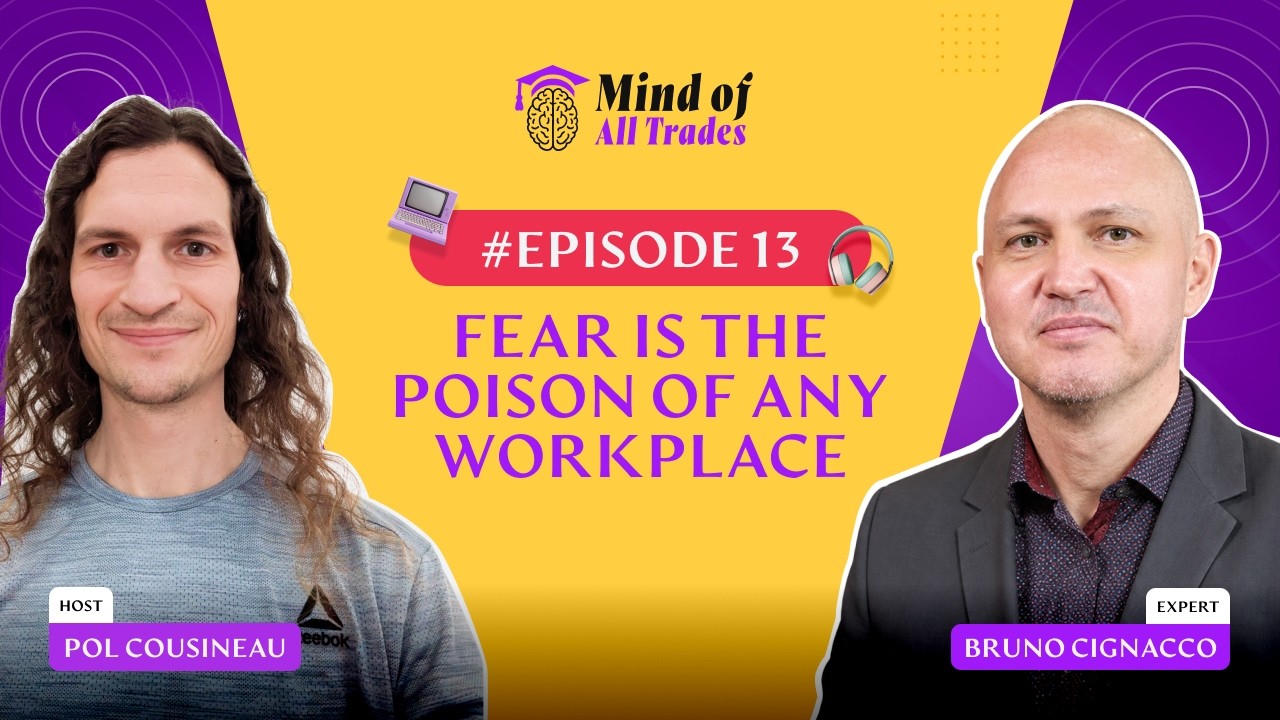
Fear Is the Poison of Any Workplace - Bruno Cignacco - Part 2 - EP 13
The Mindset That Scales Your Business
Description
“Fear is the venom, the poison of any work environment.” Bruno Cignacco says it is the first thing a leader should look for.
In Part 2, Bruno and Pol Cousineau get practical about what a compassionate business looks like day to day. Bruno explains why qualitative factors like kindness and cooperation should come before the numbers, how an anonymous survey can show whether your team is working in fear, and why serving customers is different from selling to them. They also cover why high tech needs high touch, what Trader Joe’s kept when others automated, how fully online teams can build trust, and the one question Bruno asks himself every morning.
In this episode, you’ll hear:
- Why qualitative factors like kindness and cooperation should come before the numbers
- How to find out if your team is working in fear, using anonymous surveys and suggestion boxes
- Why fear makes people defensive, less creative, and worse at serving customers
- Serving versus selling: finding out what customers need and giving more than they expect
- High tech and high touch: why customers still need to reach a real person after they buy
- What Trader Joe’s kept when other grocers moved to self-checkout
- A weekly social hour for online teams, and why knowing the person matters more than the role
- The second edition of The Art of Compassionate Business, and the question Bruno asks every morning
Chapters:
00:00 – Coming Up and Intro
02:40 – Measuring Compassion: Qualitative vs. Quantitative
11:28 – Fear in the Workplace, Groupthink and Serving vs. Selling
24:16 – Experience Engineering: High Tech Needs High Touch
30:38 – Test Your Own Customer Experience
33:11 – Trader Joe’s: Why Real People Beat Self-Checkout
38:46 – Keeping Remote Teams Connected
44:30 – Why Social Time Boosts Productivity
48:28 – The Second Edition and What COVID Changed
55:17 – Closing Advice: Add Value to Every Stakeholder
About Bruno Cignacco
Bruno Cignacco has run his international consultancy since 1993. He is an international business consultant, TEDx speaker, university lecturer, and bestselling author with more than 30 years of experience advising and training hundreds of companies worldwide on international trade, marketing, negotiation, and compassionate business. He is a Senior Fellow of the Higher Education Academy in the UK, and in 2024 he was named by World’s Leaders Magazine as one of the world’s most transformational leaders changing the face of business. Bruno teaches that companies can be profitable and compassionate at the same time, and he is based in London.
Bruno’s book, The Art of Compassionate Business: Main Principles for the Human-Oriented Enterprise, is published by Routledge.
Check out The Art of Compassionate Business, written by Bruno Cignacco: https://www.routledge.com/The-Art-of-Compassionate-Business-Main-Principles-for-the-Human-Oriented-Enterprise/Cignacco/p/book/9781032445427
Connect with Bruno:
- Website: https://brunocignacco.com/
- LinkedIn: https://www.linkedin.com/in/dr-bruno-roque-cignacco-sfhea-0609317/
Want to be a guest on Mind Of All Trades? Apply here: https://mindofalltrades.com/podcast-application
Visit The Digital Navigator: https://thedigitalnavigator.com/
Follow Mind Of All Trades:
- YouTube: https://www.youtube.com/@MindofAllTrades
- Spotify: https://open.spotify.com/show/4MixC1mfhhUVIOFO1mywUc
- Apple Podcasts: https://podcasts.apple.com/us/podcast/mind-of-all-trades/id6807196830
- Instagram: https://www.instagram.com/mindofalltrades/
- Amazon Music: https://music.amazon.com/podcasts/32ce7fa4-4473-4c53-9256-7fca60e47331/mind-of-all-trades
- LinkedIn: https://www.linkedin.com/company/mind-of-all-trades/
Theme music by Breakmaster Cylinder.
Also Listen On


Transcript
Click to read the transcript
[00:00:00] Pol Cousineau: How am I going to
[00:00:01] steer the ship?
[00:00:02] How am I going to
[00:00:02] explain this to everyone?
[00:00:04] How are we
[00:00:04] gonna get through this?
[00:00:05] Bruno Cignacco: So fear is the venom,
[00:00:07] the poison of any
[00:00:08] work environment.
[00:00:09] Pol Cousineau: And it was such a relief
[00:00:11] to know that
[00:00:12] everyone in the organization
[00:00:14] were behind me,
[00:00:15] coming together.
[00:00:16] That stress reduced.
[00:00:17] Of course, the situation
[00:00:18] was still there,
[00:00:20] but the burden of it
[00:00:21] felt so much lighter.
[00:00:23] Bruno Cignacco: And by doing so,
[00:00:24] when you face difficulties,
[00:00:25] these stakeholders
[00:00:26] are more prone
[00:00:27] to support you unconditionally.
[00:00:29] Why?
[00:00:30] Because you care
[00:00:31] for them in advance.
[00:00:33]
[00:00:40] Pol Cousineau: Welcome to Mind of All Trades, the podcast where edupreneurs turn knowledge into impact. I’m your host, Pol Cousineau, and together we explore the craft and commerce of educational businesses, we look at the strategy, we look at the systems, and we look at the real implementation work that has to happen behind the scenes.
[00:01:00] Before we dive in, make sure you subscribe so you don’t miss future episodes. We’ll be sharing practical guides, conversations, and examples for edupreneurs who are building real momentum in their business, and for coaches, course creators, podcasters, and membership site owners who need help with the tech behind the business.
[00:01:20] Check out The Digital Navigator. The Digital Navigator helps with fully managed websites, funnels, analytics, automations, and ongoing tech support. So instead of having a bunch of disconnected tools, your systems can work together, and you can spend more of your time focused on the business, the offer, and the people you serve.
[00:01:40] You can learn more at thedigitalnavigator.com. Now, let’s jump into today’s episode.
[00:01:47] In part one, Bruno Signaco, international business consultant and author of The Art of Compassionate Business, showed us why caring for people and making a profit aren’t opposites. We talked about reciprocity, why Patagonia has told customers not to buy its jackets, why choosing profit alone eventually backfires, and a free tip: read your own reviews.
[00:02:12] Just do it. Trust me, and trust Bruno on that one. And we got to Bruno’s point that when you care for people, they support you unconditionally. In this part, we get into how you actually know whether it’s working. How do you measure compassion? We also cover fear in the workplace, serving versus selling, why high tech needs high touch, and the one question Bruno wants every listener to ask each morning.
[00:02:39] Let’s get into it.
[00:02:40] You mentioned supporting unconditionally. That was about five years or so ago. I had a very challenging situation going on with stakeholders in my company, and it was very difficult, and I was quite stressed about how am I going to steer the ship? How am I going to explain this to everyone? How are we gonna get through this?
[00:03:01] And I kept preparing and reviewing everything, and then I called everyone in the company and I said, “Okay, here’s what’s going on.” And in my mind, I’m thinking, “Okay, I gotta get everyone on board, right? So that we can overcome this obstacle.” I was not even halfway through that someone said, “Hey, Pol, I just wanna let you know, no matter what, I’m behind you.
[00:03:24] I’m going to stick with you, uh, whatever I can do to help with this situation.” And then shortly after that, everyone are like, “Okay, Pol, whatever you need, we’re all supporting.” And it was such a relief to know that everyone in the organization were behind me, coming together, that stress reduced. Of course, the situation was still there, but the burden of it felt so much lighter.
[00:03:48] And then afterwards, it took a good year, year and a half to fully resolve that situation, but I was getting help from everyone, everyone was getting involved, and it just made the company so much better. Now, if I had been extracting only, right, from them, I know this reaction wouldn’t have happened. They wouldn’t have all pulled together.
[00:04:09] And for me, that was one of the most moving moments in the business, was seeing, wow, like these people really are there and are supporting me. But again, that’s that reciprocity. Now, people may not have that disastrous or that challenging situation, right? Which inevitably, I think it most likely happens in business.
[00:04:29] But otherwise, until that happens, how do we measure the impact of these, uh, this performance of being conscious, right? And being compassionate. And I’m thinking, like I have a training business, ’cause this is what most of our audience have, and they may wanna move towards more compassionate. So what does that look like, right?
[00:04:49] What are the actions, but then how do they know if it’s working?
[00:04:52] Bruno Cignacco: good, good, good. Well, well, we have to differentiate two type of factor in business. The one that can be measured precisely, these are what we– I call quantitative factors. These are, for example, profit, market share, productivity. Accountants like me and you love these factors because they can be compared from year to year, you can compare with the average in the sector, and so on. These are quantitative aspect, but these are only one of the two main factors in business. The second type of factor is called qualitative aspect of business. This cannot be measured precisely. You can have a feel, you can conduct survey and can give you some idea this is going well or not, but you cannot put a figure.
[00:05:41] You cannot say, “Oh, this has a nine or a ten,” and so on. But you can have a, a much, uh, qualitative approach on this because they are– they cannot be measured precisely. What are these factors? These are kindness, compassion, generosity, gratitude, camaraderie, cooperation. Now, let’s have a look at this paradox.
[00:06:04] Most company focus on the quantitative aspect of business because they believe that they are the most important ones. In my view, this is the wrong approach. Company should give priority to the qualitative aspect of business. This mean why they’re so important, the qualitative? Because it’s a relational aspect, help you build strong relationship with different stakeholders, relationship that are based on mutual satisfaction of needs.
[00:06:31] These are long-term relationship. They are not transactions. They are relationship that help each party grow and, uh, obviously foster cooperation, support, mutual support, and kindness. When you nurture this qualitative aspect of business as a priority over the quantitative, you build a strong relationship with the stakeholder, strong relationship with employees, strong relationship with suppliers, with community members, with customer, and so on By doing so, these stakeholders are more prone to help you achieve this quantitative aspect of business.
[00:07:14] So the, the approach is indirect. You focus on people, but because you are interdependent with them, it’s the right approach. You focus on people that are the main factor, the most important factor that will help you achieve the quantitative aspect. Instead, when you focus on quantitative aspect, you forget people.
[00:07:37] You forget about people, and this is wrong. Why? Because you’re forgetting the most important aspect. Remember that people are the meta resource. A resource, meta means above, resource that help you generate other resources. Customer can help you generate other potential customer. Employee can help you generate business model, new product, new services, new processes, new systems, and so on. So this mean that you are investing your time, your effort on building a strong relationship. And when you face difficulties, like in your case, you already have this strong relationship. You cannot build quickly. This take time. And by doing so, when you face difficulties, these stakeholders are more prone to support you unconditionally.
[00:08:25] Why? Because you care for them in advance. You care for them, and this was not a unilateral approach, only benefit for you, win-lose, but you were caring for them and for your needs. So this was mutual. This is quite relevant, but it’s counterintuitive and it’s paradoxical because, uh, you have to focus indirectly to get the best quantitative indicators, the best performing quantitative indicator. This is quite relevant. And I mentioned, uh, on a practical level, how does it look like?
[00:09:01] Pol Cousineau: Exactly, because they’re qualitative,
[00:09:03] Bruno Cignacco: what it take? How, how … Okay. First of, if you are owning a company or whatever company, training company or you have employees, the first thing to discover is, is there fear in this workplace? Is there fear, any type of fear? You can say, “Oh, this is kind of abstract.” Very important, because if there is fear in the workplace, regardless that the employees are working virtually or in the same space, this will be like a shooting your, your foot, on your foot. Why? Because when you are infusing fear or there is fear, any type of fear, for example, fear of being fired, or employees might have fear of making suggestions, new suggestions because nobody want to rock the boat, or fear of being outpaced by the very, very fierce competition between employees. And so, uh, nobody want to b- uh, to share information with the colleagues. Why? Because they’re competing like they were enemies within the company. They cannot cooperate. Any type of fear, fear of being outpaced by another colleague, fear of making, uh, very innovative or crazy ideas, uh, or fear of, uh, for example, being fired or fear of being penalized and so on. This type of fear is a negative indicator that the company’s not caring for employees. Employee might feel stress. Emfi- employee might feel harassed, bullied, pressurized, uh, might experience burnout. Not good. How you can discover this? With a simple survey. Simple survey. A survey, anonymous survey, you check to know really the facts, if employees are being at ease, relaxed, not stressed, or employees are being taken to the limit, where they cannot even see their family. If this is happening, this is not good. Why? Because this will backfire your company. Employees’ productivity levels, when their stress go down, they’re more prone to get ill, they’re more prone … Uh, but absentation might go up, uh, turnover might go up, and this also represent costs. Uh, cooperation might be inexistent.
[00:11:25] So this is quite important.
[00:11:27] Understand?
[00:11:28] Pol Cousineau: interesting, the fear that you brought up, because just before our recording session, I was talking with someone in a client’s team, checking in because I’ve been noticing there’s been a lot of stress and the owner is very stressed. And I was saying, “Hey, how are things going?” and all this. And then eventually, once I, you know, got the person comfortable, she told me, “Oh, all year we’ve all been in fear.
[00:11:52] We’re terrified. We’re afraid of making mistakes. It seems like only the thing I make wrong is being brought out, and I work overtime in the weekend. There’s no recognition.” And this person told me this, this person. We’re all feeling this way. Someone feels like we’re gonna get fired any moment. But what is interesting is that this story is not coming across from the owner, and this was just before, right?
[00:12:17] And I got this person to open up. So one is it’s interesting because if you don’t go looking for it, like I could clearly see she was afraid of even telling me this because of the fear. So the fear prevents the fear from being exposed right? Which is a problem in itself. But now you mention anonymous surveys.
[00:12:38] Do you think that would be the best way in a situation like that to unearth that?
[00:12:42] Bruno Cignacco: totally. Or suggestion boxes. Suggestion boxes that are also anonymous. Because at the end, company need to… Again, it’s about humility and humbleness. If we suspect that there is any type of fear, we are talking about a work environment that is toxic, very toxic or a little toxic, doesn’t matter. Uh, and it’s not psychological, psychologically safe. We know according to research that when the environment is psychologically safe, employees feel much more at ease, more satisfied, more motivated, lower absenteeism, lower stress level, more cooperation, more creativity, better customer satisfaction too.
[00:13:27] Psychologically, workplaces that are relaxed, no fear, they are also bringing about bet- higher customer satisfaction. Some might ask why. Because when employees feel relaxed, they don’t feel stressed, they don’t feel fearful, they can give their best when serving customer. Instead, when employees are pressurized, fearful, they have multiple projects, multiple deadlines, how they can serve customer better? Impossible. Why? Because they are thinking in a very narrow way. They’re thinking about the threat at hand. Will I be fired? Will I feed my family? Will I m- meet the deadline? Will my colleague steal the information that I have been gathering? How you can be creative? How you can be productive? So fear is the, the, the venom, the poison of any work environment.
[00:14:21] It’s the opposite to compassion. So, and when companies detect the fear, uh, some will say, “Oh, if we don’t threaten them, they won’t be productive.” No, it’s the opposite. When you threaten, they will not be productive. Why? Because you are threatening them, and they’re feeling fearful, and they are in this freeze fight-flight mode. They are reacting. They are not acting. They are reacting. They cannot perform well. Why? Because they are continually defensive. They cannot cooperate. How they can cooperate in a fearful workplace?
[00:14:52] So, uh, so the idea is,
[00:14:54] Pol Cousineau: that defen-
[00:14:55] Bruno Cignacco: yeah, the
[00:14:55] Pol Cousineau: because of that defensiveness, th- there was a situation with this person, and then the first thing is, “How am I going to present this to the owner?” Not, “How will I resolve this for the students that were impacted?” Right? The, the defensiveness that you’re talking about, and it made sense because there was so much fear, so the first reaction was self-protection
[00:15:17] Bruno Cignacco: Well, well, suggestion boxes, uh, surveys that are anonymous, company need to undertake. You don’t have anything to lose. You undertake the survey, employees may or open up or not. But you have to guarantee the confidentiality. This mean that will be really anonymous because if the workplace is very toxic, nobody would like to give their name because obviously they are risking their, their position. But also suggestion boxes. In many cases, the employees cannot make any innovative suggestion. Why? Because there is a concept called groupthink. Everything need to be thinking according to the main principle that are widespread in this company. Nobody can rock the boat. This is very common in conservative companies, traditional companies, that they do business as usual.
[00:16:09] They don’t want to innovate. And when someone come with a good idea, they might consider that it’s ridiculous or it’s a crazy idea, and they might think that this can be putting their position at risk. So nobody making any suggestion. And if the company doesn’t innovate, other companies will do, and this company, it’s a matter of time, they will be out of the marketplace.
[00:16:32] Why? Because innovation is the fuel of any business activity. In the book, I included two chapter on innovation, and it’s the fuel. If you don’t introduce creativity, innovation on a regular basis, it’s very difficult to be as a market leader with a very, the very good brand image. Why? Because there will be other companies innovating, new, using new processes, new technology, and so on. So this is quite important. But what about customers? Customer, uh, how you can make this more compassionate and focusing on the qualitative aspect. Again, you have to ask this question when you are serving customer, “What is my approach? I am selling Option A, or I am serving, option B. If you are using the option A, you are not compassionate.
[00:17:29] You are focusing only on quantitative aspects. Wrong option. If you are serving … I will explain the two option now.
[00:17:39] Serving means wishing the best for them, adding value. You are focusing on qualitative aspects. Let’s explain the two. Uh, selling means being self-centered. This mean I try … I produce some goods, or I bought some goods, and I store them, some goods or services.
[00:17:58] I, I develop some services, and I try to sell them to target customer. What is the main objective of selling? Getting more profit, more sales, and so on. Serving is a completely different paradigm. The focus is on customer. So this mean that what I want when I am serving, when I have an attitude of service, is the best for customer, regardless of the result, regardless of the outcome. And I want customer to freely decide the best for them with my support, with my technical expertise, with my experience. But at the end, it’s an interaction between my technical knowledge about my products and services, and customer that have their knowledge about themselves, their values, their need, their expectation.
[00:18:53] There is an exchange. It’s like a cooperative bond between the company and customer. Now, when I’m serving, I want to add value to them. So this mean that before my intervention The customer life has some problems, some challenges, something that were unresolved. With my intervention, many of these things get resolved.
[00:19:18] Customer feel better, happy, experience positive emotion. Their life to certain extent got better because of my intervention, regardless that I sell product or not. So this mean that the objective or the attitude of service is improving customer life to different extent. How you do? What is the most effective way? First off, finding out customer needs. This mean that I don’t assume that I know the customer need. I find out. How I find this out? No assumption. Engaging in conversation with customer for them to tell me about their needs, their past experiences, their failures, what they’re looking for, and try to see if there is a match between their needs and what y- I can offer. There are two possibilities. There could be a match. I offer my product and services in a non-manipulative way, no pressurizing way, no fine print. Allow them to decide them freely, with autonomy, and also offer them support before selling, during selling, and after selling, and providing a generous view on this exchange.
[00:20:32] The generous mean that I try to give them more than they expect. If the average company is giving, for example, for a product, a guarantee of one year, I might offer four years. Why? Because I want to give more benefit than other company. If I’m selling a computer, another company are only selling a computer, I may offer a free course how to use a computer. Why? Because I want to exceed their expectation. So this mean when I adopt an attitude of service, I’m not self-centered. I’m self-centered on them, and I try to exceed, give them as much as possible to create a positive imbalance. I give them more than they expect, and they are more prone to reciprocate with positive reviews, coming back, and so on. But I don’t do this with expectation of receiving this reciproca- re- reciprocation. I’m doing this because I want to improve their lives, and I know that they are the main source of profits, and by improving their lives, I will obtain profit. Instead, if I force and I manipulate them, this will backfire me.
[00:21:40] They might buy only once, but then they will leave negative reviews all over the internet, and this will be backfiring me. So this mean that it’s being humble, other-oriented, oriented to customer, exceeding their expectation. This mean being generous. I mentioned there is a full chapter of generosity in the book. Uh generous with tangible thing, for example, a computer, and you give a course. Or intangible thing, you give advice, or you give support, or you help them compare the different models, the different options, and so on, to see what is more suitable for them. But at the end, they are the one deciding. And in case that there is not a match, because there could be no match between their needs and my products, I recommend this customer a company that could have the product.
[00:22:34] You can say, “Are you crazy?” You do this because you want the best for them, and by doing so, you bring about a good image, a good impression. And in the future, customer have needs that are, could be related to the product you offer. Because you helped them, they are very likely that, to come back to your company or recommend your company to a friend, family, or acquaintance. So, this mean that is others-oriented. And by being other-oriented, you have this famous equilibrium. This mean that you give and receive. You are not only trying to take, and take, and take. That this is what company try to do. They try to get more profit, more sales, more customer retention. No, no. Here is a flow that is in a state of equilibrium.
[00:23:24] You give, and by giving more than expected, you create an imbalance, and you’re more prone to receive loyalty from this customer, positive review, recommendation to other customer, and so on. This apply to any other stakeholder, but the idea is… And it sounds counterintuitive, again, because you say, “Hmm, but I have to invest.” Because it’s interdependence. When you give to a specific party that is v- very relevant for your business success, you are really making an investment. Some company take this as a cost, as a, “Oh, if I give the free course, this will represent the cost.” No, it’s an investment. It’s an investment on relationship, on sustainable bonds, on long-term, uh, ties with these stakeholders
[00:24:16] Pol Cousineau: When you’re talking about serving, it made me think of experience engineering, and it’s imagining what experience will they have as either before they receive the product or during or afterwards. And there were a couple of examples that came to mind. So in one of my businesses, we do a lot of things with technology.
[00:24:35] Well, if something goes wrong, it can create just high anxiety for people when technology goes bad. In our industry, most people are going towards you can’t talk to anyone anymore. It’s all bots. So then what we did is we said, “No, it’s all about the human and putting them at the center of things.” So then we enabled voice.
[00:24:55] You can actually call us and say, “Hey, this is going on with my web system. This is going on with, you know, my ads,” or whatever it is. Why? Because I want to help lower the anxiety. If they submit a help ticket and we solve it in 10 minutes, it’s still 10 minutes of high anxiety. But if you can get ahold of someone on a live chat, you can give them a call, send an SMS, and you get an immediate response.
[00:25:19] You know, okay, someone’s looking into it, or I can talk to someone, and then we can reassure them, “Okay, great. I’ve got my lead engineer. He’s looking into that,” right? Reassure them. So the experience is intentionally engineered. Now, the other example for courses is a lot of people when they buy an online course, it’s self-study.
[00:25:37] If anything goes wrong or if you have questions, it can be very difficult in the moment to get assistance. What do you do? You look for the email. Where do I send this? What happens? An easy solution is to put a little bubble in the corner, and then people can communicate live. Obviously, you have business hours, but then they can reach someone.
[00:25:57] Whether the course is not working, they can’t download the exercise you gave them. What- whatever that is, again, just having someone that can be reached, and it might not even mean more costs for the company because someone is there, they get a ping. Okay, it happens what? Once or twice a week. Uh, the chat opens, and then you help the student out.
[00:26:17] But those small things can give a meaningful experience to the student because without that, let’s say it takes a week for the student to get an answer. This builds up this dissatisfaction during that whole period
[00:26:33] Bruno Cignacco: I agree. I agree. And what you are saying, uh, clear- very clearly, I completely agree, is the equilibrium between what I call high tech and high touch. So some companies have only high tech. They use the latest technology with website, with artificial intelligence and so on, with the best servers and so on. But this is high tech. But we need also the human side, high touch. This mean, can there be a way to communicate with stakeholder, for example, customer, in a direct way? Is there any helpline? Is there a chat box? Is there a video conference when you see a person, not a bot, and when you can feel more at ease?
[00:27:20] Because remember, as I mentioned, customer need to feel positive emotion before buying the product or service, during the buying process, and especially after buying the, the, the product or service. If they feel regretful, they feel confused, they have some doubts, can they talk to a real person? This mean a real person, not a bot, where they can have their doubts clarified, they can support, that they can feel contained and care. If so, there is an equilibrium between high tech and high touch. So why so important? Because now with the upsurge and development of artificial intelligence, a very important differentiation point will be company that have the human side, that they don’t have only the latest technology, which is good.
[00:28:10] Could be fancy, could be nice, could be quicker, could be more effective, but also they have the human side. Because at the end, we are human beings, and the only commonality, only, but very important commonality among of all us, regardless of the walk of life that we are related to, is that we are human being with fears, positive experience, negative experiences, expectation, dreams, and you can connect better human to human, not human to machine. Up to now. Maybe in the future will be the same. Unlikely, in my case. I feel that it’s very unlikely. We might not see it, but, uh, so this is a very important differentiation point, and I agree. The worst thing that could happen with a customer is feel- feeling anxious after they bought something. This is called cognitive dissonance, technically speaking.
[00:29:04] They have some internal contradiction. ” Did I make the right choice?” Or, “This is too difficult. I’m not sure if I should return this,” or, “I might ask for a refund.” This can be easily approached with a simple helpline, free helpline, or with a video conference or with a chat coming up, but talking to a real person because customer can easily discover this is a bot.
[00:29:29] If this is a bot, well, you’re not fooling customers. So this means that say, this is very generic, and this will not calm down this customer and w-might feel even more anxious, say, “Okay, you know what? I’m talking to a machine. Doesn’t clarify anything.” So very important, high tech and high touch. This is– will be the ideal aspect. And I see many companies, they don’t have even a telephone number. Today, I was looking for… I am about to move now here, very close to here, and I, I was looking for a company. I was looking for some bed for the bedroom, and they don’t even have a telephone number. I said, “What is this going on?” An email. Well, listen, if I have a problem with the bed and they deliver the wrong bed, I cannot send an email and say, “Listen, collect this.” It’s crazy, but you see still, you see still, uh, you, you, you still see this in the marketplace. So companies that are focusing only on technology, technological ad-advancement. But what about the human connection? What about building bonds? What about calming people down, especially post-purchase? So quite
[00:30:38] Pol Cousineau: It’s funny that you mentioned the phone number because actually a lot of clients are surprised that we have a phone number. They’re like, “Wow, this is amazing. There’s a phone
[00:30:47] Bruno Cignacco: good. Keep
[00:30:48] Pol Cousineau: now the norm is that there’s no phone number, right? And then you said, “Oh, what do I do? There’s furniture,” things like this.
[00:30:55] And, uh, so that is quite interesting how things are adapting. And here in Costa Rica, when I had to buy a dryer, I called everything. At the end, they’re like, “No, you have to buy it through WhatsApp,” and with a WhatsApp message. And then you go back and forth with the salesperson, and then you get a link to pay.
[00:31:13] And I thought, “Well, how ridiculous is this?” ‘Cause I was calling the store, we’re doing all this, and then when it comes the time for the purchase and the advice, then they send me to this text thing, and then it had a bot at first, right, to do this. So again, that experience, like, greatly degraded, but again, they’re trying to push everything towards that high tech, right?
[00:31:33] And they’re losing their high touch with this. Now, something else that I see is people have high touch, but they don’t really because they don’t check their systems. What I mean is there’s a phone number on your invoice, on the checkout, on the contact page. No one even calls it. It ran out of credit. When you call, it doesn’t even work.
[00:31:52] Or you send an email, it bounces back. There are a lot of these. It’s quite surprising how people don’t think, “Oh, let me test the, uh, the experience or make sure the system works.” Or there was someone else, this one is in real estate, and when you call, I’m not kidding you, it takes at least a minute, maybe 10, 20 seconds until you can finally get to an option where you can talk to someone.
[00:32:20] And I said, “This is ridiculous.” And I listened to their phone system. They have the logs. Most people hang up after 30 seconds. And I said, “Look, over 80, 90% of people that are trying to reach you,” and these are, like, residents, these are, like, people living in houses that they manage, “don’t even wait because it’s so long, your system.”
[00:32:40] And why? Because they wanted to make sure the perfect person answers it. So it determines which state are you in, okay, which city are you in, which neighborhood. Now, is it billing? Is it an issue with your appliances? Is it this, right? Then after that, it continues, and what they were doing was trying to do high touch so the right person would be there.
[00:33:02] Like, I talk with them. That was the intention. But it was backfiring because no one was actually testing the experience that you would have at
[00:33:11] Bruno Cignacco: very important. But I, I, I, I give in the book an example of the company, you might know the company, an American company’s Trader Joe’s. Trader Joe’s is a grocery,
[00:33:22] yeah, is a grocery chain, and this company has, um, lot of outlets, uh, grocery outlets. And if you see what is the trend in the s- in the supermarket and grocery sector, the trend is to set up the checkout machines at the end, checkout points.
[00:33:45] I say this is the trend. Why? Because it’s more effective. You don’t need employees. Uh, people are self-servicing, and they’re doing self-service, and so very easy and very convenient. You have to invest at the beginning on this machi- in these machines, but then they pay themselves out because they…
[00:34:03] obviously you reduce the, the, the staff and obviously… But Trader Joe go counter this trend, counter this trend. They do not use these checkout points, but they use real people. And why? But– And it’s one of the most famous companies, a very fast-growing company with the best brand image, high customer loyalty. Why? Because they want to interact with customer when they pay, but also they want to help elderly people, where in some cases they, they cannot… they are not very techy. And also, there is an interesting example that was published in one of the magazines, the Trader trade magazines, that, for example, the family was about to pay, and they were talking to the, um, person at the till, and they were about to pay, and the child in that family was a bit restless and was, uh, kind of shouting and so on and disturbing people. And the employee that was at the till start- started entertaining this child and singing and, and, um, uh, pretending that he was a clown and so on, and the child calm down So there was a, a human interaction that benefited the, the family and, uh, end up benefiting the company because then this was publicized all over the newspaper as a good example of human interaction. They were not only adding value by collecting the money when they were paying for their shopping, but also they were interacting on a much deeper human level because they were calming down the child. They didn’t have any obligation. That was not part of the job specification. But because they have a human approach, they were connecting in a much deeper way. And obviously, this bring about a multiplying effect. This appear in all the news because of a positive role model to emulate and appear like a leading company, an example of a company in the grocery sector to emulate. So this mean, in this case, you are eliminating technology that could be relevant in this sector, for example, the, the, the checkout points, but you are keeping this interaction, human interaction, and this bringing about even greater benefit than introducing technology
[00:36:31] Pol Cousineau: I like that example, yet it seems like there’s even more to that, which ties back to our earlier conversation because the employee also felt like they could go, right, and interact, assist, and they had the desire to do that. Now I’m throwing a hypothesis. Do you think it’s because management also cared about that employee or they’re continually reinforcing?
[00:36:55] Bruno Cignacco: We, we see a multiplying effect because we saw employees that are satisfied are more prone to be satisfying customer. In Trader Joe’s, if you compare, uh, Trader Joe’s has, for example, in that sector, has the highest pay, uh, for the groceries sector. This means that employees, economically speaking, are better off than other competing companies.
[00:37:21] So this is a quite important incentive. But also employees, uh, comment about this when they were interviewed. They feel that they have a very good environment, a cheerful environment, a playful environment. They can engage with customer. They’re not, not only on their own. They have a social… They have their social needs met because employees have different needs.
[00:37:40] We didn’t talk about their needs, but employees, they don’t have only economic need, they have social need. For example, employees are allowed, when customers are looking on the shelves, to make suggestions and give some advice and recommend some recipes, for example, to use for some food products. And this make th-this employee feel valuable. Valuable. They feel that their contribution is meaningful. Why? Because they are helping really others. So if you give a recipe and this, this recipe can be, uh, used, they are feeling helpful. So this mean that the employees feel that their work is not only set up to the very hard specification. They feel that they can interact with customer. They feel that they are making a difference, and this mean that their work is not only well-paid, but is meaningful from the social, uh, aspect perspective, but also from the relational perspective. They are relating to others. They’re making feel valuable, appreciated. Yeah, yeah
[00:38:46] Pol Cousineau: This was a physical context, and I love the story. How do we translate that to a world where we might be working more online? So maybe a Slack communication, perhaps you’re lucky if you have Zoom or other Hangouts and video conference. But a lot of this distributed work is taking more and more of importance in, in the workplace
[00:39:08] Bruno Cignacco: Well, we have virtual wor- workplaces. Supposing that you have a compra- company that is decentralized. Some
[00:39:15] employees are in one country, other in other countries, and they communicate online. Well, you have technology like Zoom, and you have technology like any other video conferencing software that can help you connect.
[00:39:28] Well, regular meetings Uh, beside emailing, beside, uh, shared spreadsheets, beside all the software that is much more in-person, regular meetings at least once a week to check out the projects, to check out the performance, to check out the challenges that they can have are relevant to keep the relationship up with the relationship.
[00:39:52] But also, in some cases, what many companies do, I give you a few example, what many companies do that are almost virtual, this mean that they don’t have anything offline, what they do, they have also online social meetings once a week. They do, for example, Fridays at the end of the day, they do social meeting, not to talk about budget or cost or the project or data, but they talk about how things are and connecting on a social level.
[00:40:22] I mentioned this in the book that is so important. We call, uh, social aspect of relationship that implies you are not continually focusing on business aspect, that are very important for the company performance, but you are, uh, bringing about opportunity to meet other people on a personal level, emotional, mental level.
[00:40:46] Know their hobbies, their family, their pastime, their whatever they do. You do this once a week. And why is so important? Because research has shown very clearly that when you have this meeting virtual, if, if you cannot do offline or, or offline will be even better, uh, people go back to work and they connect to one another in a more cooperative way because they know on a personal level they, they can cooperate much more, uh, thoroughly and deeply, and they, the, the trust is develop much more, uh, much faster. When people connect to one another and they can talk about letting their hair down, comment about their, their, for example, experiences, hobbies, uh, dreams, project, this can, uh, build more rapport. They can build much deeper communication. That is not only valuable for those moments, but also when they go back to work.
[00:41:48] This is what I recommend company that are fully online. Have one hour or half an hour. And many company were doing this during COVID, company that were fully offline, and they start doing this meeting online. But then when COVID finish, they, they end up with this meeting. You need to have this social event, so, the, the technical name social event that- People can talk and everyone talk equal to equal.
[00:42:14] The CEO can be talking about with the coding specialists and so on, like they were, uh, friends in a party, so in a very relaxed way. This is quite relevant. Supposing that you cannot do this meeting, they say, “No, our company is too formal.” Well, introduce five minutes or ten minutes before any meeting online with Zoom to talk about personal aspect, a small talk, to see how things went the, the, the weekend before. Say ten minutes to know the person, because the role is a very tiny part of the person, very tiny. You have to see the bigger picture. When you know the person, the person is bigger than the role, and by knowing the person, you can help this person unleash all their potential in that role. When you only know the role, that is a very tiny part.
[00:43:11] You don’t know the emotional aspect, the fear, the concern, their dreams, the expectation. It’s very unlikely that you can unleash the potential of this employee. Why? Because it’s only a facade, a very tiny part, a mask in some cases. They don’t show who they are. Am I clear? So this is appear content, but there is a lot of research that corroborated that these social events bring about more productivity, more creativity, lower stress, uh, more trustworthiness, more trust. it’s it’s wonderful. But some might say, “Oh, it’s part of, uh… We, we don’t want to spend one hour.” Well, put as part of the work time. Put part of the work time. You, you deduct from the work time one hour, say, “You know what? This hour, the last hour will be only for social aspect. We talk about non-business topic.” Some will say, “No,” because if you say, “No, we do that that day, ‘No, I’m busy.'” Well, okay, part of the work time. It’s part of the job specification. People will love it. I love it. I
[00:44:14] par- I participate in some of them. They’re wonderful. You can see
[00:44:18] people that are completely shy, and they’re bright. They, they, they, they are very talkative, and they comment about the whole life.
[00:44:27] So this is quite enriching
[00:44:30] Pol Cousineau: Yeah, I was going to say that also goes back to the concept of a good, healthy workplace because I could imagine people saying, “Oh yeah, it’s part of their work day, but I’ll be working on Saturday overtime to make up,”
[00:44:42] right, for this.” So everything is interconnected
[00:44:44] Bruno Cignacco: yeah. Put, put part if you say people won’t attend, okay, well, it’s part of the work time. So it’s part of the work time, and people will have a little of, uh, relaxing time because also people are tired. When you have so many responsibility, many project, having one hour a week to talk about non-business topic is paradise.
[00:45:07] People will love it, and people will like probably more. But it start with one hour. And you will see the productivity will go up because it’s counterintuitive. People, when they can relax, their mind tend to be much op- much more open, um, then this can be bringing about more benefit in the workplace
[00:45:30] Pol Cousineau: That makes sense about relaxing because we can easily think, “Oh, when they’re not at work, they’re relaxing.” But no, because everyone listening has different personal responsibilities, right? Whether it’s to family members, friends, kids, maybe you’re studying something. So it’s very rare that in our non-working hours, we’re just there relaxing, and then by baking that in, it can make a release valve
[00:45:58] Bruno Cignacco: Yeah,
[00:45:59] Pol Cousineau: for that person.
[00:46:01] And what I found is that people that are the most go-getter, that are high productive, this is not unique in the work dimension lens. No, it’s… They’re like that in their daily life too, right? They’re pushing everything to the max, so then the people that have that high productivity… Now, this is a hypothesis.
[00:46:19] I don’t have a study, but I suspect that they need that release valve even more, and now this half hour, hour, right, however long that is, becomes even more valuable. So I really like that idea.
[00:46:32] Bruno Cignacco: The idea is connected to, uh, some scientific study. It’s true because at the end, if people can have a chance to have positive emotions, with experiencing positive emotion, with nice interaction with others, that have only a social, uh, focus, not a business focus on project, cost, deadline. Research has shown that when people experience positive emotions, this positive emotion expand their discerning skills, expand their creative skills, expand their productivity, and also expand their connectedness with other people. So this means that positive emotions are beneficial, not only when you– people have this event, but also can be brought down to when going back to work. People experience positive emotion, their minds tend to open up. They’re not in a freeze fight-flight mode. They’re not stressed. They tend to be thinking in mu- in much more non-traditional way, innovative ideas, a non-traditional way to solve problems, a potential new product or services. And this is because positive emotion have an expansive, uh, effect. Negative emotion, fear, or for example, anger, they have a contractive effect. They– these emotions have their function in human beings, but they have a contractive e- For example, in the case of fear, we saw when people are fearful of losing their job and so on, well, they’re very defensive, and they cannot be creative.
[00:48:17] They cannot be anal- analytical or in a critical way. Why? Because they are very defensive. So yes, it’s true. It is corroborated by science
[00:48:28] Pol Cousineau: Yeah, it also makes me think that when your existence is threatened, because fear is about existence and safety, you’re not thinking, “Oh, how do I make art? How do I get creative,” right? You need to protect yourself first. So it makes sense that these would block one another. So it’s totally logical to me.
[00:48:47] Now, I have a question for you because we’ve been mentioning The Art of Compassionate Business, which is your book, and you have the second edition, which I believe came out in 2023.
[00:48:58] Bruno Cignacco: yes, yes
[00:48:59] Pol Cousineau: So what was the difference in the second edition that you decided to add in
[00:49:04] Bruno Cignacco: I added more examples in the second edition, and I added a lot of example from companies all over the world, service company, manufacturing companies, trade companies, and from different continents. But also, what I added to this book, I expanded the research on, on compassion in business. Uh, this book has 15 chapter and seven appendices, and what I tried to enhance the content for each chapter with examples and also with a study, new study, for example, including some study about psychological safety, including the full section on trust, on trust, how trust bring about tangible economic benefit. I expanded also a full new appendix on, uh, compassionate leadership. There was no appendix on leadership, and, uh, I added a new appendix on human-oriented leadership. The previous edition was around, uh, two hundred and ninety pages. This is nearly four hundred pages. It’s much, uh, much richer with examples, much clearer with the connection of theory and practical examples. So each of the chapter, some of the chapter are, for example, the importance of a mission with economic, social, and environmental aspect, the importance of passion in business, and abundance mindset in business. And then there are different chapter that, uh, bring about the importance of l-love. I use the word, the word love, love in a broad way. Love in business. Love include humanistic aspect of love, which include compassion, kindness, care, camaraderie, gratitude, generosity. I added this in relation to different stakeholders, and there are two main chapters on innovation and creativity that are the toolbox, and then many chapters on, uh, for example, ex– negative example of marketing and manipulation, how company manipulate customers that are not compassionate in these cases. Uh, social media, the, the compassionate use of social media, the mindfulness and business, and so on. There are different appendices. The book is very enhanced With the scientific content and hundred of example. I calculate that will be around 400 example of companies, uh, with… that have a compassionate attitude. In some cases, I mentioned some example of generous companies. In other cases, I mentioned example of passion-driven companies. In other cases, I mentioned example of grateful companies or companies that are– have these social events, as we mentioned. So different– Each topic is accompanied always by several examples.
[00:52:06] So, uh, for the reason the book is suitable not only in the academic world, it’s used at different colleges, university, but also it’s used by entrepreneurs because the language that is written is very simple. Even it’s science-based, it’s written in a simple language, and it have been found, uh, very valuable, uh, by entrepreneurs, uh, CEOs, managers, and employees working for companies in any sector
[00:52:36] Pol Cousineau: So that’s quite a lot of enhancements that you did, and I believe that was, there wasn’t that many years between the second edition and the first edition
[00:52:45] Bruno Cignacco: the first edition was before COVID, 2019. So this mean that two thou… Yes, it was,
[00:52:51] Pol Cousineau: Like four years, give or take, right? So to get all these enhancements, did you start working on the se- second edition shortly after the first printing, or how did that happen?
[00:53:01] Bruno Cignacco: have, I have this, um, insight during COVID, and I said, “You know what?” Because what I saw in COVID, I, I will tell you the, the full facts. In COVID, I saw many example of non-compassionate companies. I saw many example. Company firing employees mercilessly, companies getting rid of a staff member that have been working for decade, and this broke my heart. And I said, “You know what? I feel that we can include a much broader set of examples,” but also companies that are compassionate in difficult moment. I include… I give an example. I included an example that was not in the first book, that a company that was so compassionate that they had to fire employees because was kind of uncontrollable factor. And what happened? The company, uh, leader was heartbroken. Said, “Uh, this is inevitable. We have to fire these people that gave their heart for years.” What this company did, because they kn- they knew that they were firing people, people were told the truth, and they tried to support them with some counseling, with some support.
[00:54:21] But they were trying to support them beyond the psychological aspect. They were trying to support them on a practical level. They were training them to develop their CVs to apply for new job, and in many cases, the company recommended these employees that needed to be fired to competing companies, and these employee were hired by competing company. I didn’t see so much of this during COVID, and when I found few example, I say, ” You know what? Many companies in, during COVID broke my heart,” but I found very nice example of company that even in challenging times, they can still be compassionate, and they know that the most important aspect in business is not profit, but adding value to people.
[00:55:09] Because when you do so, they are, you’re more prone to get unlimited profits
[00:55:17] Pol Cousineau: Hmm. Well, I’m really glad that you shared that story, and I have to say, I don’t have any example personally where they recommended to competitors. That really is a r- a powerful gesture, and I’m glad that you got all these enhancements in that, that edition. So my original idea is incorrect, ’cause I thought you must have had started working on it shortly thereafter.
[00:55:41] And, uh, it’s good to be able to look, uh, into the world, right? And then say, “Hey, I can enhance, I can add, I can bring all these additional layers.” And what I like too is that the language is accessible, because that often is a challenge when you look at, uh, science-based information and when there’s studies, so that in the end it’s something that’s practical
[00:56:04] For anyone… Yeah. For anyone listening, this is also good if you’re not necessarily the entrepreneur. Maybe you’re in that operational role, or you’re the one coordinating, or you’re managing some of the team, and then you can pull some of the ideas and examples as well from the book. I will be putting a link in the show notes so that everyone knows where to grab the book.
[00:56:25] Bruno, is there something important that you feel we need to add to the conversation that we haven’t covered
[00:56:31] Bruno Cignacco: yes. yes. I want to leave the, the listener with some question, very practical question. Regardless of your position in a company, supposing that you are the CEO, or you are the customer service officer, or you are the janitor cleaning the bathroom, doesn’t matter your position. This question, when you ask yourself this question on a regular basis, you are more prone to contribute positively to the success of your business or your comp- or the company that you are working for. The most important question is And this question is a self-reflection question and should be posed to oneself early in the morning when you start the day before going to work or before engaging with colleagues. How can I add value to all stakeholder, to each stakeholders? This is important to ask this question on a regular basis because this bring about an attitude of other orientation. In most cases, most people in business tend to be self-centered, and we saw that self-centeredness is incompatible with interconnectedness. Because imagine, if you are interconnected with others, and you need them to grow, and they need you to grow, if you’re self-centered or everyone is self-centered, there is no interconnection. So by being others-oriented, how can I add value to my colleague? Can I give them some advice? Can I recommend some coaching? Can I p- uh, provide them with some course or some useful article or information? If you are relating to customer, how can I help this customer? How can I adopt an attitude of service? How c– I can improve their life? Because I know that by improving their life, I improving also the– my life as an employee because I feel useful, I feel that my contribution is meaningful, and also improve the life of my company. Why? Because if this customer feel that their life is improved, they’re more prone to leave positive reviews, come back, and so on.
[00:58:39] So again, others orientation. How can I be more useful to others? And being more useful means being more generous, means giving something without expecting anything in return because this g– you know that this generate a cycle of reciprocity. And being grateful too. Lot of companies that I visit, I see that employees are taken for granted. Customer are taken for granted. How can this be? They’re all useful resources, asset for the company. Being grateful mean recognizing, for example, if you are the manager, recognizing employees’ contribution on a regular basis. Not necessarily with a bonus, but a bonus will be nice. But also in some cases, a letter or a thank you note or an event to celebrate the achievement together, why not? When you meet some objectives, maybe an event, virtual event if you are online or offline event, and giving a gift to this employee if they have worked very hard And customer, again, giving more than they expect, bringing about this positive imbalance, exceeding their expectation, because anyone can meet customer need. Meeting customer need is the basic. But what about going beyond what they expect? Surprising them, make them feel exhilarated. That is the best emotion that they can feel. And by doing so, you are creating this imbalance, and they’re more prone to reciprocate, to be generous with you. You are generous with them, and they are generous with you by leaving positive reviews, coming back, recommending your product to friend. How can I add more value to others? Most people are always thinking, “What is in this situation for me?” Use the opposite. At least try for a week or two weeks to see what happen. You will see that this change the situation completely, the relationship with your colleague, the relationship with customer, relationship with your manager. Why? Because at the end, we need each other. We are all interconnected. We have– We need each other, and most people don’t understand this. Because we need each other, we need to forge this strong, mutually beneficial relationship with others. That is the basic of any business success
[01:01:06] Pol Cousineau: The way we think also influences our perspective to the world. So if you’re constantly thinking about extracting, I suspect that your perspective of the world will be significantly more hostile than if you have that collaborative, serving, giving more value, and that then the world will feel more inviting and that you’ll get many, many benefits from taking on that different perspective
[01:01:34] Bruno Cignacco: agree. Completely agree. Thank you
[01:01:37] Pol Cousineau: It was amazing to have you on Mind of All Trades, where we explore the craft and commerce of educational businesses. Bruno, that was amazing. As I said, I’ll make sure to include the, in the show notes your website, brunosignaco.com, where to find your book, as well as some references of what we shared on the episode.
[01:01:57] Thank you so much
[01:01:58] Bruno Cignacco: Thank you very much, Pol. Nice, nice to, to hear from you and nice to meet you, and thank you for the conversation
[01:02:04] Pol Cousineau: Thanks for listening to Mind of All Trades. Don’t forget to subscribe, review, and share. Join our community at mindofalltrades.com to grow your learning business with the people who get it. Our music is by the mysterious Breakmaster Cylinder
[01:02:21]
Highlights & Timestamps
00:00 – Coming Up and Intro
02:40 – Measuring Compassion: Qualitative vs. Quantitative
11:28 – Fear in the Workplace, Groupthink and Serving vs. Selling
24:16 – Experience Engineering: High Tech Needs High Touch
30:38 – Test Your Own Customer Experience
33:11 – Trader Joe’s: Why Real People Beat Self-Checkout
38:46 – Keeping Remote Teams Connected
44:30 – Why Social Time Boosts Productivity
48:28 – The Second Edition and What COVID Changed
55:17 – Closing Advice: Add Value to Every Stakeholder

About Host
Pol is a strategist and mentor who’s helped countless educators and entrepreneurs scale their businesses with clarity and ease.
From running a data-driven digital agency to co-founding an eLearning platform, he brings both technical expertise and heart-centered leadership.
With Mind of All Trades, Pol brings those lessons to the mic… helping you learn what it really takes to succeed online.
Recent Episodes
Profit and Compassion Aren't Opposites - Bruno Cignacco - Part 1 - EP 12 –
S1 Ep12

Pol Cousineau
October 26, 2026
“By caring for them, you’re caring for your business.” Bruno Cignacco has spent years researching companies that are both compassionate and highly profitable.
In Part 1, Bruno and Pol Cousineau put a big question to the test: can a company be compassionate and profitable at the same time? Bruno explains the principles behind it, from social reciprocity and respecting people’s autonomy to treating the human being as the most important resource in any business, and why Patagonia ran an ad telling customers not to buy its jacket. They close on a free, actionable tip any business can use: read your reviews, look for the patterns, and learn from the companies in your space with the best ones.
In this episode, you’ll hear:
- Why profit and compassion aren’t incompatible, and what Bruno’s research found
- Social reciprocity: why people who are cared for give their best in return
- Respecting autonomy instead of micromanaging employees or hard-selling customers
- Why the human being is the most important resource in any business
- What Patagonia’s “do not buy this jacket” ad says about long-term thinking
- Under promise, over deliver, and why one weak department can undo the rest
- A free research tip: read your reviews, find the patterns, and study the companies with the best ones
Chapters:
00:00 – Coming Up and Intro
02:30 – How Profit and Compassion Intersect
10:42 – Patagonia and the “Do Not Buy This Jacket” Ad
19:40 – When Bad Practices Catch Up With You
27:09 – When One Department Ruins the Customer Experience
34:19 – The Zero-Cost Tip: Read Your Reviews
42:22 – No Feedback Means Flying Blind
About Bruno Cignacco
Bruno Cignacco has run his international consultancy since 1993. He is an international business consultant, TEDx speaker, university lecturer, and bestselling author with more than 30 years of experience advising and training hundreds of companies worldwide on international trade, marketing, negotiation, and compassionate business. He is a Senior Fellow of the Higher Education Academy in the UK, and in 2024 he was named by World’s Leaders Magazine as one of the world’s most transformational leaders changing the face of business. Bruno teaches that companies can be profitable and compassionate at the same time, and he is based in London.
Bruno’s book, The Art of Compassionate Business: Main Principles for the Human-Oriented Enterprise, is published by Routledge.
Check out The Art of Compassionate Business, written by Bruno Cignacco: https://www.routledge.com/The-Art-of-Compassionate-Business-Main-Principles-for-the-Human-Oriented-Enterprise/Cignacco/p/book/9781032445427
Connect with Bruno:
- Website: https://brunocignacco.com/
- LinkedIn: https://www.linkedin.com/in/dr-bruno-roque-cignacco-sfhea-0609317/
Want to be a guest on Mind Of All Trades? Apply here: https://mindofalltrades.com/podcast-application
Follow Mind Of All Trades:
- YouTube: https://www.youtube.com/@MindofAllTrades
- Spotify: https://open.spotify.com/show/4MixC1mfhhUVIOFO1mywUc
- Apple Podcasts: https://podcasts.apple.com/us/podcast/mind-of-all-trades/id6807196830
- Instagram: https://www.instagram.com/mindofalltrades/
- Amazon Music: https://music.amazon.com/podcasts/32ce7fa4-4473-4c53-9256-7fca60e47331/mind-of-all-trades
- LinkedIn: https://www.linkedin.com/company/mind-of-all-trades/
Theme music by Breakmaster Cylinder.
Listen Now
Give Your Students Room to Fail - David Fradin - Part 2 - EP 11 –
S1 Ep11
Pol Cousineau
October 22, 2026
“People are not liabilities, they’re assets, yet they show up in the P&L as a liability.” It’s the argument Dave Packard made in the early 1980s, and David Fradin says most companies still haven’t taken it on board.
In Part 2, David and Pol Cousineau get into how David trains other trainers to deliver his courses, and why so many companies now treat training as an expense to cut. Pol brings his accounting lens to the P&L problem, and David explains why the only time he gets called is when product failures start hitting the bottom line. They also cover why David uses historical examples instead of current ones, what partnership disputes taught him about keeping control of a company you start, and his one piece of advice for anyone teaching: make the class fun.
In this episode, you’ll hear:
- How David trains trainers: observe the course, teach it while he observes, then get signed off
- Why David sells to both the training department and the leader who owns the P&L
- Why companies treat training as an expense, and the Dave Packard argument against it
- Why urgency, usually from product failures, is what gets David hired
- Why he uses historical examples instead of current ones
- What partnership disputes taught him about keeping control of your company
- Shared values, decisions close to the customer, and understanding culture in global markets
Chapters:
00:00 – Coming Up and Recap
02:37 – Training the Trainers to Multiply Yourself
05:21 – Landing Corporate Training Clients
09:55 – Training on the P&L: Expense or Asset
14:26 – How Corporate Training Deals Work
18:38 – Retention Tricks and the Cisco Feedback Culture
21:46 – Use Examples From History, Not Hype
25:59 – Partnerships Gone Wrong: Never Lose Control
30:14 – Flat Fees and Shared Values Instead of Partners
35:44 – Running a Global Team Across Cultures
42:46 – Training Mandates and Closed Markets
About David Fradin
David Fradin is the founder and president of Spice Catalyst, a worldwide product management and product marketing training, consulting, and assessment organization. He spent more than 47 years across 75-plus products and services at 25 organizations and 11 startups, starting as a classically trained Hewlett-Packard product manager before Apple recruited him to bring the first hard disk drive to market on a personal computer. At Apple, he rose to Apple III group product manager and then independent business unit manager. Earlier, he pioneered environmental mediation, resolving a seven-year dispute over Lake Superior taconite tailings. He is the author of Building Insanely Great Products, Organizing and Managing Insanely Great Products, and the 796-page Successful Product Design and Management Toolkit with Wiley. He has trained product and marketing managers at Cisco, Capital One, Cognizant, Infosys, and Pitney Bowes, and sits on the board of Manipal Global Academy of IT in India.
Learn more about David’s training, courses, and books at Spice Catalyst: https://www.spicecatalyst.com
Missed part 1? Watch here: https://mindofalltrades.com/episodes/ep10-david-fradin-room-to-fail-part-1/
Connect with David:
- Website: http://www.spicecatalyst.com
- LinkedIn: https://www.linkedin.com/in/davidfradin/
Want to be a guest on Mind Of All Trades? Apply here: https://mindofalltrades.com/podcast-application
Follow Mind Of All Trades:
- YouTube: https://www.youtube.com/@MindofAllTrades
- Spotify: https://open.spotify.com/show/4MixC1mfhhUVIOFO1mywUc
- Apple Podcasts: https://podcasts.apple.com/us/podcast/mind-of-all-trades/id6807196830
- Instagram: https://www.instagram.com/mindofalltrades/
- Amazon Music: https://music.amazon.com/podcasts/32ce7fa4-4473-4c53-9256-7fca60e47331/mind-of-all-trades
- LinkedIn: https://www.linkedin.com/company/mind-of-all-trades/
Theme music by Breakmaster Cylinder.
Listen Now
Give Your Students Room to Fail - David Fradin - Part 1 - EP 10 –
S1 Ep10
Pol Cousineau
October 19, 2026
“You have to give your student enough room to fail because people tend to learn more from their failures than from their successes.” David Fradin learned that as a flight instructor, and it shapes how he designs every course he teaches.
In Part 1, David and Pol Cousineau dig into how David turned his product management training into a 796-page university-level book, and why it only came together once he found the right framework. David explains the five keys to product success behind SPICE, why he quizzes students every five to 10 minutes, and how a course workbook can become a portfolio that helps students get hired. They close on why the real money in his business is in in-person corporate training, and how he scaled it by training other trainers.
In this episode, you’ll hear:
- How a training trip to Singapore led to a 796-page book with Wiley
- The five keys to product success behind David’s SPICE framework
- Why a book stalls without a structure, and how David used his courses as the outline
- Why stories help students remember the concept
- Quizzing every five to 10 minutes, and what it does for retention
- Giving students room to fail, and the flight-training method behind his exercises
- Why the real money is in in-person training, and how training other trainers helped him scale
Chapters:
00:00 – Coming Up and Intro
03:50 – How a 796-Page Textbook Came to Be
08:45 – How the SPICE Framework Unlocked the Book
15:00 – Just Sit Down and Write
22:41 – Structure First, Outline Second
26:41 – Storytelling and Starting With a Framework
29:36 – Calling Out the Competition
33:11 – Creating Online Courses and Quizzes
36:55 – Workbooks, Exercises, and Room to Fail
42:42 – Workbooks as a Portfolio and the Limits of Udemy
46:56 – Where the Real Money Is: In-Person Training
About David Fradin
David Fradin is the founder and president of Spice Catalyst, a worldwide product management and product marketing training, consulting, and assessment organization. He spent more than 47 years across 75-plus products and services at 25 organizations and 11 startups, starting as a classically trained Hewlett-Packard product manager before Apple recruited him to bring the first hard disk drive to market on a personal computer. At Apple, he rose to Apple III group product manager and then independent business unit manager. Earlier, he pioneered environmental mediation, resolving a seven-year dispute over Lake Superior taconite tailings. He is the author of Building Insanely Great Products, Organizing and Managing Insanely Great Products, and the 796-page Successful Product Design and Management Toolkit with Wiley. He has trained product and marketing managers at Cisco, Capital One, Cognizant, Infosys, and Pitney Bowes, and sits on the board of Manipal Global Academy of IT in India.
Learn more about David’s training, courses, and books at Spice Catalyst: https://www.spicecatalyst.com
Want to be a guest on Mind Of All Trades? Apply here: https://mindofalltrades.com/podcast-application
Follow Mind Of All Trades:
- YouTube: https://www.youtube.com/@MindofAllTrades
- Spotify: https://open.spotify.com/show/4MixC1mfhhUVIOFO1mywUc
- Apple Podcasts: https://podcasts.apple.com/us/podcast/mind-of-all-trades/id6807196830
- Instagram: https://www.instagram.com/mindofalltrades/
- Amazon Music: https://music.amazon.com/podcasts/32ce7fa4-4473-4c53-9256-7fca60e47331/mind-of-all-trades
- LinkedIn: https://www.linkedin.com/company/mind-of-all-trades/
Theme music by Breakmaster Cylinder.
Listen Now
Stop Being the Hero of Your Business - Bill Flynn - Part 2 - EP 9 –
S1 Ep9
Pol Cousineau
October 15, 2026
“The question you should be asking is: why did this decision reach me?” It’s the question at the center of what Bill Flynn calls decision capital.
In Part 2, Bill and Pol Cousineau dig into the hero trap: why leaders who were rewarded for years for having the answer end up as the bottleneck in their own business, and why pulling back can leave the team feeling abandoned. Bill explains his three leadership identities, the vacation test, and what a Navy submarine captain learned when he stopped giving orders. They close on why Bill sets standards instead of giving feedback, and the two steps he recommends for educational business owners stuck in the weeds.
In this episode, you’ll hear:
- Why being the hero who always has the answer becomes a trap as your business grows
- Bill’s three leadership identities: controller, builder, and architect
- The vacation test, starting with a vacation from a single meeting
- Decision capital, and the exercise that shows which decisions actually need you
- How intent-based leadership turned the worst submarine in the US Navy into the best
- Pre-mortems, after-action reviews, and milestones that keep projects on track
- Why Bill sets standards instead of giving feedback, and how red, yellow, green check-ins work
Chapters:
02:33 – How Bill’s Books Help Him Reach a Million Lives
05:24 – The Idea Behind The Hero Trap: Controller, Builder, Architect
12:09 – Escaping the Hero Trap: Stop Making Every Decision
20:36 – Turn the Ship Around: Let Your Team Decide
25:33 – Making Failure Okay: After-Action Reviews and Pre-Mortems
30:10 – Milestones: Checking In Without Micromanaging
33:32 – “How Do You Know?”: Testing Your Assumptions
40:25 – Which Metrics Matter: Leading Indicators and Red, Yellow, Green
45:59 – Setting Standards, Outcomes, and Checklists
49:39 – Advice for Educational Business Owners: Vision First, Then Audit Your Offers
54:37 – Where to Find Bill and The Hero Trap
About Bill Flynn
Bill Flynn is the founder of Catalyst Growth Advisors and an executive coach, speaker, and advisor to CEOs of scaling companies. He teaches management science to CEOs and their leadership teams so they can take the guesswork out of growth. Bill brings more than 30 years of operating experience as an eight-time VP of sales, two-time CMO, and general manager of a $100 million-plus division, across 10 startups, two IPOs, and seven acquisitions. He is a member of Marshall Goldsmith’s MG100 coaching community, and his writing has appeared in Harvard Business Review, Training Magazine, and ATD. He is the author of Further Faster and is based in Greater Boston.
Bill’s new book, The Hero Trap, comes out in October 2026 and is available to pre-order on Amazon. It centers on his core idea: great leaders build organizations that make their own indispensability unnecessary.
Check out The Hero Trap book written by Bill Flynn: https://catalystgrowthadvisors.com/the-hero-trap/
Connect with Bill:
Website: https://catalystgrowthadvisors.com/
LinkedIn: https://www.linkedin.com/in/billflynnpublic
Want to be a guest on Mind Of All Trades? Apply here: https://mindofalltrades.com/podcast-application
Follow Mind Of All Trades:
- YouTube: https://www.youtube.com/@MindofAllTrades
- Spotify: https://open.spotify.com/show/4MixC1mfhhUVIOFO1mywUc
- Apple Podcasts: https://podcasts.apple.com/us/podcast/mind-of-all-trades/id6807196830
- Instagram: https://www.instagram.com/mindofalltrades/
- Amazon Music: https://music.amazon.com/podcasts/32ce7fa4-4473-4c53-9256-7fca60e47331/mind-of-all-trades
- LinkedIn: https://www.linkedin.com/company/mind-of-all-trades/
Theme music by Breakmaster Cylinder.
Listen Now
Customers Don't Buy, They Hire - Bill Flynn - Part 1 - EP 8 –
S1 Ep8
Pol Cousineau
October 12, 2026
“People do not buy products and services from you. They hire them to get a certain job or set of jobs done for them.” It’s the idea at the center of how Bill Flynn now teaches CEOs to sell.
In Part 1, Bill and Pol Cousineau dig into why most companies sell on the supply side while their customers buy on the demand side. Bill explains how studying decision science took him from struggling in his first sales job to being the number one or two salesperson everywhere he went, what a dining room table taught one condo developer about why people don’t buy, and how to interview customers so they tell you things they didn’t know they knew. They close on the three things thriving businesses get right, and why cash should be your primary financial metric.
In this episode, you’ll hear:
- How Bill built a solo advisory business he works about 30 days a year
- Why he chose Scaling Up over EOS, and why selling takes both competence and confidence
- How studying decision-making turned his sales results around
- Jobs to Be Done and Demand Side Sales 101: why customers hire products instead of buying them
- The functional, social, and emotional reasons behind every purchase
- How to interview customers like an investigative journalist
- The three things thriving businesses get right: teams, systems, and cash
Chapters:
00:00 – Coming Up and Intro
03:43 – A One-Person Business Built Around 100 Days a Year
07:12 – Choosing an Expertise: Scaling Up vs. EOS
10:33 – Competence, Confidence, and Learning to Sell
17:58 – Jobs to Be Done: Why Customers Hire You
22:25 – Applying Jobs to Be Done to Training
25:37 – Turning Customer Needs Into Your Message
31:59 – Customer Discovery and Designing for What They Want
38:29 – Fewer Features, Fewer Bonuses, Clearer Language
41:36 – Bending the Curve: Why Most Businesses Struggle
48:51 – Getting Better and Aiming for a Million Lives
About Bill Flynn
Bill Flynn is the founder of Catalyst Growth Advisors and an executive coach, speaker, and advisor to CEOs of scaling companies. He teaches management science to CEOs and their leadership teams so they can take the guesswork out of growth. Bill brings more than 30 years of operating experience as an eight-time VP of sales, two-time CMO, and general manager of a $100 million-plus division, across 10 startups, two IPOs, and seven acquisitions. He is a member of Marshall Goldsmith’s MG100 coaching community, and his writing has appeared in Harvard Business Review, Training Magazine, and ATD. He is the author of Further Faster and is based in Greater Boston.
Bill’s new book, The Hero Trap, comes out in October 2026. Like Further Faster, it centers on his core idea: great leaders build organizations that make their own indispensability unnecessary.
Check out The Hero Trap book written by Bill Flynn: https://catalystgrowthadvisors.com/the-hero-trap/
Connect with Bill:
Website: https://catalystgrowthadvisors.com/
LinkedIn: https://www.linkedin.com/in/billflynnpublic
Want to be a guest on Mind Of All Trades? Apply here: https://mindofalltrades.com/podcast-application
Follow Mind Of All Trades:
- YouTube: https://www.youtube.com/@MindofAllTrades
- Spotify: https://open.spotify.com/show/4MixC1mfhhUVIOFO1mywUc
- Apple Podcasts: https://podcasts.apple.com/us/podcast/mind-of-all-trades/id6807196830
- Instagram: https://www.instagram.com/mindofalltrades/
- Amazon Music: https://music.amazon.com/podcasts/32ce7fa4-4473-4c53-9256-7fca60e47331/mind-of-all-trades
- LinkedIn: https://www.linkedin.com/company/mind-of-all-trades/
Theme music by Breakmaster Cylinder.
Listen Now
How to Turn One Book Into an App, Workbooks, and a Mastermind - Gary Mitchell - Part 2 - EP 7 –
S1 Ep7
Pol Cousineau
October 8, 2026
“I don’t know too many lawyers that can sit down and read a 300-plus-page book in their spare time.” That’s why Gary Mitchell didn’t stop at the book.
In Part 2, Gary and Pol Cousineau look under the hood at how Gary turned one book into workbooks, an app, and a masterclass, and how each piece fits into a ladder of offers that runs from a content subscription all the way up to premium one-on-one coaching. Gary explains how he designs each level around how people learn and how much support they need, why sharing your framework doesn’t cannibalize your premium offers, and the simple hiring rule that keeps you from burning out before help arrives. They close on A players, delegation, and the legacy Gary wants to leave.
In this episode, you’ll hear:
How Gary teaches the same message through one-on-one coaching, a mastermind, an app, workbooks, and retreats
Why peer learning works so well for risk-averse professionals
How the book became workbooks, an app, and a masterclass, and why giving away information doesn’t hurt sales
How Gary builds accountability into his mastermind, one commitment at a time
His 60/80/100 rule for knowing when to start hiring
The AI tools Gary relies on, and how he delegates the tech he’d rather not touch
How to spot your A players, and why it always comes back to attitude
Chapters:
02:32 – How One Book Becomes Workbooks, an App, and a Mastermind
09:13 – The Fear of Giving Away Your Content
15:21 – Designing Offers Around Your Clients’ Time
20:22 – Accountability and the Power of a Quick Win
23:29 – Why People Don’t Change Until It Hurts, and When to Hire
27:05 – Gary’s Tools and AI Stack
31:41 – Build Leaders: Strengths, A Players, and How Deep to Delegate
38:31 – Reasonable Expectations and Knowing Your Team
42:18 – Where to Find Gary’s Book and Program
About Gary Mitchell
Gary Mitchell is a law firm architect, business coach, and the founder of OnTrac Coach. Since 2005, OnTrac Coach has helped law firm owners create systems and processes to scale their firms for growth, increase revenues and profits, develop best leadership practices, build extraordinary teams, and gain more freedom. Gary has twice been named a top 10 coach to law firms in North America and is the author of four books, most recently The AND Approach: How to Grow Your Law Firm AND Gain More Freedom. Before coaching, he trained as an actor and singer and performed all over the world.
Chapter workbooks for The AND Approach are now available on Gary’s website, and he is launching The AND Approach Law Firm Growth Masterclass and The AND Approach Podcast.
Check out The AND Approach book written by Gary Mitchell: https://ontraccoach.com/the-and-approach/
Connect with Gary:
- Website: https://ontraccoach.com/
- LinkedIn: https://www.linkedin.com/company/ontrac-coach/
- Facebook: https://www.facebook.com/ontraccoach
- YouTube: https://www.youtube.com/ontraccoach/
- Instagram: https://www.instagram.com/theandapproach/
Want to be a guest on Mind of All Trades? Apply here: https://mindofalltrades.com/podcast-application
Follow Mind of All Trades:
- YouTube: https://www.youtube.com/@MindofAllTrades
- Spotify: https://open.spotify.com/show/4MixC1mfhhUVIOFO1mywUc
- Apple Podcasts: https://podcasts.apple.com/us/podcast/mind-of-all-trades/id6807196830
- Instagram: https://www.instagram.com/mindofalltrades/
- Amazon Music: https://music.amazon.com/podcasts/32ce7fa4-4473-4c53-9256-7fca60e47331/mind-of-all-trades
- LinkedIn: https://www.linkedin.com/company/mind-of-all-trades/
Theme music by Breakmaster Cylinder.
Listen Now
View More
0 Comments