



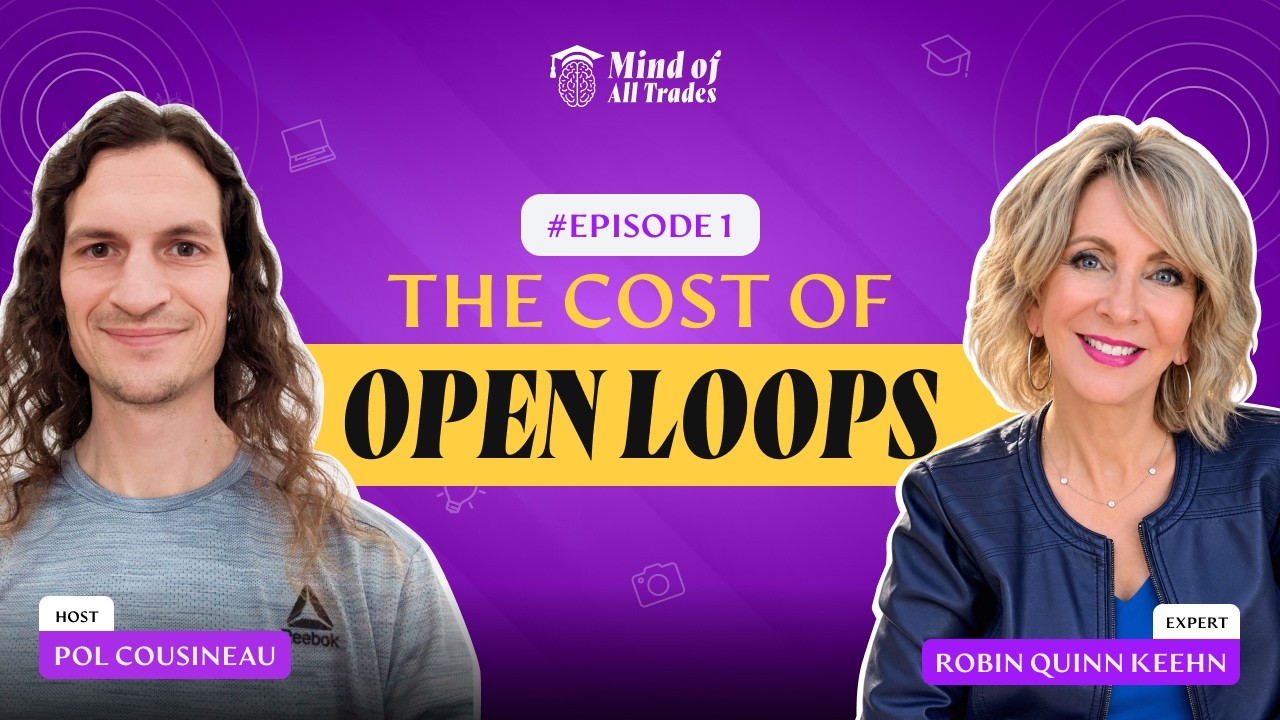
Part 1 - Sometimes You Are Not' an Imposter - Robin Quinn Keehn - Part 1 - EP 1
The Mindset That Scales Your Business
Description
You’re not overwhelmed, you’re unclosed. Robin Quinn Keehn joins Pol to explain why the exhaustion most of us feel isn’t from doing too much. It’s from everything we’ve left unfinished and unsaid: the avoided conversation, the unset boundary, the decision we keep dodging.
Robin built Aspire Academy of Expressive Arts from 15 students to over 500 a year, then walked away from it to focus on what she’d actually learned building it. In this episode, she introduces her framework for “open loops,” the small unclosed threads in our tasks, our decisions, our promises to ourselves, and our relationships, that quietly drain our energy long after we’ve stopped noticing them.
In Part 1, you’ll hear:
The real story behind what Robin calls “the beautiful monster,” and what scaling a business that fast actually cost her
The four kinds of open loops, and why the task-based ones are the easiest to spot and the hardest to fully close
A more honest take on imposter syndrome. Sometimes the fear isn’t irrational
The moment on a beach in Oregon that became the actual inspiration for her book
This is Part 1 of a two-part conversation. Part 2, where Robin walks through exactly how to have the conversation you’ve been avoiding (and the tool she built to help you practice it first), is coming soon.
About Robin Quinn Keehn
Robin is the founder of People Skillz Education & Consulting. Her new book, Stop Stealing From Yourself: Close the Open Loops That Quietly Drain Your Time, Energy, and Peace, is out now.
Robin also wants you to know:
She’s built something she’s genuinely excited about: People Skillz, a “difficult conversation simulator” where you can rehearse a hard conversation (with a partner, a boss, a parent) safely, before you ever have to have it for real. It’s free to try.
App: try.pplskillz.com
Website: pplskillz.com
Community: skool.com/peopleskillz
YouTube: @therobinquinnkeehn
Instagram: @robinquinnkeehn
Facebook: robinquinnkeehnsparks
Follow Mind of All Trades:
YouTube: youtube.com/@MindofAllTrades
Spotify: open.spotify.com/show/4MixC1mfhhUVIOFO1mywUc
Apple Podcasts: https://podcasts.apple.com/us/podcast/mind-of-all-trades/id6807196830
Instagram: instagram.com/mindofalltrades
Amazon Music: music.amazon.com/podcasts/32ce7fa4-4473-4c53-9256-7fca60e47331/mind-of-all-trades
LinkedIn: linkedin.com/company/mind-of-all-trades
Also Listen On


Transcript
Click to read the transcript
[00:00:00] Robin Quinn Keehn: In my book,
[00:00:00] I refer to it
[00:00:01] as the beautiful monster,
[00:00:03] because it was.
[00:00:04] when you don’t
[00:00:05] close loops with people,
[00:00:06] when you have
[00:00:06] unspoken brokens
[00:00:07] They wonder
[00:00:08] what the heck happened, right?
[00:00:10] Every one of those
[00:00:11] is a break
[00:00:12] in the self-trust you have.
[00:00:13] “I’m afraid
[00:00:14] somebody’s gonna discover
[00:00:15] that I’m actually not
[00:00:16] who I say I am.”
[00:00:17] And I say,
[00:00:18] ” Sometimes you are not.”
[00:00:19]
[00:00:19] Pol Cousineau: it looks like closing the open loop will be a giant open loop that can’t be closed
[00:00:24] Robin Quinn Keehn: I literally heard a voice.
[00:00:26] It was like
[00:00:26] the voice of God that said,
[00:00:27] “If you don’t bring me peace,
[00:00:29] you don’t get a place
[00:00:29] at my table.”
[00:00:31]
[00:00:38] Pol Cousineau: Welcome to Mind of All Trades, the podcast where edupreneurs turn knowledge into impact. I’m your host, Pol Cousineau, and together we explore the craft and commerce of educational businesses. We look at the strategies, we look at the systems, and we look at the real implementation work that has to happen behind the scenes.
[00:00:58] Before we dive in, make sure you subscribe so you don’t miss future episodes. We’ll be sharing practical guides, conversations, and examples for edupreneurs who are building real momentum in their business. Now let’s get into today’s episode. and we have an amazing guest today, which is also a longtime friend of a decade. our guest is Robin Quinn Keehn MPA, is… She’s a certified mediator and human dynamics specialist, and the author of “Stop Stealing From Yourself: Close the Open Loops That Quietly Drain Your Time, Energy, and Peace.” Her signature idea is the open loop, the avoided conversation, the unsaid boundary, the dodged decision that quietly drains time and energy. Before People Skills, she founded and scaled Aspire Academy of Expressive Arts, growing it from 15 to 300 to 500 students a year, and a multiple six-figure business in a town of 5,000 people.
[00:02:06] Yes, that is accurate. And then stepped away in 2015 to teach what she had learned building it. She also hosts the Liberated Life podcast. She’s an avid cyclist since age six. She rode from the Oregon border to San Francisco at 13. And yes, this is also right and not a mistake. Welcome to Mind of All Trades, Robin.
[00:02:33] Robin Quinn Keehn: Thank you, Pol. Great to be here. Appreciate you having me.
[00:02:36] Pol Cousineau: Yes, and I thought that you would make a great guest for our audience because of the extreme experience you have in education and the different businesses that you’ve also been able to build. And one of the things that we like to do is look under the hood and then see how that might apply to everyone else that are building their educational businesses.
[00:02:59] And although we’ve been friends for such a long time, I was not actually aware that you had brought Aspire Academy of Expressive Arts up to 3 to 500 students in a town of only 5,000. Like, that almost sounds too big to believe.
[00:03:16] Robin Quinn Keehn: Sounds kind of crazy. Yeah. It was, it was crazy
[00:03:19] Pol Cousineau: So let’s start there, because I’m sure everyone is wondering, what is Aspire Academy of Expressive Arts?
[00:03:26] How did you get started?
[00:03:28] Robin Quinn Keehn: Yeah. Well, back in the day, I moved from Seattle to this little tiny town on the Olympic Peninsula in Washington State, right across from Victoria, British Columbia, if anybody’s trying to get their bearings. Uh, and when we got there, I had a baby. She was 20 months old or 18 months old, and I was pregnant with her little brother, who arrived shortly after moving, and there was nothing for children there.
[00:03:52] And so I made myself a promise, like, “I’m gonna build something here for kids,” because it was pretty much a retirement community. But, you know, in a retirement community, you need people that provide services. So there were a bunch of people like my husband and I, young professionals with children, uh, but they– we’d been completely overlooked.
[00:04:11] I enrolled my daughter in a kinder music class there. Uh, that woman who was teaching, she was lovely, but she only had, like, 15 students, so very tiny. And then a couple months after I had my son, she said, “Hey, I’m so busy with my own life. Would you like to take this over?” And I said, “I’d love to,” because I’m just entrepreneurial, and I’d had lots of little businesses growing up and along the way.
[00:04:33] And so I took it over. It started small, put in a couple of big playground, playgrounds and parks for kids at the same time, and, um, it grew and it grew and it grew, and I thought, “I want it to be even bigger than this.” And so I opened up a commercial space, and that was great, and I had about I don’t remember, maybe 30, 50, 60, 80 families.
[00:04:56] Finally more like 115 students in a few years, and then I added a piano method, Simply Music, that I’ve been teaching for, you know, 23 years, something like that. And then it just blew up. So I had a business partner at that point who also taught, and then I got this crazy idea one day, let’s make it music and dance, and that’s when it really blew up.
[00:05:17] So we went from a studio of about 150 students probably maximum, in a 750 square foot space, to a studio of about 4,000 square feet. And I think we started that year that we, we blew up. It was 2007, we went to like 500 students. A- and we, we did that in a matter of weeks, six weeks. From the time we started letting people know till the semester started in October, we just– It, it just grew into this ginormous thing.
[00:05:48] And you know, things in small towns like that, it, it’s not hard to reach people because it’s a small town, right? So you’re not marketing into this ginormous metropolis where nobody knows you. You’re marketing into a town where you’re already known for being the music teacher, and it’s like, “Hey, we’re adding dance.”
[00:06:06] And so I ran some really, uh, quite remarkable ads in the paper. I came up with an idea, ’cause that was back when we had newspapers that people read, that I would just drip it out there. And so I– my first ad I ran was pretty big, and it just said, “It’s coming October.” It, it’s coming in October. And I didn’t say any more, and people were like, “What the heck is that?”
[00:06:27] And then
[00:06:27] Pol Cousineau: what I like about that is the surprise, the anticipation, and those concepts still apply today, right? Oh, that big event? What’s coming up? What is coming?
[00:06:38] Robin Quinn Keehn: Yeah. It was remarkable because people really started wondering, ’cause I didn’t put anything on there. I didn’t put my name, I put nothing. It was just, “It’s coming October,” and, and built from there. And then I would just drip a little bit more, and a little bit more, and a little bit more. And so by the time we finally said, “This is what it is,” the town was kind of buzzing about it because nobody knew and everybody was curious.
[00:07:00] So that was a really great way to build the studio. And we did a ton of marketing, and we did a lot of, you know, there were a lot of referrals. Once we had that thing going, we wanted to make sure it ran like a clock. So I hired a business coach, first business coach I ever had, and he was in the business of music and dance studios internationally.
[00:07:21] And wow, he made it possible for us to be really on it from day one, because the first impression really is the key, right? And I identified my competitor in town, had a couple, but one that was m- really, uh, a competitor, and I noted all of the things that we could compete on, and we did. And I’m not happy to say, but she did end up folding her business at some point.
[00:07:46] Not really because we put her out, but she just wasn’t very strategic, and she made some pretty major mistakes in terms of blending business with personal stuff, and I think that was part of it. But we competed, you know, we knew exactly what she wasn’t doing, ’cause my, one of my kids was enrolled there briefly before we ever made a big studio.
[00:08:06] It wasn’t even on my mind. But it, it was a powerful thing to say, “Oh, she’s not providing observation windows? We need to pro- provide observation windows. Oh, she’s not providing ample parking? Let’s put this building in a place where we’ve got plenty of parking. Oh, she’s all about, you know, you choose either cheerleading or ballet?
[00:08:28] No, no, no, no, no. We’re not gonna make you choose. Just come do it, and you’ll figure out what your priority is.” So it was a wonderful thing, but in my book, I refer to it as the beautiful monster, because it was. It was beautiful, and it was wonderful, but it was so huge, and I had four kids under 10 when I opened that thing.
[00:08:50] Uh, I had the smaller studio, and then that went big. So maybe they were more like 14 down to four when the, when the studio really blew up. But I’m telling you what, it was all-consuming. You know? I’d, I’d come home from teaching, I would’ve… I’ve taught Zumba, I taught piano, I taught whatever else I had to teach in the moment because somebody didn’t show up, so I kind of became the jack of all trades there.
[00:09:12] But you, you know, you think you get home from something and you just go, “Ah.” Never. Never ever. I was like, “Ah, let’s eat. Okay, now back to work. Let’s, you know, work on the teacher situation that came up. Oh, we have a student situation that came up. Oh, we have a teacher group meeting. Oh, we have, you know, we have recitals.”
[00:09:30] So that’s,
[00:09:32] Pol Cousineau: S- yeah, and when you were talking about competing, I was noticing how you identify a lacks or either areas where she was focusing in, and then you decided to take a contrasting position. So are you still using that type of approach today when you’re looking at business, or how does that translate now?
[00:09:51] Robin Quinn Keehn: Yeah, I think I’m a little contrarian. Uh, the open loops that we’ll talk about at some point here, you know, um, I– people say they’re overwhelmed, and a lot of this comes from my experience at the studio. I mean, watching thousands of kids, hundreds and hundreds of families move through, there were some themes that I identified, patterns that I recognized in the studio with, you know, commitment, over-commitment, misunderstanding commitment, slipping away from commitment.
[00:10:19] So it’s all, those all kind of contribute to my thinking. But with my, with my coaching clients, my business clients, my personal coaching clients, there’s a big story that is repeated everywhere that, you know, y- you’re overwhelmed, and it’s because you need a better system. You need to be more productive.
[00:10:38] You need to read these books about productivity hacks. And I think there’s some value to those, but my contrarian view is, no, actually, you have an open loop problem. You have, you have things that you said you were gonna do because you thought they were a good idea at the time, and then you decided not to do them, but you never cleared that up with anybody.
[00:11:00] You never said to the other person on the receiving end, “Hey, guess what? I’m actually not gonna do that thing. I’m not gonna serve on that committee. I no longer can do carpool. I don’t wanna bake cupcakes for the sale for the school. I don’t wanna serve on that board. I don’t wanna take on that task.” We don’t say anything.
[00:11:20] We just slip away. And that leaves an impact on the other person, for sure. Depending on the degree, it can be a, a small impact, it can be a huge impact of like, “What happened?” But in our own minds, that lives on because our brains track those things. They do. And we know this. Just you… I’m sure, Pol, you could probably think of somebody or some situation in the past where you made an agreement, you had an agreement, and either you or the other person just didn’t say anything but quietly slipped away, what I call an unspoken broken.
[00:11:55] Pol Cousineau: Hmm. you can bring one to mind because your mind has not let go, let h- your mind has not let go of it yet, right? It’s still somewhere in there. Everybody has those.
[00:12:06] yeah, so I want us to dive more into that concept of open loop because this especially relevant. Now, you mentioned systems and, you know, uh, the feeling of overwhelm. I’m guy that uses a lot of lists.
[00:12:21] Robin Quinn Keehn: Mm-hmm.
[00:12:22] Pol Cousineau: But out of the list, there’s a lot of lists that don’t have all the items finished in there, right? So is that what creates the open loops? Or like how, how do we, how do the open loops happen, and how does a person get to assess how many open loops they have? Like, listeners might be wondering, “Oh, I have one or two open loops, or do I have 100 open loops?” What does that look like?
[00:12:44] Robin Quinn Keehn: Well, it can look a lot of ways. I think most people aren’t– they haven’t thought about this concept. It’s not front and center in their mind. And so initially people think, “Oh, I, yeah, I probably have a couple of things I haven’t done yet.” But if you spend time and you let yourself just be with it a little bit, like over the course of a few days or a few weeks or a few months or a few years, you start discovering, “Oh, I, I never did that thing either.
[00:13:11] I actually never finished that thing.” So there are four kinds of open loops. The first one is really easy. It’s tasks, right? Have my little list right here. I have a task loop right now, or a task list with a bunch of open loops, the things I just need to finish, like appointments I need to make, maybe a bill I need to take care of.
[00:13:30] Um, who knows? Just things I need to accomplish. That’s, that’s normal. Those go on our list, right? And we just work through them. That’s called adulting. Right.
[00:13:40] Pol Cousineau: And then in that one with the tasks, if our listeners are using a project management system like ClickUp, Asana, Trello, you name it, there’s probably a bunch right there of open loops with tasks. was reviewing this morning, I’m like, “Oh, wait, there’s like four that are overdue. Oh, wait, I don’t need to do that one anymore.
[00:13:58] Should I close it or not?” So that might be a spot where people could see, right, what they’ve got on there. then if they have a team, their team might have a bunch of open loops. Or if someone is in charge of the operations and they just keep adding to that project management system without looking at what’s closed or what’s not, then they’re basically creating a bunch of open loops in the business
[00:14:23] Robin Quinn Keehn: Yeah. Right. And so it just comes to, “Okay, I need to handle this.” That’s, you know, at some point it becomes an, “I need to handle this,” but you’ll notice, and I think the listeners will notice, those things don’t just get written down once and disappear out of your mind. They, they sit there until you do something, right?
[00:14:42] They’re, they’re not gone. They’re just there. And the, the problem with open loops, and I’ll talk about the other types as well, but they don’t go away. They just sit there. And so you can think about– We’ll talk about the other ones, but even a task, you know, I’m sitting there, um, taking my dog for a walk and I notice she’s limping and I think, “Oh my gosh, that’s right.
[00:15:03] I was supposed to call the vet.” Or I’m talking to somebody else and they mention their cute dog and I’m like, “Oh, shoot, I still haven’t made that appointment for my dog.” Like those, those things just surface in other places. Naturally, when I’m walking the dog, but later when I see a cute dog that looks like mine, I’m like, “Oh, shoot, I, I still didn’t do that.”
[00:15:23] I had a secretary named Karen years ago out of my first job out of graduate school, and she retired and I moved away, and we had a casual agreement that we would keep in touch. And she rarely called me because she knew how busy w- I was, so I called her, and then I could never reach her. She didn’t set up voicemail, and so I’d call, and I’d call, and I’d call, and I wouldn’t reach her, and I didn’t have voicemail.
[00:15:49] Her name was Karen. My best friend in high school is Karen, so every time I talk to Karen from high school, I think of Karen, my secretary. And at the studio, there were probably four, five, or six or 10 moms named Karen. So Karen would come to the desk and my brain would immediately go to Karen I haven’t reached yet.
[00:16:07] So it’s a constant distraction when it happens, unless I close it. I eventually did close it. I eventually reached her. I was driving and finally got her and I was like, “Oh my gosh, Karen. Finally, you know, I’m in touch with you and I’ve felt really out of integrity because I have this open loop with you where we haven’t talked and yet we have an agreement.
[00:16:27] I’d like to renegotiate the agreement. Can you call me too? Because the impact on me is I’m, I’m feeling out of integrity and I’m feeling disappointed and I’m also feeling frustrated and I’d like to clear that up with you.” Close the loop. She’s like, “Sure. Let’s change it.” But those things bother us. They, they jump in and annoy us.
[00:16:46] Maybe they keep us awake or wake us up at 2:00 a.m. Or you know, I mean, it’s happened to me recently where there was a task I hadn’t finished and I’m awake at 2:00 a.m. and I’m running through things and I’m like, “Oh, there’s that thing again.”
[00:16:58] Pol Cousineau: Right. So let’s say that we use the project management example, ’cause sit all in there. What would be a way to see if we can close the loop in some of those? Like, someone might log in now and they see, “I’ve got 15 things,” or, “I’ve got 100 things,” or there’s 1,000 things that their team done, right?
[00:17:17] Well, in my, in my system, in my ClickUp, there must be, like, 400 to 1,000 items any moment. Okay. Now, they’re not all open loops, right? A lot them we’re gonna close, but there are open loops in right? There must be at least 50, I’m presuming, out of the bunch. So what, what do we do to try to get a handle on that one using this practical example?
[00:17:36] Robin Quinn Keehn: Right. And that is a practical example because one of the things I believe about open loops, if they’re living in our brains, they’re, they may not be living on paper. And so a lot of these things we just keep in our mental space, and that is not great. And in fact, I have my original whiteboard here. So about 10 years ago when I realized the whole concept of open loops for myself and noticed how many things bothered me, whether or not I had recorded them or not, I got myself a little whiteboard, you know, s- this big, and on– I drew a line down the middle, and on the left side were all of the un- unfinished things that I knew I was gonna finish, but they were still considered my unfinished things, my open loops.
[00:18:21] And on the right side of that board, I wrote all of the things I was actively working on, that they were in process. And I would get up in the morning or if I woke up in the middle of the night and I was having a moment, I’d get up and I’d look at the board. It was right where I could see it. It was right on top of my piano.
[00:18:38] And I’d say, ” Okay, you guys on the left side, I see you. I know you’re there. Thank you. You don’t need to bother me today. I’ve captured you. And you guys on the right side, great. Let’s get at it. Let’s get to it.” And I– So I think there’s something about being able to see what it is and make a decision. Is it now?
[00:18:58] Is it later? Is it never? So sometimes those open loops actually can be closed because you come to the realization that I’m actually never gonna do you. I’m never gonna complete you. You’re just there taking up space, and today is the day where I say, “Not happening, not happening, not happening.” And then for the ones that I have that are active, it’s a by when.
[00:19:22] By when am I gonna do this, right? Is it today or is it a later date? And by when is a super helpful thing to know because then they can get moved up or moved down accordingly. Um, Pol, did you ever read the book Essentialism or The One Thing?
[00:19:38] Pol Cousineau: Yes. Yes. Uh, well, essentialism. about the one thing. I think, was it Gr- Greg or… Yeah
[00:19:43] Robin Quinn Keehn: McKinnon or something like that? Yeah. Yeah, those books were really great because I, I think what they helped me understand is that we talk about what are your priorities with a plural.
[00:19:57] It’s not. That’s not what priority means. It means the one thing, right? So what’s the one thing today, and, and from those books I got the clarity about what’s the one thing you could do which is like the linchpin or the domino, that by doing it, everything else gets easier or is accomplished by doing it.
[00:20:16] So I love that idea. But I think getting, getting honest with our, our, our list and whatever productivity tool we’re using, you know, because I know for me, sometimes I have things on my list, but by doing other things, those now become… They’re, they’re, they’re meaningless. They’re pointless. I’m not gonna do them.
[00:20:36] But they’re still sitting there making me think like, “Oh, yeah.” And same thing with this little list I just put out. I’m like, “Oh.” I looked at it before our call, and I was like, “These are irrelevant now because I t- I did it a different way.” And so they live on this list, which is a little scary, but they’re actually not real.
[00:20:54] Pol Cousineau: It’s interesting that you brought the essentialism because I have an example of eliminating a lot of open loops, and it also comes from my accounting background with the sunk cost fallacy. With the sunk cost fallacy is the more we’ve invested into something, in energy, money, time, emotionally, the less we are likely to wanna give it up, and we just keep pouring more and more in it.
[00:21:20] So when I connect that with the open loop, basically the longer the loop’s been open, probably the harder it is to close ’cause there’s been more energy resources behind that. So we had a management meeting yesterday, and it was talking about a big project we were doing related to a knowledge base. And I said, “You know what? I don’t like the way that it’s shaping right now, and I don’t think that that’ll be useful.” Now, we’ve been working on this, I don’t know, let’s say four months.
[00:21:46] Robin Quinn Keehn: Wow
[00:21:47] Pol Cousineau: So the inner me, right, the, the first thought is: How can I make this work? What extra effort are we going to do so that we can bring this to completion?
[00:21:59] But in the reality, wait, we have new projects now that weren’t there back then, and this one is not taking the shape I want. So I said to the team, “Hey, you know what? Let’s just drop that project entirely, all the tasks. Now, I’m sorry,” ’cause there was a team lead for that, “that your project didn’t manifest itself, but that’s okay, too, and we’re learning from this, and it’s better to just give it the ax and then let go of that,” ’cause that might have been, like, 100 more tasks.
[00:22:26] But this sunk cost fallacy, I see it play regularly as people have invested in these different types of goals, and that can be like a business launch. Maybe there’s a big course you’re working on, and it’s the next best thing, but somehow it’s not working. People are not buying it or your students are not enjoying it as much.
[00:22:50] They prefer the legacy edition. But then you just keep investing in it and is when to realize, “Wait, maybe I should abandon that fully. Let’s not do it at all,” and accept that we learn from this, right? The other thing is, like, I wasted all this effort. Oh, that was my team working on it for months. Now we have nothing to show, but we all learn from that So that, that example of the open loop I think makes a lot of sense.
[00:23:17] And then there’s smaller ones where it might just be a recurring task that’s in your system that you decide you don’t wanna do, and then you just close that one, and then you don’t have that 10-minute open, open loop coming every single week. And then there’s, like, bigger battles and smaller battles, and then they start, you know, adding up.
[00:23:35] So then what would you recommend to people listening now if we wanna move that into action, right? Because this is all interesting, but we say, “Okay, let’s get some loops closed.” What do they do now?
[00:23:48] Robin Quinn Keehn: So, so let me go back, if I may, for a minute just to mention the other open loops, because task loops are pretty easy. Decision loops are much harder.
[00:23:56] Pol Cousineau: Oh, okay
[00:23:58] Robin Quinn Keehn: what you just mentioned was a decision loop. I’ve got this big thing. I’ve been pouring my heart into it. Could be a relationship, could be your business, could be a million different things.
[00:24:07] It’s something where you– the longer you invest, the more committed you are to it, and the less you wanna just give it up, right? Because that just feels like wasted time, energy, and that… Those things are really hard, especially when they come to, like, relationships or big projects you’ve worked on. Because you’re committed, you’ve invested, you’ve imagined it would go a certain way.
[00:24:29] It’s not, and now you gotta figure out, “How do I untangle myself from that?” Right? That’s a decision loop. Those are harder, for sure. Another– There are two more. One is relational loop, and that is where– and that, again, it can be in business, it can be personal or whatever. But it’s when you have something between you and another person where you recognize maybe, um, the relationship isn’t what you thought it was going to be, or something has changed in the relationship, or there’s something that’s happened that requires a conversation.
[00:25:03] Those are super hard because that is speaking to another person, and it has the potential of changing everything. Personal or professional, doesn’t matter. Doesn’t need to be personal. Um, you know, you’ve got a coworker or you’ve got a boss that you need to speak to. It feels a little risky to bring it up.
[00:25:21] But if you don’t bring it up, you’re heading into resentment. You’re, you know, you’re already one foot out the door, and you need to bring it up if there’s any chance of redefining the relationship or resetting expectations or changing the agreement that you have. It requires a conversation. If you don’t have the conversation and you just dip out, that’s kinda quiet quitting when we’re talking about work, right?
[00:25:42] Just stop, stop trying so hard, m-m, stop showing up all the time. That leaves damage on both sides, right? It, it’s a damaging thing. And then the final open loop is a loop, a self loop. So something that you’ve said to yourself that you were gonna do or be or have that you have not made good on, and it can be as simple as, “I’m gonna go to the gym.”
[00:26:07] That’s a, you know, typical example. But– Or, “I’m gonna get up at 6:00 AM,” and you keep hitting the snooze button, and you hit it four times. Now it’s 6:20, and you do it day after day, and you, you c- why are you doing that? Why not just say, “I’m getting up at 6:20,” unless that’s part of the plan. Like, I’m gonna put, “I’m gonna get up at 6:00, but I’m gonna hit the snooze four times and actually be up at 6:20.”
[00:26:26] That’s different. I’m saying, I tell myself I’m up and out of my bed at six o’clock, and I never am, and that’s a broken loop
[00:26:34] Pol Cousineau: And then self-loops would be at New Year, all those failed New Year resolutions, right? Where they say most people make them and then it doesn’t end up manifesting. Well, that’s a, a self-loop. It’s interesting too because on that one for exercise, I used to tell myself, “Okay, I’ll do a one-hour training,” ’cause I used to do that and that was great.
[00:26:55] But now I find I’m so busy and then eventually I change my commitment and I said, “I will do any amount of exercise.” So if I did one minute and I just run for one minute, hey, it’s one minute more than I wasn’t doing before, and that changed my perception and my reaction to it. So instead of feeling like I didn’t do an hour, it’s like, “Yes, I got five minutes in,” then I got five minutes, and now I find that I like doing 20-minute sprint type workouts and this is very rewarding.
[00:27:25] I feel good about it. But the Pol from years ago would have said, “Come on now, like you’re just going halfway. Why are you only doing 20 minutes? Or why did you only commit to just one minute?” You know? And, and there’s a scale that somehow would play psychologically there
[00:27:43] Robin Quinn Keehn: So what you just mentioned is really interesting, and again, it’s kind of my contrarian view about this because there’s a lot of– there are a lot of books out there about, you know, the big leap, the, the big, hairy, audacious goals or what some– the BHAGs, right?
[00:27:59] And how great it is to set those goals. And I’ve, I’ve gotten pulled into that trap, both in business and personally setting– ’cause I love a challenge. Like, somebody’s gonna put it out there, I’m gonna, I’m gonna jump. But what I’ve realized over the years of working with all kinds of people in many different situations, work and piano and mediation, all kinds of things, people set these really big aspirational goals.
[00:28:25] And I can give you an example. Somebody told me one time, I– it, it was a business thing, and he– this guy said, “I am going to make 15 calls this week.” And I said, “Whoa, are you sure? That sounds like a lot.” He was like, “Absolutely. I’m gonna crush it this week.” So we had our accountability check-in call the next week and I said, “Great.
[00:28:44] How did that go?” And he was like, “Uh, you know, I made four.” And I said, “Four is great. That’s great. Good job on the four. Are you interested in reframing that so that we can build from four rather than be crushed by the fact that you didn’t make 15?” Like, why are we, why are we gonna do that? Why would we penalize ourself and feel so crappy about the fact that we made four when four is fantastic?
[00:29:12] Let’s build from there. So I love what you just said, Pol, because big, audacious goals are great, and for some people they’re what they need to be motivated. But for most people, being honest and saying, “I can start here and do this,” and then acknowledge that I did it, like, “Yay. Yay,
[00:29:34] Pol Cousineau: Yes, there’s positive energy that comes from the success, and then you can also crush that goal. But if the goal is too big and you hit half of it you might feel like a failure, although this could be the most you’ve ever achieved in your entire life, and it would still somehow feel like a failure because the goal was set too high.
[00:29:56] And then as you listen to this, try to gauge, like, where are you? Like, do you set giant goals, and does that motivate you? Does it work? Or do you set bigger goals and then later you beat yourself up because you’re not able to achieve those goals?
[00:30:14] Robin Quinn Keehn: Yeah. So the, the goal setting is a, a big deal, and, um, I feel like when it comes to broken loops with yourself, getting honest about it and saying, “I’m never gonna do that thing.” Let yourself off the hook. No problem. Don’t do that thing. But don’t keep saying you’re gonna do it and not do it. And you know the idea of imposter syndrome.
[00:30:36] A lot of people’s advice is, “Well, look at all the things you’ve achieved. You, you know, you’re really okay. You’re doing fine.” Well, my, my belief about it, a little more contrarian, is you probably handed yourself the evidence piece by piece. You know? You said you were gonna get up at 6:00, you never get up at 6:00.
[00:30:53] You said you were gonna work out, you’ve been to the gym once. You promised somebody something, you didn’t make the call or you didn’t deliver. Every one of those is a break in the self-trust you have. And so if you feel like an imposter, there could be some evidence, right? And so when I hear people say that, I’m like, “Hmm,
[00:31:15] Pol Cousineau: Now let’s go into that more because I’m a very literal person, so my mind is concluding, okay, you’re an imposter. It’s now revealed you are a failure and you don’t have the capabilities to do what you set out. But I think it’s might be something else
[00:31:30] Robin Quinn Keehn: Well, it, so yes, and my husband was like, “What’s that mean, imposter syndrome?” Well, the idea that your pr- your persona, your inner person is not matching your public persona. So the inner you is not who you say you are out there publicly. And I’ve heard it for years, and I, and I’ve always kind of questioned it because, you know, Pol, for a long time we were both involved in some online marketing and online communities, and there were things said like, “Fake it till you make it.”
[00:32:01] I heard that more than once. And I coached some people in a couple of these communities who held themselves out to be a certain person. Proda- I’ll give you, productivity coach was one of them. And, and God bless this person, but they, they had done it in the past. They’d been a productivity coach, but they could not get themselves off the sofa to be a productivity coach again.
[00:32:25] So they were trying to sell their services as a productivity coach, but they couldn’t get anything done. And I was like, im- and then, then this person said, “I have imposter syndrome.” And I was thinking, well, yeah, because you are faking it till you make it, and you’re holding yourself out to be somebody, a coach of this thing, and yet there’s no evidence.
[00:32:50] I’m not seeing evidence that you are capable of doing that. So imposter syndrome says, “I’m afraid somebody’s gonna discover that I’m actually not who I say I am.” And I say, “Sometimes you are not.”
[00:33:02] Pol Cousineau: Right. But now when you discover that, what do you do? Because there’s the public persona and then, oh, if I pivot, if I change my message, people will realize I was a fraud, I’m a failure, whatever that is, right? So if people feel like the, uh, there’s so much more to lose because of that public persona, which often is tied to a business and income, so they feel like, “I can’t change right now.
[00:33:30] I have to continue in this direction. Everything depends on this.”
[00:33:34] Robin Quinn Keehn: I know. That’s a tough, that’s a tough place to be. But if it were me and I had built a business around it, I would try and figure out how to actually be that person.
[00:33:44] Pol Cousineau: Hmm.
[00:33:45] Robin Quinn Keehn: Could I actually be that person? What would it take for me to be who I say I am? And that would be a lot of introspective work to notice where am I, where am I saying I’m doing things and actually not doing it?
[00:33:59] And what would it take for me to do those things so that I don’t feel like I’m an imposter, I don’t feel like I’m a fraud? Am I willing to, you know, if I’m a productivity coach, am I willing to be productive in my own life? And where am I missing it? Where have I broken trust with myself? Where am I saying one thing but doing something else?
[00:34:19] Am I willing? Am I able? Am I capable of… Does it, is it worth it for me to clean that up and become aligned? And I think, Pol, a lot of this with the open loops is about finding alignment with yourself again. All the things you agreed to do, all of the commitments you made, the agreements you have, the promises you’ve made to others. When you start seeing all the things that you’re committed to and all the places where you’re not showing up or you’re not keeping the commitments, you start to wonder, how did this go so sideways?
[00:34:53] Pol Cousineau: Now I have to say though that it looks like closing the open loop will be a giant open loop that can’t be closed because there’s so many open loops to close.
[00:35:03] Robin Quinn Keehn: Well, I think that yes, and it can feel that way, but– and I don’t say try to close them all at once. I, I like to take people through a process, which is we could do the little process or the big process. But if we were just looking at the bigger process, it’s sitting down and going, “Okay, I, I’m gonna ask myself, where are all of these open loops?
[00:35:23] Where are the tasks I haven’t finished? Where are the decisions that I still haven’t made?” Get them down on paper. Make four lists. The things I said I was gonna do and haven’t done yet. Now– and if you have a, uh, you know, Trello or whatever, whatever place, ClickUp, all these different places, at least go and see what are, what is on that, what, what do I have in there?
[00:35:43] And then you could break it even into personal and professional, just to give yourself a little more separation, because it could be huge. And so I say make a personal list, make a professional list, and then figure out which one you wanna attack. Where are all the tasks? What are the decisions I haven’t made yet, personally or professionally?
[00:36:01] What’s still floating around? And quite honestly, give yourself some time, because as you inquire, more things will pop into your mind. Things you committed to years ago and you actually never left the commitment, but y-you just kinda dipped out and you never said anything. Those will come to mind. You know, for me, I thought of somebody I promised back in college days I’d help, I would help her move, and I never did, and I never said, ” I’m sorry,” right? Actually wrote to that friend and was like, “Hey, I told you this thing 25 years ago. Sorry.” And she was like, “I didn’t even remember.” But I did. I remembered
[00:36:37] Pol Cousineau: And until you close that, it creates like a load
[00:36:40] Robin Quinn Keehn: It’s just a mental note. It’s just a
[00:36:41] Pol Cousineau: person or…?
[00:36:42] Robin Quinn Keehn: dream. It’s just a little dream. If you can think of it, it’s still living in your mind
[00:36:47] Pol Cousineau: Oh, right, ’cause you were thinking about that event from college all those So clearly It’s taking energy, and then it’s like, well, let’s be done with that. And then when she’s like, “Well, why are you saying this?” It’s actually for you so you can get resolution, and now you don’t have to think about it again.
[00:37:03] Robin Quinn Keehn: That’s right. That’s right. It– You know, sometimes people have no idea what you’re even talking about, and I’ve done that a few times where people are like, “I don’t even know what you’re ta- I have no memory of that.” Well, I do, because it’s still floating around. But once I’ve said, “Hey, I noticed I didn’t do th- this thing, and the impact on me is it’s taking up some brain space, and what I’d like to do is just apologize,” or, “I’d like to come up with a different agreement,” or, “I’d like to close the loop on this and just say this is over.
[00:37:28] Are we good?” Right? That is for you. That is not always for the other person. Sometimes it is. Sometimes it’s for the other person, because when you don’t close loops with people, when you have unspoken brokens They, wonder what the heck happened, right? And those can be like we talked about earlier, they can be tiny.
[00:37:47] “You just never delivered that thing to me. You never made that phone call you said you were gonna make.” But in a relationship, and this is happening all the time now, people ghost people. They show up, they make a lot of promises, they love bomb, they, they for- you know, they forecast the future, and then one day they’re just gone and you’re left wondering what, what happened.
[00:38:08] And that can be super damaging depending on how far down the track you are, how many promises you were made. And when they go missing, the impact is huge. And, and people don’t even know that or they don’t care. But if you, if you know that you’ve done that, you give somebody else like closure and the opportunity to go, “I finally understand.
[00:38:31] Thank you. Now I can move on too.” So closing these loops is, can have huge impact or they can just be this minor little drain in the background. But so make, make the list. Task loop, decision loop, relationship loop or a loop, an open loop I have with myself. The first thing is identifying them. And then you’ve got to figure out what, what do I wanna do with this thing?
[00:38:54] So do I just… like we talked about with the tasks, am I actually doing this thing? Yes, no, now or later, never. Okay. Same thing with decisions. Maybe I’m not gonna make that decision. Maybe it’s irrelevant. Maybe I should just stop thinking about it. By not making the decision, I made a decision,
[00:39:10] Pol Cousineau: Right?
[00:39:11] Robin Quinn Keehn: right? I mean, to be honest, the relational loops, okay, who do you need to have a conversation with?
[00:39:18] And that’s not easy. Sometimes those conversations are pretty scary to make. But by not, by not having the conversation, things get worse, right? Like tension just rises, resentment builds. Um, you start adjusting around the other person. In business or, or personal, you start… y- you withdraw a little bit, you get a little colder, you get a little more less committed, less conversational with people.
[00:39:48] Well, you know, the writing’s kind of on the wall. If you don’t actually have a conversation and close the loop by either ending it, evolving it, or honoring it, those are your choices. You gonna end this thing? You gonna evolve it to something different? Or are you gonna say, “Actually, you know what? I wanna honor this agreement that we have, so let me go ahead and do that.
[00:40:08] I needed to speak it out loud to you so now you know that I am actually gonna do this thing.”
[00:40:13] Pol Cousineau: Well, with r-relational loops, something that I noticed working with a team is that people really wanna achieve a lot, and especially when you’re onboarding someone. Why? Because they wanna set a good image of themselves, a good impression. Before that, in the interview process, well, they’re not gonna say, “I’m gonna do half your list,” right?
[00:40:35] They wanna go above and beyond. But then what I find is that the scope is too big. So I’ve told managers in my team is, “You know what? I realize you have too much on your plate. That was great,” especially when I’m onboarding them. There’s a particular example I can think of, and said, “Well, you wanna take all these big rocks, but there’s, there’s too many for you to be successful at all of this.
[00:41:01] So what if we remove one of these areas of work, and then you can just focus now, and then you can succeed, and if you wanna take it on later, then we can take a look at it.” But dialing it back a-and, and pulling the rope is kind of challenging and in the delivery message because when I was talking with that manager, I don’t wanna make him feel like a failure.
[00:41:23] I don’t wanna make that person feel like I don’t believe in them, right? And then they have their own inner language. How am I interpreting Pol saying, “Don’t focus on this big rock now?” Am I at risk? Is he thinking I’m not doing a good job? Maybe I’m not capable enough. And then I’ve had to do several follow-up calls explaining, “Hey, this is why I made this decision,” and then, “Wow, your work is so much better now that you can focus on these areas.
[00:41:52] And I allowed you to take too much, or I even led you to believe I set these expectations which were not realistic.” And then I was creating all these open loops, and then I had this relational open loop, and then there was probably the, a decision loop now all involved, right? And then it creates this whole thing.
[00:42:13] And then this is a good time, like when you have onboarding or when you’ve been working with someone for a long time, and then assessing because I feel like these types of relational loops can be packed with a lot of like task loops, decision loops, et cetera, right? Like there’s big clusters around them.
[00:42:32] And then that leads to how to have those conversations.
[00:42:37] Robin Quinn Keehn: Right. Yeah, and those– and that is near and dear to my heart, Pol. Um, when I… The inspiration for the book was, uh, walking on the beach in, in Seaside, Oregon, five years ago in June, and I’d had clients meet me at the condo. My kids had been there briefly. A friend had been there. And I was all by myself walking on the beach after everybody left, just being quiet.
[00:43:01] I wasn’t seeking any counsel or any… I was just like, “Ah, finally alone.” And I was kind of thinking about the week, and I realized I’d had some great moments and I’d had some really disappointing moments. And as I was walking, I literally heard a voice. It was like the voice of God that said, “If you don’t bring me peace, you don’t get a place at my table.”
[00:43:19] And it stopped me, literally stopped me in my tracks, and it was like, whoa, that’s, that’s huge. Um, who have I allowed to come into my, my realm and be seated with me at my table? I’ve got so many people and things everywhere in my life. I’ve got so much going on. I need to sort. I need to sort this and say, “If you’re not aligned with who I am, if you’re not bringing me peace, if we’re not moving together through this, then I need to have a conversation.”
[00:43:50] And so I had some huge conversations. Uh, and I thought it would take me like, oh, you know, five-hour drive home, I’ll come up with my list. Oh, no. Two weeks later, two months later, two years later, I was still identifying things that just were not aligned with who I am and who I– what I’m doing and who I wanna be.
[00:44:10] So there were conversations, and I had some really tough ones in the first few weeks. Uh, the very first big one was probably six weeks after I left Seaside, and I needed to talk to a friend about her behavior and about our relationship. And, and so I have a very specific format that I use. I call it PEACE.
[00:44:30] Uh, and I, I have a close process to close the lose– b- the loops because there are literally steps, right? You wanna be, um, diligent in the way you work through this. You, you wanna be deliberate in the way you close loops. You don’t wanna just try to do something and find out that you left them open or have a conversation that created damage instead of clarity.
[00:44:53] Pol Cousineau: And then if you create damage, that could also be unresolved and then create a bigger open loop because then there’s unspoken resentment and all these things that happen. Now, I believe that the difficult conversations or challenging conversations is part of people skills and then the app that developed. How does that kinda all fit in? Because I believe that our audience can practice some of those conversations and whether it is to close those relational loops in your personal life or with your team, like I was describing earlier. Can you share a bit about that?
[00:45:30] Robin Quinn Keehn: When you decide
[00:45:31] to have a conversation,
[00:45:33] 99% committed
[00:45:35] is much harder than
[00:45:37] 100% committed.
[00:45:39] Pol Cousineau: Surprises are very challenging for me. I was “Oh no, I gotta prepare for this.” ”
[00:45:44] Robin Quinn Keehn: I feel closer
[00:45:45] than I’ve ever felt to him
[00:45:46] because we had the conversation.
[00:45:48] I made great progress
[00:45:49] on the emotional stamina,
[00:45:51] but I still can’t get
[00:45:52] that score better
[00:45:53] on the close.”
[00:45:54] Pol Cousineau: I went from being the highest level of anxiety you could possibly have with a medical test to being in the lowest category.
Highlights & Timestamps
- [00:03:20] — Aspire Academy origin story
- [00.12.06] — Open Loops framework begins / Task Loops
- [00:23:48] — Quick tour: Decision, Relational & Self Loops defined
- [00:26:35] — Self Loops deep dive (goals, imposter syndrome)
- [00:34:53] — Taking action: making your open loop lists
- [00:39:11] — Relational Loops deep dive
- [00:42:38] — The story behind the book

About Host
Pol is a strategist and mentor who’s helped countless educators and entrepreneurs scale their businesses with clarity and ease.
From running a data-driven digital agency to co-founding an eLearning platform, he brings both technical expertise and heart-centered leadership.
With Mind of All Trades, Pol brings those lessons to the mic… helping you learn what it really takes to succeed online.
Recent Episodes
Fear Is the Poison of Any Workplace - Bruno Cignacco - Part 2 - EP 13 –
S1 Ep13

Pol Cousineau
October 29, 2026
“Fear is the venom, the poison of any work environment.” Bruno Cignacco says it is the first thing a leader should look for.
In Part 2, Bruno and Pol Cousineau get practical about what a compassionate business looks like day to day. Bruno explains why qualitative factors like kindness and cooperation should come before the numbers, how an anonymous survey can show whether your team is working in fear, and why serving customers is different from selling to them. They also cover why high tech needs high touch, what Trader Joe’s kept when others automated, how fully online teams can build trust, and the one question Bruno asks himself every morning.
In this episode, you’ll hear:
- Why qualitative factors like kindness and cooperation should come before the numbers
- How to find out if your team is working in fear, using anonymous surveys and suggestion boxes
- Why fear makes people defensive, less creative, and worse at serving customers
- Serving versus selling: finding out what customers need and giving more than they expect
- High tech and high touch: why customers still need to reach a real person after they buy
- What Trader Joe’s kept when other grocers moved to self-checkout
- A weekly social hour for online teams, and why knowing the person matters more than the role
- The second edition of The Art of Compassionate Business, and the question Bruno asks every morning
Chapters:
00:00 – Coming Up and Intro
02:40 – Measuring Compassion: Qualitative vs. Quantitative
11:28 – Fear in the Workplace, Groupthink and Serving vs. Selling
24:16 – Experience Engineering: High Tech Needs High Touch
30:38 – Test Your Own Customer Experience
33:11 – Trader Joe’s: Why Real People Beat Self-Checkout
38:46 – Keeping Remote Teams Connected
44:30 – Why Social Time Boosts Productivity
48:28 – The Second Edition and What COVID Changed
55:17 – Closing Advice: Add Value to Every Stakeholder
About Bruno Cignacco
Bruno Cignacco has run his international consultancy since 1993. He is an international business consultant, TEDx speaker, university lecturer, and bestselling author with more than 30 years of experience advising and training hundreds of companies worldwide on international trade, marketing, negotiation, and compassionate business. He is a Senior Fellow of the Higher Education Academy in the UK, and in 2024 he was named by World’s Leaders Magazine as one of the world’s most transformational leaders changing the face of business. Bruno teaches that companies can be profitable and compassionate at the same time, and he is based in London.
Bruno’s book, The Art of Compassionate Business: Main Principles for the Human-Oriented Enterprise, is published by Routledge.
Check out The Art of Compassionate Business, written by Bruno Cignacco: https://www.routledge.com/The-Art-of-Compassionate-Business-Main-Principles-for-the-Human-Oriented-Enterprise/Cignacco/p/book/9781032445427
Connect with Bruno:
- Website: https://brunocignacco.com/
- LinkedIn: https://www.linkedin.com/in/dr-bruno-roque-cignacco-sfhea-0609317/
Want to be a guest on Mind Of All Trades? Apply here: https://mindofalltrades.com/podcast-application
Visit The Digital Navigator: https://thedigitalnavigator.com/
Follow Mind Of All Trades:
- YouTube: https://www.youtube.com/@MindofAllTrades
- Spotify: https://open.spotify.com/show/4MixC1mfhhUVIOFO1mywUc
- Apple Podcasts: https://podcasts.apple.com/us/podcast/mind-of-all-trades/id6807196830
- Instagram: https://www.instagram.com/mindofalltrades/
- Amazon Music: https://music.amazon.com/podcasts/32ce7fa4-4473-4c53-9256-7fca60e47331/mind-of-all-trades
- LinkedIn: https://www.linkedin.com/company/mind-of-all-trades/
Theme music by Breakmaster Cylinder.
Listen Now
Profit and Compassion Aren't Opposites - Bruno Cignacco - Part 1 - EP 12 –
S1 Ep12
Pol Cousineau
October 26, 2026
“By caring for them, you’re caring for your business.” Bruno Cignacco has spent years researching companies that are both compassionate and highly profitable.
In Part 1, Bruno and Pol Cousineau put a big question to the test: can a company be compassionate and profitable at the same time? Bruno explains the principles behind it, from social reciprocity and respecting people’s autonomy to treating the human being as the most important resource in any business, and why Patagonia ran an ad telling customers not to buy its jacket. They close on a free, actionable tip any business can use: read your reviews, look for the patterns, and learn from the companies in your space with the best ones.
In this episode, you’ll hear:
- Why profit and compassion aren’t incompatible, and what Bruno’s research found
- Social reciprocity: why people who are cared for give their best in return
- Respecting autonomy instead of micromanaging employees or hard-selling customers
- Why the human being is the most important resource in any business
- What Patagonia’s “do not buy this jacket” ad says about long-term thinking
- Under promise, over deliver, and why one weak department can undo the rest
- A free research tip: read your reviews, find the patterns, and study the companies with the best ones
Chapters:
00:00 – Coming Up and Intro
02:30 – How Profit and Compassion Intersect
10:42 – Patagonia and the “Do Not Buy This Jacket” Ad
19:40 – When Bad Practices Catch Up With You
27:09 – When One Department Ruins the Customer Experience
34:19 – The Zero-Cost Tip: Read Your Reviews
42:22 – No Feedback Means Flying Blind
About Bruno Cignacco
Bruno Cignacco has run his international consultancy since 1993. He is an international business consultant, TEDx speaker, university lecturer, and bestselling author with more than 30 years of experience advising and training hundreds of companies worldwide on international trade, marketing, negotiation, and compassionate business. He is a Senior Fellow of the Higher Education Academy in the UK, and in 2024 he was named by World’s Leaders Magazine as one of the world’s most transformational leaders changing the face of business. Bruno teaches that companies can be profitable and compassionate at the same time, and he is based in London.
Bruno’s book, The Art of Compassionate Business: Main Principles for the Human-Oriented Enterprise, is published by Routledge.
Check out The Art of Compassionate Business, written by Bruno Cignacco: https://www.routledge.com/The-Art-of-Compassionate-Business-Main-Principles-for-the-Human-Oriented-Enterprise/Cignacco/p/book/9781032445427
Connect with Bruno:
- Website: https://brunocignacco.com/
- LinkedIn: https://www.linkedin.com/in/dr-bruno-roque-cignacco-sfhea-0609317/
Want to be a guest on Mind Of All Trades? Apply here: https://mindofalltrades.com/podcast-application
Follow Mind Of All Trades:
- YouTube: https://www.youtube.com/@MindofAllTrades
- Spotify: https://open.spotify.com/show/4MixC1mfhhUVIOFO1mywUc
- Apple Podcasts: https://podcasts.apple.com/us/podcast/mind-of-all-trades/id6807196830
- Instagram: https://www.instagram.com/mindofalltrades/
- Amazon Music: https://music.amazon.com/podcasts/32ce7fa4-4473-4c53-9256-7fca60e47331/mind-of-all-trades
- LinkedIn: https://www.linkedin.com/company/mind-of-all-trades/
Theme music by Breakmaster Cylinder.
Listen Now
Give Your Students Room to Fail - David Fradin - Part 2 - EP 11 –
S1 Ep11
Pol Cousineau
October 22, 2026
“People are not liabilities, they’re assets, yet they show up in the P&L as a liability.” It’s the argument Dave Packard made in the early 1980s, and David Fradin says most companies still haven’t taken it on board.
In Part 2, David and Pol Cousineau get into how David trains other trainers to deliver his courses, and why so many companies now treat training as an expense to cut. Pol brings his accounting lens to the P&L problem, and David explains why the only time he gets called is when product failures start hitting the bottom line. They also cover why David uses historical examples instead of current ones, what partnership disputes taught him about keeping control of a company you start, and his one piece of advice for anyone teaching: make the class fun.
In this episode, you’ll hear:
- How David trains trainers: observe the course, teach it while he observes, then get signed off
- Why David sells to both the training department and the leader who owns the P&L
- Why companies treat training as an expense, and the Dave Packard argument against it
- Why urgency, usually from product failures, is what gets David hired
- Why he uses historical examples instead of current ones
- What partnership disputes taught him about keeping control of your company
- Shared values, decisions close to the customer, and understanding culture in global markets
Chapters:
00:00 – Coming Up and Recap
02:37 – Training the Trainers to Multiply Yourself
05:21 – Landing Corporate Training Clients
09:55 – Training on the P&L: Expense or Asset
14:26 – How Corporate Training Deals Work
18:38 – Retention Tricks and the Cisco Feedback Culture
21:46 – Use Examples From History, Not Hype
25:59 – Partnerships Gone Wrong: Never Lose Control
30:14 – Flat Fees and Shared Values Instead of Partners
35:44 – Running a Global Team Across Cultures
42:46 – Training Mandates and Closed Markets
About David Fradin
David Fradin is the founder and president of Spice Catalyst, a worldwide product management and product marketing training, consulting, and assessment organization. He spent more than 47 years across 75-plus products and services at 25 organizations and 11 startups, starting as a classically trained Hewlett-Packard product manager before Apple recruited him to bring the first hard disk drive to market on a personal computer. At Apple, he rose to Apple III group product manager and then independent business unit manager. Earlier, he pioneered environmental mediation, resolving a seven-year dispute over Lake Superior taconite tailings. He is the author of Building Insanely Great Products, Organizing and Managing Insanely Great Products, and the 796-page Successful Product Design and Management Toolkit with Wiley. He has trained product and marketing managers at Cisco, Capital One, Cognizant, Infosys, and Pitney Bowes, and sits on the board of Manipal Global Academy of IT in India.
Learn more about David’s training, courses, and books at Spice Catalyst: https://www.spicecatalyst.com
Missed part 1? Watch here: https://mindofalltrades.com/episodes/ep10-david-fradin-room-to-fail-part-1/
Connect with David:
- Website: http://www.spicecatalyst.com
- LinkedIn: https://www.linkedin.com/in/davidfradin/
Want to be a guest on Mind Of All Trades? Apply here: https://mindofalltrades.com/podcast-application
Follow Mind Of All Trades:
- YouTube: https://www.youtube.com/@MindofAllTrades
- Spotify: https://open.spotify.com/show/4MixC1mfhhUVIOFO1mywUc
- Apple Podcasts: https://podcasts.apple.com/us/podcast/mind-of-all-trades/id6807196830
- Instagram: https://www.instagram.com/mindofalltrades/
- Amazon Music: https://music.amazon.com/podcasts/32ce7fa4-4473-4c53-9256-7fca60e47331/mind-of-all-trades
- LinkedIn: https://www.linkedin.com/company/mind-of-all-trades/
Theme music by Breakmaster Cylinder.
Listen Now
Give Your Students Room to Fail - David Fradin - Part 1 - EP 10 –
S1 Ep10
Pol Cousineau
October 19, 2026
“You have to give your student enough room to fail because people tend to learn more from their failures than from their successes.” David Fradin learned that as a flight instructor, and it shapes how he designs every course he teaches.
In Part 1, David and Pol Cousineau dig into how David turned his product management training into a 796-page university-level book, and why it only came together once he found the right framework. David explains the five keys to product success behind SPICE, why he quizzes students every five to 10 minutes, and how a course workbook can become a portfolio that helps students get hired. They close on why the real money in his business is in in-person corporate training, and how he scaled it by training other trainers.
In this episode, you’ll hear:
- How a training trip to Singapore led to a 796-page book with Wiley
- The five keys to product success behind David’s SPICE framework
- Why a book stalls without a structure, and how David used his courses as the outline
- Why stories help students remember the concept
- Quizzing every five to 10 minutes, and what it does for retention
- Giving students room to fail, and the flight-training method behind his exercises
- Why the real money is in in-person training, and how training other trainers helped him scale
Chapters:
00:00 – Coming Up and Intro
03:50 – How a 796-Page Textbook Came to Be
08:45 – How the SPICE Framework Unlocked the Book
15:00 – Just Sit Down and Write
22:41 – Structure First, Outline Second
26:41 – Storytelling and Starting With a Framework
29:36 – Calling Out the Competition
33:11 – Creating Online Courses and Quizzes
36:55 – Workbooks, Exercises, and Room to Fail
42:42 – Workbooks as a Portfolio and the Limits of Udemy
46:56 – Where the Real Money Is: In-Person Training
About David Fradin
David Fradin is the founder and president of Spice Catalyst, a worldwide product management and product marketing training, consulting, and assessment organization. He spent more than 47 years across 75-plus products and services at 25 organizations and 11 startups, starting as a classically trained Hewlett-Packard product manager before Apple recruited him to bring the first hard disk drive to market on a personal computer. At Apple, he rose to Apple III group product manager and then independent business unit manager. Earlier, he pioneered environmental mediation, resolving a seven-year dispute over Lake Superior taconite tailings. He is the author of Building Insanely Great Products, Organizing and Managing Insanely Great Products, and the 796-page Successful Product Design and Management Toolkit with Wiley. He has trained product and marketing managers at Cisco, Capital One, Cognizant, Infosys, and Pitney Bowes, and sits on the board of Manipal Global Academy of IT in India.
Learn more about David’s training, courses, and books at Spice Catalyst: https://www.spicecatalyst.com
Want to be a guest on Mind Of All Trades? Apply here: https://mindofalltrades.com/podcast-application
Follow Mind Of All Trades:
- YouTube: https://www.youtube.com/@MindofAllTrades
- Spotify: https://open.spotify.com/show/4MixC1mfhhUVIOFO1mywUc
- Apple Podcasts: https://podcasts.apple.com/us/podcast/mind-of-all-trades/id6807196830
- Instagram: https://www.instagram.com/mindofalltrades/
- Amazon Music: https://music.amazon.com/podcasts/32ce7fa4-4473-4c53-9256-7fca60e47331/mind-of-all-trades
- LinkedIn: https://www.linkedin.com/company/mind-of-all-trades/
Theme music by Breakmaster Cylinder.
Listen Now
Stop Being the Hero of Your Business - Bill Flynn - Part 2 - EP 9 –
S1 Ep9
Pol Cousineau
October 15, 2026
“The question you should be asking is: why did this decision reach me?” It’s the question at the center of what Bill Flynn calls decision capital.
In Part 2, Bill and Pol Cousineau dig into the hero trap: why leaders who were rewarded for years for having the answer end up as the bottleneck in their own business, and why pulling back can leave the team feeling abandoned. Bill explains his three leadership identities, the vacation test, and what a Navy submarine captain learned when he stopped giving orders. They close on why Bill sets standards instead of giving feedback, and the two steps he recommends for educational business owners stuck in the weeds.
In this episode, you’ll hear:
- Why being the hero who always has the answer becomes a trap as your business grows
- Bill’s three leadership identities: controller, builder, and architect
- The vacation test, starting with a vacation from a single meeting
- Decision capital, and the exercise that shows which decisions actually need you
- How intent-based leadership turned the worst submarine in the US Navy into the best
- Pre-mortems, after-action reviews, and milestones that keep projects on track
- Why Bill sets standards instead of giving feedback, and how red, yellow, green check-ins work
Chapters:
02:33 – How Bill’s Books Help Him Reach a Million Lives
05:24 – The Idea Behind The Hero Trap: Controller, Builder, Architect
12:09 – Escaping the Hero Trap: Stop Making Every Decision
20:36 – Turn the Ship Around: Let Your Team Decide
25:33 – Making Failure Okay: After-Action Reviews and Pre-Mortems
30:10 – Milestones: Checking In Without Micromanaging
33:32 – “How Do You Know?”: Testing Your Assumptions
40:25 – Which Metrics Matter: Leading Indicators and Red, Yellow, Green
45:59 – Setting Standards, Outcomes, and Checklists
49:39 – Advice for Educational Business Owners: Vision First, Then Audit Your Offers
54:37 – Where to Find Bill and The Hero Trap
About Bill Flynn
Bill Flynn is the founder of Catalyst Growth Advisors and an executive coach, speaker, and advisor to CEOs of scaling companies. He teaches management science to CEOs and their leadership teams so they can take the guesswork out of growth. Bill brings more than 30 years of operating experience as an eight-time VP of sales, two-time CMO, and general manager of a $100 million-plus division, across 10 startups, two IPOs, and seven acquisitions. He is a member of Marshall Goldsmith’s MG100 coaching community, and his writing has appeared in Harvard Business Review, Training Magazine, and ATD. He is the author of Further Faster and is based in Greater Boston.
Bill’s new book, The Hero Trap, comes out in October 2026 and is available to pre-order on Amazon. It centers on his core idea: great leaders build organizations that make their own indispensability unnecessary.
Check out The Hero Trap book written by Bill Flynn: https://catalystgrowthadvisors.com/the-hero-trap/
Connect with Bill:
Website: https://catalystgrowthadvisors.com/
LinkedIn: https://www.linkedin.com/in/billflynnpublic
Want to be a guest on Mind Of All Trades? Apply here: https://mindofalltrades.com/podcast-application
Follow Mind Of All Trades:
- YouTube: https://www.youtube.com/@MindofAllTrades
- Spotify: https://open.spotify.com/show/4MixC1mfhhUVIOFO1mywUc
- Apple Podcasts: https://podcasts.apple.com/us/podcast/mind-of-all-trades/id6807196830
- Instagram: https://www.instagram.com/mindofalltrades/
- Amazon Music: https://music.amazon.com/podcasts/32ce7fa4-4473-4c53-9256-7fca60e47331/mind-of-all-trades
- LinkedIn: https://www.linkedin.com/company/mind-of-all-trades/
Theme music by Breakmaster Cylinder.
Listen Now
Customers Don't Buy, They Hire - Bill Flynn - Part 1 - EP 8 –
S1 Ep8
Pol Cousineau
October 12, 2026
“People do not buy products and services from you. They hire them to get a certain job or set of jobs done for them.” It’s the idea at the center of how Bill Flynn now teaches CEOs to sell.
In Part 1, Bill and Pol Cousineau dig into why most companies sell on the supply side while their customers buy on the demand side. Bill explains how studying decision science took him from struggling in his first sales job to being the number one or two salesperson everywhere he went, what a dining room table taught one condo developer about why people don’t buy, and how to interview customers so they tell you things they didn’t know they knew. They close on the three things thriving businesses get right, and why cash should be your primary financial metric.
In this episode, you’ll hear:
- How Bill built a solo advisory business he works about 30 days a year
- Why he chose Scaling Up over EOS, and why selling takes both competence and confidence
- How studying decision-making turned his sales results around
- Jobs to Be Done and Demand Side Sales 101: why customers hire products instead of buying them
- The functional, social, and emotional reasons behind every purchase
- How to interview customers like an investigative journalist
- The three things thriving businesses get right: teams, systems, and cash
Chapters:
00:00 – Coming Up and Intro
03:43 – A One-Person Business Built Around 100 Days a Year
07:12 – Choosing an Expertise: Scaling Up vs. EOS
10:33 – Competence, Confidence, and Learning to Sell
17:58 – Jobs to Be Done: Why Customers Hire You
22:25 – Applying Jobs to Be Done to Training
25:37 – Turning Customer Needs Into Your Message
31:59 – Customer Discovery and Designing for What They Want
38:29 – Fewer Features, Fewer Bonuses, Clearer Language
41:36 – Bending the Curve: Why Most Businesses Struggle
48:51 – Getting Better and Aiming for a Million Lives
About Bill Flynn
Bill Flynn is the founder of Catalyst Growth Advisors and an executive coach, speaker, and advisor to CEOs of scaling companies. He teaches management science to CEOs and their leadership teams so they can take the guesswork out of growth. Bill brings more than 30 years of operating experience as an eight-time VP of sales, two-time CMO, and general manager of a $100 million-plus division, across 10 startups, two IPOs, and seven acquisitions. He is a member of Marshall Goldsmith’s MG100 coaching community, and his writing has appeared in Harvard Business Review, Training Magazine, and ATD. He is the author of Further Faster and is based in Greater Boston.
Bill’s new book, The Hero Trap, comes out in October 2026. Like Further Faster, it centers on his core idea: great leaders build organizations that make their own indispensability unnecessary.
Check out The Hero Trap book written by Bill Flynn: https://catalystgrowthadvisors.com/the-hero-trap/
Connect with Bill:
Website: https://catalystgrowthadvisors.com/
LinkedIn: https://www.linkedin.com/in/billflynnpublic
Want to be a guest on Mind Of All Trades? Apply here: https://mindofalltrades.com/podcast-application
Follow Mind Of All Trades:
- YouTube: https://www.youtube.com/@MindofAllTrades
- Spotify: https://open.spotify.com/show/4MixC1mfhhUVIOFO1mywUc
- Apple Podcasts: https://podcasts.apple.com/us/podcast/mind-of-all-trades/id6807196830
- Instagram: https://www.instagram.com/mindofalltrades/
- Amazon Music: https://music.amazon.com/podcasts/32ce7fa4-4473-4c53-9256-7fca60e47331/mind-of-all-trades
- LinkedIn: https://www.linkedin.com/company/mind-of-all-trades/
Theme music by Breakmaster Cylinder.
Listen Now
View More
0 Comments