



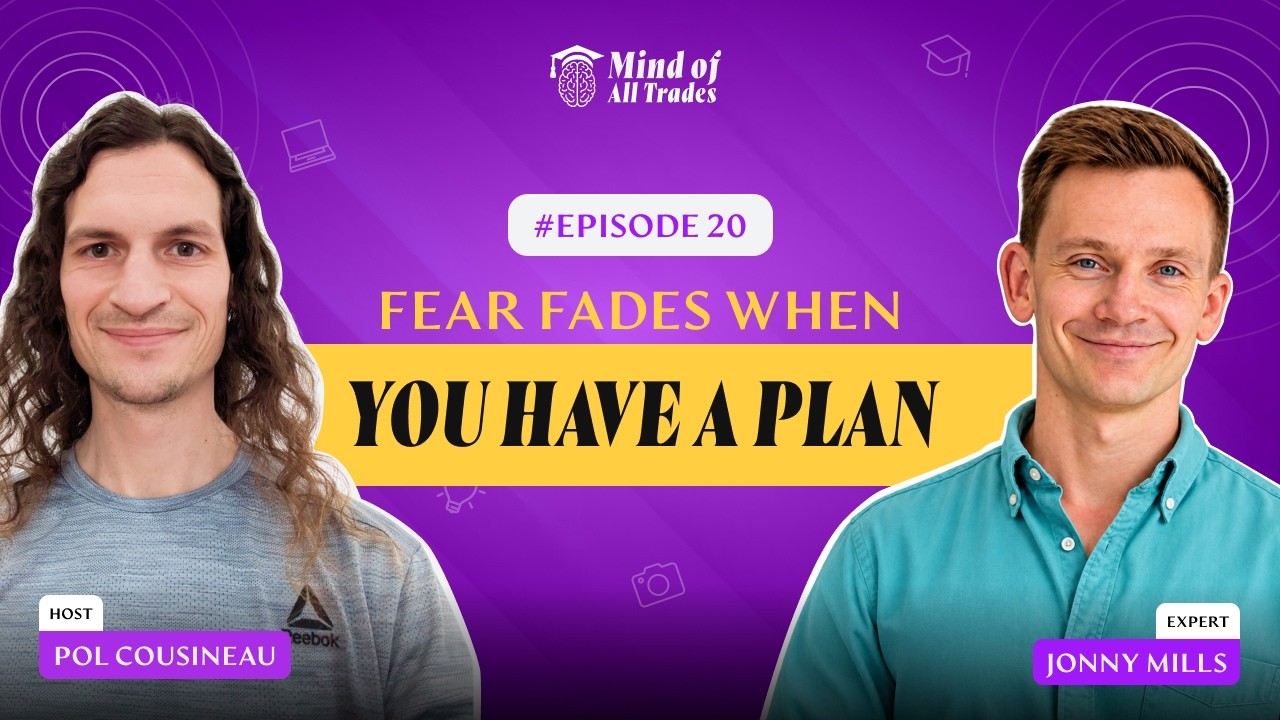
The Mindset That Scales Your Business
Description
“The fear of regret of not trying… once I faced that consequence, that’s when I realized I’ve got to make a change.” Jonny Mills spent a decade as a Deloitte chartered accountant before walking away to build an online business from scratch.
In Part 1, Jonny and Pol Cousineau dig into the four-step framework Jonny developed for moving through fear instead of around it – awareness, worst case, best case, and action. They trace his path from career coaching to wealth coaching to founding Wealth Pilot, where he now helps online coaches and consultants install the systems they need to sign clients predictably. Along the way, Pol shares his own reckoning with fear: realizing his worst-case scenario was simply returning to a job he’d already proven he could do.
In this episode, you’ll hear:
- Jonny’s four-step framework for moving through fear: awareness, worst case, best case, action
- Why the worst-case scenario is almost never as bad as the feeling around it
- The role identity plays in making – and resisting – a major pivot
- How Jonny’s offer evolved by listening to what clients kept asking for
- The difference between building in a vacuum and testing with real people
- Why “just thinking about it” quietly kills most businesses
- The cricket story that reframes how to think about risk and horizon
Chapters:
00:00 – Coming Up and Intro
04:32 – Leaving a 10-Year Career and a Four-Step Framework for Fear
10:23 – Worst Case, Best Case and Your Vision of the Future
20:39 – Action Over Paralysis: Sales Calls Without the Fear
25:04 – The Right Offer for the Right Customer
29:24 – Business Is One Big Science Experiment
38:19 – Dog Walking, Dog Sitting and the Outcome
43:03 – Speed, Simple Tools and Real Humans in the AI Age
About Jonny Mills
Jonny Mills is the founder of Wealth Pilot, where he helps online coaches and consultants install the systems they need to sign clients predictably through the Wealth Pilot Mastermind and the Wealth Pilot Academy. A former Deloitte chartered accountant, Jonny left a decade-long corporate career to build an online business, pivoting first into career coaching, then wealth coaching, before building Wealth Pilot around the specific problem of cash-flow business creation. He grew up in London and is now based in Cape Town, and writes about the whole journey in his weekly Substack newsletter, The Wealth Code.
Connect with Jonny:
- Substack (The Wealth Code): https://jonnymills.substack.com
- LinkedIn: https://www.linkedin.com/in/thejonnymills
- Skool: https://www.skool.com/wealth-pilot/
Want to be a guest on Mind Of All Trades? Apply here: https://mindofalltrades.com/podcast-application
Visit The Digital Navigator: https://thedigitalnavigator.com/
Follow Mind Of All Trades:
- YouTube: https://www.youtube.com/@MindofAllTrades
- Spotify: https://open.spotify.com/show/4MixC1mfhhUVIOFO1mywUc
- Apple Podcasts: https://podcasts.apple.com/us/podcast/mind-of-all-trades/id6807196830
- Instagram: https://www.instagram.com/mindofalltrades/
- Amazon Music: https://music.amazon.com/podcasts/32ce7fa4-4473-4c53-9256-7fca60e47331/mind-of-all-trades
- LinkedIn: https://www.linkedin.com/company/mind-of-all-trades/
- Facebook: https://www.facebook.com/MindOfAllTrades
Theme music by Breakmaster Cylinder.
Also Listen On


Transcript
Click to read the transcript
Pol Cousineau: [00:00:00] So how did you
come to grip
with the fear
and made a decision?
How did you face that?
Jonny Mills: So I’ve actually
adopted a framework
that I return to time and again.
Pol Cousineau: Like, if you’re hesitating, right,
on taking a next step,
what is really
the worst-case scenario?
Jonny Mills: I’ve learned that actually
when I have a plan
and I’m taking action,
I don’t, I never feel scared.
Pol Cousineau: Yeah, you’re making me realize
this also applied to me.
During the call itself,
I don’t remember
the fear of it.
Jonny Mills: And so business is really
a one big science experiment
to work out what’s working.
Pol Cousineau: Welcome to Mind of All Trades, the podcast where edupreneurs turn knowledge into impact. I’m your host, Pol Cousineau, and together we explore the craft and commerce of educational businesses. We look at the strategy, we look at the systems, and we look at the real implementation work that has to happen [00:01:00] behind the scenes.
Before we dive in, make sure you subscribe so you don’t miss future episodes. We’ll be sharing practical guides, conversations, and examples for edupreneurs who are building real momentum in their business, and for coaches, course creators, podcasters, and membership site owners who need help with the tech behind the business.
Check out The Digital Navigator. The Digital Navigator helps with fully managed websites, funnels, analytics, automations, and ongoing tech support. So instead of having a bunch of disconnected tools, your systems can work together, and you can spend more of your time focused on the business, the offer, and the people you serve.
You can learn more at thedigitalnavigator.com. Now, let’s jump into today’s episode.
Today’s guest is Jonny Mills, and Jonny is J-O-N-N-Y, which is important. Just like my name, Pol, P-O-L, you gotta get it right. Jonny is [00:02:00] a former Deloitte chartered accountant who left corporate after a decade to build an online business.
Interestingly enough, I am a former Ernst & Young CPA, so I don’t know if we count as rivals. He, he now helps online coaches and consultants install systems to sign clients predictably through Wealth Pilot Mastermind. Jonny grew up in London and is now based in Cape Town. His first business was a career coaching practice, and after 200 client calls, he noticed clients wanted help building wealth and businesses, not just careers, which makes total sense to me, and pivoted to wealth coaching, working with 50-plus clients.
Then he noticed that financial freedom through investing alone had a 10-plus year time horizon for most people, which is quite a lot, which led him to focus specifically on cash flow businesses, coaching and [00:03:00] consulting in particular. That pivot became Wealth Pilot. Jonny hosts the Wealth Pilot Mastermind, and he also runs the Wealth Pilot Academy with one-on-one support.
He writes about the whole journey in his weekly Substack newsletter, The Wealth Code. You can follow his Substack newsletter at jonnymills.substack.com, and that is Jonny with J-O-N-N-Y, and also on his LinkedIn at @thejonnymills. That is @thejonnymills. I’ll also put all those links inside of the show notes.
Welcome to the show, Jonny.
Jonny Mills: Thank you, Pol, and I think that just makes us accounting friends. There’s no, no hard feelings over EY and Deloitte
Pol Cousineau: Yeah, I don’t know. I feel like back in the days, like people were really competitive between those big accounting firms. And, uh, the, I don’t know, there, there was this whole thing going on and somehow we were all in the same [00:04:00] buildings.
Jonny Mills: Well, well, I have to tell you, I did do an internship at Ernst & Young way back, and so I’ve seen from both sides and I, I tell you they are very, very similar businesses. So lots of overlap
Pol Cousineau: Yes. That being said, though, we both moved on, uh, right? And now we’re entrepreneurs, and that actually leads me to something that I find that can be really interesting for our audience, which is the fact that you’ve pivoted multiple times, and I’m really curious to know, like, how did you know when it was time for making those pivots?
Jonny Mills: Yeah. So as you say, I’ve made many pivots, but the, the biggest one was leaving a 10-year career and, and setting up a business. And so the, the process that I went through was, was pretty fundamental because I had to face issues relating to identity, to fear, to finance. You know, how was I actually gonna make this work? And for me, [00:05:00] o- one thing that I’ve noticed having made multiple personal but also business pivots, one of the first things you have to overcome is actually letting go the person that you are or the person that you used to be in order to become the thing that you want to become. So that was, that was a big thing that I, that I had to, to work on. The other thing when it comes to specifically starting a business, uh, and a lot of this is driven by fear, of the biggest reasons I had never started a business was, was I was just scared of, of failure. But I started to think about the consequence of the path that I was on, and I, I sat down with my wife with blank sheets of paper, and we mapped out both where we were going and where we actually wanted to end up. And then a new fear arose, and it it was the fear of regret. The, the fear of regret of not trying. And so this, this really is a, a story of fear. You know, there’s f- [00:06:00] fear of what might happen, what might not happen, what am I gonna be, um, and what am I gonna regret? And once I faced that, that consequence, which I think often we, we, we miss.
You know, we, we think about the now, but we often don’t think about w- what– how we’re gonna feel in 20 years’ time. Once I actually faced that, that’s when it hit me and I realized, “Okay, I, I, I’ve gotta make a, a change.” And th- this happens continuously even in my business when you think about launching a new offer or even a new marketing funnel or, or selling to a new type of customer. There’s always this, what am I letting go and, and what, what could I achieve if I do make a change? So lots of, lots of different things, but really focusing on, on where you want to be and, and, and trying to level up and, and be the person that, that you, you, you truly can become if you’re willing to let go of, of what’s gone in the past.
Pol Cousineau: And I’m, now you talk about fear, and for me that’s my best friend. [00:07:00] So we have a long relationship. And then you said like, like facing those fears, right? And there was fears no matter which option you were picking it seems like, leaving or not, right? It, it was there. So how did you comes to grip with the fear and made a decision?
How did you face that?
Jonny Mills: So I’ve actually a-adopted a framework that I return to time and again. Not, not so much these days, but certainly when I was really early on in starting my business. So it’s a four-step framework, and the first step is all about awareness. The basis being we as humans fear things, but in– certainly in modern society, we don’t have a lot to fear.
You know, our, our, our fear as, as humans stemmed from the fear of basically being eaten or being killed by, by big, scary animals, you know, when we were, uh, living in caves and things.
Pol Cousineau: Which hopefully won’t happen in my office.
Jonny Mills: if, if, it does, [00:08:00] something has gone seriously wrong
Pol Cousineau: There, there– Although there is a puma living in the jungle where I go and walk the dogs and, and we’ve seen like the bedding where it is, and there has been sightings of it. Now that being said, no one has to be worried about me. I don’t go on a noctur- nocturnal walk.
Jonny Mills: Wow. I think you’re a braver man than me. So, so aside from the puma that lives next door to you,
we don’t really have, have, have fears like, like our ancestors did. And so the first step of this four-step framework is around understanding what am I actually scared of? And, and typically it’s fear of failure, it’s fear of what are people gonna think of me? It’s, it, it’s– A- and you, you realize actually often it’s, it’s really menial. It’s, it’s about emotion, it’s about judgment, about societal expectations. But that first step of really understanding what am I facing and, and what is driving that? Is it [00:09:00] something from– coming from the people around me? Is it something from my childhood? What, what actually is driving the fear? And, and getting that down on paper i- is a real leveler. You know, you’re there staring at the, the, the black and white, the real substance of it. So that’s step one, and then I move into step two, which is what is the worst case scenario? And I think one thing I’m certainly guilty of is if I, if I’m scared of something or I’m feeling uncomfortable, I try and, I try and avoid it. Um, and there are so many ways we a- we avoid these things. You know, you open your phone and you scroll, and you refresh your Instagram feed, and maybe you go on the news app, and we’re kind of just avoiding what’s really going on. But what I love about this step is you, you stare that that deepest, darkest fear in the face.
So I write down what would happen if this went absolutely terribly wrong. And the beauty of that is you start to [00:10:00] realize that actually, one, it’s not that bad, and two, there’s always something you can do about it. Someone can help you. You know, y- your partner might step in and support you, or friends or family. And so I start to work through both what, what could happen in the worst case scenario, but also what I would do. What’s the first thing I would do, or who would I speak to if that worst case scenario happened? Did you have a question?
Pol Cousineau: Well, I, I had an observation because for me personally, and as I’ve talked to other people, I found the same applied to multiple people, which is that worst fear often is, or that worst-case scenario is the status quo, oddly. So what I mean by that is, like, for me, I went through a similar exercise and I said, “Okay, well, worst-case scenario, I guess I’ll have to go back to accounting, and I can always make money that way and then survive.”
And then that logic became odd because I’m like, “Okay, wait. I’m afraid of taking the next step because if it fails, it’ll cause financial [00:11:00] disaster, and then the way to recover will be to go back working as a high-earning accountant,” which I was doing before making the move. So then I said, “Well, then I, I must take the action,” because the worst-case scenario is just looping back to the original point.
And, uh, it was just an observation because as people are tuning in, really look at it. Like, if you’re hesitating, right, on taking a next step, what is really the worst-case scenario?
Jonny Mills: So with that said, money being kind of not the problem, what, what do you think was driving your fear?
Pol Cousineau: Well Initially, it was oddly still money because I was earning a lot, and I thought, “Well, if my business doesn’t f- doesn’t succeed, then, okay, how am I gonna do car payments? What’ll happen with the house?” Like those types of financial obligations. It was more the fear of losing the assets that I had already acquired [00:12:00] than the cash flow, right, of, of the pay there.
Now, there was a second thing, which was a little bit of the status. So if I told someone that, “Oh, I’m the auditor of the city of Ottawa,” which was the capital of Canada, ” and I work for Ernst & Young,” instant social credibility in some circles. Okay, some of you may not get this, but in a lot of circles, this is something prestigious and highly valued as a status.
But then a person starting a new business, there’s almost no status associated to that. Now, at the time, I don’t recall having internalized it in that manner. I think it was more about social reactions and, “Okay, well, what is my family going to say? What are my friends going to say?” Et cetera. But now I think it’s more associated to status looking back.
Jonny Mills: Yeah, and I really appreciate your honesty [00:13:00] because I think that’s a, a big thing that people overcome. And even now, I, I was in the gym yesterday and someone– I, I met someone and he said, “Oh, what do you do?” And even now I don’t have an answer for that. I never, I never describe myself as an entrepreneur because I think it sounds too grand. So I still haven’t worked out h- yeah, how to answer the what do you do question. And, and it’s a way of people sort of fitting you in, you know, working out where you sit in the societal hierarchy. So it’s, uh, it’s a, it’s an interesting loaded question.
Pol Cousineau: Well, honesty for me is so important, and it’s difficult to be honest with ourselves. Like I even said, at the time I’m not trying to internalize it that way. But what I found is that it’s so liberating, and then you start understanding that even when you speak these things out loud, like people may, “Well, why are you sharing that, Pol?”
Well, there’s nothing actually to lose, and it generally tends to help people, and it relieves that burden. Like you were mentioning writing things down, but also [00:14:00] being able to just share that with someone. There is something liberating than keeping it in the confines of your own mental cage, really.
Jonny Mills: Yeah. And, and for me it was more fear of, of failure, but specifically what people would think of the failure. So it was less about the status for me personally, but it was more about people watching me fail. ‘Cause I, I really– I mean, I hadn’t really failed in anything. You know, I’d taken a very safe path to, to, to basically my early 30s.
And so this was the first thing I did where, where failure was, was something I had to really look in the eye and, and face.
Pol Cousineau: Wow. And then did you share that with someone or did you keep it to your writings?
Jonny Mills: Good question. I, I, I think it was mainly actually in my writing. It was really in my writing. I, I did, I did– One of the, the best things that I did was I, I built a bit of a team around me, [00:15:00] uh, you know, in terms of business mentorship and, and personal mentorship, and that helped me work through the substance of, of, you know, what I was actually doing and what I needed to do to make the business work. But no, the fear side of things, I, I really worked through on my own, and I f- I found this… So I’m only in step two of, of four talking you through it, but, but this framework really helped me do that. And as you say, just getting it out and, and, uh, externalizing it really, really made, made the difference.
Pol Cousineau: Hmm. Th- yeah, thank you for sharing. So let’s continue through those steps then
Jonny Mills: Yeah. So, so once I’ve, I’ve, I’ve, I’ve made myself depressed and terrified and I’ve, I’ve looked at what the the absolute worst, worst case scenario looks like, then we, then we start to improve the picture because I then, I then in step three look at what’s the best case scenario. And now you start to feel excited because you think, ” Well, if this thing succeeds,” you [00:16:00] know, for me it was my business, “What does that look like?” And honestly, it wasn’t really about money. You know, money is kind of a byproduct of helping lots of people with something valuable. But the idea of controlling my time and having time with my now baby son and providing for my wife, you know, those, those really meaningful things and, and really in, in a great level of detail, writing down what a day or a week might look like in that, in that future. And this just starts to give you such a feeling of empowerment and, and a reminder of why you’re doing this thing. And I think that’s really important. You know, anything great takes a long time to build. You know, building a business is, in many cases or in, in all cases, building a series of quite dull steps, but doing them in an amazing quantity and volume over long periods of time.
And it’s easy to become disconnected from why we’ve actually [00:17:00] gone down that path in the first place.
And this part of the the framework
Pol Cousineau: yeah, the vision also can help connect with the emotions, right? O- of what that is, and then that can get you excited, happy, different types of feelings. And our biology, I mean, our body responds to emotional cues. And for me, when you’re describing this step, I envision the contrast with the e- fear that was being experienced before, right?
So that creates a bodily experience, and now we’re changing that bodily experience. We’re associating it with thoughts, and now we’re starting to have more influence over our internal chemistry
Jonny Mills: Yeah, 100%. And, and you start to focus on, on where you’re going rather than what might happen to you. And, and since we have time, let’s digress. I, I heard an amazing story recently by– I, I love cricket, which probably won’t resonate with, with the, the US and, and Canadian audience, [00:18:00] um, but, but maybe in other countries. But that’s kind of by the by. So, so a very famous Australian cricketer tells this story of when he’s growing up, his, his grandfather wakes him up really early, like 5:00 in the morning. I think this is in Melbourne, in Australia. And he says, “Wake up, come with me.” And he– They get in the car, and they drive to a building site, and his grandfather takes him to a construction site with a, a, a 17-story high unfinished building. So it, it’s the bare bones of, of a concrete structure, but it doesn’t have any walls, no windows, nothing. And this, this sportsman, this cricketer, is terrified of heights, and his grandfather makes him walk up every single s-set of stairs in this unfinished concrete construction And he’s so terrified of, of heights that the higher he gets, the, the less willing he is to actually walk up the stairs.
So eventually [00:19:00] he’s crawling up the, the last– the remaining flights of stairs to get to the top because he is just so terrified. And remember, this is, this is really early in the morning, so it’s ju-ju-just still dark. And then they get to the top and the grandfather says: “Okay. Stand, stand here and look there.
Stand up and look over there.” And then slowly the, the sun starts to rise, so it comes over the horizon. And he described this most beautiful, you know, it’s the, the, the first proper sunrise he’d ever seen. Absolutely beautiful. You see the whole city being lit up, and he just felt amazing, you know, this, this beautiful thing.
And the message or the, the lesson from his grandfather was: “Look at, look at the horizon. You know, look, look at the beauty in front of you. Don’t spend your whole time looking down.”
Pol Cousineau: Right?
Jonny Mills: why I love this step because now, now I’m thinking about, “Okay, why am I doing this? Let’s go and get whatever the thing is that I wanna get.” And, and [00:20:00] it makes you feel so, so excited, which then leads you very nicely into step four, which is perhaps the hardest, which is action, doing something. So having been through this process, I’m feeling good about where I’m going. I’ve faced the downside. I always do at least one thing, and it could be something so simple, sending a direct message.
It could be sending an email. It could be something more advanced like writing an offer or sending a marketing email. Whatever it is, I do something because that’s really what gets the results you want. You, you have to take action. Ultimately, that, that is what really matters.
Pol Cousineau: Mm-hmm. Yeah. The, and that action place is where if you don’t have a check on your emotions, that paralysis can sink in, and I find that we get really good at justifying, “Oh, I had to do this before I got to that. I had to do B before I got to A.” And for me, one of the biggest, uh, [00:21:00] fears and paralyzing aspects was the sales calls and the sales discussions, ’cause I wasn’t used to that.
And, uh, I really had to work myself through that. And at the time, I got a, uh, a coach. That was a long time ago. I still remember. Jeremy the Merchant is his name, which is a pretty good name actually for a sales coach. But then he was, like, always telling me, “Okay, you gotta make these calls, you gotta talk to these people,” and he was holding me accountable.
I don’t think… Like, without his support, it would have been extremely difficult to take those actions at the time, because although I, I realized I needed to take action and there was those fears, the fears were so strong
Jonny Mills: Yeah. A- and I’ve, I’ve learned that actually when I have a plan and I’m taking action, I don’t– I never feel scared. So if it’s easy to feel scared about a sales call, but if you are on the sales call, you’re in the moment, you’re listening, present, hearing what the person is saying, or [00:22:00] even actually preparing for a sales call, you know, rehearsing your script, preparing your pitch. don’t know about you, but when I’m doing something, I don’t feel scared. It’s the times when I’m not doing things, that’s when the fear and the anxiety builds up and, and that’s, that’s the paralysis where you, you get stuck, you don’t take action, and so you don’t make any progress.
Pol Cousineau: Yeah, you’re making me realize this also applied to me. During the call itself, I don’t recommend– I don’t remember the fear of it. It was more the thought of it. And especially like in the morning, I’m like, “Oh no, I’m gonna get like two more calls this afternoon,” and then was getting anxious and all that.
But during it… No, actually, ‘ cause you’re, you’re in it, right? You’re taking action, it’s happening, you’re not overthinking it. And then I also had a plan. So like you said, right, having the steps so then I knew how to lead the discussion and how that was going as well. If I didn’t have a plan, then yes, I think I would be scrambling again and in fear during it.
Jonny Mills: [00:23:00] Yeah. I mean, we’re, we’re, we’re going deep now on sales calls, but I actually hate the term because, you know, one of the things I love about speaking to a new prospect is, is, is actually more about fit. You know, you’re finding out about someone and being curious, you know, what’s going on with your business?
Like, why isn’t it working, and what do you need to do to fix it? And actually, we, we, we build sales into this like scary used car salesman thing that just doesn’t really apply. actually what you’re trying to do is, is see, you know, can I help this person? Am I the right person to, to, to do that? And if not, then point them in the right direction. Um, so it doesn’t have to be this like scary thing.
Pol Cousineau: Yeah, there’s a little bit of detachment from the outcome that can help as well, because as you’re saying, like, is it a fit or not? If it’s not a fit and you validated that, then you can see it as not a [00:24:00] failure, right? But if you’re too tied to the outcome, I mean, one thing is you might actually succeed in sales, but then you’re gonna have another problem afterwards because the fit isn’t there, and then that’ll become way worse.
And I mean, I’ve done that mistake where I thought, “Hey, this is probably good,” and maybe I was wanting it a little bit more, right? And then after that I’m like, “Okay, now how am I gonna manage this situation?” Because things didn’t pan out as I thought, and, and then that’s a much bigger problem
Jonny Mills: Yeah. And we’re talking about sales calls, but I think the principle applies to pretty much everything, but especially in business, you know. It, it’s always about the inputs, about what you’re actually doing, what you’re– the, the, the, the work you’re putting in. And, and often in, in business, as with lots of things, you have to accept you don’t know whether they’re gonna work. But you have to trust that if you do the things for long enough, the right things specifically, [00:25:00] you will get the outcome. You just don’t know when.
Pol Cousineau: Yeah, now you’re, you’re talking about inputs, so I’d like to shift things a little bit to look at the programs that you’ve developed and what are the inputs into those programs, and why did you decide to, uh, to structure it in this way? Like, maybe we could use the WealthPilot Mastermind, or we could use one of your other programs as an example
Jonny Mills: Yeah. So on, on, on Wealth Pilot Mastermind, I’m helping coaches and consultants predictably sign clients. I found that most coaches and consultants are really good at delivering for customers. They, they’ve, they’ve gone into that business because they like it, they feel comfortable, they understand the material. What they all ha- have in common though is that they tend to find f- finding and signing clients more difficult. So that’s what we focus on. We can go into specific [00:26:00] examples, but broadly speaking, it’s about putting the right stimulus in front of the right person. In, in, in sort of business speak, that is putting the right offer in front of the right ideal customer. ICP, most people refer to it as. And a lot of people I, I speak to, es- uh, especially early on, they, they, they say, “Oh, yeah, no, I’m gonna start a business and I just need to think about the idea a little bit more. You know, I’m just gonna reflect and I’m gonna chat to AI and, and, and then I’ll think of this idea and then, and then I’ll start a business.”
And then you speak to them three years later, they’re still thinking about it. They’re still wondering, “Oh, I’m just waiting for the, for the best idea to, to, to appear.” But actually, the only way, as you will know, to build a business is to actually do the thing, to put the offer in front of someone, to help someone with a problem that they have that you know more about, to [00:27:00] employ someone to help solve a problem or to find you a client.
You actually have to do the exercise in order to learn. So if, if we step back where I started, I had this hypothesis that I could help people build more fulfilling careers. So I would speak to people and I would say, “This is how we’re gonna get you into a more fulfilling job.” Sounds great. And we, we did that, and we were helping people, but this message kept coming back: “I would love to have a more fulfilling career, but I need the money.”
Pol Cousineau: pretty important.
Jonny Mills: so I, so I, so I built a wealth coaching business, so that was helping people become financially independent, so they didn’t need to have the job that they didn’t find fulfilling.
Pol Cousineau: So Johnny, was there like a large number of clients that were bringing that up and that’s kinda how you knew? Or was it a few
Jonny Mills: It was, it was many. Yeah. This was, this was repeated over and [00:28:00] over again. And s-some people even I was speaking to and, and trying to help, they, they didn’t even have jobs or income, so they, they simply couldn’t afford to, to pay to work with me. So that it was, it was a constant message. So I, I, I built a wealth coaching business, and we helped a lot of people.
And, you know, when people get control of their money, their lives truly transform. It’s, it’s really incredible. You feel more empowered. You can see what actions you’re taking and how you’re gonna achieve financial freedom. You understand investing. You, you, you really take control of your future. And then as you said, you alluded to in the in- uh, in the introduction, people started to say to me, “This is great.
You know, I’m, I’m in control of my money and I’m, I’m investing and feeling wealthier, but I still have to ask a boss if I wanna take a day off.” Help me, help me build a business. [00:29:00] And the, the, the whole– this is, this is a sort of microcosm of, of what I, what I teach in, in Wealth Pilot Mastermind, which is to say you have to test both the stimulus and the person you’re putting it in front of to work out what the market wants, and you can’t build that in a, in a vacuum. that’s a bit of an overview. I can go into more detail if you’d like, but, but please, please
ask
Pol Cousineau: yeah. Well, I, I, I’m curious ’cause when you mentioned testing, right? And, and for me it’s like that offer, right, in front of the person. What are different ways still to get that feedback, right? And, and what have you found for putting that offer in? Because there comes to, like, packaging, pricing, presentation, fulfillment, right?
There’s a lot of things that go into that. So what does that process look like?
Jonny Mills: A-and, and this is one of the, the smartest things I did. I, I, I hired a, a business mentor right at the start because one of the, the [00:30:00] great things is you can acquire knowledge and skills rather than waiting two or three years to try and learn them yourself. So that’s the first thing– smart thing that I did. The, the, the next thing th-that is, is most useful is data. A lot of business owners I speak to are… Well, we’re, we’re humans, so we’re all emotional, but they take emotional decisions. “Ugh, I’ve got this hunch. This thing’s not working. I’m just gonna change it. I’m gonna tear it up. I’m gonna start again.” I say, “How many times did you test that thing?” And they say, “Oh, well, I spoke to 10 people.” And I say, “Well, why don’t you speak to 100 people and then tell me what the answer is?” And so it could be, uh, an outbound message, cold or warm. It could be different types of content and then within the content, different types of calls to action. It could be the way you present on a [00:31:00] sales call.
It could be the types of emails that you’re writing to your email list and the tone. It could be the subject lines. And so business is, is really a one big science experiment to work out what’s working. And the way that you, you work out what does work is by going through the funnel. So like a science experiment that you would’ve done at school, you must only change one thing at a time.
So we start at the top. So let’s say it’s a cold message. I’ve gotta test this cold message, and I’ve gotta test it 300 times to see if it works and if it doesn’t. And if it does, then I go to the next step, which is maybe sending a bit more information, and then I’ve gotta test that point of the bottleneck in the process maybe another 100 times. And we maybe have a sales call, and we’ve gotta test our script and the pitch, and we’ve gotta do at least 50 of those before we really know whether this is working or not. So the, the, the the two, the two parts to my answer, one, [00:32:00] one is, you know, clearly if you, if you pay someone who has been through the process before, you’re gonna get to the right outbound message, the right follow-up information, the, the right sales scripts much faster. But then each and every business has to go through that process of data accumulation, and that takes time. But it’s, it’s, it’s absolutely fundamental, and without it, you end up making rash decisions
Pol Cousineau: And it takes discipline. That’s the thing. Because what I’m seeing too is when the businesses are successful and they’re looking at doing changes, it’s also very difficult to keep that discipline and not make too many changes. So I’ve seen many times where there’s an offer that’s working great, they wanna make it better, but they change too many variables and now it doesn’t sell anymore.
Like they’ve sabotaged it because they can’t hold that discipline that, that you’re talking about. And when you’re making an offer There needs to pretty [00:33:00] much be all the stars need to be aligned for it to work. So when you’re thinking about it, like if you’re at 80%, right? And this is a fictitious grading of it, but let’s say you’re at 80%.
Well, 80% doesn’t mean that you get one sale out of X. It might still mean you get zero sales ’cause it’s never quite right for anyone, and then you need to get it to a certain level. So I remember with my other company, The Digital Navigator, which does technology solutions, and one of the key findings was that anything related to tech creates a lot of anxiety and a lot of overwhelm.
And then the second thing I found is that people tended to gravitate to buying a new software to solve the issue, which would actually increase that feeling of overwhelm and anxiety, which would make the problem worse. So initially, I was using a lot of technical jargon in my language, and then what I did, it was about like 10 calls or so, 20 minutes, [00:34:00] asking real business owners in my target market what were some of their challenges.
I was recording that on Zoom. And then that’s when I noticed that common thread of the overwhelm and that IT item. So what happened is that I pivoted my message, and often now in my calls and how I was leading, I was asking them if they had a lot… Like how many tools they had that they felt was getting unused, and if they felt overwhelmed.
The other thing I found is a lot of entrepreneurs, especially in these educational businesses, they tend to try to do everything themselves, right? And they’re doing all that. So the IT and tech work, as the business grows, keeps taking more and more time of the founder, and they don’t like that. So then I would jokingly say, and I’d be like, “Oh, how much time are you spending on tech per week?”
And let’s say they say, “Oh, about 25 hours.” And I say, ” Oh, okay. So do you do that because it’s relaxing you from your core business, right? Takes your mind off of things.” [00:35:00] Knowing very well that is the opposite. And they’re like, “No!” I’m like, “Okay, great. I can help you take that off your plate.” But until I got that message, I didn’t get that strong traction, right?
Like it would just always kill the sales. And why? Because the language I was using was triggering that anxiety and that overwhelm, which was a negative emotional response, so the last thing they wanted to do was hire
Jonny Mills: Such, such a good lesson.
Pol Cousineau: me.
Jonny Mills: lesson. It, it made me think of a recent, uh, podcast. I don’t know if you follow Alex Hormozi, but I listened to, to one of his podcasts recently, and he had a number of businesses pitching for him to invest $100,000 into their business, plus a year’s worth of mentorship. And he said– He got down to the final two, and he said to them, “Okay, I want you to pitch to me. You know, part of business is selling, so please pitch your business and why I should invest in you.” And both of them said, “I am the [00:36:00] hardest worker, and I’m gonna do all I can, and I’ve shown you I can graft, and I’ve…” And eventually he had to pick one of them. But he said, “Neither of you in your pitch told me what you thought I might like from investing in your business.”
Pol Cousineau: Right?
Jonny Mills: And so I think your story tells a really s-sort of humble tale of being willing to ask, you know, ask what someone needs help with and how they want help.
And, and that’s a very important part of, of any business, is listening. Listening to, to your customers, to your employees, um, because that’s really what counts, you know? W-what your customers want, fulfill that.
Pol Cousineau: Right. And then also going back to what you were saying, gathering the data is important, right? So then, like in this instance, I did a several calls to gather some of that data. Then afterwards, I was measuring how those conversations were going [00:37:00] with the new language, and then like my emails, right, all the other items, and then was seeing a much more favorable response.
But I continued to looking at that instead of, again, relying on a hunch, which I would be willing to bet a lot of you listening right now, you’re not looking at your data enough. That is a common thing I tend to notice. So if there’s one thing you’re taking away is like, okay, well, what is going on with your business, and maybe what might be one or two of your most important goals, and what data points do you have around those goals?
Jonny Mills: Yeah. A- and I think we, we like the idea o-of, of new ideas and trying new things and a new sales funnel or a new social media platform, when actually once you do have the data, very often the answer is simply you need to do more of what you’re already doing. It’s the
boring answer, but often it’s the right answer.
Pol Cousineau: The one we don’t wanna hear. [00:38:00] But then, so, so let’s go a little bit back now, right? ‘Cause we were talking about the, uh, the Web Pilot Mastermind and how some of the inputs and the structure came about for that program. And for me, that, that’s really valuable for our listeners to understand that process
Jonny Mills: Yeah. So, so I always, I always explain using, using a story which, uh, uh, I believe is told in the, the book “The Million Dollar Weekend,” which is by Noah Kagan. And he tells a story about someone who decides to start a dog walking business. And so they build a website, they get a logo, they name it, you know, all looks beautiful, and then they launch the website and nothing happens. No one comes to them. No one knows about them. It doesn’t happen. then there’s a, a second theoretical business owner who s- decides to start the same kind of business, except they go and ask 10 neighbors, “Can I walk your dog?” And [00:39:00] the, the, the, the answer comes back, ” No, I don’t want you to walk my dog, but actually what we do need is a dog sitter to look after our dog when we go on holiday.” Now I know I have a dog sitting business, so I’ve not wasted any time or money. I know that there’s a market for, for dog sitting. And that’s really a metaphor for the, for the way that I, uh, certainly at the beginning of, of, of working with someone, that’s, that’s the principle I apply. So I’m very keen on simply getting out there and, and asking people and hustling and, you know, DMs and, and content and, and actually testing wording in front of people, you know, does this stimulus work?
So that’s really where we, where we begin the process. And then a- a- as I did, because I, I learned so much from doing sales calls, is actually asking questions of, of people that, that I, that I potentially want to work with. And, and obviously you, you do a lot of the work upfront in terms of writing an [00:40:00] offer and, you know, how can I help people most? But one thing that I’ve noticed, especially amongst people who, who come from more traditional corporate backgrounds, we’re obsessed with, you know, I’m gonna sell one hour session per week, and they’re gonna get three tools, and they’re gonna get 25 workshop worksheets, and they’re gonna fill them all in and, and you say this, this, this person doesn’t care about h- the, the logistics. Can you get them the outcome? How are you gonna get them the outcome? Not, not, not number of worksheets, but, but demonstrate to someone that you have the credibility to, to, to get the outcome they want. So very early on, we’re, we’re, we’re, we’re testing, yeah, both the stimulus, but also trying to position things in a, in a way that people understand to, to your point about language and technology, you know, keeping things simple, but making it clear, you know, I understand your problem [00:41:00] and I understand how to fix it, and I’m a credible authority to fix that thing. And that, that’s really where the experiment begins.
Pol Cousineau: Well, when you mentioned the outcome, it made me think to when you’re in a restaurant, and maybe I’m hungry, not sure, but you order a pad Thai. Well, it doesn’t say, okay, one teaspoon of tamarind sauce, half a bell pepper, right? Like, all the ingredients. That’s like your worksheets, number of calls, all of those things.
The outcome is a spicy pad Thai, right? Or whatever, right, is the dish. But we don’t order based on the raw ingredients, and the same thing when someone comes to your business for a solution. Like, those nuts and bolts. Uh, of course, it needs to have the right sauce and the right ingredients for the dish to be good, but to be quite honest, I don’t really care how it gets made, as long as at the end it tastes good and it’s not too bad for my health.
Jonny Mills: The, the other funny thing, of course, is [00:42:00] you, you don’t know what suits the person better. You know, if someone says to me, “I’m gonna have an hour-long call with you every week for six months,” and they think it
sounds amazing, to me that sounds like an hour out of my diary every week for the next six months.
I actually don’t want that.
So actually, can you give me the outcome with less time of yours? You know, I, I don’t care how much time it takes you, I just want the outcome. So, so I think there’s the other aspect which is sometimes people don’t want all of the things that you’re pulling together. Um, y- it’s your job actually to make it simpler.
So quite an, quite an interesting sort of psychological dynamic to play with when you’re putting an offer in front of people.
Pol Cousineau: Well, going back to the restaurant example, so, uh, in a lot of the spicy dishes, uh, they can marinate or prepare the spices for a long time. Well, that’d be kind of like the same thing. I don’t wanna wait 12 hours for it to marinate in the restaurant. It’s not gonna make it better if I’m there waiting while that’s happening, right?
Let me just come in and eat the dish when it’s ready.
Jonny Mills: [00:43:00] It’s such a good metaphor. I love the restaurant metaphor. I’m gonna take that away
Pol Cousineau: Awesome. So then when you’re… So now we’re, we’re thinking, right? We’re like, what will also help get them the outcome in the most effective and desirable medium, right? Which is a little bit what we’re, what we’re talking about. So how did you come up with that medium for the mastermind?
Jonny Mills: Again, th-this is, this is just another part of the, of the big test. So I, I realized, and, and this is through experience of my own as well, going through different programs, I realized the biggest thing people want is speed. You know, when you’re a business owner and you’ve spent the day writing the offer, which is, you know, the foundation of your business, you then have to wait four days to get some feedback from someone, that really doesn’t [00:44:00] work and it slows the business down.
It’s even worse when you start building, you know, an outbound campaign or an email campaign. You know, you– the, the whole essence of testing is testing quickly. You know, you wanna gain the data as, as fast as you can. So I, I do– I mean, we’re now getting into logistics. I, I do a weekly office hours in case people wanna sort of join, um, and people do.
You know, it’s just some things that are quicker just to chat through. But the biggest thing that I love doing is, is giving people personalized feedback on the specifics of their business, ideally within 12 hours, if not 24 hours. So whether it’s their offer, whether it’s an email they want me to look at or content, anything of those, of those, of that sort, because that’s my principle, that’s my fundamental belief: act fast. Uh, I call it patient urgency. We expect results patiently, but we act with urgency, and I wanna, I wanna match that for people.
Pol Cousineau: And how are you [00:45:00] able to give such a fast response? What communication channel do you use?
Jonny Mills: I use, I use Skool, which I, I really like, S-K-O-O-L. And I use Loom videos and voice notes and DMs because I find that to be the most dynamic way of, of interacting with people. And it means no matter what their time zone, what their working hours are, it just means they get feedback fast
Pol Cousineau: And do you have a way to protect some of your, like, non-business hours? Or no, your phone just keeps getting all the messages and all of those things?
Jonny Mills: No, I, I do set boundaries and, and I don’t, you know, weekends, uh, I protect and evenings. but but I think generally as, as long as people know that you’re, you’re gonna respond to them quickly, uh, and, and there’s a trust, you know. You, you build an expectation that you will respond in a timely manage- manner, not necessarily within 10 minutes, but, but quickly. That’s really what matters because as a, [00:46:00] as a, as a business mentor, you are trying to take risk and concern and anxiety out of the process. So if someone builds, you know, puts their heart and soul into an offer, and then they have this anxiety of like, “When this, when’s this guy gonna come back to me?” That’s, that’s something to be removed. That, that shouldn’t be added in as an extra stress. They’ve got enough to worry about. So it’s really about building a trusting expectation and, uh, and, and I– that’s, that’s– I mean, the other thing is I love it. So I love looking at offers and I love re-reading emails and content and, and giving people feedback, and I love seeing results.
So I don’t really view it as like my phone’s always going. I mean, all my notifications are switched off.
So when I’m checking something, when I’m checking something, it’s because I’ve chosen to check it. Um, but,
uh, but I, I
Pol Cousineau: are you finding, how are you finding Skool for that communication? ‘Cause I, I know some people might be considering that platform. It is a co- uh, popular platform in our [00:47:00] space. Uh, how has that been going?
Jonny Mills: I think it’s beautiful in its simplicity. It’s really easy to use. You can get video content up there quickly. You can plug in Loom videos or YouTube videos just by dropping in a link. Uh, you can put video transcripts very easily. It’s also searchable, so I put, uh, the, the w- the office hours that I talked, I talked about, the transcripts will go in there.
So if someone wants to search a previous discussion on a, a relevant topic, they can do that. And yeah, it just– it, it’s so easy to use and it’s, it’s relatively cheap
and
Pol Cousineau: And are you managing it by yourself or you have an assistant or you’re able to kind of handle all of that?
Jonny Mills: Yeah, I do it myself ’cause it’s, ’cause it’s that easy. I
use Riverside just to top and tail, you know, workshops and webinars. Um, but I find Riverside really easy as well. And, and then Skool just sort of run- runs itself in a way. That’s how it [00:48:00] feels anyway
Pol Cousineau: Mm-hmm. Yeah, there’s a lot to say for simplicity. I m- I really like sophisticated, advanced automations and systems, but I enjoy that, right? But when, when you’re looking at your business, you also wanna think, “Well, where would my time be going?” And then again, do those features make an impact in the solution and the transformation you’re trying to give?
And a lot of the time, not always, ’cause I, I am pro-automation, right, and, and tech, but a lot of the times the decisions are actually made because of something you want. Like, ” Oh, that looks so cool. Oh, I wanna try that. Oh, this is interesting. Oh my, I can have this AI agent that will answer all the questions.”
But the next thing you know, you have a whole project of documenting all your knowledge and how will it answer and what is the tone, and it’s all gonna be built on stale information. And now you realize you’ve been spending your time in the wrong [00:49:00] direction, and you might enjoy it quite a bit, and that’s probably why you’re going in that angle.
So the message of simplicity, Johnny, I, I think it’s a really strong and important one
Jonny Mills: And, and I think you made such an important point a- about whether it being for your customers or whether it being something that you want. And I, I just, I just started working with a career coach, and he just watched a, a, a webinar that I, that I ran with, with other clients. And as I said, I, I top and tail, I don’t edit out anything.
You know, I want people to hear everything that I’ve got to say on the subject, plus questions that people ask. And he said afterwards, he said: “I loved the way that you just did it. It was imperfect. You got it up there. I’ve got the information I want. But m- most importantly, you’ve shown me that I can do that in my business too. So I’m just gonna make stuff and get it up there.” So I feel as though I’m, you know, leading by example and, and [00:50:00] you could have agonized making the perfect video and, and making sure you’ve said everything perfectly with no ums, but actually that’s not necessarily what people want. People want real humans, especially in this AI age
Pol Cousineau: Oh yeah, it can be more persuasive with the ums and uhs. Or you think about videos. A lot of the videos that are hyper-produced don’t perform as well as the off-the-cuff, just from the phone, slightly unstable. And it’s about taking action, which is something, right, we were talking about earlier again, and then building that velocity, building a certain level of momentum, and then being careful because complexity tends to stifle that and put a huge roadblock
Jonny Mills: Yeah, that’s right
Jonny Mills: Knowledge is basically free.
You know, we can find
the answer to any question [00:51:00] in seconds.
Pol Cousineau: So this is highlighting
the difference as well
between information and transformation.
Jonny Mills: I always go back
to every business
has one bottleneck today
that if you unlock
will transform your business.
Pol Cousineau: Now I know personally
if I’m in a discovery or sales call
and I don’t get the sale,
there is still
a small inner blow that happens.
Jonny Mills: If someone sees the value
in what you are providing,
the price is generally,
unless there’s a real financial situation,
the price is rarely the biggest driver.
Highlights & Timestamps
00:00 – Coming Up and Intro
04:32 – Leaving a 10-Year Career and a Four-Step Framework for Fear
10:23 – Worst Case, Best Case and Your Vision of the Future
20:39 – Action Over Paralysis: Sales Calls Without the Fear
25:04 – The Right Offer for the Right Customer
29:24 – Business Is One Big Science Experiment
38:19 – Dog Walking, Dog Sitting and the Outcome
43:03 – Speed, Simple Tools and Real Humans in the AI Age

About Host
Pol is a strategist and mentor who’s helped countless educators and entrepreneurs scale their businesses with clarity and ease.
From running a data-driven digital agency to co-founding an eLearning platform, he brings both technical expertise and heart-centered leadership.
With Mind of All Trades, Pol brings those lessons to the mic… helping you learn what it really takes to succeed online.
Recent Episodes
Price Isn't Why They Didn't Buy - Jonny Mills - Part 2 - EP 21 –
S1 Ep21

Pol Cousineau
November 27, 2026
When a client’s close rate dropped after raising prices, the obvious assumption was that the price had gone too high. Jonny Mills saw it differently – and the data proved him right.
In Part 2, Jonny and Pol Cousineau dig into why price is almost never the real reason someone doesn’t buy, and what coaches and consultants get systematically wrong about their own offers. Jonny runs the Wealth Pilot Mastermind, where he teaches a simple rule: find the one bottleneck in a business and don’t let anything else distract from solving it. They also get into Jonny’s public goal of reaching 50K a month, why he announced it on Substack, and what three years of his own data tell him about where to focus next.
In this episode, you’ll hear:
- Why a dropping close rate after a price increase is usually a good sign, not a warning sign
- The revenue math behind raising prices even when close rates fall
- How 75% of Jonny’s clients are systematically underpriced, and why
- The one-bottleneck rule behind how Jonny runs his mastermind calls and feedback
- Jonny’s Substack strategy: diary-style writing, long-form depth, and why silent followers are often the real buyers
- How to build authority before you have an audience
- Why AI-sounding content is a liability when connection is the actual differentiator
Chapters:
00:00 – Coming Up and Recap
02:16 – Drop-In Calls, Public Feedback and Competitors in the Group
09:07 – Information vs. Transformation: One Bottleneck at a Time
13:04 – Going Public With a $50K Goal and Finding the Bottleneck
18:22 – Substack as the Nurture Stage
28:16 – Why Closing Less Can Earn More
32:15 – One Lost Sale Isn’t Data, and Price Isn’t the Reason
37:36 – Guilt, Limiting Beliefs and Underpricing
41:34 – How Much to Raise Your Price, and How Fast
47:27 – Take Emotion Out and Follow the Data
About Jonny Mills
Jonny Mills is the founder of Wealth Pilot, where he helps online coaches and consultants install the systems they need to sign clients predictably through the Wealth Pilot Mastermind and the Wealth Pilot Academy. A former Deloitte chartered accountant, Jonny left a decade-long corporate career to build an online business, pivoting first into career coaching, then wealth coaching, before building Wealth Pilot around the specific problem of cash-flow business creation. He grew up in London and is now based in Cape Town, and writes about the whole journey in his weekly Substack newsletter, The Wealth Code.
Connect with Jonny:
Substack (The Wealth Code): https://jonnymills.substack.com
LinkedIn: https://www.linkedin.com/in/thejonnymills
Skool: https://www.skool.com/wealth-pilot/
Missed part 1? Watch here: https://mindofalltrades.com/episodes/ep20-jonny-mills-fear-plan-part-1/
Want to be a guest on Mind Of All Trades? Apply here: https://mindofalltrades.com/podcast-application
Visit The Digital Navigator: https://thedigitalnavigator.com/
Follow Mind Of All Trades:
- YouTube: https://www.youtube.com/@MindofAllTrades
- Spotify: https://open.spotify.com/show/4MixC1mfhhUVIOFO1mywUc
- Apple Podcasts: https://podcasts.apple.com/us/podcast/mind-of-all-trades/id6807196830
- Instagram: https://www.instagram.com/mindofalltrades/
- Amazon Music: https://music.amazon.com/podcasts/32ce7fa4-4473-4c53-9256-7fca60e47331/mind-of-all-trades
- LinkedIn: https://www.linkedin.com/company/mind-of-all-trades/
- Facebook: https://www.facebook.com/MindOfAllTrades
Theme music by Breakmaster Cylinder.
Listen Now
Live Up to Your Reputation or Change It - Stever Robbins - Part 2 - EP 19 –
S1 Ep19
Pol Cousineau
November 20, 2026
“Sometimes you end up with a reputation, and then the question is: do you wanna live up to it or try to change it?” Stever Robbins has had several reputations. The Get It Done Guy. The startup advisor. The goofy technologist with a zombie musical. Now something new.
In Part 2, Stever and Pol Cousineau move from learning theory into identity, reinvention, and what it actually means to build a personal brand. Stever explains why you can only choose one box in people’s minds, what Babson College taught him about leaning into a reputation you already have, and why he is now betting his professional credibility on a marketing textbook written as a personal memoir of his attempts to get laid at Burning Man. They talk about the value of strange niches, two-website strategies, the wisdom of Frances Hesselbein at 87, and why he was raised in a traveling hippie commune and rebelled by going to Harvard.
In this episode, you’ll hear:
- Why people will put you in one box – you can choose it, but you can only choose once
- The Babson College lesson: when you already have a strong reputation, the only real question is whether to lean into it
- Personal brand vs. reputation: how do you want someone to describe you to a friend in one sentence?
- The Get It Done Guy box: millions of people know Stever only as a productivity person, and that happened by accident
- Why he is publishing an X-rated marketing textbook – and what early readers under 40 said vs. readers over 40
- Frances Hesselbein at 87: ‘You haven’t even started your real work yet’ – and what she did until she was 100
- Why he was raised in a traveling hippie commune and rebelled by going to Harvard Business School
Chapters:
00:00 – Coming Up and Recap
02:39 – Part 2 starts
04:27 – Learning Through Play, Not Lectures
07:52 – Comedy Classes, Corporate Buyers and Partitioning Your Life
18:27 – Reinvention Was Never a Deliberate Plan
25:52 – Personal Brand: Live Up to Your Reputation or Change It
34:10 – The Book: Marketing Concepts, Not a How-To
40:38 – Following the Road: Trends, Risk and Openness
About Stever Robbins
Stever Robbins is the founder of Ideas Unleashed and a career-long entrepreneur with an MIT computer science degree, a Harvard MBA, and early-team experience at ten startups, four of which went public. He spent over a decade as a top-10 iTunes podcaster with the Get It Done Guy podcast, reaching more than 36 million downloads before closing it in 2019. He now runs the Get It Done Groups, an accountability program that helps people make real progress on important projects and habits, alongside advising, coaching, and speaking work. He is also the author of a forthcoming marketing book written during COVID lockdowns and described by early readers as the best marketing book they have ever read.
Learn more and join the Get It Done Groups: https://steverrobbins.com
Connect with Stever:
- Website: https://steverrobbins.com
- Newsletter / Substack: https://ideas.steverrobbins.com
- Marketing book (notify me): https://marketingforvirgins.com
Missed part 1? Watch here: https://mindofalltrades.com/episodes/ep18-stever-robbins-behavior-change-part-1/
Want to be a guest on Mind Of All Trades? Apply here: https://mindofalltrades.com/podcast-application
Visit The Digital Navigator: https://thedigitalnavigator.com/
Follow Mind Of All Trades:
- YouTube: https://www.youtube.com/@MindofAllTrades
- Spotify: https://open.spotify.com/show/4MixC1mfhhUVIOFO1mywUc
- Apple Podcasts: https://podcasts.apple.com/us/podcast/mind-of-all-trades/id6807196830
- Instagram: https://www.instagram.com/mindofalltrades/
- Amazon Music: https://music.amazon.com/podcasts/32ce7fa4-4473-4c53-9256-7fca60e47331/mind-of-all-trades
- LinkedIn: https://www.linkedin.com/company/mind-of-all-trades/
- Facebook: https://www.facebook.com/MindOfAllTrades
Theme music by Breakmaster Cylinder.
Listen Now
Behavior Change Needs More Than Understanding - Stever Robbins - Part 1 - EP 18 –
S1 Ep18
Pol Cousineau
November 17, 2026
“A lot of people don’t understand that understanding does not lead to behavior change. You can understand something and still not do it.” Stever Robbins spent over a decade teaching productivity to 36 million podcast listeners and found the same gap every time.
In Part 1, Stever and Pol Cousineau cover the future of educational businesses in an AI-saturated world, what it really takes to build an audience that sticks, and why understanding a concept is never enough to change behavior. Stever traces his journey from co-founding one of the first e-learning companies in 1996 to rethinking his entire business model for the LLM era. They unpack how content is becoming a commodity, why personal relationships and voice are the durable differentiators, and what experiential learning can do that a lecture never could.
In this episode, you’ll hear:
- The 1996 e-learning startup at the Smithsonian that was essentially Coursera ten years early – and what timing really means for a business
- Why LLMs are making content a commodity and what it means for everyone in the educational business space
- How to actually rank in an AI chatbot (and why agencies selling LLM optimization probably cannot prove it works)
- Niching by audience type, identity, psychographics, and geography: how the brain assigns value to narrow specificity
- Understanding doesn’t lead to behavior change: the difference between knowing what to do and being able to do it in the moment
- The vomit draft and the Scribe Method: how to actually write without blank-page syndrome
- Experiential learning, Dungeons and Dragons accounting, and why high-touch, high-ticket is probably the future of education
Chapters:
00:00 – Coming Up and Intro
03:15 – Reinvention, Timing and the First E-Learning Company
08:07 – Can You Optimize for AI? Demand Proof
15:27 – Fake AI Rankings and the Framework Overload
26:46 – Relationships Over Content, and Why Understanding Isn’t Enough
32:04 – Human in the Loop and High-Touch Learning
39:19 – How Adults Learn, and a D&D Accounting Course
About Stever Robbins
Stever Robbins is the founder of Ideas Unleashed and a career-long entrepreneur with an MIT computer science degree, a Harvard MBA, and early-team experience at ten startups, four of which went public. He spent over a decade as a top-10 iTunes podcaster with the Get It Done Guy podcast, reaching more than 36 million downloads before closing it in 2019. He now runs the Get It Done Groups, an accountability program that helps people make real progress on important projects and habits, alongside advising, coaching, and speaking work. He is also the author of a forthcoming marketing book written during COVID lockdowns and described by early readers as the best marketing book they have ever read.
Learn more and join the Get It Done Groups: https://steverrobbins.com
Connect with Stever:
- Website: https://steverrobbins.com
- Newsletter / Substack: https://ideas.steverrobbins.com
- Marketing book (notify me): https://marketingforvirgins.com
Want to be a guest on Mind Of All Trades? Apply here: https://mindofalltrades.com/podcast-application
Visit The Digital Navigator: https://thedigitalnavigator.com/
Follow Mind Of All Trades:
YouTube: https://www.youtube.com/@MindofAllTrades
Spotify: https://open.spotify.com/show/4MixC1mfhhUVIOFO1mywUc
Apple Podcasts: https://podcasts.apple.com/us/podcast/mind-of-all-trades/id6807196830
Instagram: https://www.instagram.com/mindofalltrades/
Amazon Music: https://music.amazon.com/podcasts/32ce7fa4-4473-4c53-9256-7fca60e47331/mind-of-all-trades
LinkedIn: https://www.linkedin.com/company/mind-of-all-trades/
Facebook: https://www.facebook.com/MindOfAllTrades
Theme music by Breakmaster Cylinder.
Listen Now
Your Team Can't Read Your Mind - Sue Pats - Part 2 - EP 17 –
S1 Ep17
Pol Cousineau
November 12, 2026
“Your team is not going to read your mind. So that’s why it is very important to have everything written down, step by step.” Sue Pats learned this after building her own team, and she says the same thing that breaks partnerships also breaks companies.
In Part 2, Sue and Pol Cousineau move from LinkedIn strategy into how Sue built and manages her team. Sue explains why she pays above market, why strive for excellence beats strive for perfection, and what a step-by-step task system did for her ability to delegate and travel. Pol shares the full story of his six months in the Peruvian jungle and what a jaguar taught him about anger. They close on the importance of digital products as a path to multiple income streams, and Sue’s one piece of advice for anyone in a valley right now.
In this episode, you’ll hear:
- LinkedIn: how 3% of users create all the content, and why Sue scheduled posts throughout her vacation
- Why Sue lost her LinkedIn account, rebuilt from zero, and what she will never automate again
- Fake engagement, bots, and how to spot when growth is not real
- Protecting your community from scams, especially spiritually-inclined audiences
- Why Sue pays her team above market and treats them like family
- Your team can’t read your mind: writing step-by-step tasks and building recurring workflows
- Pol’s six months in the Peruvian jungle, the jaguar, and how he found his anger
Chapters:
00:00 – Coming Up and Intro
02:10 – Learning Your Audience’s Language
06:13 – LinkedIn: Why Creators Win
11:11 – LinkedIn Content, Consistency and Costly Shortcuts
18:53 – Be Vigilant About the Sharks
23:10 – Building the Team: Pay, Roles and Cruise Control
29:14 – Mapping Processes, Responsibility and Culture
36:26 – Pol’s Journey: Anger and Forgiveness in the Jungle
45:34 – Back to Educational Businesses: Homeschooling and Closing Advice
About Sue Pats
Sue Pats is the founder of nuBeginning (N-U), a platform that helps solopreneurs design, launch, and grow digital products profitably. After a spinal cord injury she recovered from without surgery, Sue redirected her business toward helping others and what she calls her bonus years. She teaches her students how to generate income through private label rights and master resell rights products, affiliate programs, and community-based learning. She is the author of The Bhagavad Gita for Happiness and a recognized LinkedIn influencer based in the United States.
Get free resources to design, launch, and grow your digital product at nuBeginning: https://www.nubeginning.com/
Affiliate disclosure: this episode contains a referral link. Mind Of All Trades may earn a commission when you use the systeme.io link in the show notes to sign up. We only share platforms we use and believe in.
Systeme.io (affiliate link): https://bit.ly/4BKV5ZQ
Connect with Sue:
- Website: https://www.nubeginning.com/
- LinkedIn: https://www.linkedin.com/in/suepats/
Want to be a guest on Mind Of All Trades? Apply here: https://mindofalltrades.com/podcast-application
Visit The Digital Navigator: https://thedigitalnavigator.com/
Follow Mind Of All Trades:
- YouTube: https://www.youtube.com/@MindofAllTrades
- Spotify: https://open.spotify.com/show/4MixC1mfhhUVIOFO1mywUc
- Apple Podcasts: https://podcasts.apple.com/us/podcast/mind-of-all-trades/id6807196830
- Instagram: https://www.instagram.com/mindofalltrades/
- Amazon Music: https://music.amazon.com/podcasts/32ce7fa4-4473-4c53-9256-7fca60e47331/mind-of-all-trades
- LinkedIn: https://www.linkedin.com/company/mind-of-all-trades/
- Facebook: https://www.facebook.com/MindOfAllTrades/
Theme music by Breakmaster Cylinder.
Listen Now
Money Amplifies Whoever Holds It - Sue Pats - Part 1 - EP 16 –
S1 Ep16
Pol Cousineau
November 9, 2026
“Money is neutral. Money is not good or bad. Whoever holds the money, money amplifies its nature.” Sue Pats has been a solopreneur for most of her career, and she says the first step to building a profitable business is making peace with what money actually is.
In Part 1, Sue and Pol Cousineau explore the connection between spirituality and business, then get into the practical mechanics of how Sue built nuBeginning. Sue explains how a spinal cord injury reshaped her priorities, why she built her digital product business around private label rights and master resell rights, and how the systeme.io platform became the backbone of her affiliate model. They close on the importance of community, taking feedback from your audience, and why Sue turned her blogs into three YouTube channels.
In this episode, you’ll hear:
- Why money is neutral and amplifies whoever holds it
- How a spinal cord injury and near-death experience redirected Sue’s business toward legacy
- PLR and MRR explained: buy once, brand it, and resell it to generate income without building from scratch
- Why Sue gives away a bundle of eight courses free when someone joins her affiliate platform
- Systeme.io: a free all-in-one platform for hosting courses, funnels, email, and community
- Why community members who wanted more hand-holding led Sue to create a paid hybrid program
- How audience feedback turned blogs into three YouTube channels, and why LinkedIn became her strongest channel
Chapters:
00:00 – Coming Up and Intro
03:34 – Spirituality and Prosperity: Money Is Neutral
11:53 – Solopreneurs and the Three-Year Promise
17:41 – Private Label Rights and the Win-Win-Win Affiliate Model
24:23 – Choosing a Platform: systeme.io and Affiliate Revenue
28:10 – Every Offer Starts With Feedback: The Community
32:48 – From Free to Paid: People Take Free for Granted
39:52 – Funnels, Lead Magnets and Tripwires
45:52 – Asking for Feedback by Email and Validating Offers
About Sue Pats
Sue Pats is the founder of nuBeginning, a platform that helps solopreneurs design, launch, and grow digital products profitably. After a spinal cord injury she recovered from without surgery, Sue redirected her business toward helping others and what she calls her bonus years. She teaches her students how to generate income through private label rights and master resell rights products, affiliate programs, and community-based learning. She is the author of The Bhagavad Gita for Happiness and a recognized LinkedIn influencer based in the United States.
Get free resources to design, launch, and grow your digital product at nuBeginning: https://www.nubeginning.com/
Affiliate disclosure: this episode contains a referral link. Mind Of All Trades may earn a commission when you use the systeme.io link in the show notes to sign up. We only share platforms we use and believe in.
Systeme.io (affiliate link): https://bit.ly/4BKV5ZQ
Connect with Sue:
- Website: https://www.nubeginning.com/
- LinkedIn: https://www.linkedin.com/in/suepats/
Want to be a guest on Mind Of All Trades? Apply here: https://mindofalltrades.com/podcast-application
Visit The Digital Navigator: https://thedigitalnavigator.com/
Follow Mind Of All Trades:
- YouTube: https://www.youtube.com/@MindofAllTrades
- Spotify: https://open.spotify.com/show/4MixC1mfhhUVIOFO1mywUc
- Apple Podcasts: https://podcasts.apple.com/us/podcast/mind-of-all-trades/id6807196830
- Instagram: https://www.instagram.com/mindofalltrades/
- Amazon Music: https://music.amazon.com/podcasts/32ce7fa4-4473-4c53-9256-7fca60e47331/mind-of-all-trades
- LinkedIn: https://www.linkedin.com/company/mind-of-all-trades/
Theme music by Breakmaster Cylinder.
Listen Now
Signing Up Doesn't Mean They'll Stay - Jeanne Hopkins - Part 2 - EP 15 –
S1 Ep15
Pol Cousineau
November 5, 2026
“Just because somebody signed up with you doesn’t mean they’re gonna be with you in two days, in five days.” Jeanne Hopkins has seen it happen over and over: the acquisition works, and the retention falls apart.
In Part 2, Jeanne and Pol Cousineau get into the mechanics of executing well once you have someone’s attention. Jeanne walks through a 10-week webinar plan, explains why a failed webinar is 40 hours of work and a quarter of momentum lost, and makes the case for post-event debriefs. They also cover email database hygiene, the moment of delight that most course businesses miss, and why the biggest threat to your growth might be the one person in your company who knows where everything is.
In this episode, you’ll hear:
- A 10-week webinar checklist: content, marketing, producer, reminders, thank you notes
- The world’s biggest webinar: 36,000 registrants and an earthquake on the Eastern Seaboard
- Why 40 hours on a webinar that generates no leads is a quarter of momentum lost
- Debriefs, the five whys, and clearing what isn’t working out of your marketing calendar
- Email recency, database hygiene, and why ZeroBounce is worth using
- The moment of delight: why signing up is not the same as succeeding
- Heroes don’t scale: the one person who knows everything is your biggest point of failure
Chapters:
00:00 – Coming Up and Recap
02:56 – Planning a Project: The 10-Week Webinar and the Year Ahead
18:39 – Debriefs, Email Deliverability and Texting
28:43 – Getting Found: Crawlability and AI Search
38:06 – After the Sale: Delight, Onboarding and the Learner Experience
52:16 – Signing Up Isn’t Staying: Closing Advice
About Jeanne Hopkins
Jeanne Hopkins is the principal of growth and revenue at Key Delta, an operator-led advisory firm for AI-enabled execution. She was one of HubSpot’s first 100 employees and has served as chief marketing officer at SmartBear, IPSwitch, and Lola.com. At Key Delta, Jeanne works with private equity-backed and hypergrowth companies to fix broken execution before layering on AI. Her firm’s framework, VOOCS, helps leadership teams align on vision, outcomes, ownership, cadence, and systems so they can scale.
Explore Key Delta’s capabilities and book a free 30-minute conversation with founder Russ Reeder: https://keydelta.com/
Connect with Jeanne:
- Website: https://keydelta.com/
- LinkedIn: https://www.linkedin.com/in/jeannehopkins
Tools discussed in the show:
Zerobounce – https://bit.ly/4sHhjYu
Want to be a guest on Mind Of All Trades? Apply here: https://mindofalltrades.com/podcast-application
Visit The Digital Navigator: https://thedigitalnavigator.com/
Follow Mind Of All Trades:
- YouTube: https://www.youtube.com/@MindofAllTrades
- Spotify: https://open.spotify.com/show/4MixC1mfhhUVIOFO1mywUc
- Apple Podcasts: https://podcasts.apple.com/us/podcast/mind-of-all-trades/id6807196830
- Instagram: https://www.instagram.com/mindofalltrades/
- Amazon Music: https://music.amazon.com/podcasts/32ce7fa4-4473-4c53-9256-7fca60e47331/mind-of-all-trades
- LinkedIn: https://www.linkedin.com/company/mind-of-all-trades/
Theme music by Breakmaster Cylinder.
Listen Now
View More
0 Comments